Electric vehicles, or EVs, are becoming an important part of the automobile industry. However, one major challenge is still the price of electric cars.
The battery is one of the most important and expensive parts of an EV. This is why engineers and battery companies are working on new battery technologies that could reduce costs while improving range, safety, charging, and battery life.
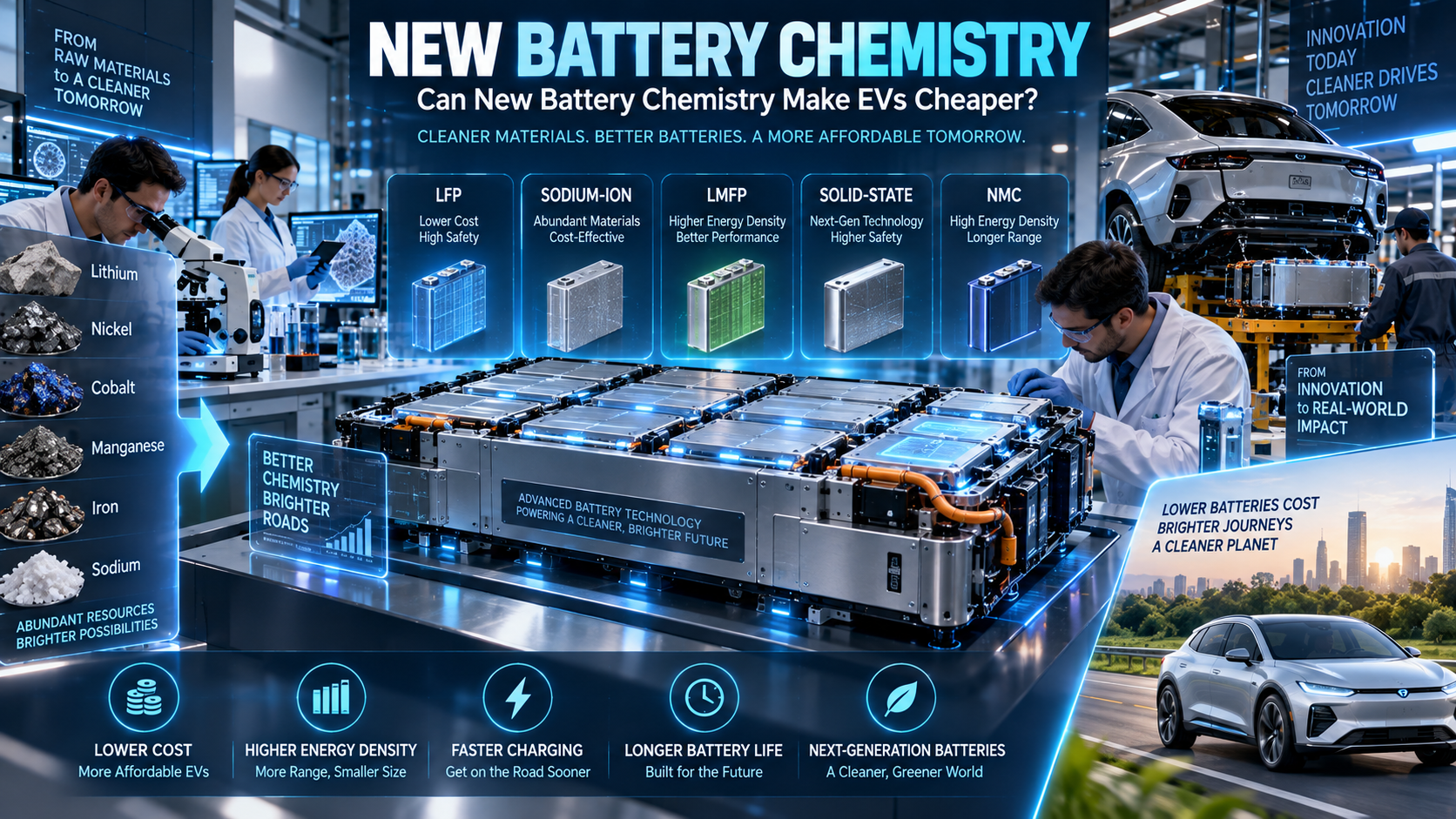
Today, different battery chemistries are being developed and used, including LFP, NMC, sodium-ion, LMFP, and solid-state batteries.
So, can new battery chemistry make EVs cheaper?
The answer could be yes, but battery chemistry is only one part of the overall cost.
Why Are EV Batteries So Important?
An electric vehicle needs a large battery pack to store electricity.
The battery powers the electric motor, which moves the vehicle. A larger battery can provide more driving range, but it can also increase the vehicle’s cost and weight.
Because of this, automakers are looking for batteries that can provide the right balance between price, range, safety, charging speed, and durability.
What Is Battery Chemistry?
Battery chemistry refers to the materials and chemical system used inside a battery.
Different battery chemistries can provide different benefits.
For example, one chemistry may be cheaper, while another may provide higher energy density. Some batteries may perform better in cold temperatures, while others may offer longer cycle life.
This is why there is no single battery chemistry that is perfect for every electric vehicle.
What Are the Main EV Battery Types?
Several battery technologies are currently important in the EV industry.
The most common include:
- LFP
- NMC
- Sodium-ion
- LMFP
- Solid-state batteries
Each technology has different advantages and limitations.
What Are LFP Batteries?
LFP stands for Lithium Iron Phosphate.
LFP is a type of lithium-ion battery that uses iron and phosphate in its cathode chemistry.
One of its biggest advantages is cost.
LFP batteries generally avoid expensive nickel and cobalt materials used in many NMC batteries. They are also known for good durability and safety characteristics.
According to the IEA, LFP battery packs were more than 40% cheaper per kWh on average than NMC packs in 2025, although the comparison is influenced by differences in applications and energy-density requirements.
This is one reason LFP has become important for more affordable EVs.
Why Are LFP Batteries Important for Cheaper EVs?
Imagine two electric cars with similar battery sizes.
If one uses a lower-cost battery chemistry, the manufacturer may have more flexibility to reduce the overall vehicle cost or improve other parts of the vehicle.
LFP can therefore be useful for:
- Affordable electric cars
- City EVs
- Electric buses
- Commercial vehicles
- Energy storage
The main trade-off is that LFP generally has lower energy density than some nickel-based batteries.
What Are NMC Batteries?
NMC stands for Nickel Manganese Cobalt.
NMC is another lithium-ion battery chemistry.
It has traditionally been popular in EVs because it can provide high energy density.
Higher energy density means a battery can store more energy without becoming as large or heavy.
This can be useful for long-range electric vehicles.
However, NMC batteries generally use more expensive materials than LFP, which can increase costs.
What Are Sodium-Ion Batteries?
Sodium-ion batteries are one of the most interesting alternatives to traditional lithium-ion batteries.
Instead of mainly using lithium ions, these batteries use sodium ions to store and release energy.
Sodium is widely available, which makes the technology attractive for reducing dependence on lithium.
The technology is developing quickly, but it is not yet a simple replacement for lithium-ion batteries.
The IEA reports that the latest sodium-ion cells can reach around 175 Wh/kg, compared with up to around 205 Wh/kg for the latest LFP cells and higher values for some NMC batteries.
Can Sodium-Ion Batteries Make EVs Cheaper?
Potentially, yes.
One attraction of sodium-ion technology is that it does not require lithium as its main charge carrier.
This could help diversify battery supply chains.
However, sodium-ion batteries currently have lower energy density than leading lithium-ion technologies. That means they may be more suitable for vehicles where maximum range is not the primary requirement.
The IEA identifies smaller-range EVs, urban vehicles, two- and three-wheelers, and some commercial applications as potential areas for sodium-ion batteries.
Are Sodium-Ion Batteries Already Ready?
The technology is moving toward commercial use, but there are still challenges.
One major challenge is manufacturing scale.
The global production infrastructure for lithium-ion batteries is much larger than for sodium-ion batteries. The IEA says current sodium-ion manufacturing capacity is only a small fraction of lithium-ion capacity.
So even if sodium-ion cells become cheaper to manufacture, companies still need large factories and supply chains to produce them at scale.
What Is LMFP Battery Technology?
LMFP stands for Lithium Manganese Iron Phosphate.
LMFP builds on the LFP battery concept but adds manganese to the chemistry.
The goal is to improve energy density while maintaining many of the cost and durability advantages associated with LFP.
This makes LMFP an interesting option between lower-cost LFP and some higher-energy-density battery chemistries.
However, its commercial success will depend on manufacturing costs, production scale, performance, and supply chains.
What Are Solid-State Batteries?
Solid-state batteries are another major area of battery development.
Most conventional lithium-ion batteries use a liquid electrolyte.
Solid-state batteries replace this liquid electrolyte with a solid material.
This could potentially provide:
- Higher energy density
- Improved safety
- Better packaging
- Faster charging potential
However, solid-state batteries are still difficult to manufacture at large scale.
Their production can be more complex and expensive, so they are not necessarily the immediate answer to making low-cost EVs.
Can New Batteries Increase EV Range?
Yes, some new battery technologies are being developed with higher energy density in mind.
Energy density tells us how much energy a battery can store for its weight or size.
Higher energy density can provide more range without making the battery significantly larger.
For example:
Higher energy density → More energy in the same space → Potentially longer driving range
However, higher energy density does not automatically mean a cheaper battery.
Sometimes achieving higher energy density requires more expensive materials or more complicated manufacturing.
Could Smaller Batteries Make EVs Cheaper?
Yes.
EV manufacturers do not necessarily need to put a huge battery into every electric vehicle.
A small city car may only need enough range for daily urban travel.
A long-distance electric SUV may require a much larger battery.
If battery technology becomes cheaper, manufacturers could create EVs with appropriately sized batteries instead of using unnecessarily large battery packs.
This could help make smaller EVs more affordable.
Does a Cheaper Battery Mean a Cheaper EV?
Not always.
The battery is a major component, but an electric vehicle contains many other expensive systems.
These include:
- Electric motor
- Inverter
- Battery-management system
- Power electronics
- Software
- Sensors
- Charging system
- Interior
- Safety equipment
- Body and chassis
- Manufacturing costs
Therefore, a reduction in battery cost does not necessarily result in the same percentage reduction in the final price of the car.
How Does Battery Manufacturing Affect EV Prices?
Battery chemistry is only part of the story.
Manufacturing efficiency is also extremely important.
Large battery factories can reduce costs by producing millions of cells and improving production processes.
Automation, better equipment, improved materials, and efficient cell designs can all reduce manufacturing costs.
So the formula is more like:
Better Chemistry + Efficient Manufacturing + Large-Scale Production = Lower Battery Costs
Can Battery Recycling Make EVs Cheaper?
Battery recycling could also play an important role.
Used EV batteries contain valuable materials.
Recycling companies can recover materials such as lithium, nickel, cobalt, copper, and other components.
These recovered materials can potentially be used to manufacture new batteries.
Over time, better recycling could reduce waste and provide an additional source of battery materials.
Can New Chemistry Reduce Dependence on Lithium?
Some technologies can.
Sodium-ion batteries are particularly interesting because they do not use lithium as the main charge carrier.
However, this does not mean sodium-ion batteries completely eliminate supply-chain challenges.
The IEA notes that some commercial sodium-ion chemistries still depend on materials such as nickel and manganese, and their supply chains are currently much less developed than lithium-ion supply chains.
So sodium-ion is better understood as a way to diversify battery technology, rather than simply replacing lithium everywhere.
Which Battery Is Best for an EV?
There is no single answer.
Different EVs need different batteries.
Affordable City EV
LFP or potentially sodium-ion could be suitable where low cost is more important than maximum range.
Mainstream EV
LFP or LMFP can offer a balance between cost, durability, and performance.
Long-Range EV
Higher-energy-density lithium-ion chemistries can be useful when range is a major priority.
Future Premium EV
Solid-state technology could eventually offer advantages in energy density and charging, if manufacturing challenges are solved.
Why Are Battery Companies Developing So Many Chemistries?
Because different customers have different needs.
A delivery vehicle may need durability and low operating cost.
A small city EV may need an affordable battery.
A premium electric car may need maximum range.
A commercial vehicle may prioritize long battery life.
Therefore, the future of EV batteries is likely to include multiple battery chemistries instead of one technology replacing everything.
What Are the Biggest Challenges for New EV Batteries?
New battery technologies still have several challenges.
Energy Density
Some cheaper chemistries store less energy for their weight or size.
Manufacturing
A battery that works in a laboratory still needs to be produced reliably in millions of cells.
Cost
New manufacturing equipment and materials can initially be expensive.
Charging
Consumers expect EVs to charge quickly and reliably.
Battery Life
EV batteries need to maintain useful performance over many years.
Safety
Battery systems must remain safe during charging, driving, accidents, and extreme temperatures.
Supply Chains
New battery technologies still require large-scale raw-material processing and manufacturing infrastructure.
Could New Battery Chemistry Help India Build Cheaper EVs?
Battery technology could be particularly important for India’s growing electric mobility market.
Affordable batteries can help reduce the cost of electric cars, scooters, three-wheelers, buses, and commercial vehicles.
LFP is already an important lower-cost lithium-ion option, while sodium-ion technology could provide another route for applications where its lower energy density is acceptable.
However, the final price of an EV in India will also depend on local battery manufacturing, raw-material supply chains, imports, manufacturing scale, and other vehicle components.
Will Sodium-Ion Replace Lithium-Ion?
It is unlikely that one battery chemistry will completely replace all others.
Instead, different technologies may be used for different applications.
For example:
Sodium-ion → Cost-sensitive and shorter-range applications
LFP → Affordable and mainstream EVs
LMFP → Cost and energy-density balance
NMC → Higher-energy-density applications
Solid-state → Potential future high-performance applications
This multi-chemistry approach could give automakers more choices.
What Could the Future of EV Batteries Look Like?
The future EV battery market could become more diverse.
Instead of asking:
“Which battery will replace lithium-ion?”
the better question may be:
“Which battery is best for each type of vehicle?”
A small city EV does not need the same battery as a luxury long-range vehicle.
As battery technology improves, manufacturers can choose the chemistry that provides the right combination of cost, range, safety, charging, and durability.
Can New Battery Chemistry Really Make EVs Cheaper?
Yes, but there is an important condition.
New chemistry alone is not enough.
LFP has already demonstrated the potential for lower battery costs compared with NMC. Sodium-ion could provide another option, especially where its energy-density limitations are acceptable. LMFP could offer a different balance between cost and energy density, while solid-state batteries are being developed mainly around performance and safety potential rather than immediate low cost.
The biggest cost improvements are likely to come from a combination of:
Better Chemistry + Better Manufacturing + Larger Production + Efficient Supply Chains + Battery Recycling
Together, these technologies could help reduce the cost of electric vehicles.
Conclusion
Battery technology is one of the most important factors in the future of electric vehicles.
LFP batteries are already helping reduce battery costs, while sodium-ion and LMFP are being developed as additional options. Solid-state batteries could bring new performance advantages in the future, although large-scale manufacturing remains a challenge.
The future is unlikely to be controlled by one battery chemistry.
Instead, different battery technologies may be used for different vehicles and applications.
So, can new battery chemistry make EVs cheaper?
Yes, it has the potential to do so. But the biggest impact will come when new chemistry is combined with efficient manufacturing, large-scale production, better supply chains, and recycling.
That could make electric vehicles more affordable and help bring EV technology to a much larger number of people.
