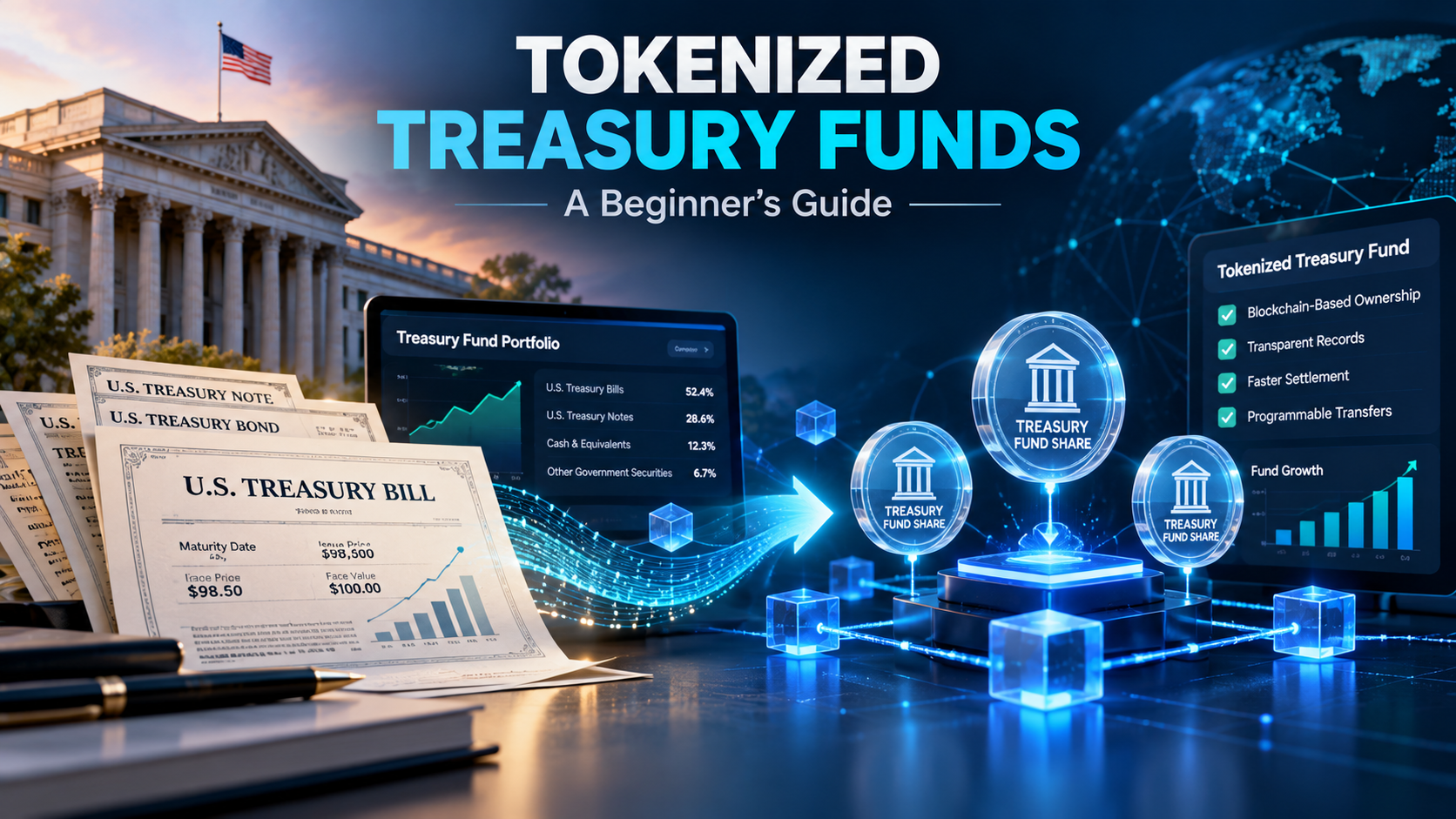
Blockchain technology is changing how people access and manage financial assets. While many people associate blockchain with cryptocurrencies such as Bitcoin and Ethereum, it is also being used to represent traditional financial products digitally.
One example is tokenized Treasury funds. These products combine traditional investments in government securities with blockchain technology.
Instead of recording fund ownership only through conventional financial systems, a tokenized Treasury fund represents fund shares as digital tokens on a blockchain. Depending on the product, this structure may enable faster transfers, automated transactions, and new ways to use financial assets in digital markets.
But what exactly are tokenized Treasury funds? How do they work, and why are financial institutions exploring them?
In this beginner-friendly guide, we will explain tokenized Treasury funds, their benefits, their risks, and how they differ from traditional investments and stablecoins.
1. What Are Tokenized Treasury Funds?
Tokenized Treasury funds are investment funds whose shares are represented by digital tokens recorded on a blockchain.
To understand this concept, first consider a traditional Treasury fund. Such a fund may invest in short-term government securities, including Treasury bills. Investors purchase shares in the fund and may earn income from its investments.
A tokenized version uses blockchain technology to record ownership or transfers of fund shares. The underlying investment strategy may remain similar to that of a traditional fund, even though the ownership records and transfer processes use different technology.
For example, imagine a fund that invests in short-term U.S. Treasury securities. Instead of representing an investor’s fund shares exclusively through conventional records, the fund issues digital tokens that represent those shares under its legal structure.
These tokens are not simply ordinary cryptocurrencies. They represent an interest in a financial product, and the rights attached to them depend on the fund’s terms and legal arrangements.
In simple words, a tokenized Treasury fund combines a traditional government-securities investment with blockchain-based ownership records.
2. What Are Treasury Securities?
Treasury securities are debt instruments issued by a government to borrow money.
For example, the U.S. government issues Treasury bills, Treasury notes, and Treasury bonds. These instruments have different maturity periods and payment structures.
Treasury bills generally have short maturities and are commonly sold at a discount to their face value. The investor receives the face value when the bill matures, subject to the applicable terms and the government’s ability to pay.
Investment funds can purchase Treasury securities and offer investors exposure to a portfolio of these instruments.
Treasury securities are often considered relatively low-credit-risk investments when issued by governments with strong repayment capacity. However, they are not completely free from risk. Interest rates, inflation, market conditions, and the structure of an investment product can all affect the investor’s experience.
It is also important to distinguish direct ownership of a Treasury security from owning shares in a fund that invests in Treasury securities. The legal rights and risks are different.
3. How Do Tokenized Treasury Funds Work?
Tokenized Treasury funds generally combine traditional investment management with blockchain-based recordkeeping and transfers.
The exact process varies by fund, but the following steps provide a simple overview.
Step 1: The Fund Invests in Treasury Securities
The fund collects money from eligible investors and invests according to its stated investment strategy.
Depending on the product, the portfolio may include Treasury bills, other government securities, cash, or repurchase agreements backed by government securities.
The fund’s official documents explain what it can hold, how it operates, and what risks investors face.
Step 2: Fund Shares Are Represented as Digital Tokens
The fund or an authorized service provider uses blockchain technology to represent fund shares digitally.
Each token represents rights defined by the fund’s legal and operational structure. It does not necessarily represent direct ownership of an individual Treasury bill.
The token’s legal meaning is important because different products may provide different rights and protections.
Step 3: Investors Access the Fund Through Approved Channels
Eligible investors may purchase fund shares through the fund’s approved subscription process.
Depending on the product, investors might use a financial platform, an authorized intermediary, or an approved digital wallet.
Many tokenized Treasury funds have eligibility restrictions. They may require identity verification and compliance checks before an investor can participate.
Step 4: Blockchain Records Eligible Transfers
When a permitted transfer occurs, the blockchain can record the movement of tokens between approved addresses.
Smart contracts and other automated systems may help enforce transfer restrictions or support certain transaction processes.
However, blockchain transactions do not automatically bypass traditional financial controls. Fund rules, identity checks, settlement arrangements, and legal requirements may still apply.
Step 5: Investors Receive Returns According to the Fund’s Terms
The fund earns income from its underlying investments. Depending on its structure, that income may be distributed to investors or reflected in the value of their holdings.
The method of calculating, accruing, and distributing income depends on the specific fund.
Owning a token does not guarantee a fixed return. Actual results depend on the fund’s investments, expenses, terms, and applicable risks.
4. Why Are Tokenized Treasury Funds Gaining Attention?
Financial institutions are exploring tokenization as a way to modernize how financial assets are issued, transferred, and managed.
Traditional financial transactions often involve multiple systems, intermediaries, and operating schedules. Blockchain-based systems can provide a shared digital record and may support automated transaction workflows.
Tokenized Treasury funds are one application of this idea because they connect familiar financial products with digital-asset infrastructure.
For example, an institution that already holds eligible tokenized fund shares may be able to use them in certain digital financial workflows, subject to the fund’s terms and the rules of the relevant platform.
However, tokenization does not automatically make an investment more profitable or safer. Its potential benefits depend on how the product is designed and used.
The growing interest in tokenized funds also comes with questions about investor protection, liquidity, regulation, custody, and financial stability.
5. Benefits of Tokenized Treasury Funds
Tokenized Treasury funds may offer several operational benefits, although the advantages vary from product to product.
Faster Transfers and Settlement
Blockchain technology can allow eligible token transfers to be recorded quickly.
This may reduce some delays associated with traditional recordkeeping and settlement processes. The actual time required to subscribe to or redeem a fund may still depend on the fund’s operating procedures and financial infrastructure.
More Efficient Recordkeeping
A shared digital ledger can make certain ownership records and transactions easier to track.
Depending on the system, this may help reduce reconciliation work between different parties and improve operational efficiency.
However, blockchain records do not eliminate the need for accurate legal ownership records, reliable service providers, and appropriate controls.
Potential for Extended Transaction Availability
Some tokenized funds support transfers outside conventional market operating hours.
This can be useful for approved digital transactions, particularly when the fund’s infrastructure allows transfers at different times of day.
Nevertheless, continuous token transfers do not necessarily mean that investors can subscribe to or redeem fund shares at any time.
Programmable Financial Transactions
Smart contracts can automate certain actions according to predefined rules.
For example, a system may restrict transfers to approved wallets or support an automated process involving eligible digital assets.
Automation can reduce manual work, but smart contracts still require careful design, testing, monitoring, and security controls.
New Uses in Digital Finance
Some tokenized fund shares may be used in approved collateral arrangements or integrated into institutional digital-asset platforms.
Such uses can connect traditional financial products with blockchain-based services.
These arrangements are not universally available. Whether a token can be used as collateral depends on the fund’s rules, the platform, the counterparty, and applicable regulations.
6. Risks of Tokenized Treasury Funds
Although tokenized Treasury funds offer potential benefits, investors should understand that tokenization does not remove the risks of the underlying investment or the technology.
Investment Risk
A tokenized fund is still an investment product.
Its returns depend on the underlying portfolio, expenses, market conditions, and the fund’s structure. Changes in interest rates and other market conditions may affect its value or performance.
Government securities can have relatively low credit risk, but this does not make every fund holding them risk-free.
Liquidity Risk
Liquidity refers to how easily an investment can be converted into cash under the applicable terms.
A token may be transferable on a blockchain, but that does not guarantee that another buyer will be available or that the investor can redeem it immediately.
If many investors seek to withdraw money at the same time, the fund may face additional liquidity pressures, depending on its structure and holdings.
Smart Contract and Cybersecurity Risks
Tokenized funds may depend on blockchain networks, digital wallets, smart contracts, and other technical systems.
Software vulnerabilities, compromised credentials, operational errors, or attacks on service providers can create risks.
Investors should understand how the product handles wallet security, authorized transfers, recovery procedures, and technical failures.
Custody and Counterparty Risks
Investors may depend on fund managers, custodians, administrators, wallet providers, or other intermediaries.
Problems involving these organizations can affect access to assets or the processing of transactions.
It is important to understand who holds the underlying assets, who maintains the official ownership records, and what legal rights investors have if a service provider fails.
Regulatory and Legal Risks
Tokenized fund shares may be subject to securities laws and other financial regulations.
Requirements vary by country, product structure, investor eligibility, and transaction type.
A token’s existence on a blockchain does not automatically make it legally equivalent to direct ownership of the underlying government securities.
Before participating, investors should review the fund’s official documentation and applicable legal requirements.
7. Tokenized Treasury Funds vs. Traditional Treasury Funds
Both tokenized and traditional Treasury funds can provide exposure to government securities. The main differences often concern how ownership is represented and how transactions are processed.
| Feature | Traditional Treasury Fund | Tokenized Treasury Fund |
|---|---|---|
| Investment approach | Invests according to its stated portfolio strategy | May use a similar strategy while representing fund shares as blockchain tokens |
| Ownership records | Maintained through conventional financial systems | May use blockchain records alongside official fund records |
| Transfers | Processed through established financial channels | May support blockchain-based transfers between approved addresses |
| Transaction availability | Depends on the fund’s dealing and settlement arrangements | May allow extended transfer availability, depending on the product |
| Automation | Uses conventional operational systems | May use smart contracts for selected processes |
| Investor access | Depends on the fund and distribution channel | May require approved wallets, intermediaries, and additional eligibility checks |
| Risks | Investment, liquidity, operational, and other fund-related risks | Underlying fund risks plus potential blockchain, custody, and technology risks |
A tokenized fund is not automatically better than a traditional fund. The most suitable structure depends on the investor’s needs, access requirements, legal rights, costs, and risk tolerance.
8. Tokenized Treasury Funds vs. Stablecoins
Tokenized Treasury funds and stablecoins are both used in digital finance, but they serve different purposes.
A stablecoin is a digital asset designed to maintain a relatively stable value, often by referencing a currency such as the U.S. dollar.
A tokenized Treasury fund, by contrast, represents an interest in an investment fund that may hold Treasury securities or other permitted assets.
For example, a dollar-pegged stablecoin is generally designed to be used for transferring or holding digital value. A tokenized Treasury fund is an investment product whose returns and risks depend on its underlying portfolio and legal structure.
Some stablecoins may be backed partly or largely by Treasury bills or similar assets. However, holding such a stablecoin is not necessarily the same as owning shares in a Treasury fund.
| Feature | Tokenized Treasury Fund | Stablecoin |
|---|---|---|
| Main purpose | Provide investment exposure to a fund portfolio | Maintain a relatively stable digital value |
| Underlying structure | Fund shares representing an interest in a portfolio | Depends on the stablecoin’s reserve and issuance model |
| Potential return | May earn investment income according to the fund’s terms | Generally designed for price stability rather than passing investment returns directly to holders |
| Ownership rights | Defined by the fund’s legal structure | Defined by the issuer’s terms and applicable legal arrangements |
| Main risks | Investment, liquidity, custody, and technology risks | Depegging, reserve, issuer, redemption, and technology risks |
Neither product should be assumed to be risk-free. Investors should examine the specific terms, redemption arrangements, and legal protections before using either one.
9. Examples of Tokenized Treasury and Government Money Market Funds
Several financial institutions have introduced blockchain-based products that provide exposure to government securities or related money market investments.
Two examples are:
BlackRock USD Institutional Digital Liquidity Fund (BUIDL)
BlackRock’s BUIDL is a tokenized fund designed to provide eligible investors with exposure to a portfolio that includes cash, U.S. Treasury bills, and other permitted investments described in its official documents.
The fund uses blockchain-based technology to represent its shares digitally. Access is subject to the product’s eligibility requirements and distribution arrangements.
It illustrates how a traditional asset-management firm can offer an investment product using digital-asset infrastructure.
Franklin OnChain U.S. Government Money Fund
Franklin Templeton’s OnChain U.S. Government Money Fund is another example of a fund that uses blockchain technology in connection with fund-share records.
The fund invests according to its stated strategy, which includes government-related investments. Its blockchain-based structure demonstrates how digital recordkeeping can be integrated into a conventional investment product.
These products have different legal structures, eligibility requirements, and operating arrangements. They should not be assumed to be interchangeable or available to every investor.
10. Who Might Use Tokenized Treasury Funds?
Tokenized Treasury funds may be useful to certain investors and financial institutions that need access to government-securities exposure through digital financial systems.
Institutional Investors
Eligible institutions may use these products as part of cash management or digital-asset operations, subject to their investment policies and the fund’s terms.
Digital Asset Businesses
Some digital-asset businesses may explore tokenized funds as a way to connect traditional financial assets with approved blockchain-based services.
The actual benefits depend on the platform’s infrastructure, custody arrangements, and applicable regulations.
Financial Technology Companies
Fintech companies may explore tokenized funds to improve settlement processes or automate selected financial workflows.
Such systems still require compliance controls, reliable infrastructure, and clear legal arrangements.
Individual Investors
Some tokenized funds may be available to individual investors who satisfy the relevant eligibility requirements. Others are restricted to institutional or otherwise qualified investors.
Individuals should not assume that a tokenized fund is accessible simply because it operates on a public blockchain.
11. The Future of Tokenized Treasury Funds
Tokenized Treasury funds are part of a broader movement to represent traditional financial assets digitally.
As financial institutions experiment with blockchain technology, tokenization may support new ways to maintain ownership records, transfer assets, and automate selected financial processes.
Future developments may include improved connections between traditional financial systems and blockchain networks, more standardized compliance tools, and broader use of tokenized assets in institutional settlement and collateral workflows.
However, wider adoption will depend on more than technology alone. Clear regulations, investor protection, reliable custody, sufficient liquidity, and interoperable systems will also matter.
Tokenization may improve some financial processes, but it cannot remove the underlying economic and legal risks of an investment.
12. Is Tokenized Treasury Fund Investing Right for Everyone?
No. Tokenized Treasury funds are not suitable for every investor.
Some products have minimum investment requirements, restrictions on who can invest, or limitations on where tokens can be transferred. Others may require access through an approved intermediary or digital wallet.
Before considering a product, it is important to understand the underlying investments, fees, redemption rules, tax treatment, legal rights, and risks.
Investors should also consider whether they need direct exposure to Treasury securities, shares in a conventional fund, or a digital representation of fund shares.
The right choice depends on individual circumstances and the specific product. Tokenization alone is not a reason to invest.
Conclusion
Tokenized Treasury funds bring together traditional government-securities investments and blockchain technology. They represent fund shares digitally and may support more efficient recordkeeping, faster transfers, and automated financial processes.
At the same time, these products carry investment, liquidity, cybersecurity, custody, and regulatory risks. A blockchain token does not automatically guarantee direct ownership of Treasury securities, instant redemption, or a fixed return.
Understanding how these funds work is an important first step toward understanding the broader trend of real-world asset tokenization.
As digital finance continues to develop, tokenized Treasury funds will remain an important area to watch. Their long-term value will depend on whether they deliver practical benefits while maintaining reliable legal protections, operational controls, and investor safeguards.
