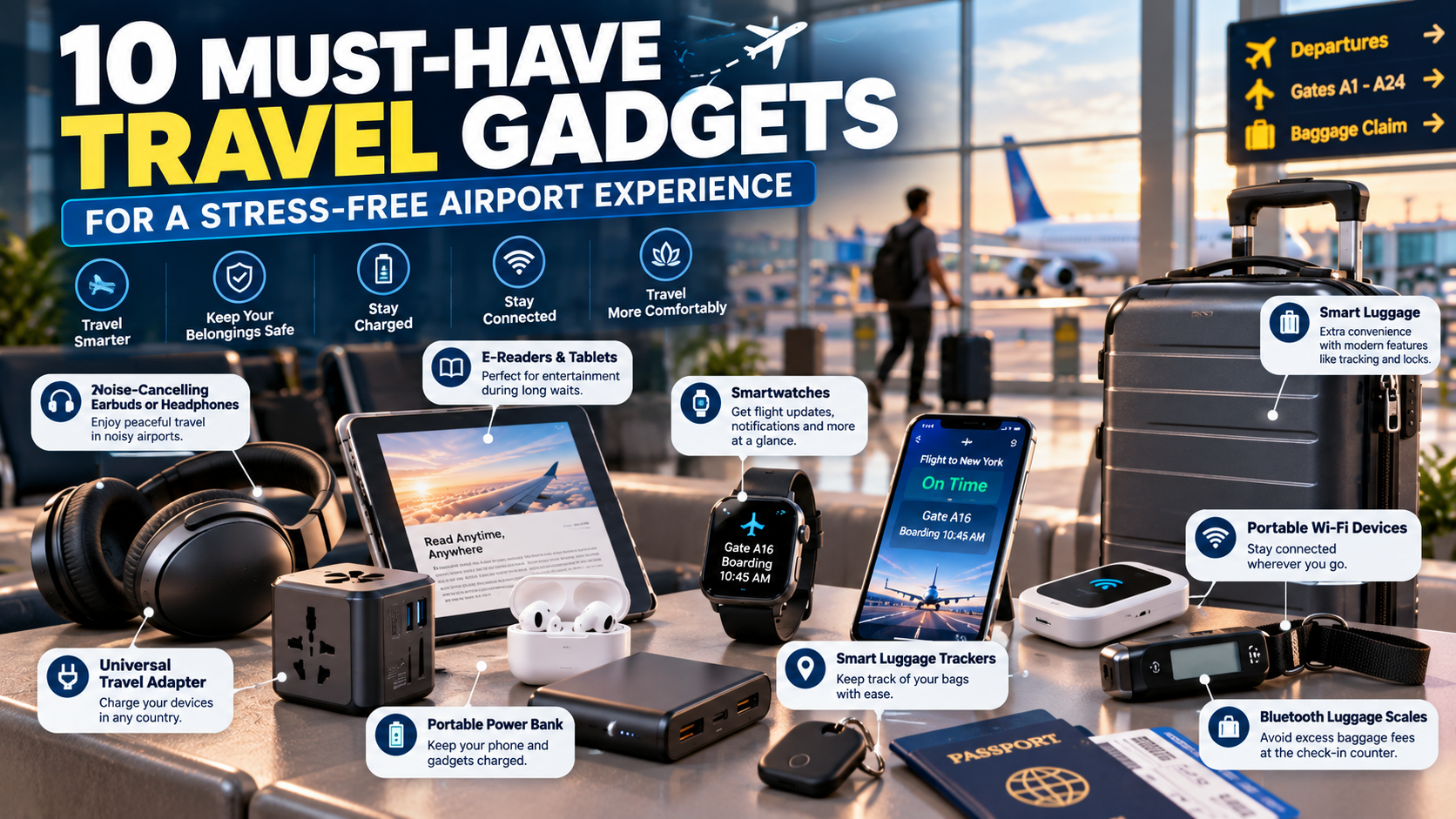
Traveling by air can be exciting, but spending time at airports can sometimes be stressful. From waiting in long queues and finding your boarding gate to keeping your luggage safe and making sure your phone stays charged, there are several things travelers need to manage before boarding a flight.
Fortunately, modern technology has made airport travel more convenient. Today, many smart travel gadgets can help passengers stay organized, protect their belongings, enjoy entertainment, and remain connected throughout their journey.
Whether you travel frequently for business, plan occasional vacations, or enjoy exploring new destinations, choosing the right travel accessories can make a noticeable difference.
In this guide, we explore 10 must-have travel gadgets for a stress-free airport experience, explaining how each device works, why it is useful, and what to consider before purchasing it.
1. Smart Luggage Trackers
Losing track of your luggage is one of the most frustrating experiences during air travel. A smart luggage tracker can help you locate your belongings and provide additional peace of mind while moving through busy airports.
These small devices can be attached to luggage, backpacks, or travel bags. Depending on the model, they use Bluetooth, a compatible smartphone network, GPS, or cellular connectivity to help users locate their belongings.
Why Are Smart Luggage Trackers Useful?
Smart luggage trackers offer several practical benefits:
- Location tracking: Check the reported location of your luggage through a compatible mobile application.
- Lost-item assistance: Some trackers can help you locate a misplaced bag using nearby compatible devices.
- Separation alerts: Certain models notify you when your bag moves out of Bluetooth range.
- Easy installation: Most trackers are small enough to fit inside a suitcase pocket or attach to a key ring.
For example, you can place a tracker inside your checked suitcase and check its location when you arrive at your destination.
However, Bluetooth trackers do not necessarily provide continuous GPS tracking. Their accuracy and coverage depend on the technology used, nearby devices, network availability, and other conditions.
What Should You Consider Before Buying?
Choose a tracker that works with your smartphone and offers reliable coverage for the places you visit. Also consider battery life, replacement options, privacy features, and whether a subscription is required.
Best for: Frequent flyers, international travelers, families, and anyone carrying valuable luggage.
2. Noise-Cancelling Earbuds or Headphones
Airports can be noisy environments. Announcements, conversations, background music, and crowds can make it difficult to relax while waiting for a flight.
Noise-cancelling earbuds and headphones help reduce unwanted background noise, making them useful companions during airport visits and long journeys.
Active noise cancellation uses microphones and electronic processing to reduce certain external sounds. Although it cannot eliminate every noise, it can make the surrounding environment more comfortable.
How Can Noise-Cancelling Audio Devices Improve Airport Travel?
These gadgets can help you:
- Listen to music without constantly increasing the volume.
- Enjoy podcasts, audiobooks, or downloaded entertainment.
- Reduce distractions while working in an airport lounge.
- Relax while waiting at your boarding gate.
- Make long flights more comfortable.
Wireless earbuds are convenient because they take up very little space. Over-ear headphones may offer better comfort for some users, particularly during long listening sessions.
Features to Look For
When choosing noise-cancelling earbuds or headphones, consider battery life, comfort, Bluetooth connectivity, microphone quality, and charging case capacity.
A transparency or ambient mode is also useful because it lets you hear important announcements and conversations without removing your earbuds.
Remember to keep the volume at a safe level and remain attentive to boarding announcements.
Best for: Business travelers, students, remote workers, and passengers taking long flights.
3. Portable Power Banks
A smartphone is one of the most important devices during airport travel. Travelers use their phones to access boarding passes, receive flight updates, book transportation, check maps, communicate with family, and store travel documents.
However, frequent phone use can drain the battery before you reach your destination.
A portable power bank provides additional battery capacity when a wall socket is unavailable.
Why Should Every Traveler Consider a Power Bank?
A power bank can help you:
- Keep your smartphone charged during long airport waits.
- Charge wireless earbuds and other compatible devices.
- Access digital boarding passes when needed.
- Stay connected during unexpected delays.
- Reduce dependence on airport charging stations.
For many travelers, a power bank with a capacity of approximately 10,000 mAh offers a useful balance between portability and charging capacity. Travelers carrying multiple devices may prefer a higher-capacity model, provided it meets airline requirements.
Important Features to Check
Look for USB-C charging, adequate output power, clear battery indicators, built-in safety protections, and compatibility with your devices.
Before flying, check your airline’s rules for power banks. Lithium batteries and power banks are generally subject to restrictions on where and how they can be carried. Capacity limits, approval requirements, and handling rules can vary.
Do not assume that a power bank is permitted in checked baggage simply because it is compact.
Best for: Smartphone users, digital nomads, international travelers, and passengers with connecting flights.
4. Smartwatches
A smartwatch can help travelers manage important information without repeatedly taking their smartphones out of their bags or pockets.
Depending on the model and connected smartphone, a smartwatch can display notifications, reminders, time zones, activity information, and other useful details.
Some models also support boarding-pass applications, navigation prompts, contactless payments, or travel-related apps.
How Do Smartwatches Help at Airports?
Smartwatches can make airport routines easier in several ways.
Quick notifications: Check selected messages and alerts directly from your wrist.
Travel reminders: Set reminders for check-in, boarding times, or other important activities.
Time-zone management: Keep track of local time when traveling between countries.
Health and activity tracking: Monitor steps, movement, and selected health-related measurements.
Hands-free convenience: Check supported information while pulling luggage or walking through the terminal.
Not every smartwatch supports every feature. Some functions require a connected phone, internet access, a specific application, or a compatible airline service.
What Should You Look For?
Choose a smartwatch with comfortable straps, reliable battery life, a readable display, and compatibility with your smartphone.
If you plan to use it for international travel, check whether the features you need work without a mobile connection.
Best for: Frequent flyers, business professionals, fitness enthusiasts, and travelers who want quick access to notifications.
5. Universal Travel Adapters
International travelers often discover that their charging plugs do not fit the electrical outlets at their destination.
A universal travel adapter helps solve this problem by allowing compatible plugs to connect to different outlet types.
This makes it a useful accessory for people traveling between countries with different electrical socket standards.
Why Is a Universal Travel Adapter Useful?
A suitable travel adapter can help you charge compatible devices in hotels, airport lounges, and other locations where the appropriate outlet is available.
Many modern adapters support multiple plug types and include USB-A or USB-C ports for charging smartphones and accessories.
Some models also provide multiple charging ports, helping travelers reduce the number of separate adapters they need to carry.
Important Things to Check
Before buying an adapter, consider:
- Supported plug types and destination countries.
- USB charging output and device compatibility.
- Built-in overload or surge protection, where applicable.
- Size, weight, and portability.
- Whether your devices require a voltage converter.
Important: A plug adapter does not automatically convert electrical voltage. Check the input voltage printed on your charger or device before connecting it to a different power supply.
Best for: International travelers, digital nomads, students studying abroad, and business professionals.
6. Bluetooth Luggage Scales
Unexpected baggage fees can add unnecessary stress to an airport journey. A portable luggage scale helps you check your suitcase weight before arriving at the check-in counter.
Some models offer Bluetooth connectivity and companion applications, while simpler versions display the weight directly on the device.
The primary purpose is the same: helping you estimate your baggage weight before departure.
How Can a Luggage Scale Save Time?
A luggage scale allows you to:
- Check suitcase weight before leaving home.
- Distribute items between bags if necessary.
- Reduce the chance of exceeding baggage weight limits.
- Avoid last-minute repacking at the airport.
- Check your luggage again before returning home.
For example, if your airline permits a checked bag weighing up to a specified limit, you can weigh the suitcase in advance and adjust its contents before reaching the airport.
Which Features Matter Most?
Look for an easy-to-read display, suitable weight capacity, compact design, and reliable measurement accuracy.
Bluetooth connectivity may be useful if you want to record measurements in an application, but it is not essential for most travelers.
Always verify your airline’s current baggage allowance because limits vary by airline, ticket type, route, and travel class.
Best for: International travelers, families, shoppers, and passengers carrying heavy luggage.
7. E-Readers and Tablets
Long airport waits and flight delays can leave travelers with plenty of time to fill.
An e-reader or tablet provides a convenient way to enjoy books, magazines, articles, movies, and other digital content without carrying several physical items.
An e-reader is particularly useful for people who enjoy reading, while a tablet offers more flexibility for entertainment and productivity.
Why Are E-Readers Useful for Travelers?
Many e-readers are lightweight and designed for comfortable reading. Their displays can be easier on the eyes for extended reading sessions, depending on the device and lighting conditions.
A single device can store numerous books, helping travelers save space in their luggage.
Tablets, meanwhile, can support downloaded movies, games, video content, digital documents, and productivity applications.
Features to Consider
Before purchasing an e-reader or tablet, check battery life, screen size, storage capacity, weight, and offline content support.
Download your books, documents, or entertainment before leaving home because airport Wi-Fi may be unreliable, restricted, or unavailable.
If you plan to work during your journey, a tablet with a compatible keyboard can also be useful.
Best for: Readers, students, business travelers, and passengers with long layovers.
8. Compact Travel Wi-Fi Devices
Internet connectivity is important for modern travelers. Passengers often need access to maps, email, messaging applications, hotel bookings, and online travel services.
A portable Wi-Fi hotspot can provide an internet connection to compatible devices using a supported mobile network.
Depending on the device and service plan, it can allow multiple devices to connect without relying on public Wi-Fi.
How Does a Portable Wi-Fi Hotspot Work?
A portable hotspot generally uses a cellular connection to provide internet access over a local Wi-Fi network.
Travelers can connect smartphones, tablets, and laptops to that network when supported coverage is available.
This can be useful when airport Wi-Fi is congested or when you need a connection for multiple devices.
What Should You Check Before Buying?
Consider network compatibility, supported frequency bands, battery life, data limits, roaming charges, and coverage in your destination country.
Some devices require a physical SIM card, while others support eSIM or specific subscription services.
A portable hotspot does not guarantee internet access everywhere. Connectivity depends on the mobile network, coverage, local regulations, and your service plan.
For occasional travelers, a smartphone’s personal hotspot feature may be sufficient, so purchasing a separate device is not always necessary.
Best for: Remote workers, digital nomads, international travelers, and people who need internet access on multiple devices.
9. Smart Luggage and GPS-Enabled Suitcases
Traditional suitcases are designed mainly for carrying belongings. Smart luggage adds technology-based features intended to make luggage management more convenient.
Depending on the model, these suitcases may include electronic locks, built-in tracking systems, digital identification features, or removable charging accessories.
Some products combine several features, while others focus on just one.
What Makes Smart Luggage Different?
Smart luggage may offer:
- Digital locks: Convenient locking mechanisms on supported models.
- Tracking integration: Compatibility with certain location-tracking technologies.
- Organization features: Dedicated compartments for electronics and accessories.
- Charging support: Some models provide a way to connect a compatible power bank to a device.
The actual benefits depend on the suitcase design and included technology.
Important Airline Considerations
Smart luggage requires special attention when it contains a lithium battery.
Some airlines restrict or prohibit smart bags with non-removable batteries in checked baggage. Bags with removable batteries may be permitted under applicable rules, but the battery may need to be removed before the suitcase is checked.
Always verify the current requirements of your airline before purchasing or traveling with a battery-powered suitcase.
Also remember that a luggage tracker and a GPS-enabled suitcase are not necessarily the same thing. A tracker may depend on nearby devices or a separate network, while GPS-enabled systems may require additional connectivity to report location.
Best for: Frequent flyers, business travelers, and people who want integrated luggage-management features.
10. Compact Bluetooth Speakers and Wireless Audio Accessories
Entertainment can make waiting at an airport more enjoyable. Wireless audio accessories allow travelers to listen to music, podcasts, audiobooks, or other content without carrying bulky equipment.
Although compact Bluetooth speakers can be useful in hotel rooms or private accommodation, wireless earbuds and headphones are generally more practical for use inside crowded airport terminals.
Why Are Wireless Audio Accessories Useful?
Wireless audio devices offer convenient connectivity with compatible smartphones, tablets, and laptops.
Depending on the product, they may provide:
- Wireless music playback.
- Hands-free calling.
- Access to downloaded entertainment.
- Compact storage in a backpack or carry-on bag.
- Quick switching between compatible devices.
If you choose a Bluetooth speaker, use it considerately and follow airport rules about audio playback. Speakers are not ideal for every public environment.
What Should You Look For?
Consider battery life, Bluetooth range, sound quality, portability, water resistance, and device compatibility.
For airport travel specifically, prioritize compact size and long battery life.
If you already own good wireless earbuds, you may not need a separate speaker solely for air travel.
Best for: Leisure travelers, music lovers, and people who want convenient entertainment during their trip.
How to Choose the Right Travel Gadgets for Your Needs
You do not need to purchase every travel gadget available. The best choices depend on your travel habits, budget, destination, and the devices you already own.
Here are a few practical considerations before making a purchase.
1. Prioritize Essential Devices
Start with gadgets that solve common problems. A power bank can help keep your phone charged, a luggage tracker can help you locate your bag, and noise-cancelling earbuds can make noisy environments more comfortable.
Choose accessories that provide clear benefits rather than purchasing gadgets simply because they are popular.
2. Check Battery Life
Devices with short battery life may become inconvenient during long journeys.
Compare the battery performance of smartwatches, earbuds, portable hotspots, and other rechargeable accessories before buying them.
Remember that actual battery life depends on usage, settings, network conditions, and device age.
3. Consider Size and Weight
Every additional device takes up space in your luggage.
Look for compact accessories that are easy to carry and do not add unnecessary weight to your backpack or carry-on bag.
4. Verify Airline Rules
Some travel gadgets contain lithium batteries or include wireless communication features that may be subject to airline or airport requirements.
Check the rules that apply to your specific route and airline, especially for power banks, spare batteries, and smart luggage.
5. Protect Your Privacy
Smart gadgets can collect location information, health measurements, or other personal data.
Review privacy settings, location-sharing permissions, account security, and application permissions before using a connected device.
Avoid sharing sensitive travel details publicly, particularly when your journey includes extended periods away from home.
6. Check Device Compatibility
Not every gadget works with every smartphone or operating system.
Before buying a tracker, smartwatch, wireless accessory, or travel adapter, confirm that it supports your existing devices and destination requirements.
Are Travel Gadgets Worth Buying?
Travel gadgets can be worthwhile when they solve a problem you regularly experience.
For example, a frequent flyer may benefit from a luggage tracker, while someone who travels internationally for work may find a universal adapter and portable hotspot particularly useful.
A passenger who takes only occasional short flights may need little more than a power bank, comfortable earbuds, and a smartphone.
The key is to focus on practical value, reliability, portability, and compatibility instead of buying every new travel accessory.
Choosing a few well-designed gadgets can help make your airport routine more organized without adding unnecessary complexity to your journey.
The Future of Airport Travel Gadgets
Travel technology continues to evolve, with connected devices becoming increasingly common in everyday life.
Future travel accessories may offer better integration between smartphones, smartwatches, luggage-tracking systems, and digital travel services.
For example, improved tracking integrations could help travelers manage their belongings more easily. Wearable devices may also make it more convenient to access selected travel notifications, while smarter mobile applications could help organize itineraries and travel reminders.
Artificial intelligence may further improve travel planning by helping users organize schedules, summarize travel information, and manage changes to their plans.
However, these developments depend on device capabilities, service availability, privacy protections, and adoption by travel providers.
The most useful innovations will be those that solve real problems while remaining easy to use, secure, and reliable.
Conclusion
Airport travel does not have to be unnecessarily stressful. The right gadgets can help you stay connected, protect your belongings, enjoy entertainment, and manage important travel tasks more comfortably.
From smart luggage trackers and noise-cancelling earbuds to portable power banks and smartwatches, each device offers different benefits depending on your needs.
Before buying anything, consider your travel frequency, budget, destination, and existing accessories. Check battery requirements and airline restrictions, and prioritize gadgets that provide genuine everyday value.
Ultimately, the goal is not to carry more technology. It is to use technology wisely to make your airport experience simpler, more comfortable, and better organized.
