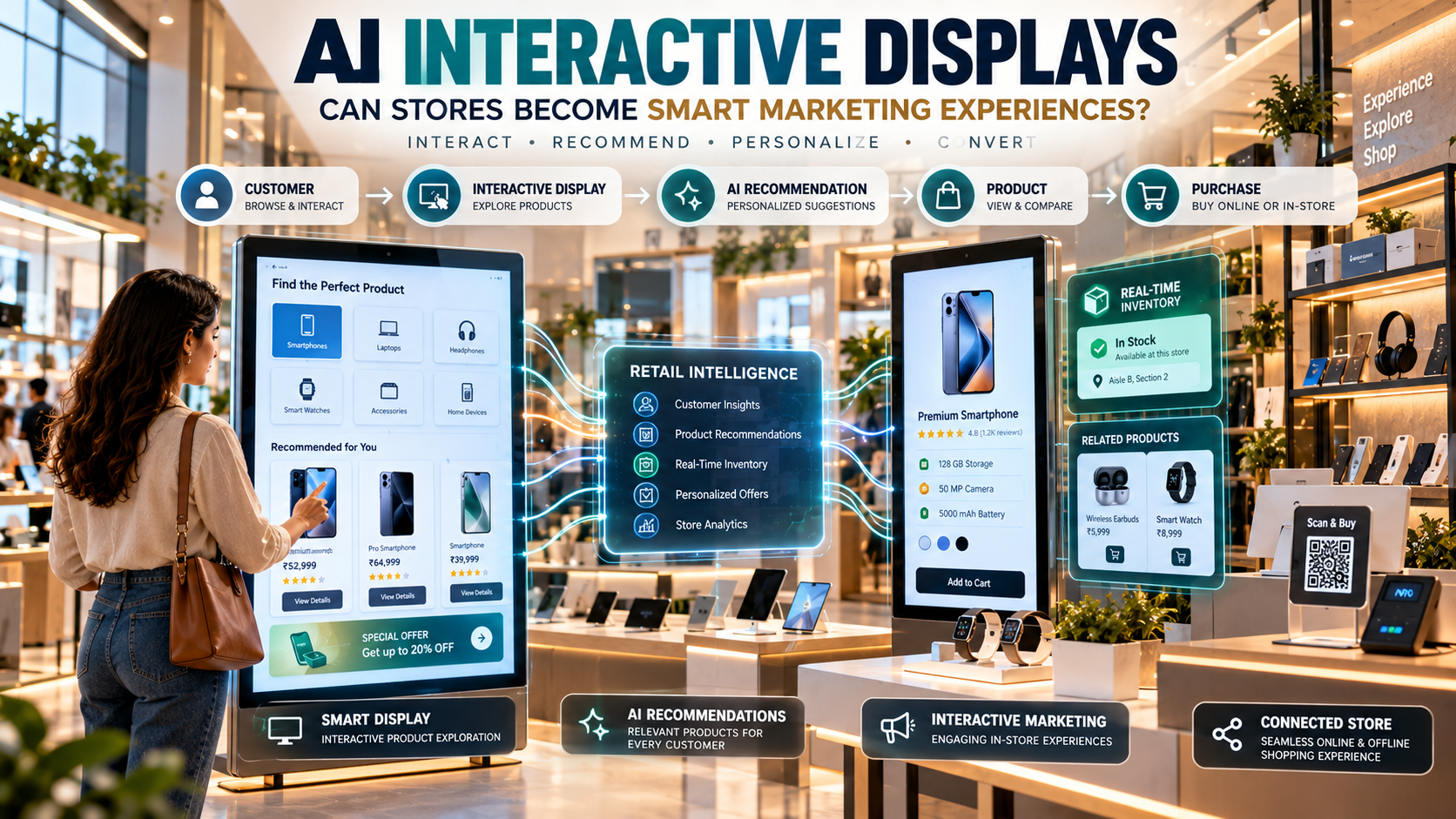
Imagine walking into a store and seeing a digital display that does more than play an advertisement. You can touch the screen, compare products, scan a QR code, check availability, get recommendations, or even interact with an AI assistant.
This is the idea behind AI interactive displays. By combining artificial intelligence, digital screens, sensors, product information, and retail software, stores can create more interactive and personalized shopping experiences.
But can these displays actually change the way businesses market their products? Let’s understand how AI interactive displays work and what they could mean for the future of retail marketing.
What Are AI Interactive Displays?
AI interactive displays are smart digital screens that allow customers to interact with products, services, and marketing content.
Traditional digital signage usually shows the same advertisement to everyone. An AI-powered display can respond to customer interactions and other available information. It can show product details, recommendations, offers, comparisons, videos, and other useful content.
For example, a customer looking at a laptop could use an interactive display to compare different models, check specifications, see available accessories, and find the latest offers.
How Are AI Interactive Displays Different From Normal Screens?
A normal digital screen mainly shows information.
An interactive AI display can show, understand, respond, and recommend.
A traditional screen might show:
“New Smartphone — Starting at ₹29,999.”
An interactive display could allow the customer to select:
Gaming → Camera → Battery → Compare Models → Check Offer
The display can therefore become part of the customer’s shopping journey rather than simply being an advertising screen.
How Do AI Interactive Displays Work?
An AI interactive display usually combines several technologies.
The first is the display itself, which can be a touchscreen, large commercial screen, kiosk, LED display, or other interactive surface.
The second is software that manages product information and marketing content.
The third is AI, which can analyze available information and help decide what content or recommendation should be shown.
Sensors can also provide information about activity around the display. Retail systems can use these signals to understand customer movement, interactions, and store activity.
The basic process looks like this:
CUSTOMER → SENSOR / INTERACTION → AI → CONTENT → RECOMMENDATION
Can AI Displays Personalize Marketing?
Yes, AI can make retail marketing more contextual.
For example, imagine a customer is looking at running shoes. Instead of displaying a general advertisement, the screen could provide different options for running, walking, gym training, or outdoor activities.
It could then show:
- Product specifications
- Available sizes
- Customer reviews
- Related products
- Current offers
- Product videos
- Accessories
Some retail AI signage systems are already being designed around audience analysis, dynamic content, product recommendations, and local campaign analytics.
The important point is that personalization does not always require identifying a specific person. Retailers can also use product interaction, store location, inventory, time, and other contextual signals.
Can AI Displays Recommend Products?
One of the most useful applications is AI-powered product recommendation.
Imagine a customer entering an electronics store and selecting “laptop” on an interactive display.
The system could ask:
What will you use it for?
→ Gaming
→ Office Work
→ Programming
→ Video Editing
→ Student Use
The customer selects Programming.
The display can then show suitable products and explain their differences.
This makes the display work more like a digital shopping assistant.
AI-powered retail assistants and product recommendation systems are among the technologies being explored in current interactive retail environments.
Can AI Displays Connect With Store Inventory?
Yes. Connecting displays with inventory systems can make marketing more useful.
Suppose a store is promoting a product that has almost sold out. Instead of continuing to promote unavailable stock, the system could change the displayed recommendation to another available product.
The basic process could be:
Inventory Data → AI → Marketing Decision → Display Update
Retail technology platforms are increasingly connecting dynamic content with inventory and store data.
This could help reduce the gap between what a store advertises and what customers can actually purchase.
Can Interactive Displays Use QR Codes and NFC?
Yes. QR codes and NFC can connect physical shopping experiences with digital services.
For example, a customer could see a product on a store display and scan a QR code.
The experience could become:
PRODUCT → QR / NFC → SMARTPHONE → PRODUCT DETAILS → OFFER → PURCHASE
NFC can also be used for product information, loyalty experiences, promotions, and other forms of customer interaction.
Current retail technology trends include NFC, barcode scanning, interactive kiosks, and sensor-enabled product experiences.
What Are AI-Powered Smart Kiosks?
AI-powered kiosks are another form of interactive retail technology.
Instead of simply displaying information, a kiosk can allow customers to search for products, compare options, ask questions, check availability, and complete certain self-service tasks.
For example, a clothing store could have a kiosk where customers search for a particular product, select a size, check available colors, and find the product’s location inside the store.
Self-service kiosks and AI-powered retail assistants were prominent themes at EuroShop 2026.
Can AI Displays Understand Customer Behavior?
AI can help retailers understand how customers interact with displays and store environments.
For example, retailers can analyze:
- Which displays receive the most interaction
- Which products receive attention
- How long customers interact with certain areas
- Which promotions receive engagement
- Which parts of a store receive more traffic
Sensors can collect store-level signals that AI systems can analyze to identify patterns.
This can help retailers improve store layouts and marketing campaigns.
Can AI Change Advertisements in Real Time?
Yes. This is one of the biggest differences between traditional and AI-powered digital signage.
A normal advertisement might remain unchanged for several hours.
An AI-enabled system can potentially change content based on available signals such as:
Time → Inventory → Store Activity → Promotion → Display Content
For example, a store could promote one product during the morning and another during the evening based on its marketing strategy and available context.
This moves digital signage from scheduled content toward dynamic content.
Can AI Displays Become Retail Media Platforms?
This is another important opportunity.
Retailers can use screens inside stores as advertising channels for brands.
For example:
Store Entrance → Brand Advertisement
Electronics Section → Product Promotion
Product Shelf → Product Information
Checkout → Related Offer
This creates a physical retail media network where brands can advertise closer to the point of purchase.
Recent retail technology developments are connecting digital displays, connected shelves, sensors, and retail media systems to create measurable in-store marketing experiences.
Can AI Displays Improve the Customer Experience?
The biggest benefit may be making information easier to access.
Customers often have questions while shopping:
Which product is better?
Is another size available?
What is the difference between these two models?
Is there an offer?
What accessories do I need?
An interactive display can provide these answers without requiring the customer to search manually on another device.
This can make the physical store feel more like a digital shopping platform.
Can AI Interactive Displays Support 3D Marketing?
AI interactive displays do not have to be limited to traditional flat screens.
Companies are also exploring 3D and spatial display technologies.
In April 2026, Samsung showcased glasses-free 3D spatial signage in India as part of an AI-powered retail ecosystem. The company presented it as a way to create more immersive commercial experiences without requiring viewers to wear 3D glasses.
This could be useful for:
- Product launches
- Automotive marketing
- Luxury products
- Electronics
- Shopping malls
- Brand events
- Real-estate visualization
Can AI Displays Help Small Businesses?
AI interactive displays are not only useful for huge shopping malls.
Smaller businesses can also use simpler versions of the technology.
For example, a furniture store could provide an interactive catalog where customers select:
Room → Product → Color → Material → Size
The display could then show matching products and combinations.
A restaurant could use an interactive menu.
A clothing store could use a smart product catalog.
An electronics store could use product comparison displays.
The technology can therefore be adapted to different types of businesses.
What Are the Benefits of AI Interactive Displays?
AI interactive displays can provide several potential benefits.
Better Product Discovery
Customers can explore products without waiting for an employee to explain every detail.
More Interactive Marketing
Instead of simply watching an advertisement, customers can interact with it.
Personalized Recommendations
AI can use available context to provide more relevant product information.
Real-Time Content
Businesses can update promotions and information without replacing printed material.
Better Store Analytics
Retailers can analyze interactions and store activity to understand what works.
Omnichannel Experiences
Interactive displays can connect physical stores with websites, mobile apps, QR codes, and online shopping.
Modern retail strategies increasingly aim to connect these physical and digital experiences into a single customer journey.
What Are the Challenges?
AI interactive displays also have some important challenges.
Privacy
If cameras or sensors are used, retailers must carefully consider privacy, consent, and data handling.
Cost
Large commercial displays, sensors, AI hardware, software, and installation can be expensive.
Maintenance
Hardware needs maintenance, while software and content need regular updates.
Integration
A smart display may need to connect with inventory, product databases, POS systems, e-commerce platforms, and marketing software.
Customer Acceptance
Not every customer wants technology to track or analyze their behavior. Smart retail systems need to provide useful experiences without becoming intrusive.
Will AI Interactive Displays Replace Traditional Advertising?
Probably not.
Traditional posters, banners, advertisements, and normal digital signage will continue to have a place in retail.
AI interactive displays simply add another layer of interaction.
Traditional marketing is mostly:
BRAND → MESSAGE → CUSTOMER
Interactive AI marketing can become:
BRAND → AI → CONTEXT → CUSTOMER → INTERACTION → RESPONSE
This makes marketing more dynamic and measurable.
What Will the Smart Store of the Future Look Like?
The future store could combine many technologies:
AI + Sensors + Interactive Displays + Smart Shelves + NFC + Computer Vision + Inventory Systems + Retail Media
A customer’s journey could look like this:
ENTER STORE
↓
INTERACTIVE DISPLAY
↓
PRODUCT DISCOVERY
↓
AI RECOMMENDATION
↓
SMART PRODUCT DISPLAY
↓
PERSONALIZED OFFER
↓
PURCHASE
The store becomes more than a place where products are displayed. It becomes a connected digital environment that can respond to customer activity and business data.
Current retail research and technology demonstrations point toward this combination of AI, sensors, edge computing, kiosks, displays, and connected store systems.
The Future of AI-Powered Store Marketing
The biggest change may not be the screen itself. It is the intelligence behind the screen.
Traditional digital signage asks:
“What advertisement should we show?”
An AI-powered system can ask:
“What information or experience is most useful right now?”
That shift could turn digital displays from passive advertising tools into interactive marketing interfaces.
The future store may not simply have more screens. It may have smarter screens that connect products, customers, inventory, marketing, and digital services.
Conclusion
AI interactive displays are becoming an important part of smart retail technology.
By combining AI, sensors, digital signage, interactive interfaces, inventory data, product information, and retail media, stores can create more useful and engaging customer experiences.
The goal is not simply to put AI inside a display.
The bigger opportunity is to connect the entire shopping journey:
CUSTOMER → PRODUCT → DISPLAY → AI → RECOMMENDATION → PURCHASE
As these technologies become more accessible, AI interactive displays could become an important tool for businesses that want to connect physical stores with digital marketing.
The store of the future may not just show advertisements.
It may interact with customers, understand context, and help them make better purchasing decisions.
