Have you ever forgotten an important meeting, missed a reminder, or struggled to remember something someone told you? These small problems happen to many people, especially when they have busy schedules.
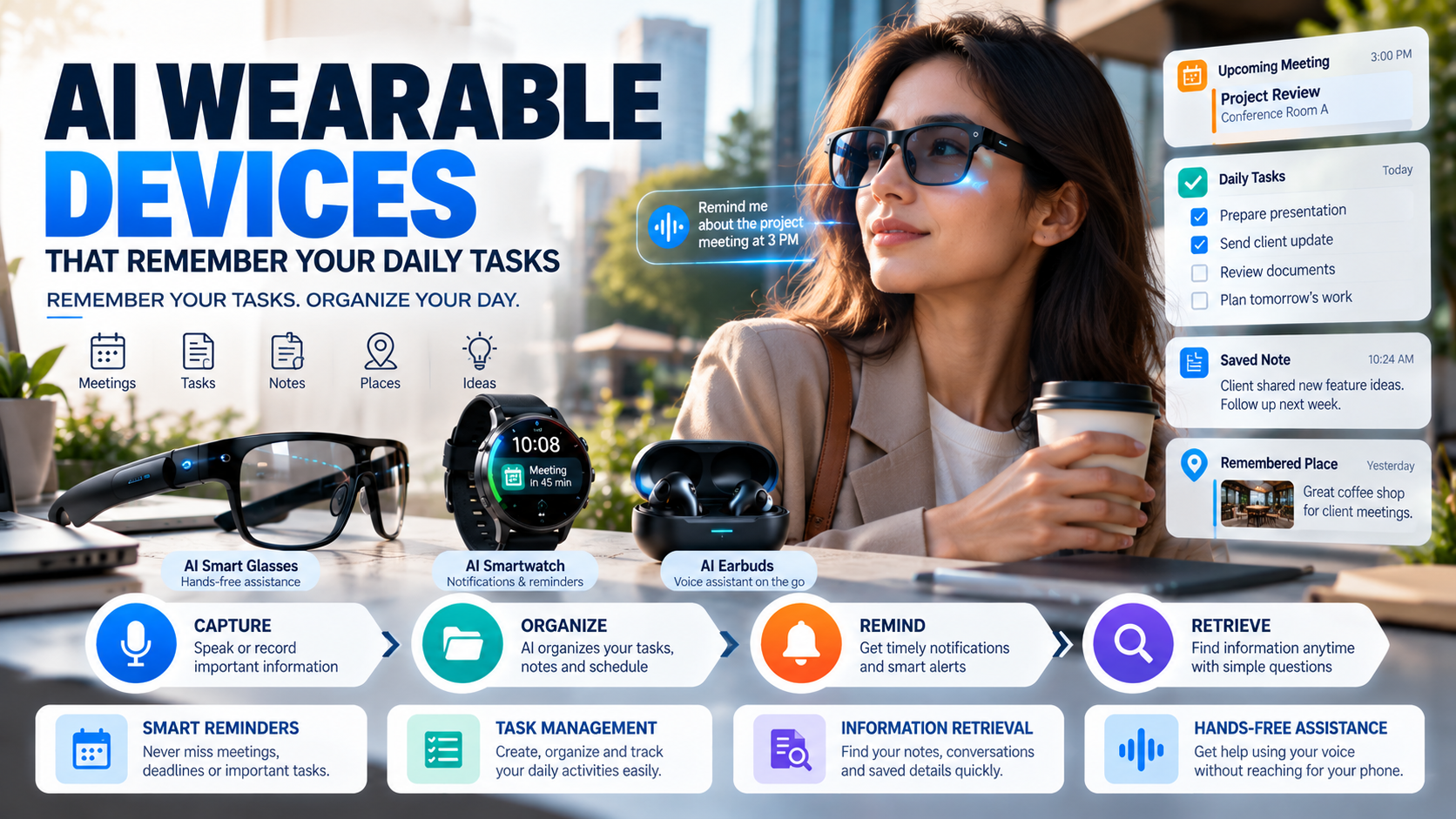
Artificial Intelligence (AI) is making it easier to manage these everyday tasks. AI wearable devices, such as smart glasses, smartwatches, and smart assistants, can help people set reminders, check their schedules, save information, and organize their daily activities.
Instead of opening your smartphone every time you need help, some wearable devices allow you to use voice commands and receive information directly through the device. These technologies are making everyday life more convenient by helping people manage information and remember important tasks.
What Are AI Wearable Devices?
AI wearable devices are smart electronic gadgets that people can wear on their bodies. They use artificial intelligence to understand commands, process information, and help users complete different activities.
Examples include smart glasses, smartwatches, AI-powered earbuds, and other wearable assistants. Depending on the device, users may be able to ask questions, create reminders, check appointments, or receive helpful suggestions.
For example, imagine you are preparing for an important meeting. You can use a supported AI assistant to create a reminder instead of manually typing it into your phone. When the reminder is due, the connected device or application can notify you.
These devices do not all have the same features. Some offer basic reminders, while others provide more advanced AI assistance.
How AI Wearable Devices Remember Daily Tasks
AI wearable devices use different technologies to help users manage important information. Their capabilities depend on the hardware, software, and applications connected to them.
1. Voice Commands and Reminders
Many AI-enabled wearables allow users to give commands using their voice. This means you may not need to stop what you are doing and type information into your smartphone.
For example, you could say, “Remind me to call the client at 4 PM.” If the device supports this command and has the required permissions, it can create a reminder for you.
Voice reminders are useful when driving, walking, cooking, or working with your hands. They make it easier to record small tasks before you forget them.
2. Saving Important Information
Some AI assistants can help users save notes, record information, or summarize conversations when the relevant features are available.
For example, after a work meeting, a supported AI tool might create a summary of the main discussion points and action items. You can then refer to those notes instead of trying to remember every detail.
However, not every smartwatch or pair of smart glasses can automatically save conversations. Recording and summarization features depend on the specific product, and users should always respect other people’s privacy.
3. Calendar and Task Management
AI wearables can also work with calendars and task-management applications. This allows users to check upcoming appointments, create events, and receive notifications without constantly checking their phones.
For example, a user might ask an AI assistant about the next meeting or request a reminder about an upcoming deadline.
When connected applications support these functions, wearable devices can help users organize their schedules and avoid missing important appointments.
4. Finding Previously Saved Information
Some advanced AI memory systems are designed to help users find information they saved earlier.
Imagine that you saved a note about a project several days ago but cannot remember where you stored it. A searchable AI assistant may help you locate the information by allowing you to ask a question in everyday language.
This capability is still different from a device remembering everything automatically. The quality of the result depends on what information was captured, how it was stored, and whether the assistant can access it.
Types of AI Wearable Devices That Help With Daily Tasks
1. AI Smart Glasses
AI smart glasses look similar to ordinary glasses but include smart features such as microphones, speakers, cameras, and voice assistants, depending on the model.
Users can interact with supported AI features without holding a smartphone. Some devices can answer questions, help manage reminders, or provide information through voice commands.
For example, Ray-Ban Meta AI glasses offer voice-based AI features, with availability depending on the feature, region, and software support.
Smart glasses can be helpful for people who want hands-free assistance while walking, traveling, or completing everyday activities.
2. Smartwatches
Smartwatches are among the most familiar wearable devices. They can display notifications, reminders, calendar events, alarms, and fitness information.
Some models also include AI-assisted features through built-in software or connected smartphone applications.
For example, a smartwatch can remind you to attend a meeting, notify you about an upcoming appointment, or show a task notification on your wrist.
Smartwatches are especially useful for people who want quick access to reminders without taking their phones out of their pockets.
3. AI-Powered Earbuds
AI-powered earbuds are wireless audio devices that may include voice assistants, microphones, translation features, and other smart functions.
Depending on the model, users can interact with an assistant, ask questions, or receive spoken information while keeping their hands free.
For example, someone working outside the office might use compatible earbuds to hear a reminder or ask a connected assistant about their schedule.
However, earbuds do not automatically remember every conversation or task. Such capabilities require specific software and supported features.
4. AI Memory Assistants
AI memory assistants are designed to help users capture, organize, and retrieve information from their daily activities.
Some are software-based assistants, while others are being explored through wearable hardware and research projects.
For example, a memory assistant might help a user search saved notes or find important details from previously captured information.
These systems have potential for people who handle many meetings, projects, and personal tasks. However, more advanced personal-memory features are not available in every commercial wearable.
Real-World Examples of AI Wearable Technology
Ray-Ban Meta AI Glasses
Ray-Ban Meta AI glasses are an example of commercially available smart glasses with AI features. They combine a familiar glasses design with supported voice interactions and other connected functions.
Depending on the device and available software, users can ask questions and interact with the assistant hands-free. Some supported integrations may also help with everyday reminders and scheduling.
These glasses demonstrate how AI assistance can become part of a wearable device rather than remaining limited to a smartphone screen.
Memoro: Research Into Personal Memory Assistance
Memoro is a research project associated with the MIT Media Lab that explores ways to capture conversations and help people retrieve information later.
The idea is to make personal information easier to search and recall. For example, a person might want to find a detail from an earlier conversation instead of relying entirely on memory.
Memoro is best understood as an example of research into personal memory technology, not as a typical consumer product that everyone can purchase and use.
Both examples show different sides of wearable AI: products available to consumers today and research exploring what future memory assistants might achieve.
Benefits of AI Wearable Devices
1. Better Daily Organization
AI wearables can help users manage appointments, reminders, and simple tasks in one connected experience. This can make daily planning easier, especially for people with busy schedules.
2. Hands-Free Convenience
Users can interact with supported assistants through voice commands instead of always typing on a smartphone. This is useful when their hands are occupied with other activities.
3. Less Dependence on Remembering Every Detail
Reminders, saved notes, and searchable information can reduce the need to remember every small task or detail. Users can rely on organized information when they need to recall something.
4. Improved Productivity
Wearable AI can make certain activities quicker, such as checking a schedule, creating a reminder, or retrieving a saved note. These small improvements may help users spend less time switching between applications.
5. Accessibility Support
Voice interactions and audio notifications can make some digital tasks easier for people who have difficulty using a touchscreen or reading small text. The usefulness of these features depends on the individual’s needs and the device’s accessibility options.
Challenges and Limitations of AI Wearables
Although AI wearables can be useful, they also have limitations that users should understand before buying or relying on them.
1. Privacy Concerns
Devices with microphones or cameras may handle sensitive personal information. Recording conversations or capturing other people without their knowledge can create privacy concerns.
Before using these features, check the device’s recording indicators, permissions, privacy controls, and data-storage policies. Always respect applicable laws and obtain appropriate consent when recording other people.
2. Battery Life
AI features can consume battery power, particularly when they depend on frequent processing, audio use, or continuous connectivity.
Some devices may need daily charging, while others can last longer depending on their design and usage. Battery life should be considered when choosing a wearable for everyday use.
3. Incorrect Information
AI assistants can misunderstand voice commands, miss important details, or generate inaccurate summaries.
For example, an assistant might interpret a date incorrectly or leave an important action item out of a meeting summary. Users should review important reminders, deadlines, and work-related notes instead of trusting every AI-generated result.
4. Internet and Smartphone Dependence
Some wearables require a smartphone connection, an internet connection, or a compatible application to perform certain tasks.
If the connection is unavailable, some features may stop working or become limited. Before buying a device, check which features work independently and which require another device or online service.
5. Cost and Feature Availability
Advanced smart glasses and other AI wearables may cost more than traditional gadgets. In addition, some features may only be available in selected countries, languages, or software versions.
Compare the features you actually need instead of paying extra for capabilities you may rarely use.
How to Choose the Right AI Wearable Device
Choosing the right device depends on your daily routine and the tasks you want help with.
If you mainly need reminders and calendar notifications, a smartwatch may be enough. If you prefer hands-free voice assistance, smart glasses or compatible earbuds may be more suitable.
If your main goal is to search old notes or retrieve details from conversations, look for a system that explicitly supports memory storage and information retrieval. Do not assume that every device marketed as an AI wearable offers these features.
Before making a purchase, compare battery life, supported applications, privacy settings, device compatibility, regional availability, and the total cost of any required subscription.
The Future of AI Wearable Devices
AI wearable technology is continuing to develop. Future devices may become better at understanding context, organizing information, and helping users retrieve details from their daily activities.
For example, a personal assistant could potentially connect a user’s calendar, saved notes, and task list to provide more useful reminders throughout the day. Research into wearable memory systems is also exploring ways to make previously captured information easier to find.
However, these possibilities should not be confused with features that every device already supports. Accuracy, privacy, battery life, and user control will remain important as the technology develops.
The most useful wearables will be those that solve real problems without making everyday life more complicated.
Conclusion
AI wearable devices are changing how people interact with technology and manage everyday tasks. Smart glasses, smartwatches, earbuds, and AI assistants can help users create reminders, check schedules, save information, and retrieve useful details when supported features are available.
These devices can improve convenience and productivity, but they are not perfect replacements for personal memory. Their performance depends on the technology, available integrations, and information they can access.
Before choosing an AI wearable, consider your needs, privacy, battery life, and supported features. With the right device and sensible use, wearable AI can become a helpful tool for staying organized and remembering important tasks.
