Display technology is improving rapidly, making screens smaller, sharper, and more detailed than ever before. One technology attracting attention is the Micro OLED display, which can deliver high-resolution images from a very small display panel.
Micro OLED technology is particularly useful for virtual reality (VR) headsets, mixed reality (MR) devices, electronic camera viewfinders, and other compact display systems. It combines OLED pixels with silicon-based electronics to create detailed visuals in a small space.
But what exactly is Micro OLED, how does it work, and how is it different from traditional OLED and MicroLED displays? Let’s explore this technology in simple terms.
1. What Is a Micro OLED Display?
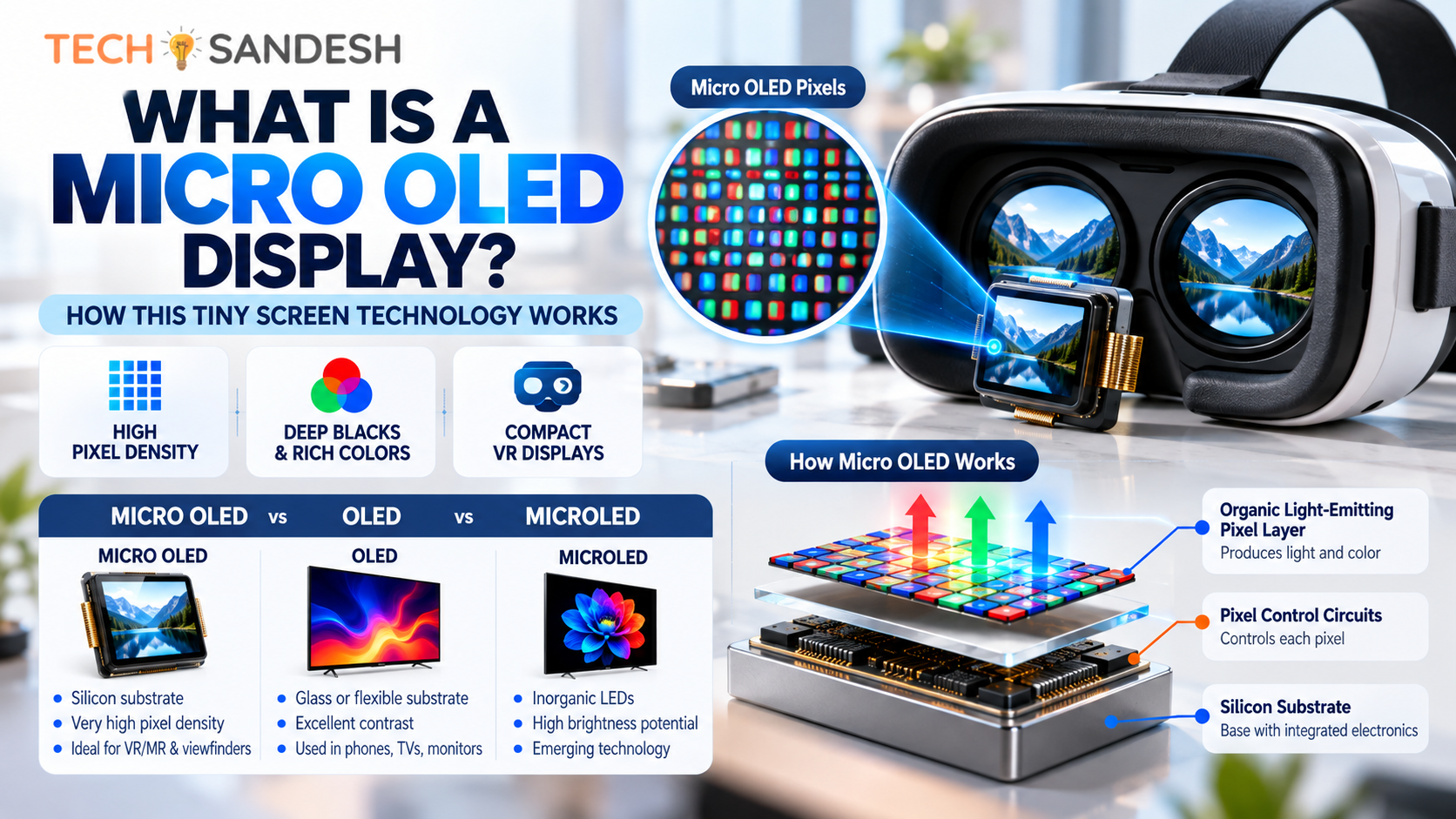
A Micro OLED display is a miniature screen that uses organic light-emitting diode technology on a silicon substrate. It is also known as OLED on Silicon (OLEDoS).
Unlike many conventional OLED displays that use glass substrates, Micro OLED displays use a silicon wafer containing tiny electronic circuits that control individual pixels. This design allows manufacturers to create extremely small screens with very high pixel density.
Pixel density refers to the number of pixels packed into a particular area. A higher pixel density can make images and text appear sharper, especially when a display is positioned close to the viewer’s eyes.
For example, a VR headset needs a compact display that can produce detailed images when viewed through magnifying lenses. Micro OLED technology is well suited to this requirement because it can fit many pixels into a small display area.
Micro OLED displays are not designed primarily to replace large televisions or ordinary laptop screens. Their main advantage is providing detailed visuals in compact devices where space is limited.
2. How Does Micro OLED Display Technology Work?
Micro OLED technology combines microscopic light-producing pixels with silicon-based electronic circuits. Each pixel can generate its own light, so the display does not require a separate backlight like a conventional LCD.
Here is a simple explanation of how it works.
Step 1: Silicon substrate controls the display
The display is built on a silicon substrate containing electronic circuits. These circuits control the operation of individual pixels and determine how the image appears on the screen.
Step 2: Organic materials produce light
Organic light-emitting materials are integrated into the display structure. When an electrical current passes through these materials, they emit light.
Step 3: Pixels create colors and brightness
Tiny pixels work together to produce different colors and brightness levels. By controlling these pixels individually, the display creates images, videos, text, and other visual content.
Step 4: Optical lenses enlarge the image
In devices such as VR headsets and electronic viewfinders, optical lenses magnify the tiny display image so that the viewer can see it clearly.
This combination of compact pixels, silicon electronics, and optical magnification makes Micro OLED useful for near-eye display applications.
3. What Are the Main Advantages of Micro OLED Displays?
Micro OLED displays offer several benefits that make them attractive for advanced wearable and imaging devices.
High Pixel Density
Micro OLED technology can pack a large number of pixels into a very small area. This helps produce sharp images and detailed text, which are especially important when a display is viewed through lenses at close range.
Deep Blacks and High Contrast
Because OLED pixels produce their own light, individual pixels can turn off when displaying black. This enables deep black levels and high contrast between bright and dark areas.
Rich Colors
Micro OLED displays can produce vibrant colors and detailed images. Actual color accuracy and brightness depend on the panel design, calibration, and device implementation.
Compact Design
The silicon-based architecture supports small display panels with integrated electronic control circuits. This makes the technology suitable for devices where conventional display panels would be too large.
Fast Pixel Response
OLED pixels can change their light output quickly, helping displays render motion smoothly. However, the complete viewing experience also depends on refresh rate, image processing, and the optical system.
Despite these advantages, Micro OLED displays have limitations. Manufacturing can be complex and expensive, and maximum brightness, heat management, production yield, and panel lifetime remain important engineering considerations.
4. Where Are Micro OLED Displays Used?
Micro OLED technology is especially useful in products that need small, detailed displays.
Virtual Reality and Mixed Reality Headsets
VR and MR headsets use compact displays and optical lenses to create immersive visual experiences. Micro OLED can provide detailed imagery within these small display systems.
Electronic Camera Viewfinders
Some digital cameras use miniature electronic viewfinders to show photographers a live preview of a scene. Micro OLED displays can deliver sharp images and strong contrast in these compact viewfinders.
Professional and Industrial Equipment
Compact displays can also be useful in specialized equipment, including inspection systems, medical visualization devices, and industrial viewing systems. The exact display technology varies by product.
Advanced Near-Eye Devices
Micro OLED is a candidate for certain wearable viewing systems and compact optical devices. However, not every smart-glasses product uses Micro OLED; the technology depends on the product’s design and purpose.
As display components become more compact, Micro OLED may enable additional applications that require detailed images without a large physical screen.
5. Micro OLED vs OLED vs MicroLED: What Is the Difference?
Although these technologies have similar names, they work differently and serve different purposes.
| Feature | Micro OLED | Traditional OLED | MicroLED |
|---|---|---|---|
| Light source | Organic light-emitting pixels | Organic light-emitting pixels | Tiny inorganic LEDs |
| Typical substrate | Silicon | Often glass or flexible substrates | Depends on implementation |
| Main strength | High pixel density in a small area | Excellent contrast and image quality | Potential for high brightness and long lifespan |
| Common applications | VR/MR headsets and electronic viewfinders | Phones, TVs, monitors and wearables | Emerging displays and specialized products |
| Main challenge | Manufacturing complexity and brightness requirements | Panel lifespan, burn-in risk and production cost | Complex manufacturing and mass transfer |
Micro OLED vs OLED: Both use organic materials that emit light. The key distinction is that Micro OLED is designed as a miniature display using a silicon-based backplane, enabling very high pixel density in a small area.
Micro OLED vs MicroLED: Micro OLED uses organic light-emitting materials, while MicroLED uses tiny inorganic light-emitting diodes. MicroLED has potential advantages in brightness and longevity, but its manufacturing process is challenging.
Neither technology is automatically best for every device. The right choice depends on size, brightness, image quality, cost, power requirements, and intended use.
Conclusion: Is Micro OLED the Future of Small Displays?
Micro OLED is an important display technology because it combines OLED image quality with a compact, silicon-based design. Its ability to deliver detailed visuals in a small space makes it especially valuable for VR and MR headsets, electronic camera viewfinders, and other near-eye display systems.
However, it is not a universal replacement for traditional OLED or LCD screens. Manufacturing costs, brightness requirements, and application-specific needs still influence where it makes sense to use Micro OLED.
As wearable technology and immersive computing continue to develop, Micro OLED could play an important role in making compact displays more detailed and useful. Understanding how it works also helps consumers distinguish it from traditional OLED and MicroLED technology.
