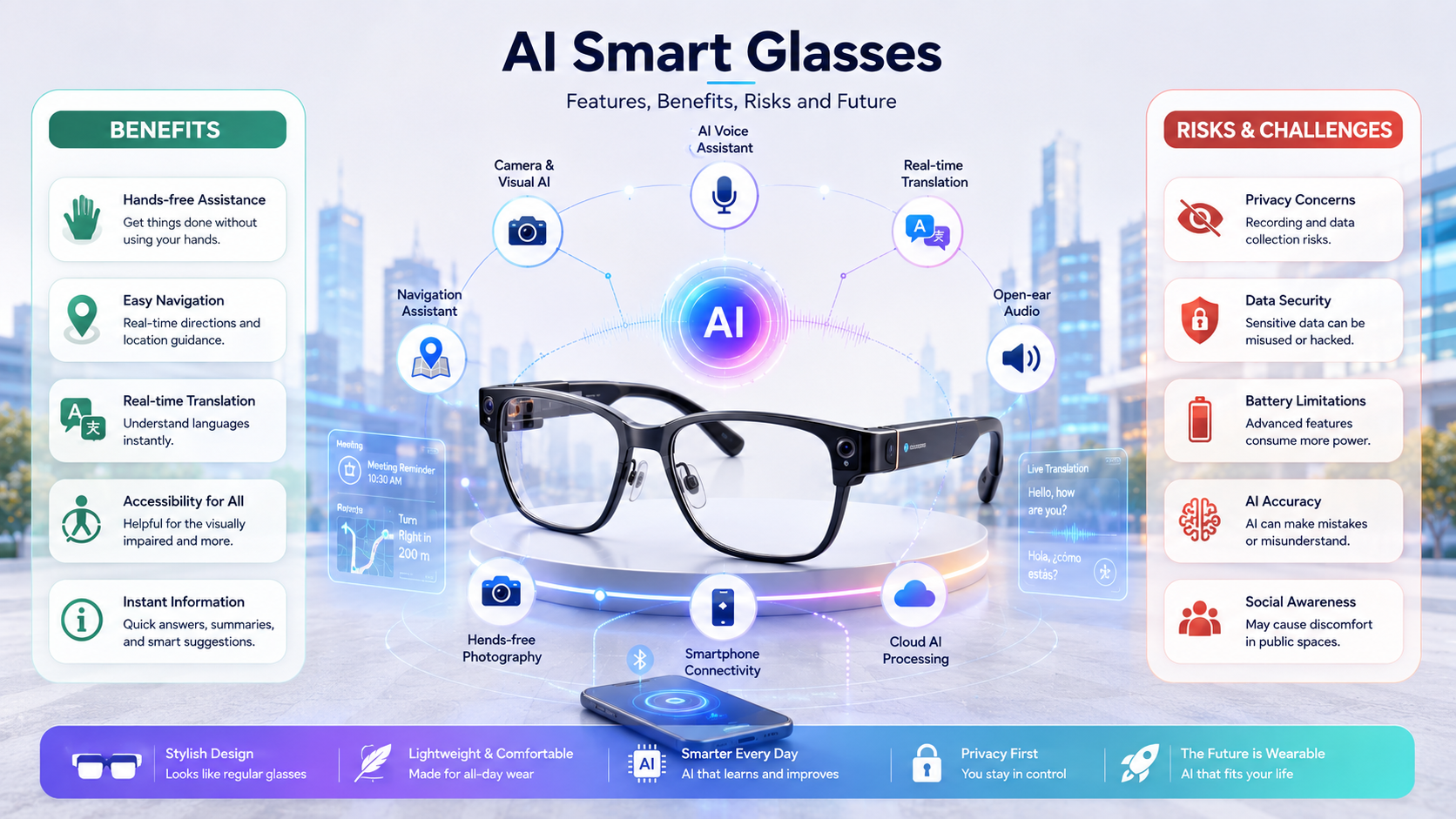
Smart glasses are becoming one of the most interesting types of wearable technology. They look similar to normal glasses, but they can include cameras, microphones, speakers, sensors, internet connectivity, and artificial intelligence.
AI makes these glasses more useful because they can understand voice commands, answer questions, recognize objects, translate text, provide information, and help users without requiring them to constantly use a smartphone.
However, AI smart glasses also come with challenges. Privacy, security, battery life, accuracy, cost, and social acceptance are some of the biggest concerns.
In this article, let’s understand what AI smart glasses are, how they work, their main features, benefits, risks, and what the future may look like.
What Are AI Smart Glasses?
AI smart glasses are wearable glasses that combine the look and comfort of regular glasses with smart technology and artificial intelligence.
Depending on the model, they may include cameras for photos and videos, microphones for voice commands, speakers for audio, sensors for understanding the environment, and AI assistants for answering questions.
Some smart glasses do not have a screen. Instead, they use voice and audio to communicate with the user. Other advanced models may include small displays that can show information directly in front of the user’s eyes.
Simply put, AI smart glasses are glasses that can understand your commands and help you using AI.
How Do AI Smart Glasses Work?
AI smart glasses combine several technologies to work together.
When you speak to the glasses, the built-in microphone captures your voice. The device then processes your request using its AI system. Depending on the design, the processing may happen on the glasses, a connected smartphone, or cloud-based services.
The AI understands your request and generates a response. The glasses can then give you the answer through built-in speakers or display information through an integrated screen.
For example, you could ask:
“What is this object?”
The camera can capture the object, AI can analyze it, and the glasses can tell you what it is.
This allows users to interact with technology without constantly looking at a phone.
Key Features of AI Smart Glasses
AI Voice Assistant
One of the main features of AI smart glasses is the voice assistant.
Users can speak naturally to their glasses instead of typing on a smartphone. They may ask questions, request information, set reminders, or perform supported actions.
This makes AI assistance more convenient because your hands can remain free.
Camera and Visual AI
Many AI smart glasses include a built-in camera.
The camera allows the AI to understand things around the user. Depending on the device, it may recognize objects, read text, identify products, analyze images, or provide information about a location.
For example, you could point your glasses at a menu and ask the AI to explain or translate it.
However, cameras also create privacy concerns because other people may be recorded without knowing it.
Open-Ear Audio
Many smart glasses use small speakers positioned near the ears instead of traditional headphones.
This allows users to listen to music, calls, navigation instructions, or AI responses while still hearing sounds around them.
This can be useful when walking, traveling, or working.
Hands-Free Photos and Videos
Camera-equipped smart glasses can capture photos and videos without requiring users to take out their smartphones.
This can be useful while traveling, participating in sports, attending events, or simply capturing everyday moments.
The main advantage is convenience because the camera is always available when needed.
Translation
AI smart glasses can potentially help users understand different languages.
For example, a user could look at a sign written in another language and ask the AI to translate it.
Future devices could make real-time conversation translation even more natural.
Navigation
AI smart glasses can also help users navigate unfamiliar places.
Instead of repeatedly checking a phone for directions, users could receive navigation instructions through audio or, on display-equipped glasses, visual information.
This could make walking and traveling more convenient.
Accessibility Features
AI smart glasses may also be useful for people with certain accessibility needs.
They can potentially read text aloud, describe objects, recognize surroundings, and provide hands-free assistance.
This makes AI glasses more than just entertainment gadgets. They could become useful tools for accessibility and everyday assistance.
Benefits of AI Smart Glasses
Hands-Free Technology
One of the biggest advantages of AI smart glasses is that they allow users to interact with technology without holding a device.
You can ask a question, listen to information, take a photo, or perform supported actions while keeping your hands free.
Quick Access to Information
AI glasses can make information available more naturally.
Instead of taking out your phone, unlocking it, opening an application, typing a question, and checking the result, you can simply speak to the glasses.
This can be particularly useful when you’re walking, traveling, cooking, working, or doing other activities.
More Natural AI Interaction
Smartphones require users to look at a screen.
AI smart glasses can make AI assistance feel more natural because the technology is available around you.
Instead of thinking about which application to open, you can simply tell the AI what you need.
Better Accessibility
AI glasses could help people who have difficulty reading text, identifying objects, or navigating unfamiliar environments.
Features such as text reading, object recognition, voice assistance, and audio descriptions could make everyday tasks easier.
Risks of AI Smart Glasses
Privacy Concerns
Privacy is one of the biggest concerns surrounding AI smart glasses.
A camera-equipped pair of glasses can capture photos, videos, and surroundings from the user’s point of view.
The problem is that people around the wearer may not always know when they are being recorded.
For this reason, manufacturers need clear recording indicators, privacy controls, and responsible data practices.
Data Security
Smart glasses can potentially collect sensitive information such as images, audio, location data, and user interactions.
If this information is stored or transferred through smartphones or cloud services, security becomes important.
Manufacturers need strong security measures to protect users’ personal information.
Battery Life
Smart glasses need power for cameras, microphones, speakers, wireless connections, sensors, and AI-related features.
More features generally require more energy.
Because glasses need to remain lightweight and comfortable, manufacturers cannot simply add a very large battery.
Battery life therefore remains an important challenge.
AI Mistakes
AI is not always correct.
An AI assistant could misunderstand a question, incorrectly identify an object, provide inaccurate information, or misunderstand what is happening around the user.
Users should therefore avoid blindly trusting AI, especially when using it for important decisions or safety-related situations.
Social Acceptance
Not everyone is comfortable around camera-equipped smart glasses.
Some people may worry about being recorded without permission.
Because of this, the success of AI smart glasses will depend not only on technology but also on social acceptance, clear privacy rules, and responsible use.
AI Smart Glasses vs Traditional Smart Glasses
Traditional smart glasses usually focus on features such as notifications, audio, fitness information, and smartphone connectivity.
AI smart glasses add another layer of intelligence.
For example, a traditional device might allow you to say:
“Play music.”
An AI-powered device could potentially understand a more natural request such as:
“Play some relaxing music for my evening walk.”
The second example requires the system to understand context and user intent.
Can AI Smart Glasses Replace Smartphones?
Not completely — at least not yet.
Smartphones still offer large displays, powerful applications, cameras, keyboards, gaming, payments, video, and many other functions.
AI smart glasses are better suited for quick, hands-free interactions.
The more likely future is that smartphones and smart glasses will work together.
The smartphone can handle applications and heavy processing, while the glasses provide a convenient way to interact with information.
What Could AI Smart Glasses Do in the Future?
The future of AI smart glasses could be much more advanced.
Future glasses may become better at understanding the user’s surroundings, remembering useful information, translating conversations, providing real-time assistance, and connecting with other smart devices.
Some devices may also include lightweight displays that show information directly in front of the user’s eyes.
Imagine walking through a new city and receiving directions through your glasses, looking at a foreign-language sign and seeing its translation, or attending a meeting where the glasses help you remember important information.
These possibilities could make smart glasses an important part of the next generation of personal technology.
Challenges Before Mass Adoption
For AI smart glasses to become mainstream, several problems still need to be solved.
They need to become more comfortable, affordable, accurate, secure, and power-efficient.
Privacy will also be extremely important. People need to feel comfortable around others wearing smart glasses.
If manufacturers can solve these challenges, AI smart glasses could move from being an interesting gadget to an everyday technology.
Final Thoughts
AI smart glasses combine traditional eyewear with artificial intelligence, cameras, microphones, speakers, sensors, and connectivity.
Their biggest advantage is hands-free access to information and AI assistance.
They can help with questions, photography, translation, navigation, accessibility, and many other everyday tasks.
At the same time, privacy, security, battery life, AI accuracy, cost, and social acceptance remain important challenges.
The future of AI smart glasses will depend on how well manufacturers balance usefulness with privacy, intelligence with accuracy, and advanced features with comfort.
The goal is not simply to put AI into glasses. The real goal is to create technology that can quietly assist people without becoming intrusive.
AI smart glasses could become an important part of the future of wearable technology — if they can become smart, useful, comfortable, and trustworthy at the same time.
