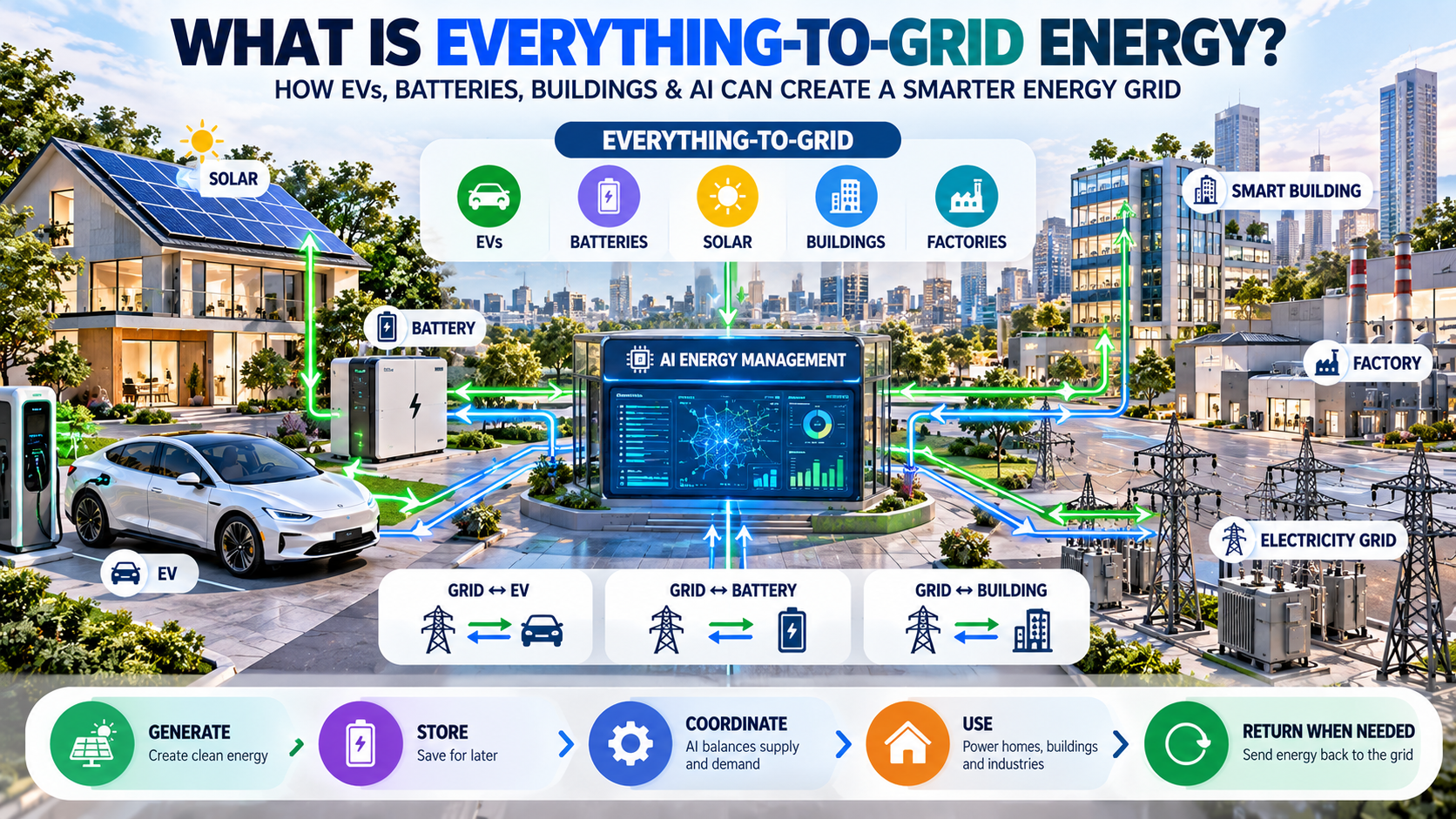
Electric vehicles, home batteries, buildings, factories and solar systems can increasingly store electricity, change when they use electricity, and in some cases send electricity back to the grid.
Power Plant → Electricity Grid → Home / Building / Factory
This idea is called Everything-to-Grid Energy.
The World Economic Forum named Everything-to-Grid Energy its #1 emerging technology for 2026, describing a future where buildings, vehicles and other devices become active resources for the electricity grid. World Economic Forum
How Does Everything-to-Grid Energy Work?
The basic idea is simple.
Instead of treating every building, vehicle or battery as only an electricity consumer, the grid can use these connected assets as flexible energy resources.
For example:
Solar panels → Generate electricity
Battery → Store electricity
EV → Charge or supply electricity
Smart building → Adjust electricity usage
Grid → Coordinates everything
This creates a much more flexible energy system.
Traditional Grid vs Everything-to-Grid
A traditional electricity system generally works like this:
POWER PLANT → GRID → CONSUMER
The Everything-to-Grid model can work more like:
POWER PLANT ↔ GRID ↔ EV ↔ BATTERY ↔ BUILDING ↔ FACTORY
Electricity can move in different directions depending on what the grid needs.
The WEF describes this as turning buildings, vehicles and devices from passive consumers into active grid resources. World Economic Forum
Why Is Everything-to-Grid Becoming Important?
Electricity demand is changing quickly.
Electric vehicles, data centers, air conditioning, industrial equipment and other technologies are increasing electricity demand.
At the same time, solar and wind power do not produce electricity at exactly the same time that people need it.
For example, solar panels can generate a lot of electricity during the afternoon, while electricity demand can remain high after sunset.
This creates a challenge:
How do we store extra electricity and use it when we need it?
Everything-to-Grid is one possible answer.
Can Electric Vehicles Become Energy Sources?
Yes, with compatible technology.
Electric vehicles contain large batteries, but those batteries often sit unused for many hours.
With bidirectional charging, an EV can potentially do more than simply receive electricity.
It can:
Charge → Store → Supply electricity when needed
This creates technologies such as:
- V1G: Smart charging
- V2H: Vehicle-to-Home
- V2B: Vehicle-to-Building
- V2G: Vehicle-to-Grid
- V2L: Vehicle-to-Load
The IEA says smart charging and V2G can help reduce peak demand and provide grid services, although widespread adoption still requires compatible vehicles, chargers, communication standards, regulations and suitable incentives. IEA
What Is Vehicle-to-Grid (V2G)?
Vehicle-to-Grid, or V2G, allows a compatible electric vehicle to send electricity from its battery back to the electricity grid.
Imagine your EV is fully charged during a period when electricity demand is low.
Later, demand increases.
Instead of getting all the additional electricity from large power plants, the grid could potentially receive some energy from connected EV batteries.
The simple process is:
EV Charges → Battery Stores Energy → Grid Needs Power → EV Sends Some Energy Back
V2G is therefore an important part of the larger Everything-to-Grid concept. IEA
What Is Vehicle-to-Home (V2H)?
Vehicle-to-Home, or V2H, uses an EV battery to provide electricity to a home.
For example, an EV could charge during the day using solar power.
At night, the stored electricity could help power the home.
A compatible EV could also potentially provide backup power during an outage.
So instead of thinking of an EV only as a vehicle, we can also think of it as a large mobile battery.
The U.S. Department of Energy also identifies bidirectional EV charging as a way to provide backup power to buildings and work alongside solar and other distributed energy resources.
Can Home Batteries Help the Electricity Grid?
Yes.
A home battery can store electricity when supply is high or when electricity is cheaper.
It can then provide energy later when demand increases.
Imagine thousands of homes with batteries.
Individually, each battery is relatively small.
But if software connects thousands of them, they can collectively become a much larger energy resource.
This is one reason Australia is an interesting example: the WEF reports that Australian households added more than 180,000 home batteries in the second half of 2025, while programmes are connecting batteries into software-controlled networks that can support the grid. World Economic Forum
Can Buildings Become Part of the Energy Grid?
Yes.
A smart building can have:
- Solar panels
- Batteries
- EV chargers
- Smart HVAC systems
- Energy-management software
- Smart appliances
The building does not always need to consume electricity at maximum levels.
For example, a smart energy system could temporarily reduce certain electricity loads when the grid is under pressure.
This is called demand flexibility.
The building becomes an active part of the energy system instead of simply consuming electricity.
What Role Does Solar Energy Play?
Solar power is an important part of this future.
The challenge with solar is that electricity generation changes throughout the day.
For example:
Afternoon ☀️
Solar production is high.
Evening 🌆
Solar production falls while electricity demand can remain high.
Everything-to-Grid systems can help by storing some of the afternoon electricity in batteries or EVs and using it later.
This can make better use of renewable energy.
What Is a Virtual Power Plant?
A Virtual Power Plant (VPP) connects many small energy resources using software.
These resources could include:
- Home batteries
- Solar panels
- Electric vehicles
- Commercial batteries
- Smart buildings
- Flexible industrial equipment
Each resource is small by itself.
But when thousands of them are connected and coordinated, they can work together like one large energy system.
Think of it like this:
One EV = Small Energy Resource
One Home Battery = Small Energy Resource
One Solar System = Small Energy Resource
Thousands Connected = Virtual Power Plant
This idea is especially important for Everything-to-Grid Energy.
How Can AI Help Everything-to-Grid Energy?
AI can act as the brain of the energy-management system.
Imagine thousands of EVs, batteries and buildings connected to a smart grid.
The system could analyze:
- Electricity demand
- Weather
- Solar generation
- Battery levels
- EV charging requirements
- Grid conditions
- Electricity prices
- User preferences
AI can then help determine when different devices should charge, reduce consumption or potentially send stored electricity back.
The WEF’s 2026 technology-convergence report highlights AI-driven optimization for coordinating distributed assets such as EVs, home batteries and solar systems. World Economic Forum
Why Is AI Important for Smart Energy?
Managing one battery is relatively easy.
Managing millions of batteries, EVs and buildings is much harder.
AI and advanced software can analyze huge amounts of information and coordinate many devices at the same time.
For example:
High solar production
↓
AI detects excess electricity
↓
EVs start charging
↓
Home batteries store energy
↓
Demand increases
↓
AI adjusts charging/discharging
↓
Grid remains more balanced
This is where AI and energy infrastructure can become closely connected. The WEF notes that AI is increasingly entering the operating side of power systems and helping buildings and storage assets act as more autonomous energy managers. World Economic Forum
What Are the Benefits of Everything-to-Grid Energy?
⚡ Better Grid Flexibility
Connected batteries and other devices can help respond when electricity demand changes.
☀️ Better Use of Renewable Energy
Extra solar or wind electricity can potentially be stored and used later.
🚗 Smarter EVs
EVs can become more than transportation. Their batteries can also provide energy flexibility.
🔋 Better Battery Usage
Connected batteries can potentially provide useful grid services when they are not needed for their primary purpose.
🏠 Backup Power
Compatible EVs and batteries can provide backup electricity for homes and buildings.
💰 Potential Cost Savings
Smart charging can shift electricity use toward lower-cost periods.
The IEA says smart charging can reduce charging costs and V2G can potentially provide revenue through grid services, depending on local systems and market arrangements. IEA
Can Everything-to-Grid Reduce Electricity Costs?
It can potentially reduce costs.
For example, an EV could charge when electricity demand is lower and prices are cheaper.
During a high-demand period, the system could reduce charging or use stored energy where the equipment and market allow it.
This process is called load shifting.
However, savings depend on:
- Local electricity prices
- Utility programmes
- Equipment
- Regulations
- Battery capacity
- Participation incentives
So Everything-to-Grid does not automatically mean lower electricity bills for everyone.
What Are the Challenges?
Everything-to-Grid Energy is promising, but several challenges remain.
🔌 Compatible Hardware
Vehicles, chargers and batteries need to support the required bidirectional technology.
🔋 Battery Degradation
Repeated charging and discharging can affect battery life, so systems need to balance grid benefits with battery health.
The WEF specifically identifies battery degradation as one of the challenges for Everything-to-Grid systems. World Economic Forum
🔐 Cybersecurity
Connecting millions of devices to energy networks creates new cybersecurity risks.
📡 Communication
Different EVs, chargers, batteries and grid systems need to communicate correctly.
📜 Regulations
Energy rules differ between countries and regions.
💰 Business Models
Consumers need clear financial or practical benefits for allowing their assets to participate in grid services.
The IEA also highlights interoperability, testing, regulation and financial incentives as important requirements for scaling V2G. IEA
Is Everything-to-Grid the Same as V2G?
No.
V2G is only one part of Everything-to-Grid.
| Technology | Simple Meaning |
|---|---|
| V1G | Smart EV charging |
| V2H | EV → Home |
| V2B | EV → Building |
| V2G | EV → Electricity Grid |
| V2L | EV → Devices |
| Everything-to-Grid | EVs + Buildings + Batteries + Factories + Other Energy Assets |
So, Everything-to-Grid is the bigger concept.
Could Factories Participate Too?
Yes.
Factories consume large amounts of electricity, but they may also have:
- Solar systems
- Batteries
- Backup generators
- Energy storage
- Flexible machines
- Energy-management systems
A smart factory could adjust certain processes based on electricity availability.
For example, some energy-intensive processes could be scheduled when electricity is more available.
This could make factories energy-flexible rather than simply energy-consuming.
The WEF specifically describes factories and data centres as potential active energy resources in the emerging Everything-to-Grid model. World Economic Forum
What Could the Future Look Like?
Imagine a smart neighborhood.
During the afternoon:
☀️ Solar panels generate electricity
↓
🔋 Batteries store extra energy
↓
🚗 EVs charge
↓
🏠 Buildings use smart energy systems
In the evening:
🌆 Electricity demand increases
↓
🤖 AI analyzes the grid
↓
🔋 Batteries provide stored energy
↓
🚗 Compatible EVs can provide flexibility
↓
⚡ Grid demand is balanced
This creates a more connected energy ecosystem.
The WEF’s vision is that buildings, vehicles and other devices can become intelligent nodes in the electricity system, rather than simply consuming whatever electricity the grid provides. World Economic Forum
Will Everything-to-Grid Replace Power Plants?
No, not completely.
Large power plants and renewable-energy projects will continue to be important.
Everything-to-Grid is better understood as an additional layer of flexibility.
The future electricity system could combine:
Large Power Plants + Solar + Wind + Batteries + EVs + Buildings + Factories + Smart Software
Instead of depending on only a few large energy sources, the grid could coordinate millions of smaller resources.
Why Is Everything-to-Grid Important for the Future?
The biggest change is the way we think about electricity.
Today, we often think:
Power Plant → Grid → Consumer
In the future, it could become:
Power Plant ↔ Grid ↔ EV ↔ Battery ↔ Building ↔ Factory
Electric vehicles, buildings and batteries could become active participants in the electricity system.
That could become especially important as electrification increases and grids need more flexibility.
The World Economic Forum selected Everything-to-Grid Energy as its #1 emerging technology of 2026, highlighting its potential to turn buildings, vehicles and devices into active grid resources.
Conclusion
Everything-to-Grid Energy could change the way we use and manage electricity. Instead of homes, electric vehicles, batteries and buildings only consuming power, they could also store electricity, adjust their energy usage and potentially send power back to the grid.
With AI, smart grids, renewable energy, batteries and bidirectional charging, these connected devices can work together as one flexible energy system.
The technology still has challenges, including battery life, cybersecurity, compatibility, regulations and cost. However, as electric vehicles and renewable energy become more common, Everything-to-Grid Energy could become an important part of a smarter and more flexible electricity grid.
In simple words: the future grid may not just deliver electricity to us — our cars, homes, batteries and buildings could also become part of the grid.
