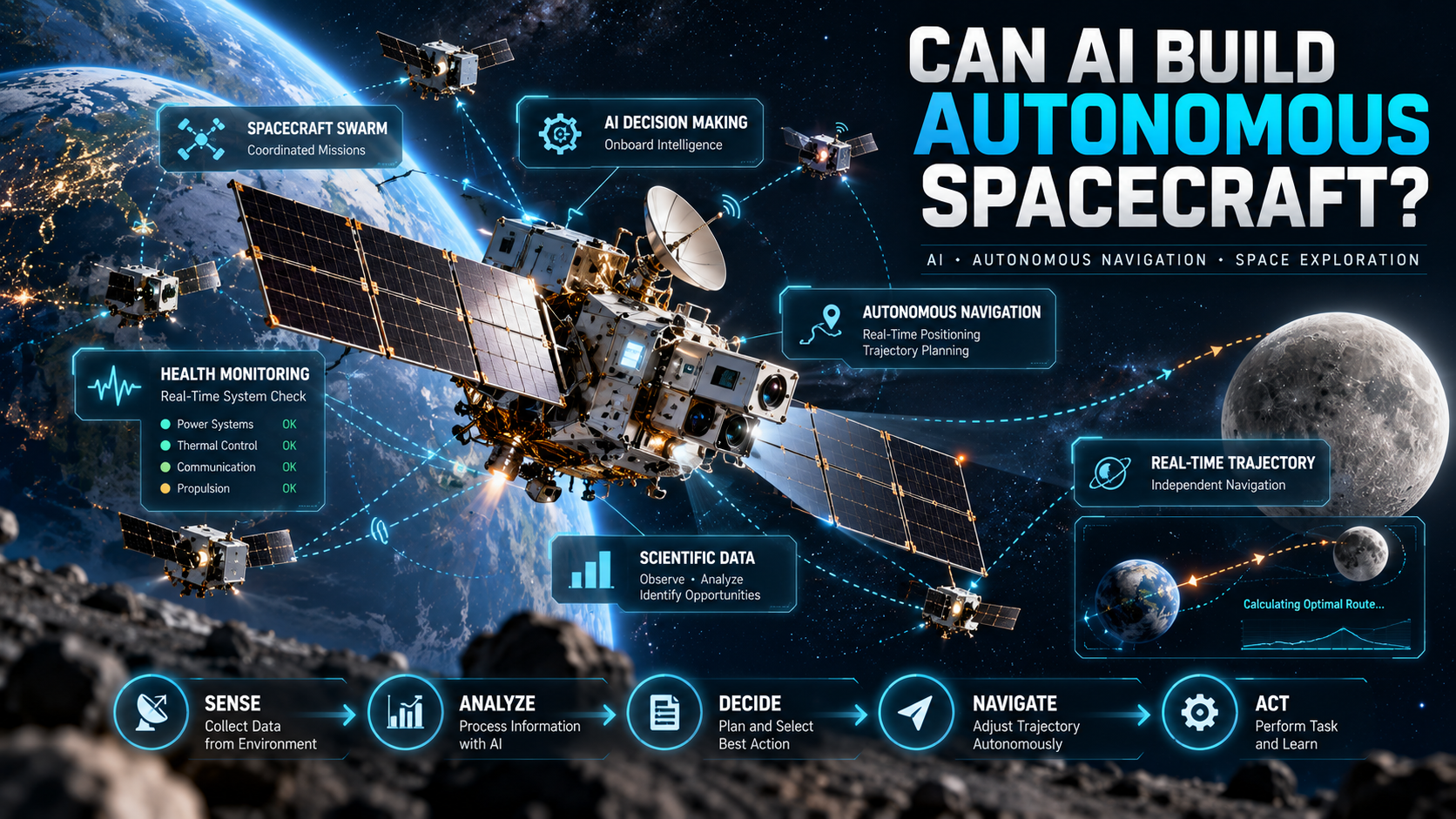
Space exploration is becoming more advanced every year. As spacecraft travel farther from Earth, controlling them from the ground becomes more difficult because communication can take time and sometimes may not be available.
This is where Artificial Intelligence (AI) and autonomous technology can help.
AI can allow spacecraft to understand information from their sensors, make certain decisions, navigate, detect problems, and perform tasks without waiting for instructions from Earth.
NASA is already working on technologies that can make spacecraft more self-reliant. Its AstroNav project, for example, is being developed to help spacecraft determine their position and control their trajectory in real time.
But can AI actually build an entire spacecraft on its own?
The answer is more complicated. AI is becoming an important tool for designing, operating, and controlling spacecraft, but human engineers are still essential for designing systems, testing them, setting safety limits, and managing missions.
🚀 What Is an Autonomous Spacecraft?
An autonomous spacecraft is a spacecraft that can perform certain tasks and make some decisions without receiving instructions from Earth for every individual action.
Traditional spacecraft depend heavily on ground teams. Engineers send commands, receive information, analyze it, and then decide what the spacecraft should do next.
An autonomous spacecraft can perform some of these steps by itself.
A simple autonomous process can look like:
Sense → Understand → Decide → Act → Check
For example, if a spacecraft notices that it is moving away from its planned path, an autonomous system could calculate the difference and determine whether a correction is needed.
NASA’s autoNGC technology is being developed to support onboard navigation, maneuver planning, trajectory correction, and other spacecraft control functions with less dependence on ground operations.
🧠 How Can AI Help Spacecraft?
AI can support many different parts of a space mission.
It can help spacecraft understand sensor information, recognize objects, monitor system health, plan activities, and respond to certain unexpected situations.
The goal is not necessarily to let AI control everything.
Instead, engineers can give the spacecraft specific levels of autonomy and define what it is allowed to do.
This approach can make missions more flexible while keeping important decisions under human supervision.
🛰️ 1. AI Can Help Spacecraft Navigate
Navigation is one of the most important jobs for any spacecraft.
A spacecraft needs to know:
- Where it is
- Where it is going
- How fast it is moving
- What its current trajectory is
- Whether it needs to change direction
For spacecraft traveling far from Earth, relying completely on ground-based navigation can create delays.
NASA’s AstroNav project is designed to help spacecraft determine their position and velocity onboard and plan maneuvers in real time. NASA says the technology is intended for future missions involving the Moon, Mars, and deep space.
This could allow spacecraft to react faster instead of waiting for every navigation update from Earth.
🌌 2. AI Can Help Spacecraft Navigate Without GPS
GPS is extremely useful on Earth, but spacecraft exploring deep space cannot simply depend on Earth’s GPS network.
Instead, autonomous spacecraft can use other information.
For example, they can use:
- Stars
- Planetary bodies
- Cameras
- Optical sensors
- Inertial sensors
- Radio measurements
- Other spacecraft
NASA’s Starling mission has tested GPS-independent navigation using onboard observations of objects in space. The FALCON technology demonstrated how a spacecraft can determine its position using optical observations rather than depending entirely on a navigation network.
This type of technology could become increasingly useful for future lunar and deep-space missions.
🔧 3. AI Can Detect Spacecraft Problems
Spacecraft operate in harsh environments.
A small problem with temperature, power, communication, sensors, or other equipment can become serious if it is not detected quickly.
AI and autonomous software can continuously monitor spacecraft systems.
For example, the system could notice:
Temperature increasing → Something unusual detected → System analyzed → Safety action performed
NASA has been testing event-driven autonomous operations where onboard systems detect specific conditions and trigger predefined actions without waiting for human instructions.
This could help protect spacecraft when communication with Earth is limited.
🛠️ 4. AI Can Help With Automatic Decision-Making
An autonomous spacecraft does not need to receive instructions for every small activity.
Engineers can provide a high-level objective and allow onboard software to handle some of the details.
For example:
Mission Goal: Collect scientific information from an interesting area.
The spacecraft could then decide when to:
- Observe the area
- Use a specific instrument
- Collect data
- Process the information
- Store important results
- Send selected information back to Earth
NASA’s research into increasingly autonomous spacecraft includes onboard planning, scheduling, execution, scientific target selection, and data processing.
This could become especially valuable when communication delays make constant human control difficult.
🤖 5. AI Can Help Spacecraft Work Together
The future of space exploration may not depend only on one large spacecraft.
Instead, many smaller spacecraft could work together.
This idea is known as a spacecraft swarm.
Imagine several small spacecraft working as a team.
One spacecraft could collect measurements.
Another could observe a target.
Another could communicate information between the group and Earth.
AI and autonomous software could help coordinate these activities.
NASA’s Starling mission uses four CubeSats to test autonomous coordination, relative navigation, communications networking, and swarm maneuvering.
🌐 6. What Is a Spacecraft Swarm?
A spacecraft swarm is a group of spacecraft that work together to complete a mission.
Instead of depending completely on one large spacecraft, the mission can distribute work between multiple smaller spacecraft.
For example:
Spacecraft A → Observation
Spacecraft B → Navigation
Spacecraft C → Communication
Spacecraft D → Scientific Measurement
The spacecraft can share information and coordinate their activities.
NASA’s Distributed Spacecraft Autonomy project is exploring how spacecraft swarms can share workloads and make decisions with less human intervention.
This could eventually support missions around the Moon, Mars, and other destinations.
🧪 7. AI Can Help Spacecraft Study Their Environment
Autonomous spacecraft can use cameras and sensors to collect information about their surroundings.
AI can then help analyze that information.
For example, AI could help identify:
- Interesting geological features
- Potential hazards
- Scientific targets
- Other spacecraft
- Planetary surfaces
- Changes in the environment
This can reduce the amount of information that must be sent to Earth for initial analysis.
NASA’s broader AI program includes using AI for space exploration, mission planning, autonomous systems, and scientific research.
🔭 8. AI Could Help Spacecraft Choose Scientific Targets
Imagine a spacecraft exploring an unknown environment.
It discovers something unusual.
Normally, scientists on Earth might need to analyze the information and decide what the spacecraft should investigate next.
With greater autonomy, onboard software could identify interesting information and recommend or perform a predefined response.
NASA’s research is exploring autonomous science systems that can analyze information onboard and help spacecraft respond to new scientific opportunities.
This could allow spacecraft to react faster to discoveries.
🌕 9. Why Is Autonomous Space Technology Important for the Moon and Mars?
The farther spacecraft travel from Earth, the more useful autonomy becomes.
Communication delays can make real-time control difficult.
For missions around the Moon and Mars, autonomous navigation and decision-making can help spacecraft operate more efficiently.
NASA’s CAPSTONE 02 mission, targeted for 2027, is planned to demonstrate technologies including autonomous navigation and cislunar communications using two small spacecraft in lunar orbit.
Future missions could therefore depend increasingly on spacecraft that can handle routine decisions themselves.
🧑🚀 10. Can AI Build a Spacecraft Completely by Itself?
This is where the answer needs some clarification.
AI can help engineers with many parts of spacecraft development.
It can potentially assist with:
- Design optimization
- Engineering calculations
- Simulations
- Software development
- Mission planning
- Navigation algorithms
- Data analysis
- Testing
- Fault detection
But a spacecraft still needs extensive engineering and testing.
Engineers must make sure that the spacecraft can survive:
- Extreme temperatures
- Radiation
- Vibration
- Launch forces
- Limited power
- Communication problems
- Long mission durations
So, today’s realistic model is not:
AI → Builds Everything → Launches Spacecraft
It is closer to:
Human Engineers + AI Tools + Autonomous Software + Spacecraft
🧠 11. Could AI Design Better Spacecraft?
AI could become an important engineering assistant.
Engineers can give an AI system requirements such as:
“Design a spacecraft that uses less power while carrying this scientific instrument.”
The system could explore many possible designs through simulations.
It might compare:
- Weight
- Power consumption
- Structural strength
- Thermal performance
- Communication requirements
- Mission duration
Engineers could then evaluate the designs and select a suitable solution.
This could reduce the time needed to explore large numbers of engineering possibilities.
🪐 12. Could Autonomous Spacecraft Repair Themselves?
Self-repairing spacecraft are still a futuristic idea, but autonomy can already help spacecraft respond to problems.
A future system could follow a process such as:
Problem Detected → Diagnose → Select Safe Response → Execute → Verify
For example, if one component begins behaving abnormally, the spacecraft could switch to a backup component if that action has been approved and programmed into the mission.
More advanced autonomous systems could eventually perform more complex troubleshooting.
However, physical repair of major spacecraft damage would require additional technologies such as robotic manipulators, spare parts, modular components, or servicing spacecraft.
🤝 13. Will AI Replace Space Engineers?
AI is more likely to assist space engineers than completely replace them.
Space missions involve high risks and expensive hardware.
Human engineers still need to decide:
- What the mission should accomplish
- What the spacecraft is allowed to do
- How much autonomy is safe
- How systems should be tested
- What happens when something unexpected occurs
AI can handle many repetitive calculations, monitoring tasks, simulations, and operational decisions.
This means future space teams may work more like:
Human Engineers + AI + Autonomous Spacecraft + Mission Control
⚠️ 14. What Are the Challenges of Autonomous Spacecraft?
Autonomous spacecraft sound exciting, but there are many challenges.
Reliability
A spacecraft may operate millions of kilometers away from Earth.
If something goes wrong, repairing it may be impossible.
Limited Computing Power
Spacecraft have strict limits on power, weight, cooling, and computing hardware.
Advanced AI models cannot simply be run like they are in a large data center.
Radiation
Space radiation can affect electronics and computer systems.
Space hardware must therefore be designed to operate reliably in a harsh radiation environment.
Communication Delays
Deep-space communication can take a long time.
Autonomous systems must be able to operate when Earth is not immediately available.
Safety
AI cannot have unlimited control over a spacecraft.
Engineers need to define safe boundaries and rules for autonomous actions.
Unexpected Situations
Space environments can be unpredictable.
An AI system may encounter a situation that was not included in its training or testing.
This is why validation and human oversight remain important.
🌍 15. AI Is Already Moving Toward More Autonomous Space Missions
Autonomous space technology is not just a future concept.
NASA’s current programs demonstrate several parts of this technology.
Starling has tested autonomous spacecraft coordination and navigation. AstroNav is being developed for real-time autonomous navigation, while autoNGC supports autonomous navigation and maneuver planning.
NASA also recently field-tested an AI-based robotic fleet that could choose tasks, assess risks, adapt to new information, and report results to human managers. Although this was an Earth-based planetary-analog test rather than an actual space mission, it demonstrates the type of autonomous science-team behavior researchers are exploring for future missions.
🚀 16. What Will Autonomous Spacecraft Look Like in the Future?
Future spacecraft could become much more independent.
Instead of Earth sending instructions for every individual action, mission teams could provide broader objectives and safety rules.
The spacecraft could then perform many routine activities itself.
A future mission might work like this:
Mission Goal → Observe → Analyze → Plan → Navigate → Act → Check → Report
Multiple spacecraft could also work together as a team.
This could support:
- Lunar exploration
- Mars exploration
- Asteroid missions
- Deep-space science
- Satellite servicing
- Space telescopes
- Spacecraft swarms
- Autonomous navigation
- Scientific discovery
🌟 Conclusion: Can AI Build Autonomous Spacecraft?
So, can AI build autonomous spacecraft?
AI is not yet independently designing, manufacturing, testing, launching, and operating complete spacecraft without human involvement.
But AI and autonomous software are already changing how spacecraft can operate.
Modern research is moving toward spacecraft that can navigate, monitor their health, make certain decisions, coordinate with other spacecraft, and respond to selected situations without waiting for instructions from Earth.
The future of space exploration may therefore not be about humans controlling every action.
Instead, it could be about humans setting goals and safety boundaries while intelligent spacecraft handle more decisions locally.
That could make future missions to the Moon, Mars, asteroids, and deep space more flexible, responsive, and capable.
