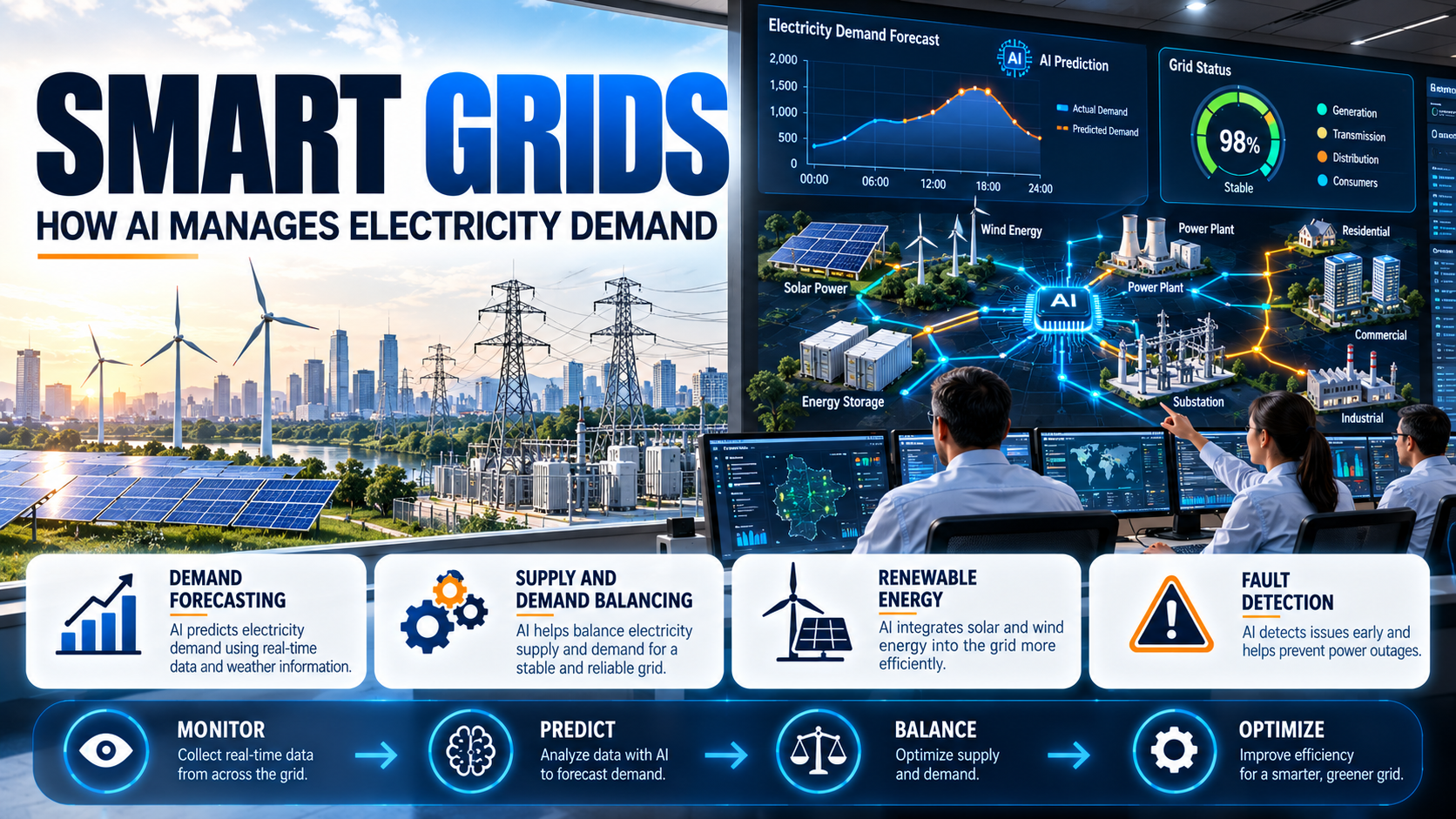
Electricity is an essential part of everyday life. Homes, offices, factories, hospitals, and transportation systems all depend on a reliable supply of power. However, electricity demand changes throughout the day. For example, demand often increases when people return home, switch on air conditioners, and use multiple electrical appliances.
Managing these changing needs can be challenging for electricity providers. This is where smart grids and Artificial Intelligence (AI) can help.
A smart grid is an electricity network that uses digital technology, sensors, communication systems, and automated controls to manage electricity more effectively. AI can analyze information from this network to help predict demand, identify problems, and improve how electricity is distributed.
By combining smart grids with AI, electricity providers can work toward a more reliable, efficient, and flexible power system.
2. What Is a Smart Grid?
A smart grid is a modern electricity network that uses digital technologies to monitor and manage the movement of electricity between power stations and consumers.
Traditional electricity networks mainly deliver electricity from power plants to homes and businesses. Smart grids add digital communication and monitoring systems that help electricity providers understand what is happening across the network.
For example, smart meters can measure electricity consumption and send readings to the electricity provider. Sensors can monitor parts of the network, while automated equipment can help detect faults and adjust electricity distribution.
These technologies give electricity providers better information about supply, demand, and network conditions. They can then use this information to make more informed decisions and improve service reliability.
3. What Is AI in Smart Grids?
Artificial Intelligence allows computer systems to analyze data, recognize patterns, and make predictions based on the information they receive.
In a smart grid, AI can process information from smart meters, weather forecasts, electricity generators, sensors, and other connected systems.
For example, an AI system may analyze previous electricity usage and weather conditions to predict how much electricity people will need on a hot afternoon.
Electricity providers can use these predictions to plan their resources and prepare for periods of high demand.
AI does not manage every smart grid automatically. In many applications, it provides forecasts, recommendations, or alerts that support decisions made by grid operators.
4. How AI Helps Manage Electricity Demand
4.1 Predicting Electricity Demand
One of the most useful applications of AI in smart grids is electricity demand forecasting.
Demand forecasting means estimating how much electricity consumers will need at a particular time. AI models can analyze historical usage, temperature, weather conditions, holidays, and other relevant information to make these predictions.
For example, electricity demand may increase during a heatwave because more people use air conditioners. An AI forecasting system can identify this pattern and help the electricity provider prepare for higher consumption.
Better forecasts can help providers plan electricity generation, manage available resources, and reduce the risk of supply shortages.
4.2 Balancing Electricity Supply and Demand
Electricity providers must ensure that enough power is available to meet changing demand while maintaining the stability of the grid.
AI can help operators understand where demand is increasing and which resources may be available to meet it.
For example, if electricity demand rises in the evening, grid operators may need to coordinate power generation, stored electricity, and other available resources.
AI-based analysis can help evaluate these options and support decisions about how electricity should be supplied across the network.
4.3 Managing Peak Electricity Demand
Peak demand refers to the period when electricity consumption reaches a high level.
In many areas, peak demand can place additional pressure on power stations, transmission lines, and distribution equipment.
AI can help predict when these periods are likely to occur. Electricity providers can then prepare by coordinating available resources, managing flexible electricity consumption, or encouraging consumers to shift certain activities to less busy periods.
For example, some compatible electric vehicle chargers can schedule charging during off-peak hours when electricity demand is lower.
This can help reduce pressure on the grid, although the actual benefits depend on local infrastructure and how demand-management programs are designed.
4.4 Integrating Solar and Wind Energy
Solar panels and wind turbines generate electricity based on weather conditions. Solar generation can fall when clouds cover the sun, while wind generation changes with wind speed.
These variations can make it more difficult to match electricity supply with demand.
AI can analyze weather forecasts and historical generation data to estimate how much renewable electricity may be available.
Grid operators can use these estimates to plan other power sources, coordinate energy storage, and manage changing electricity supply.
This helps support the integration of renewable energy into modern electricity networks.
4.5 Detecting Faults and Preventing Outages
Power grids contain transformers, cables, substations, and other equipment that must operate reliably.
AI systems can analyze sensor readings and equipment performance data to identify unusual patterns that may indicate a developing problem.
For example, an unexpected change in temperature or equipment behavior may signal that a component needs inspection.
This approach is known as predictive maintenance. It helps maintenance teams identify possible issues before equipment fails, although AI predictions cannot prevent every outage.
Smart grid systems can also use sensors and automated controls to help locate faults and support faster restoration of electricity.
5. Important Technologies Used in AI-Powered Smart Grids
5.1 Smart Meters
Smart meters measure electricity consumption and can communicate readings to electricity providers. They help improve consumption monitoring and provide more detailed information about how and when electricity is used.
This information can support demand forecasting, billing, and certain energy-management programs.
5.2 Internet of Things Sensors
The Internet of Things (IoT) connects physical devices that collect and exchange data.
In smart grids, sensors can monitor conditions such as voltage, current, temperature, and equipment performance. AI can analyze this information to help operators understand the condition of the network.
5.3 Machine Learning
Machine learning is a type of AI that identifies patterns in data and uses them to make predictions or classifications.
In electricity networks, machine learning can help forecast demand, estimate renewable energy generation, detect unusual consumption patterns, and support equipment maintenance.
Its accuracy depends on the quality of the data and how well the model represents real-world conditions.
5.4 Energy Storage Systems
Battery storage systems can store electricity when it is available and release it when needed.
For example, electricity generated by solar panels during the day may be stored in a battery and used later when solar production decreases.
AI can help estimate when to charge or discharge compatible storage systems based on expected demand, electricity availability, and operating requirements.
5.5 Automated Grid Controls
Modern electricity networks can use automated switches, control systems, and communication technologies to respond to changing conditions.
AI can provide information or recommendations that help operators decide how to manage electricity flows. Depending on the system, some responses may be automated under predefined safety rules.
These controls can help improve network flexibility and support faster responses to certain problems.
6. Real-World Applications of Smart Grids
6.1 Smart Electricity Distribution
Electricity distribution companies can use smart meters, network sensors, and analytical software to understand consumption patterns and identify operational problems.
In India, smart grid initiatives include smart metering and peak-load management technologies. These systems can help utilities monitor electricity consumption and manage demand according to available supply. <a href=”https://www.nsgm.gov.in/en/sg-technologies“>Learn more from India’s National Smart Grid Mission.</a>
6.2 Renewable Energy Management
Electricity providers can use AI-supported forecasts to estimate solar and wind generation and plan for changes in renewable supply.
This is particularly useful as electricity networks connect more renewable energy sources, whose output can change with weather conditions.
6.3 Electric Vehicle Charging
As more electric vehicles connect to the grid, charging demand can become an important part of electricity planning.
Smart charging systems can schedule charging based on user requirements, grid conditions, and available electricity. AI may help forecast charging demand and coordinate flexible charging where supported.
6.4 Industrial Energy Management
Factories and commercial buildings often use large amounts of electricity. Smart meters and energy-management software can help businesses understand their consumption patterns.
AI can analyze this information and suggest opportunities to reduce unnecessary consumption, schedule flexible equipment use, and improve energy efficiency.
7. Benefits of AI-Powered Smart Grids
7.1 More Reliable Electricity Supply
Better demand forecasts and improved monitoring can help electricity providers prepare for changing conditions. Fault detection and automated controls may also support faster responses to certain network problems.
7.2 Improved Energy Efficiency
AI can help identify patterns of electricity use and opportunities to reduce waste. More effective planning can also help providers use available generation, storage, and network capacity efficiently.
7.3 Better Integration of Renewable Energy
AI-assisted forecasting helps operators prepare for changing solar and wind generation. This can make it easier to coordinate renewable electricity with other available resources.
7.4 Improved Maintenance Planning
By identifying unusual equipment behavior, AI can help maintenance teams prioritize inspections and repairs. This may reduce unexpected equipment failures and unnecessary maintenance work.
7.5 Better Information for Consumers
Smart meters and compatible energy-management applications can give consumers clearer information about their electricity consumption.
With appropriate programs and tools, consumers may be able to identify high-consumption periods and adjust some activities to reduce energy use or electricity costs.
8. Challenges of Using AI in Smart Grids
8.1 Data Privacy
Smart meters can collect detailed information about electricity consumption. Depending on how frequently readings are recorded, this information may reveal patterns about when a building is occupied or which appliances are used.
Utilities must protect consumer data and follow applicable privacy requirements.
8.2 Cybersecurity Risks
Smart grids depend on digital communication and connected equipment. Poorly secured systems can create opportunities for cyberattacks.
Electricity providers need strong access controls, secure communication, software updates, and continuous security monitoring to protect critical infrastructure.
8.3 High Implementation Costs
Smart meters, sensors, communication networks, energy storage, and AI software require investment.
Utilities may also need to upgrade existing infrastructure and train employees. The cost and expected benefits should be evaluated before deploying new systems.
8.4 Inaccurate Predictions
AI models rely on data and assumptions. Unexpected weather, equipment failures, sudden changes in consumption, or poor-quality data can reduce prediction accuracy.
Grid operators must monitor system performance and maintain backup plans for situations that AI models do not predict correctly.
8.5 Integration With Older Infrastructure
Some electricity networks use equipment that was installed before modern digital technologies became common.
Connecting new smart grid systems to older infrastructure can require additional engineering, compatible communication standards, and careful testing.
9. The Future of AI and Smart Grids
As electricity demand changes and renewable energy becomes more widely connected to power networks, smart grids will play an important role in electricity planning and management.
AI may help improve demand forecasting, analyze network conditions, support predictive maintenance, and make better use of existing grid capacity.
The International Energy Agency’s 2026 report on modernizing electricity grids highlights the role of digital technologies, including AI, in improving forecasting, optimization, resilience, and the use of existing network infrastructure. <a href=”https://www.iea.org/reports/modernising-grids-in-the-age-of-electricity“>Read the IEA report.</a>
Future systems may also coordinate smart buildings, electric vehicle charging, battery storage, and renewable energy more effectively.
However, AI alone cannot solve every electricity challenge. Reliable power networks also require suitable infrastructure, skilled operators, cybersecurity protections, effective regulations, and investment in generation and transmission capacity.
Conclusion: Building a Smarter Electricity Network
Smart grids are helping modernize the way electricity is monitored, distributed, and managed. By combining digital sensors, smart meters, communication systems, and AI, electricity providers can better understand demand and respond to changing network conditions.
AI can support electricity demand forecasting, peak-load management, renewable energy integration, and equipment maintenance. These applications can help improve efficiency and reliability when they are implemented correctly.
At the same time, smart grids must address challenges such as cybersecurity, data privacy, implementation costs, and prediction errors.
The future of electricity management will depend on combining intelligent software with reliable infrastructure and human expertise. AI-powered smart grids are an important step toward a more flexible and efficient energy system.
