Artificial intelligence is becoming more powerful every year. AI models are getting larger, and companies are using thousands of GPUs and other processors to train and run them.
But there is a problem.
AI processors do not work alone. They constantly need to exchange huge amounts of data with other processors, memory, storage systems, and network switches.
As AI data centers become larger, moving this data quickly and efficiently is becoming a major engineering challenge.
This is where silicon photonics could become important.
Silicon photonics uses light to move data instead of relying only on traditional electrical connections. Engineers are exploring this technology to increase bandwidth and improve the efficiency of AI data-center connections.
What Is Silicon Photonics?
Silicon photonics is a technology that combines silicon chips with optical communication.
In simple words, it allows engineers to use tiny optical components on or near silicon chips to send information using light.
Traditional electronic systems mainly move information using electrical signals.
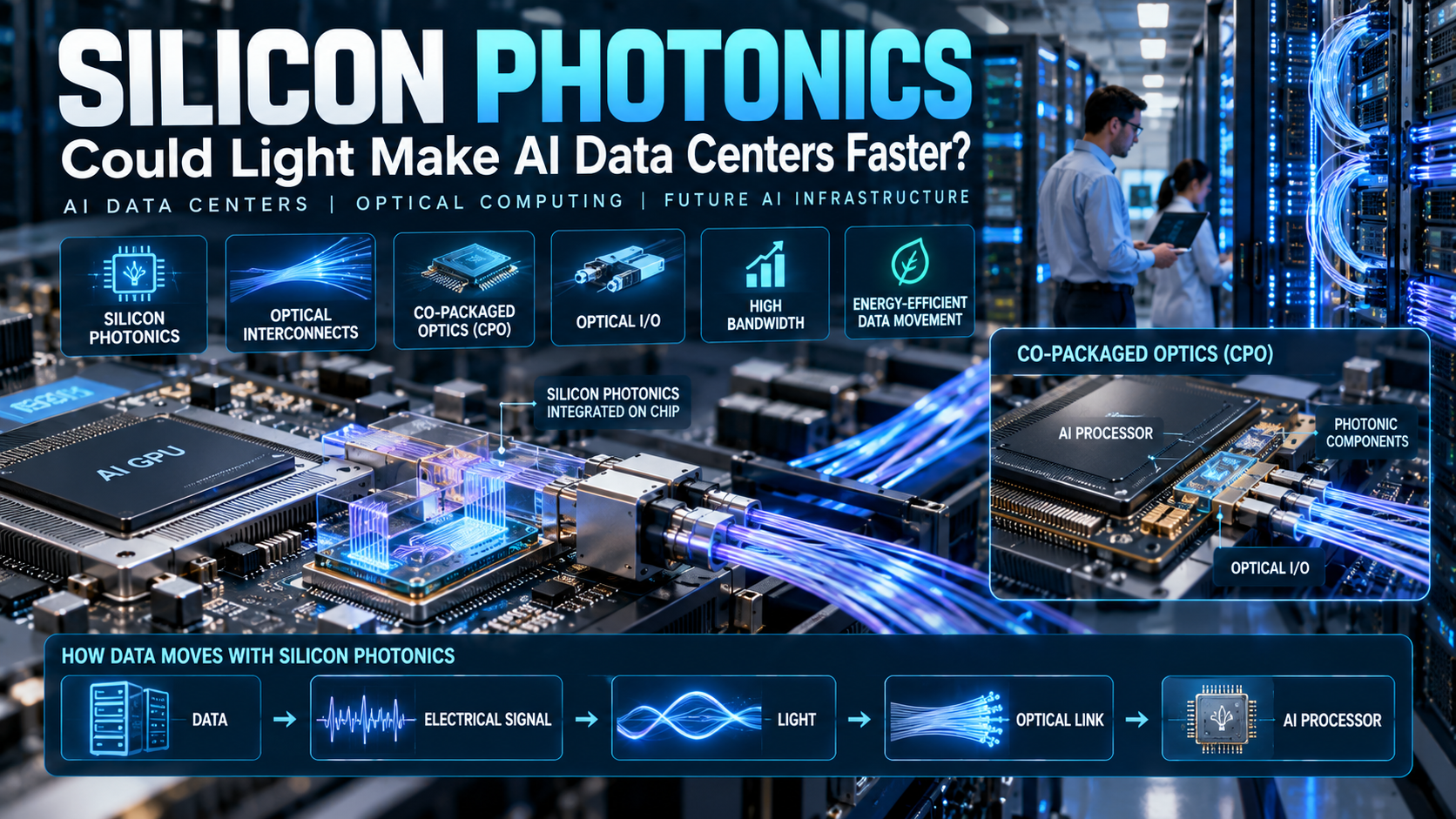
Silicon photonics can convert electrical information into light, send that information through an optical connection, and then convert it back into an electrical signal when needed.
A simple example is:
Electrical Data → Light Signal → Optical Connection → Electrical Data
This makes silicon photonics especially interesting for systems that need to move huge amounts of data.
Why Is Light Important for AI?
Modern AI systems process enormous amounts of information.
Imagine a data center containing thousands of GPUs. These GPUs may need to communicate with each other while training a large AI model.
The faster the processors become, the more important their connections become.
If processors can calculate very quickly but have to wait for data to arrive, some of their computing power may not be fully used.
This creates a new challenge:
Faster AI chips need faster ways to communicate.
Optical connections can provide very high bandwidth and can be useful for moving data across AI infrastructure. Research published in 2026 highlights optical interconnects as a potential solution to bandwidth, energy and signal-quality limitations in large AI and high-performance computing systems.
How Does Silicon Photonics Work?
The basic idea is easier than it sounds.
First, electronic information is prepared by the computer.
Then an optical component converts that information into a signal carried by light.
The light travels through an optical path, such as a fiber or an integrated optical waveguide.
At the other end, the optical signal is detected and converted back into an electrical signal.
The simplified process looks like this:
Data → Electrical Signal → Light → Optical Link → Light Detection → Data
Silicon photonics uses components such as optical waveguides, modulators, photodetectors and other photonic elements to perform these operations.
Is Silicon Photonics Faster Than Copper?
The answer needs some explanation.
It is not simply correct to say that light is faster than electricity and therefore every optical connection is automatically faster.
The bigger advantage is how much data can be moved efficiently.
Electrical connections become increasingly difficult to scale as bandwidth and distance increase. Signal loss, power consumption and signal-quality problems can become more challenging.
Optical connections can offer high bandwidth and lower transmission loss over suitable distances.
This is why engineers are increasingly considering optics for connections between AI processors, switches, memory systems and other components.
Why Are AI Data Centers Creating This Problem?
AI workloads are different from many traditional computing workloads.
A large AI model may be divided across many GPUs or accelerators.
Those processors constantly exchange information.
For example:
GPU → GPU → GPU → Memory → Network → GPU
As the number of processors increases, the amount of data moving between them also increases.
This means the data center needs not only powerful processors but also extremely fast connections.
In other words:
More AI Computing = More Data Movement
And that is one reason optical technology is receiving more attention.
What Is an Optical Interconnect?
An optical interconnect is a connection that uses light to transfer data between computing components.
Think of it as a high-speed communication road for data.
Instead of sending information only as electrical signals through copper traces, an optical interconnect can use light.
Optical interconnects can be used for communication between:
- GPUs
- CPUs
- AI accelerators
- Network switches
- Memory systems
- Servers
- Data-center racks
The industry is increasingly exploring optical connections deeper inside AI infrastructure as bandwidth requirements continue to grow.
What Is Co-Packaged Optics?
One of the most important ideas connected to silicon photonics is Co-Packaged Optics, or CPO.
Traditionally, optical components can sit separately from the main processor or networking chip.
CPO brings optical components much closer to the electronic chip.
The basic idea is:
Electronic Chip + Optical Components = One Closely Integrated System
Why does this matter?
Because shorter electrical connections can reduce some of the problems associated with moving extremely high-speed signals through copper.
Research published in 2026 describes CPO as a promising approach for addressing bandwidth, power and scalability challenges in AI and high-performance computing.
Why Does CPO Matter for AI?
AI processors are becoming extremely powerful.
But adding faster processors also creates greater communication requirements.
CPO tries to bring the optical connection closer to the processor so that large amounts of data can move efficiently between computing and networking components.
A simplified example is:
AI Processor → Optical Engine → Optical Network
Instead of forcing a very high-speed electrical signal to travel a longer distance first, the system can convert the data to an optical signal closer to the chip.
Could Silicon Photonics Reduce Data Center Power Consumption?
It could help, especially for high-bandwidth connections.
Moving data requires energy.
As AI data centers become larger, the energy required for communication can become an important part of the overall system.
Optical technologies such as silicon photonics and CPO are being developed partly to improve the amount of data that can be transferred for the available power.
However, silicon photonics will not solve the entire data-center energy problem.
GPUs, CPUs, memory, cooling systems, power supplies and other equipment will continue to consume significant energy.
So the goal is not:
Silicon Photonics = No More Power Problems
Instead, it is:
Better Optical Connections = Potentially More Efficient Data Movement
Could Silicon Photonics Make AI Training Faster?
It could help, but silicon photonics does not replace powerful GPUs.
AI training requires both computation and communication.
If processors spend less time waiting for data to move between them, the overall system can potentially use its computing resources more efficiently.
The simplified idea is:
Faster Data Movement → Less Communication Bottleneck → Better Hardware Utilization → Potentially Faster AI Workloads
The actual improvement depends on the complete system design, including processors, memory, networking, software and optical connections.
What About AI Inference?
Silicon photonics could also become important for AI inference.
Inference happens when an AI model processes a request and produces an answer.
Large AI services may need to handle huge numbers of inference requests.
These systems need:
- High bandwidth
- Low latency
- Efficient networking
- High computing capacity
- Efficient power usage
Optical connections could help data centers handle communication between processors and networking systems as AI inference workloads grow.
What Is Optical I/O?
Optical I/O means using optical communication directly around computing systems.
Instead of keeping optical connections only at the edge of a server or network, engineers are working toward bringing optical communication much closer to processors.
A future architecture could look something like:
CPU ↔ Optical I/O ↔ AI Accelerator ↔ Optical I/O ↔ Memory
This approach could help connect powerful processors while reducing some of the limitations of long electrical connections.
Could Light Eventually Connect AI Chips Directly?
This is one of the most interesting possibilities.
Future AI systems may use optical connections between chips, processors, switches and memory.
Instead of thinking about a data center as a collection of separate computers, engineers could design it as a large connected computing system.
The architecture could become:
AI Chips + Memory + Photonics + Networking + Advanced Packaging
This is particularly important as AI clusters continue to scale.
Silicon Photonics vs Traditional Electrical Connections
| Feature | Traditional Electrical Connections | Silicon Photonics |
|---|---|---|
| Signal | Electrical | Optical |
| Main technology | Copper/electrical traces | Light and optical components |
| Bandwidth potential | High | Very high |
| Power challenge at high speeds | Can become significant | Can potentially improve efficiency |
| Long-distance communication | More challenging | Well suited to optical links |
| Technology maturity | Very mature | Rapidly developing |
| Manufacturing | Highly established | More complex |
| AI data-center role | Already widely used | Growing |
The important point is that silicon photonics is not expected to replace every electrical connection.
Both technologies can be useful depending on the distance, speed, cost and system requirements.
What Are the Biggest Challenges?
Silicon photonics has major potential, but engineers still need to solve several problems.
Manufacturing Complexity
Combining electronic and optical components can make manufacturing more complicated.
Thermal Management
AI chips already produce significant heat.
Optical components must work reliably in these high-performance environments.
Packaging
Very small optical components need to be positioned and connected accurately.
Advanced packaging is therefore extremely important.
Laser Integration
Optical communication needs light sources such as lasers.
Integrating and managing these components efficiently remains an engineering challenge.
Cost
Silicon photonics needs to become cost-effective enough for large-scale deployment.
Standardization
Different companies and systems need compatible technologies and standards so that optical components can work together.
Research on CPO highlights thermal management, manufacturing and standardization as important challenges before optical compute interconnects can become a more widespread foundation of AI infrastructure.
Is Silicon Photonics Already Being Used?
Yes.
Optical communication is already widely used in data centers and telecommunications.
What is changing is how deeply optical technology is being integrated into AI infrastructure.
The industry is moving beyond traditional optical transceivers toward approaches such as:
- Silicon photonics
- Linear-drive optics
- Co-packaged optics
- Near-package optics
- Optical I/O
- Optical switching
These technologies are being explored to handle the growing bandwidth requirements of AI systems.
Why Are Companies Investing in Silicon Photonics?
AI data centers need to move more information than ever.
This is creating demand for technologies that can provide:
Higher Bandwidth + Better Efficiency + Greater Scalability
Recent industry activity also shows increasing demand for photonics-related components used in AI data-center connectivity. Reuters reported in August 2026 that demand for photonics silicon-on-insulator wafers was rising as hyperscalers increased their use of optical connections in AI infrastructure.
Will Silicon Photonics Replace Copper?
Probably not everywhere.
Copper connections are mature, widely available and still useful for many applications.
The more likely future is a combination of technologies.
For example:
Short, simpler connections → Electrical
High-bandwidth connections → Optical
Longer connections → Optical Fiber
High-density AI systems → Silicon Photonics + CPO
This mixed approach could allow engineers to use the right technology for each part of the data center.
How Could Silicon Photonics Change Future Data Centers?
Future AI data centers may look very different from today’s traditional server rooms.
Instead of focusing only on faster processors, engineers will also need to improve the connections between those processors.
A future AI infrastructure stack could include:
AI GPUs → High-Bandwidth Memory → Optical I/O → Silicon Photonics → CPO → Optical Network
This could allow AI systems to scale while reducing some of the communication bottlenecks created by traditional electrical connections.
Silicon Photonics and AI Hardware
AI hardware is becoming more than just GPUs.
Modern AI infrastructure can include:
- GPUs
- AI accelerators
- CPUs
- High-bandwidth memory
- Chiplets
- Advanced packaging
- Network switches
- Silicon photonics
- Optical interconnects
These technologies need to work together.
That means the future of AI hardware may depend not only on making chips faster, but also on making the connections between chips smarter and more efficient.
Could Light Become a Key Part of AI Computing?
The future of computing may combine electronics and photonics.
A simple way to understand the division is:
Silicon → Computing
Photonics → High-Speed Communication
AI → Intelligent Processing
Advanced Packaging → Integration
This does not mean computers will stop using electronics.
Instead, electronics and photonics could work together to create faster and more scalable computing systems.
Why Is Silicon Photonics Important in 2026?
AI data centers are expanding rapidly, and the industry is facing growing challenges around bandwidth, power and physical scaling.
That makes data movement increasingly important.
Recent research and industry developments in 2026 show strong attention toward silicon photonics, CPO and optical compute interconnects as possible solutions for future AI infrastructure.
The important shift is this:
AI performance is no longer only about how fast a chip can calculate.
It is also about:
How quickly can the system move information between those chips?
So, Could Light Make AI Data Centers Faster?
Yes, light could help make AI data centers faster and more efficient, especially by improving how huge amounts of data move between processors and networking systems.
But silicon photonics is not a magic replacement for GPUs, memory or electrical connections.
Its real value is in helping solve the growing data-movement problem.
As AI models become larger and AI data centers become more powerful, technologies such as silicon photonics, optical I/O and co-packaged optics could become increasingly important.
The future may not simply be about building bigger computers.
It may be about building computers that can communicate faster with each other.
Conclusion
Silicon photonics brings together two important technologies: silicon electronics and light-based communication.
For AI data centers, this combination could help address growing bandwidth and data-movement challenges.
Co-packaged optics and optical I/O are taking this idea even further by bringing optical communication closer to AI processors.
There are still challenges involving manufacturing, packaging, thermal management, cost and standards.
But as AI systems continue to grow, moving data efficiently will become just as important as processing it.
The next big improvement in AI data centers may not come only from faster chips. It could also come from using light to connect them.
