The growth of e-commerce, online grocery shopping, and food delivery has changed how products reach customers. People now expect deliveries to be faster, more convenient, and increasingly reliable. However, delivering a package from a local warehouse or distribution centre to the customer’s doorstep remains one of the most challenging parts of the logistics process.
This final stage is known as last-mile delivery.
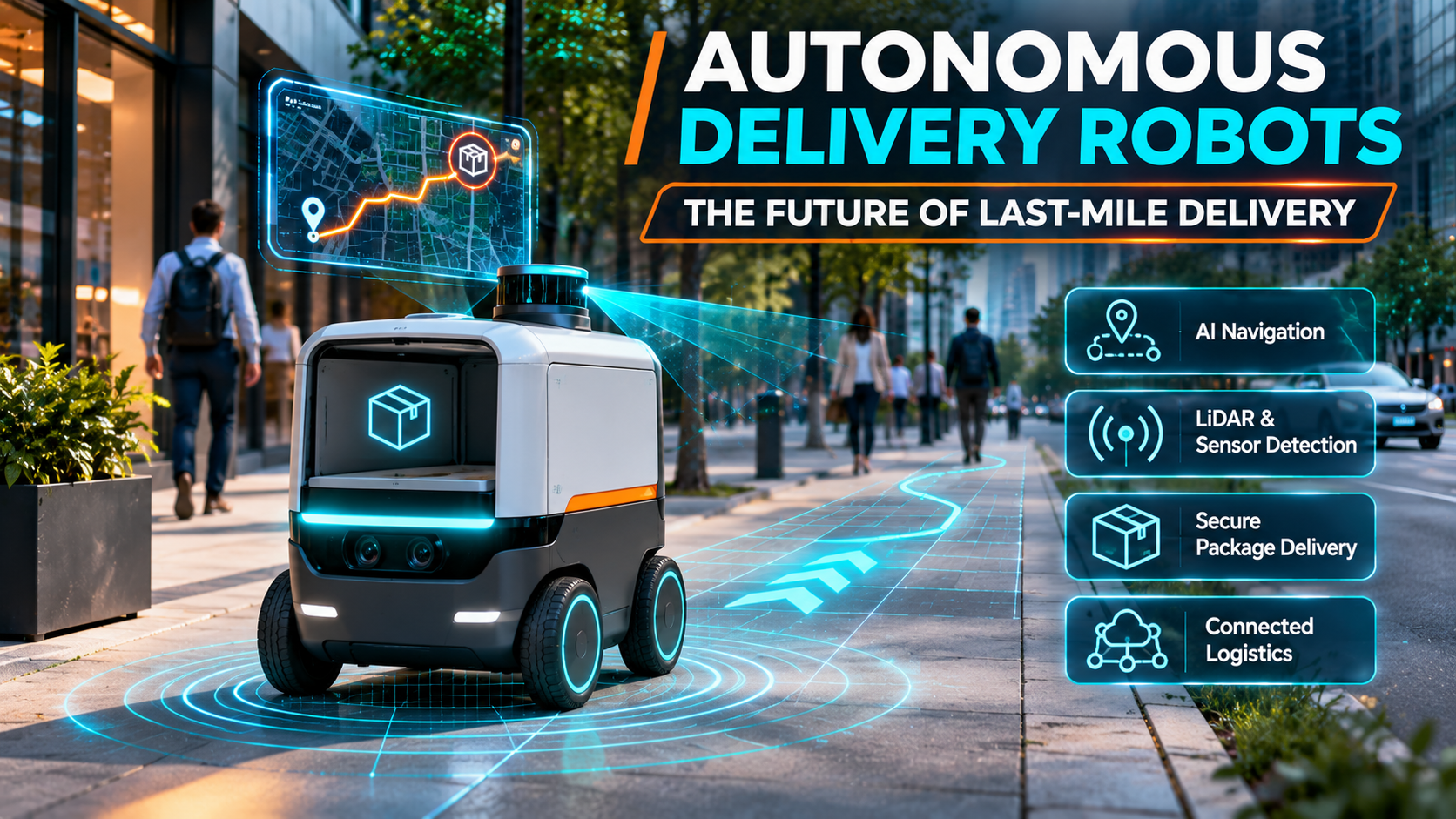
To make this process more efficient, logistics companies and technology developers are exploring autonomous delivery robots. These small, self-driving machines can travel along approved routes, navigate around obstacles, and transport packages to customers with limited human intervention.
Powered by artificial intelligence (AI), cameras, sensors, GPS, and advanced navigation systems, autonomous delivery robots are becoming an important innovation in modern logistics.
But how do these robots work? Where are they being used, and can they really transform the future of delivery?
Let’s explore.
What Are Autonomous Delivery Robots?
Autonomous delivery robots are self-driving robotic vehicles designed to transport goods from one location to another without requiring a human driver to control every movement.
They are generally compact, battery-powered vehicles equipped with wheels, storage compartments, cameras, sensors, and intelligent navigation software.
These robots can be used to deliver:
- Food and restaurant orders
- Grocery products
- E-commerce packages
- Medicines and healthcare supplies
- Documents and small business items
- Internal goods between buildings or facilities
Unlike traditional delivery vehicles, many sidewalk delivery robots operate at relatively low speeds and are designed for short-distance journeys.
They can travel through designated pedestrian areas, university campuses, residential communities, business parks, and other approved environments.
How Do Autonomous Delivery Robots Work?
Autonomous delivery robots combine several technologies to understand their surroundings, select routes, avoid obstacles, and complete deliveries.
Here is how the process generally works.
1. Order Placement
The process begins when a customer places an order through a website, mobile application, or delivery platform.
The order is received by the business or logistics management system. Once the package is ready, the system assigns it to an available delivery robot.
2. Package Loading
The package is placed inside the robot’s secure storage compartment.
Some robots have electronically locked compartments that can only be opened by an authorised customer using a mobile application, PIN, or verification process.
3. Route Planning
The robot receives its delivery destination and calculates a suitable route.
GPS, digital maps, and navigation algorithms help it identify the destination and follow an approved path.
Depending on the operating environment, it may also use local mapping and positioning technologies to improve navigation.
4. Obstacle Detection
While moving, the robot continuously observes its surroundings.
It uses cameras, ultrasonic sensors, radar, or LiDAR to detect objects such as:
- Pedestrians
- Vehicles
- Walls and buildings
- Road barriers
- Other robots
- Unexpected obstacles
Its navigation software processes this information and adjusts its movement when necessary.
5. Autonomous Navigation
Artificial intelligence and robotics software help the robot make movement decisions.
It can slow down, stop, avoid obstacles, or select an alternative route depending on the environment and its safety rules.
Some systems also allow remote operators to monitor robot activity and provide assistance when required.
6. Customer Notification and Delivery
When the robot reaches the destination, the customer receives a notification.
The customer can unlock the storage compartment through an application or another verification method and collect the package.
After the delivery is completed, the robot can receive another assignment or return to its charging or collection station.
Key Technologies Behind Autonomous Delivery Robots
Autonomous delivery robots depend on multiple technologies working together. Each technology performs a specific role in making deliveries safer and more efficient.
1. Artificial Intelligence and Machine Learning
AI helps robots understand their surroundings and make decisions based on sensor information.
Machine learning models can support object recognition, pedestrian detection, route planning, and navigation.
For example, an AI-powered robot can identify a person crossing its path and stop before continuing its journey.
2. GPS and Navigation Systems
GPS helps determine the robot’s approximate geographical location.
Combined with digital maps and other positioning technologies, it helps robots identify their routes and reach delivery destinations.
GPS alone may not provide sufficient accuracy in every environment, particularly around tall buildings or covered areas. Therefore, robots may combine it with cameras, sensors, and local positioning systems.
3. LiDAR Sensors
LiDAR stands for Light Detection and Ranging.
It uses laser pulses to measure distances and generate information about surrounding objects.
LiDAR can help robots detect obstacles, understand nearby structures, and build a three-dimensional representation of their environment.
4. Cameras and Computer Vision
Cameras capture visual information from the robot’s surroundings.
Computer vision software processes these images to identify pedestrians, vehicles, traffic signs, road boundaries, and other objects.
This allows robots to understand their environment and respond to changing conditions.
5. Ultrasonic and Other Proximity Sensors
Ultrasonic sensors use sound waves to detect nearby objects.
They can support short-range obstacle detection and help robots maintain a safe distance from objects.
Different robots may also use radar, infrared, or other proximity sensors depending on their design.
6. Internet of Things (IoT)
IoT connectivity allows delivery robots to exchange information with cloud platforms, logistics systems, mobile applications, and monitoring dashboards.
Businesses can use these connections to monitor robot locations, delivery progress, battery levels, and operational status.
Types of Autonomous Delivery Robots
Autonomous delivery robots come in different designs depending on the type of goods they transport and the environment in which they operate.
1. Sidewalk Delivery Robots
These are small, wheeled robots designed to travel through approved sidewalks and pedestrian areas.
They are commonly associated with food, grocery, and small-package delivery.
2. Campus Delivery Robots
Campus delivery robots operate in controlled or semi-controlled environments such as universities, hospitals, and corporate campuses.
They can transport meals, documents, medicines, and other items between buildings.
3. Indoor Delivery Robots
Indoor delivery robots are designed to operate inside buildings.
They can be used in hotels, hospitals, offices, warehouses, and shopping centres to move products between departments or directly to customers.
4. Autonomous Mobile Robots for Logistics
Larger autonomous mobile robots can transport goods inside warehouses, distribution centres, and industrial facilities.
Although they may not always perform doorstep delivery, they can automate important parts of the logistics process.
5. Refrigerated Delivery Robots
Some delivery applications require temperature-controlled transportation.
Specialised robots can be designed with insulated or refrigerated compartments to transport groceries, food, and selected healthcare products.
Their suitability depends on temperature requirements, journey duration, and operating conditions.
Real-World Applications of Autonomous Delivery Robots
Autonomous delivery robots can support several industries where short-distance transportation is required.
1. Food and Restaurant Delivery
Restaurants and food delivery platforms can use robots to transport meals over short distances.
For example, a robot could collect an order from a restaurant and deliver it to a customer in a nearby residential community or campus.
2. E-Commerce and Parcel Delivery
Online shopping creates a continuous demand for package transportation.
Autonomous robots can help deliver smaller parcels from local distribution points to nearby customers, particularly in suitable urban and residential environments.
3. Grocery and Retail Delivery
Supermarkets and local stores can use delivery robots to transport groceries and everyday products.
This can support quick-commerce services and provide another delivery option for customers.
4. Healthcare and Hospital Logistics
Hospitals require regular transportation of medicines, documents, laboratory samples, and medical supplies.
Indoor autonomous robots can help move these items between departments, reducing the need for staff to perform every routine transportation task manually.
Medical use cases require appropriate safety, hygiene, tracking, and handling procedures.
5. Hotels and Hospitality
Hotels can use indoor delivery robots to transport towels, toiletries, food, and other guest requirements.
This can help staff manage repetitive delivery tasks while focusing on guest services.
6. Warehouses and Distribution Centres
Robots can move packages, containers, and inventory between storage areas, sorting stations, and dispatch points.
This improves coordination between warehouse operations and the final delivery process.
Benefits of Autonomous Delivery Robots
Autonomous delivery robots offer several potential advantages for businesses and customers.
1. Reduced Delivery Costs
For suitable routes and delivery volumes, robots may reduce some recurring labour and transportation expenses.
However, the overall cost also depends on robot purchase or leasing, maintenance, charging, monitoring, insurance, and regulatory compliance.
2. Faster Local Deliveries
Robots can support short-distance deliveries within campuses, residential communities, and other suitable areas.
They may help businesses manage nearby orders without assigning a separate human driver to every delivery.
3. Improved Operational Efficiency
A connected fleet can be monitored through a central management platform.
Businesses can track robot availability, delivery status, battery levels, and route progress from one system.
4. Reduced Vehicle Emissions
Many sidewalk delivery robots use rechargeable electric batteries.
When they replace suitable trips made by conventional fuel-powered vehicles, they may help reduce local emissions. The actual environmental benefit depends on electricity sources, robot utilisation, manufacturing, and the transport mode being replaced.
5. Contactless Delivery
Customers can collect packages from secure robot compartments without direct interaction with a delivery person.
This can be useful in selected environments where contactless collection is preferred.
6. Support for Delivery Operations
Robots can handle repetitive, short-distance transportation tasks, allowing human workers to focus on more complex activities, customer service, and situations that require human judgement.
Challenges of Using Autonomous Delivery Robots
Despite their potential, autonomous delivery robots still face several challenges before they can become a common delivery option everywhere.
1. Navigation in Crowded Areas
Busy footpaths, traffic crossings, construction zones, parked vehicles, and unexpected obstacles can make navigation difficult.
Robots need reliable sensing and safe decision-making systems to operate around pedestrians.
2. Weather Conditions
Heavy rain, flooding, extreme temperatures, and poor visibility can affect robot performance.
Weather-resistant hardware and reliable operating procedures are important for outdoor deployment.
3. Regulatory Restrictions
Autonomous robots may be subject to local rules covering public-road access, speed, dimensions, safety, insurance, and operating areas.
Regulations vary by country and location, making deployment more complicated across different markets.
4. Security and Theft
Robots carrying valuable goods may become targets for theft, vandalism, or unauthorised access.
Secure storage compartments, authentication, tracking, alarms, and remote monitoring can help reduce these risks.
5. Infrastructure Limitations
Not every area has suitable sidewalks, ramps, crossings, or accessible pathways.
Poor infrastructure can limit where robots can operate safely.
6. High Initial Investment
Businesses may need to invest in robots, software platforms, charging facilities, maintenance, connectivity, and operational support.
For some locations, traditional delivery methods may remain more economical.
7. Public Acceptance
People may be unfamiliar with robots operating in public spaces.
Businesses and local authorities need to build public trust through safe operation, clear communication, accessibility, and responsible deployment.
Autonomous Delivery Robots vs Traditional Delivery
Both delivery methods have advantages, and the right choice depends on distance, package size, location, and customer requirements.
| Comparison | Autonomous Delivery Robots | Traditional Delivery |
|---|---|---|
| Operation | Automated navigation | Human-operated |
| Best suited for | Short-distance deliveries | Short and long-distance deliveries |
| Package capacity | Generally limited | Varies by vehicle |
| Human involvement | Monitoring and support may be required | Driver handles delivery |
| Route flexibility | Depends on approved operating areas | Generally more flexible |
| Operating costs | Includes technology and maintenance costs | Includes labour and vehicle costs |
| Weather handling | Depends on robot design and conditions | Depends on vehicle and driver |
| Customer interaction | Often app-based and contactless | Usually direct or app-based |
Autonomous robots are not expected to replace every delivery vehicle. Instead, they can complement existing delivery networks in locations where their capabilities make practical and economic sense.
How Autonomous Delivery Robots Can Transform Last-Mile Logistics
Last-mile delivery is often difficult because individual packages must reach different destinations, sometimes across congested urban areas.
Autonomous robots can become part of a broader logistics network.
For example, a delivery company could transport multiple packages to a local distribution hub using a conventional vehicle. Smaller autonomous robots could then handle selected deliveries within nearby residential areas.
This approach can combine the capacity of traditional vehicles with the flexibility of short-distance robotic delivery.
A connected logistics platform could coordinate:
- Order management
- Robot assignment
- Route optimisation
- Live location tracking
- Battery monitoring
- Delivery confirmation
- Customer notifications
- Fleet performance reporting
The result could be a more connected and automated last-mile delivery operation.
The Future of Autonomous Delivery Robots
The future of autonomous delivery robots will depend on improvements in AI, robotics, battery technology, navigation, infrastructure, and public acceptance.
Several developments could influence their adoption.
1. Smarter AI Navigation
Advanced AI models and computer vision could improve how robots understand complex environments and respond to unexpected situations.
2. Better Battery Technology
Improved battery capacity and charging systems could increase operating time and reduce downtime.
3. Connected Smart Cities
Smart infrastructure, digital maps, and connected transportation systems could help robots operate more effectively in approved urban environments.
4. Fleet Management Automation
Businesses could manage larger fleets through intelligent software that assigns tasks, plans routes, monitors performance, and identifies maintenance requirements.
5. Human-Robot Collaboration
Future delivery systems are likely to combine human workers, autonomous robots, delivery vehicles, and central monitoring teams.
This hybrid approach can provide flexibility while keeping human support available when needed.
6. Integration with Drones and Autonomous Vehicles
Ground robots may work alongside drones, autonomous vans, and traditional delivery vehicles.
Different technologies can serve different delivery distances and environments rather than relying on one solution for every situation.
Are Autonomous Delivery Robots the Future of Last-Mile Delivery?
Autonomous delivery robots have the potential to change how businesses handle short-distance deliveries.
They can support food delivery, e-commerce, healthcare logistics, retail operations, and internal transportation. Their ability to navigate suitable environments and connect with digital logistics platforms makes them an interesting development in automation and robotics.
However, widespread adoption will require more than advanced technology. Businesses must also address safety, infrastructure, regulations, operational costs, cybersecurity, and public acceptance.
The most practical future is likely to involve a combination of autonomous robots and traditional delivery systems, with each handling the tasks it performs best.
As robotics and AI continue to improve, autonomous delivery robots could become an increasingly important part of smarter, more connected logistics networks.
Frequently Asked Questions (FAQs)
1. What are autonomous delivery robots?
Autonomous delivery robots are self-driving robotic vehicles designed to transport packages, food, groceries, and other goods with limited human intervention.
2. How do autonomous delivery robots navigate?
They use technologies such as GPS, cameras, LiDAR, ultrasonic sensors, computer vision, and AI-based navigation software to understand their surroundings and follow routes.
3. Where are autonomous delivery robots used?
They can be used in residential communities, university campuses, hospitals, hotels, warehouses, business parks, and selected urban areas.
4. What are the benefits of autonomous delivery robots?
Potential benefits include lower delivery costs on suitable routes, improved operational efficiency, contactless delivery, reduced emissions in some use cases, and support for repetitive transportation tasks.
5. Are autonomous delivery robots safe?
Safety depends on their design, sensors, software, operating speed, route conditions, and monitoring procedures. They need to follow applicable safety requirements and operate only in approved environments.
6. Can delivery robots replace human delivery workers?
They are more likely to complement human workers than completely replace them. Human support remains important for complex deliveries, customer service, supervision, maintenance, and unexpected situations.
7. What is the difference between delivery robots and delivery drones?
Delivery robots generally travel on the ground, often using sidewalks or designated routes. Delivery drones fly through the air and require different navigation systems, operating permissions, and safety arrangements.
8. What is the future of autonomous delivery robots?
Future developments may include smarter AI navigation, improved batteries, larger delivery fleets, connected smart-city infrastructure, and integration with other autonomous transportation systems.
Conclusion
Autonomous delivery robots represent an important step toward the automation of last-mile logistics. By combining artificial intelligence, sensors, computer vision, and connected fleet management, these machines can help businesses automate selected short-distance delivery operations.
Although challenges related to infrastructure, regulations, safety, and costs remain, continued improvements in robotics could expand their role in the logistics industry.
The future of delivery may not be fully autonomous, but it will likely be more intelligent, connected, and automated.
