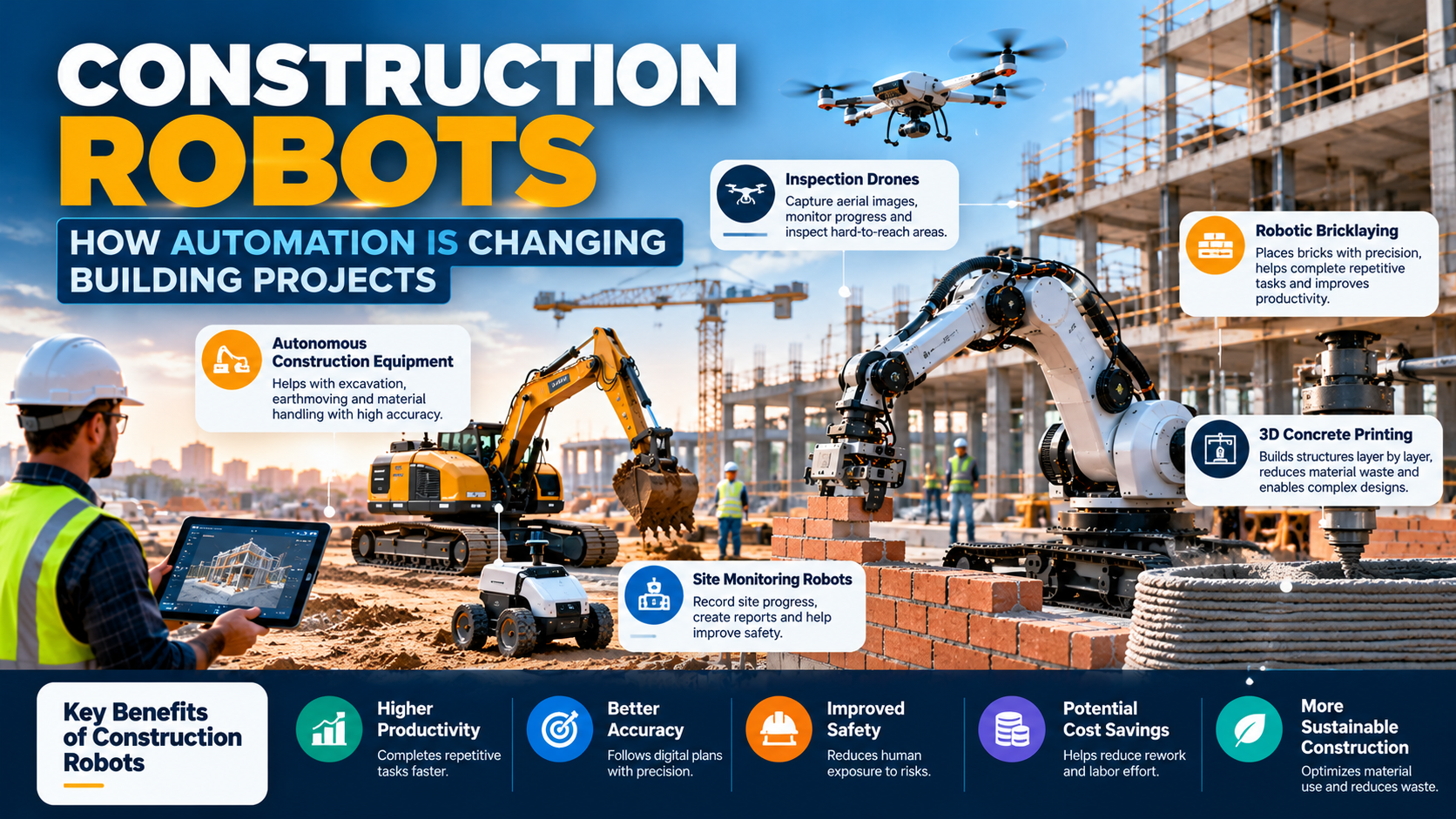
The construction industry is changing with the help of modern technology. Today, companies are exploring new ways to build houses, offices, roads, bridges, and other structures more efficiently. One important development is the use of construction robots.
Construction robots are machines that help workers perform different building tasks. They can assist with laying bricks, moving materials, inspecting buildings, drilling surfaces, and printing structures using special construction materials.
These robots use technologies such as sensors, cameras, computer software, and artificial intelligence (AI) to perform specific tasks. Some robots follow instructions from human operators, while others can complete certain activities automatically.
The main goal is not simply to replace human workers. Instead, construction robots can help reduce repetitive work, improve accuracy, and make some construction activities easier and safer.
In this article, we will explore what construction robots are, how they work, their benefits, their challenges, and how they may change the future of building projects.
Category 1: Understanding Construction Robots
What Are Construction Robots?
Construction robots are machines designed to help perform tasks on construction sites. They can work under human supervision or automatically complete specific activities.
For example, a bricklaying robot can help place bricks in the correct positions, while an inspection robot can capture images of a building to help workers identify possible problems.
Some construction robots are large machines used for heavy work, while others are smaller devices designed for detailed tasks.
These robots are useful because construction work often involves repetitive activities, heavy materials, and tasks that require careful measurements.
How Do Construction Robots Work?
Construction robots use a combination of hardware and software to perform their jobs. Their hardware may include robotic arms, wheels, cameras, sensors, and specialized tools.
Software provides instructions that tell the robot what to do and where to move. Some advanced systems also use AI to analyze information from their surroundings.
For example, a construction robot may receive a digital plan showing where a particular component should be placed. The robot can then use its positioning system and sensors to help perform the task.
However, not every robot can work independently. Many systems still require workers to set them up, provide instructions, monitor their activities, and check the final results.
Why Is Automation Becoming Important in Construction?
Construction projects often require significant time, physical effort, and careful coordination. Workers must manage materials, operate machinery, follow designs, and complete tasks within project deadlines.
Automation can help with some of these challenges.
Robots can repeat certain tasks without getting physically tired, help move heavy materials, and perform selected operations according to digital instructions.
For construction companies, these capabilities may improve productivity and reduce some types of manual work.
However, robots are not suitable for every construction task. Their usefulness depends on the type of project, site conditions, equipment costs, and the skills available to operate them.
Category 2: Types of Construction Robots
1. Robotic Bricklaying Machines
Bricklaying is an important part of many building projects. It requires workers to place bricks carefully, maintain consistent spacing, and ensure that walls are properly aligned.
Robotic bricklaying machines help automate some of this work. They can use robotic arms and digital instructions to position bricks according to a planned design.
These systems may help construction teams complete repetitive masonry tasks more consistently.
For example, a bricklaying robot can assist with building a section of a wall while workers prepare materials, check alignment, and handle other construction activities.
Main benefits:
- Helps with repetitive brick placement.
- Supports consistent positioning.
- Can reduce some physical effort.
- May improve productivity on suitable projects.
However, workers are still needed for site preparation, material handling, quality checks, and tasks that require adjustments.
2. 3D Concrete Printing Robots
3D concrete printing is a construction method that uses machines to place specially prepared material layer by layer.
The machine follows a digital design and deposits material along a planned path. This process can be used to create certain walls, building components, and other structures.
Think of it as a large 3D printer, but instead of printing small plastic objects, it uses construction materials.
One advantage is that some shapes can be created without traditional formwork, which is commonly used to hold concrete in place while it sets.
Main benefits:
- Automates selected material-placement tasks.
- Can create certain complex shapes.
- May reduce material waste in suitable applications.
- Connects digital designs with physical construction.
However, 3D printing does not automatically complete every part of a building. Foundations, reinforcement, electrical systems, plumbing, inspections, and finishing work may still require conventional methods.
The material must also meet the project’s strength and safety requirements.
3. Autonomous Excavation and Earthmoving Machines
Excavation is one of the first activities in many construction projects. It involves preparing land, digging foundations, and moving soil or other materials.
Autonomous and semi-autonomous construction machines use sensors, positioning systems, and software to help perform these tasks.
Some machines can follow predefined routes or assist operators with accurate digging and movement.
For example, an automated excavator may use digital site information to help dig an area according to planned measurements.
Main benefits:
- Helps with repetitive earthmoving activities.
- Supports accurate machine positioning.
- Can reduce the need for direct human exposure to certain hazards.
- May improve consistency in selected operations.
These machines still need proper supervision and safety controls. Uneven ground, changing site conditions, and nearby workers can make construction environments difficult to manage.
4. Construction Inspection Robots and Drones
Construction projects need regular inspections to check progress, identify visible problems, and make sure the work follows the design.
Robots and drones can help collect photographs, videos, and measurements from different parts of a site.
For example, a drone can capture aerial images of a large construction project. A ground robot can move through suitable areas to collect images or other information.
Construction teams can use this information to review progress and identify areas that need further inspection.
Main benefits:
- Helps document construction progress.
- Can inspect selected difficult-to-reach areas.
- Reduces some manual data-collection work.
- Helps project teams review site conditions.
However, these systems do not automatically detect every construction defect. Important findings may need to be checked by qualified engineers or inspectors.
5. Robotic Drilling and Surface-Preparation Machines
Construction projects often require drilling holes, sanding surfaces, and preparing walls or other materials.
These tasks can involve repeated movements and careful positioning.
Robotic drilling and surface-preparation machines help automate selected operations by following programmed instructions or using sensors to guide their tools.
For example, a robotic drilling machine can help create holes at planned positions, while an automated sanding system can assist with preparing a surface.
Main benefits:
- Supports consistent task execution.
- Reduces some repetitive physical work.
- Helps maintain planned tool positions.
- Can improve efficiency for suitable tasks.
The results depend on the machine, the surface condition, and how accurately the equipment is configured.
Workers may still need to prepare the surface, set up the machine, and inspect the finished work.
6. Construction Site Monitoring Robots
Construction sites change every day. Materials arrive, workers move between areas, and different stages of the project progress at different speeds.
Monitoring robots can help construction teams collect information about these changes.
Some robots move through designated areas and capture photographs or other site data. Project teams can then review this information to understand progress and identify areas that need attention.
For example, repeated photographs may help a project manager compare the current state of a building with its condition earlier in the week.
Main benefits:
- Helps record site progress.
- Reduces some manual monitoring activities.
- Creates useful project documentation.
- Supports better-informed planning.
These robots are tools for collecting information, not complete replacements for site managers and safety supervisors.
7. Robotic Material-Handling Machines
Construction sites require many materials, including bricks, cement, steel components, tools, and finishing supplies.
Moving these materials can be physically demanding and time-consuming.
Robotic material-handling machines help transport, lift, or position certain materials. Depending on their design, they may use robotic arms, automated carts, or mobile robots.
For example, a mobile robot may transport supplies along a designated route, while a robotic arm may help move components into position.
Main benefits:
- Helps reduce repetitive lifting.
- Supports organized material movement.
- Can improve the consistency of selected workflows.
- Reduces some physical demands on workers.
Safe operation requires careful planning because construction sites often contain obstacles, moving equipment, and people working nearby.
Category 3: How AI Makes Construction Robots Smarter
What Is the Role of AI in Construction Robotics?
Artificial intelligence helps computers analyze information and perform certain tasks that traditionally require human judgment.
In construction robotics, AI can help machines interpret images, recognize objects, monitor progress, and navigate suitable environments.
For example, an AI-powered inspection system may analyze photographs to identify visible differences between two stages of a project.
AI capabilities vary between systems. Some use it only for image analysis, while others combine it with sensors and automated controls.
How Computer Vision Helps Construction Robots
Computer vision is a technology that allows computers to analyze images and videos.
Construction robots can use cameras and computer vision software to recognize objects, understand parts of a work area, or compare site images.
For example, a system may compare photographs of a building with digital project information to help workers review whether certain activities have been completed.
Computer vision can save time during selected inspection and monitoring tasks, but its results are not always perfect. Lighting, dust, blocked views, and changing site conditions can affect accuracy.
How Robots Use Digital Construction Plans
Modern construction projects often use digital drawings and 3D building models to plan dimensions, materials, and structural components.
Some robotic systems can use this digital information to guide physical activities.
For example, a robotic layout machine can help mark wall positions on a floor based on a digital plan.
Connecting digital designs with construction equipment can reduce some manual measurement work and help teams coordinate their activities.
However, the digital information must be accurate and suitable for the equipment being used.
Category 4: Benefits of Construction Robots
1. Better Productivity
Robots can perform certain repetitive tasks consistently and may help construction teams complete them more efficiently.
This can be useful for activities such as material handling, drilling, and selected bricklaying operations.
However, overall productivity also depends on setup time, maintenance, material availability, and how well the robot fits into the existing workflow.
2. Improved Accuracy
Some robotic systems follow digital measurements and programmed movements.
This can help reduce certain positioning and measurement errors.
For example, a robotic layout system can assist with marking construction positions according to a digital plan.
Workers still need to check the results because incorrect instructions, equipment calibration problems, or changing site conditions can affect accuracy.
3. Reduced Physical Effort
Construction workers often perform repetitive activities, carry heavy materials, or work in uncomfortable positions.
Robots can assist with selected tasks that involve lifting, repetitive movements, or difficult access.
This may reduce physical strain and allow workers to focus on other activities.
4. Better Workplace Safety
Some robots can perform tasks in hazardous areas or reduce the need for workers to approach certain risks directly.
For example, a remotely operated inspection robot may collect information from a difficult-to-access location.
However, robots can also create new hazards when operating near people. Proper training, protective systems, and safety procedures are essential.
5. Potential Cost Savings
Automation may help companies reduce certain repetitive labor requirements, improve consistency, and avoid some forms of rework.
Over time, these improvements may reduce costs for suitable projects.
However, robots can be expensive to purchase, install, operate, and maintain. Companies should compare the expected benefits with the total cost before investing.
Category 5: Challenges of Construction Automation
1. High Equipment Costs
Construction robots can require significant investment in machinery, software, installation, maintenance, and training.
This can make them difficult to afford for smaller contractors or projects with limited automation needs.
Before purchasing a robot, a company should calculate how often it will be used and whether the expected improvements justify the cost.
2. Difficult Construction Site Conditions
Unlike factories, construction sites are constantly changing.
Workers move materials, temporary structures appear, and the ground may be uneven or dusty.
These conditions can make it difficult for robots to navigate safely and perform tasks consistently.
3. Safety Concerns
Robots working near people must be carefully managed.
Unexpected movements, blocked sensors, equipment failures, or poor coordination can create safety risks.
Companies need clear operating procedures, suitable protective systems, and regular safety checks.
4. Need for Skilled Workers
Construction automation requires people who understand how to operate, monitor, and maintain robotic equipment.
Workers may need training in digital tools, machine controls, troubleshooting, and safety procedures.
As automation grows, technical skills may become increasingly valuable in construction.
5. Not Every Task Can Be Automated
Construction work involves many unpredictable situations.
Some tasks require creative problem-solving, careful judgment, or adjustments based on conditions that a robot may not understand.
For this reason, robots are generally most useful when applied to clearly defined tasks that can be automated safely and practically.
Category 6: Will Construction Robots Replace Human Workers?
Many people wonder whether construction robots will eventually replace human workers.
The reality is more complicated. Robots can automate selected activities, but construction projects involve much more than operating machines.
Workers are needed to plan projects, prepare sites, manage materials, solve unexpected problems, inspect results, and coordinate different teams.
For example, a bricklaying robot may help build a section of a wall, but workers still need to prepare materials, supervise the process, and check the finished structure.
Similarly, an inspection drone can collect photographs, but qualified professionals may need to interpret the results and decide whether repairs are required.
Automation may change some job responsibilities while creating demand for skills related to robotics, equipment maintenance, digital construction, and safety management.
The most practical approach is to use robots to support workers and improve selected construction activities rather than assume that every job can be fully automated.
Category 7: The Future of Construction Robots
More Intelligent Construction Machines
As AI and sensor technologies improve, construction machines may become better at understanding their surroundings and assisting with complex tasks.
These improvements could help automate more activities, although reliable operation on unpredictable construction sites remains a challenge.
Better Collaboration Between Humans and Robots
Future construction sites may use more robots designed to work alongside people.
These systems could assist with repetitive tasks, material handling, and selected assembly operations while workers supervise the process and make important decisions.
Growth of 3D Printing in Construction
3D concrete printing may become more useful for certain building components and construction methods as equipment and materials improve.
Its wider adoption will depend on cost, structural requirements, building regulations, and the suitability of each project.
Smarter Construction Monitoring
Robots, drones, cameras, and AI software may work together to help construction teams collect and review project information.
This could improve progress monitoring and help teams identify potential problems earlier.
More Connected Digital Construction Systems
Robotic equipment may become more closely connected with digital building models, project management software, and site monitoring tools.
This could help companies connect construction planning with real-world activities and make better use of project data.
The future will depend on how effectively these technologies can be used safely, reliably, and economically.
Conclusion: Are Construction Robots the Future?
Construction robots are changing how companies approach selected building activities. From robotic bricklaying and 3D concrete printing to inspection drones and automated material handling, these technologies offer new ways to improve productivity and reduce repetitive physical work.
However, construction automation still faces challenges, including equipment costs, changing site conditions, safety requirements, and the need for skilled operators.
Robots are not suitable for every construction task, and human expertise remains essential for planning, supervision, quality control, and decision-making.
As technology continues to improve, construction robots may become an increasingly useful part of modern building projects.
The goal is not simply to replace human workers with machines. It is to combine technology and human skills to make construction more efficient, accurate, and safe.
