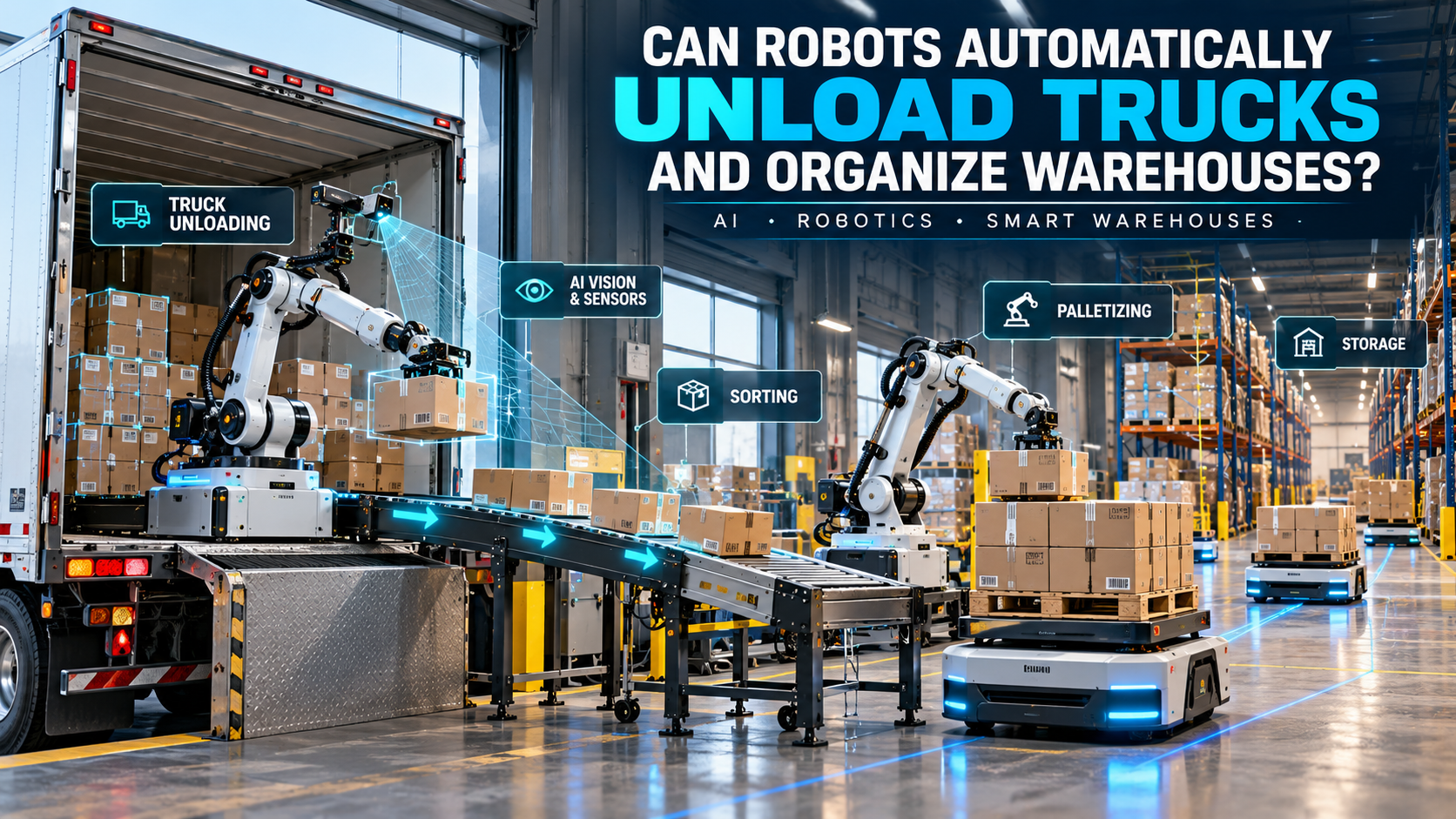
Imagine a truck arriving at a warehouse. Instead of workers manually unloading hundreds of boxes, robots enter the trailer, identify packages, pick them up, place them on conveyors, organize them onto pallets, and move them toward the correct storage area.
This is no longer only a futuristic idea.
In 2026, AI-powered robotic systems are already being used to automate parts of truck unloading and warehouse receiving. Some systems combine robotic arms, cameras, LiDAR, conveyors, and AI software to understand different package sizes and positions.
So, can robots automatically unload trucks and organize warehouses?
The answer is yes, for many warehouse tasks — but full automation still has important limitations.
What Is Robotic Truck Unloading?
Robotic truck unloading means using robots to remove boxes, cartons, packages, or other goods from a truck or trailer without requiring workers to manually handle every item.
Traditional truck unloading can be physically demanding because packages may be heavy, tightly packed, or arranged differently in every trailer.
Modern robotic systems use cameras and sensors to understand what is inside the trailer. An AI system can then help the robot decide which package to pick and how to grip it.
For example, a robotic system developed for trailer unloading can use AI-powered vision to identify cartons and decide whether they should be grabbed from the top or from the side. LiDAR can also help the robot understand its position inside the trailer.
How Do Robots Unload a Truck?
The process can be divided into several simple steps.
1. The Truck Arrives
The truck is positioned at a warehouse loading dock.
The robotic unloading system is moved or positioned near the trailer opening.
2. Robots Scan the Trailer
Cameras, LiDAR, and other sensors collect information about the trailer and its cargo.
The robot needs to understand:
- Where the boxes are
- Their approximate size
- Their position
- How they are stacked
- Whether the load has shifted
- Where the robot can safely move
This is where AI-powered computer vision becomes important.
3. AI Identifies the Next Package
The robot analyzes the available packages and selects an item that can be safely picked.
Instead of following only one fixed movement pattern, modern systems can adapt to different package arrangements.
4. The Robot Picks the Package
A robotic arm uses a gripper to pick up the package.
Different packages may require different gripping methods. AI vision can help the system decide how to approach each carton.
5. Packages Move to a Conveyor
After picking up a package, the robot can place it onto a powered conveyor.
The conveyor transports the package out of the trailer and into the receiving area.
6. Another Robot Can Organize the Packages
The next robotic system can sort or stack packages.
For example, packages can be placed onto pallets according to product type, destination, warehouse zone, or other operational rules.
A 2026 commercial integration between Pickle Robot and Ambi Robotics demonstrated a workflow connecting robotic trailer unloading with robotic pallet stacking and warehouse receiving.
How Do Robots Organize a Warehouse?
Truck unloading is only the first part of warehouse automation.
After goods enter the warehouse, other robots can transport and organize them.
Autonomous Mobile Robots, or AMRs, can move goods between different areas of a facility.
Automated storage and retrieval systems can place products into storage locations.
Robotic arms can pick and place products.
Sorting systems can send packages toward different destinations.
Together, these technologies can create a connected warehouse workflow.
Truck → Robot Unloading → Conveyor → Sorting → Palletizing → Mobile Robot → Storage
This is one reason warehouse robotics is becoming more sophisticated. Modern research focuses not only on individual robots but also on multi-robot coordination, task allocation, fleet management, perception, and path planning.
Can AI Decide Where Products Should Go?
Yes, AI can help with warehouse organization.
A warehouse management system can provide information about inventory, orders, storage locations, and priorities.
AI software can then help optimize decisions such as:
- Which product should be moved first?
- Where should an item be stored?
- Which robot should perform the task?
- What route should the robot take?
- How can congestion be avoided?
- Which packages should be grouped together?
This becomes especially useful in large warehouses where hundreds of robots may operate simultaneously.
Researchers from MIT and Symbotic reported a 2026 approach that uses deep reinforcement learning to help coordinate robot traffic and reduce congestion. In their simulations, the method produced about a 25% throughput improvement compared with other approaches.
What Is Physical AI in Warehouses?
One of the biggest trends behind this development is Physical AI.
Traditional software AI mainly works with digital information.
Physical AI connects AI with the physical world through:
- Robots
- Cameras
- LiDAR
- Sensors
- Motors
- Actuators
- Industrial equipment
- Real-time control systems
This allows AI systems to perceive an environment, make decisions, and take physical actions.
Gartner identified Physical AI agents as one of four major AI trends transforming warehousing in 2026. These systems combine AI, robotics, and sensors to perform activities such as picking, packing, sorting, and material handling.
Why Is Automated Truck Unloading Important?
Truck unloading is one of the physically demanding parts of warehouse operations.
Robots can potentially help warehouses in several ways.
Better Worker Safety
Workers may not need to repeatedly lift and move heavy packages.
Robots can take on some repetitive and physically demanding tasks while employees focus on other responsibilities.
Faster Receiving
Automated unloading can create a continuous flow of packages from the truck to the warehouse.
This can reduce delays at the receiving dock.
More Consistent Operations
Robots can perform repetitive movements consistently without becoming physically tired.
Better Warehouse Visibility
Robotic systems can collect information about packages and movements.
When connected to warehouse software, this data can help companies understand how goods move through the facility.
Flexible Automation
AI-powered systems can potentially handle different package sizes and arrangements instead of requiring every package to be positioned exactly the same way.
Can Robots Handle Randomly Stacked Boxes?
This is one of the biggest technical challenges.
A warehouse cannot always control how products are packed inside every truck.
Boxes can have different:
- Sizes
- Shapes
- Weights
- Materials
- Orientations
- Stacking patterns
Packages can also shift during transportation.
AI vision and sensors help robots deal with these changing conditions, but robots still need to handle difficult situations carefully.
For example, KUKA and Contoro’s robotic unloading system uses cameras and LiDAR to understand carton positions and adapt its gripping approach. In situations involving extreme load shifting, human intervention may still be required.
Will Robots Completely Replace Warehouse Workers?
Not necessarily.
The more realistic future is a human-and-robot warehouse.
Robots can handle repetitive physical work while humans manage exceptions, maintenance, quality checks, planning, supervision, and tasks that are difficult to automate.
This approach is important because real warehouses are unpredictable.
A damaged package, unexpected obstruction, sensor failure, shifted cargo load, or unusual product may require human intervention.
Gartner also highlights the importance of human oversight as warehouses adopt increasingly autonomous AI systems.
What Are the Biggest Challenges?
Despite rapid progress, fully automated warehouses still face several challenges.
Unpredictable Environments
Real warehouses are constantly changing.
Workers, forklifts, packages, vehicles, and equipment can all move through the same environment.
Safety
Robots must safely operate around people and other machines.
Safety sensors, restricted zones, emergency stops, and controlled robot movements are essential.
Integration
Robots need to communicate with warehouse management systems, conveyors, scanners, inventory systems, and other equipment.
Cost
Advanced robotic systems require investment in hardware, software, integration, maintenance, and training.
Edge Cases
AI may perform extremely well on common situations but still struggle with unusual objects, damaged packages, or unexpected environments.
Cybersecurity
As more warehouse equipment becomes connected to networks and software, cybersecurity becomes increasingly important.
What Will the Warehouse of the Future Look Like?
The future warehouse may operate more like a coordinated robotic ecosystem.
A truck arrives.
An AI system identifies the incoming shipment.
Robots unload the trailer.
Conveyors move packages into the facility.
Robots sort and palletize them.
AMRs transport goods through the warehouse.
Automated storage systems place products in the correct locations.
When an order arrives, robots retrieve the products and move them toward packing and shipping.
AI can continuously monitor the operation and adjust task assignments, routes, and robot priorities.
This means the warehouse is not simply filled with individual robots. Instead, it becomes a connected system where AI, robots, sensors, software, and humans work together.
The Future of Automated Warehouses
Truck unloading may become one of the next major areas of warehouse automation.
Industry research in 2026 has identified truck unloading as an important robotics opportunity, while commercial deployments are already connecting trailer unloading with palletizing and receiving operations.
The bigger change, however, is the connection between different automation systems.
Instead of having one robot perform one isolated task, future warehouses can use multiple robots that coordinate their work.
The goal is simple:
Unload → Sort → Move → Store → Pick → Pack → Ship
AI can become the decision-making layer connecting these activities, while robots perform the physical work.
Conclusion
So, can robots automatically unload trucks and organize warehouses?
Yes. Modern robotic systems can already automate important parts of truck unloading, palletizing, material handling, sorting, and warehouse transportation.
However, completely autonomous warehouses are still challenging.
The biggest opportunity is not simply replacing people with robots. It is creating smarter warehouse systems where AI makes operational decisions, robots perform physical tasks, and humans handle supervision and unexpected situations.
As Physical AI, computer vision, autonomous mobile robots, and multi-robot coordination continue to improve, truck unloading could become an increasingly automated part of the modern supply chain.
