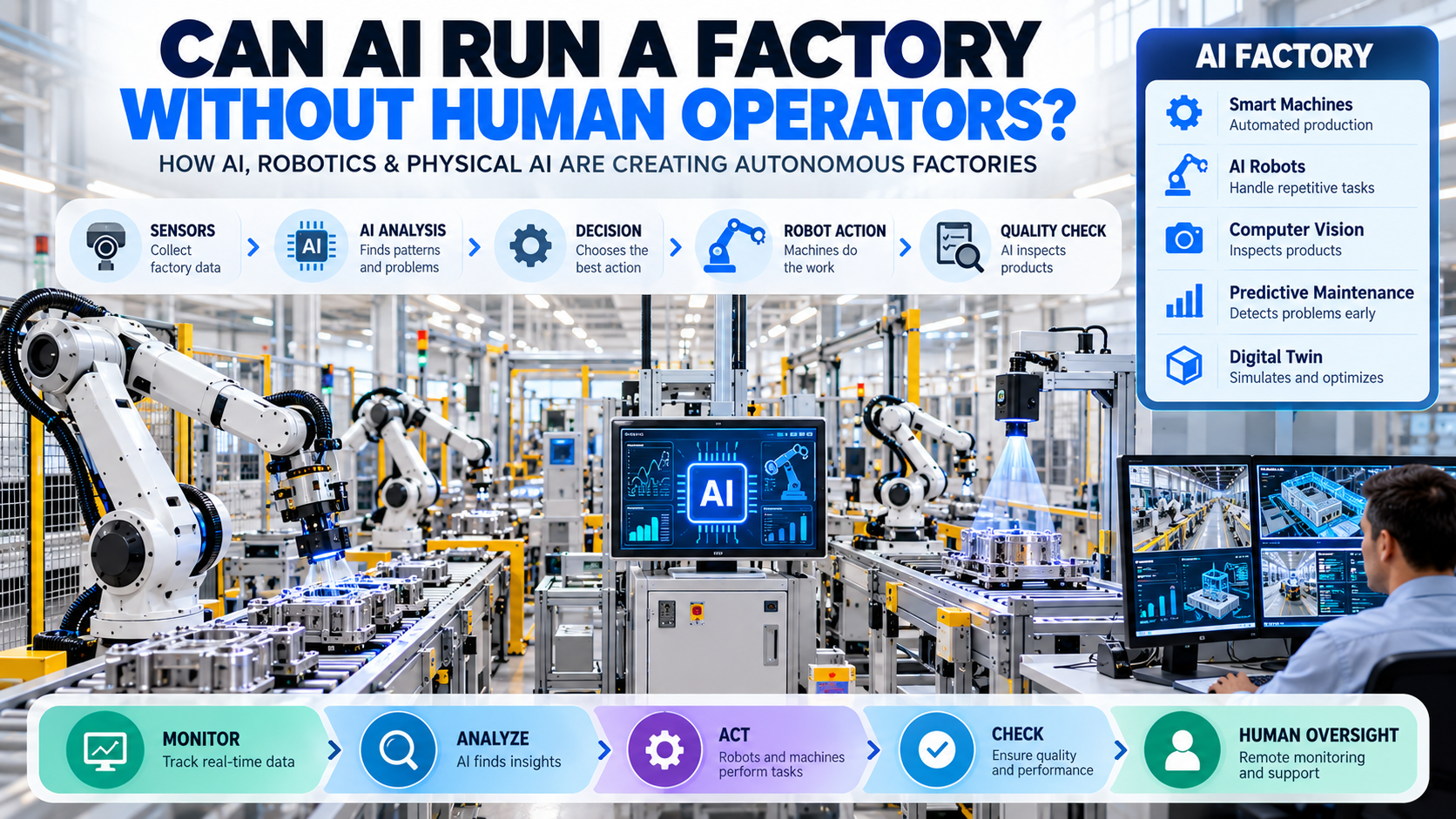
Factories have used robots and automation for many years. But now, AI is taking factory automation to another level. Instead of robots simply following fixed instructions, AI can help machines understand data, detect problems, optimize production and make decisions.
This is creating a new idea called the autonomous factory or lights-out factory. In this type of factory, production can continue with very little human intervention. Humans can still monitor the factory remotely and step in when something unusual happens. Tata Consultancy Services
So, can AI completely run a factory without human operators? In some controlled environments, parts of this are already possible. But a completely human-free factory is still difficult for many industries.
What Is an Autonomous Factory?
An autonomous factory is a manufacturing facility where AI, robots, sensors, cameras and industrial software work together to manage production.
Instead of workers controlling every step manually, automated systems can move materials, operate machines, inspect products and monitor production.
The main idea is simple:
Machines collect information → AI understands it → The system makes a decision → Robots take action.
Modern Physical AI is making this approach more practical by connecting AI intelligence with machines that can physically interact with the real world. Gartner says the value of Physical AI depends on coordinating multiple technologies rather than relying on a single AI model or robot. Gartner
What Is a Lights-Out Factory?
A lights-out factory is a factory designed to operate with minimal human presence on the production floor.
The name comes from the idea that if people are not working inside the factory, there may be no need to keep the lights on.
A lights-out system can combine:
- AI
- Industrial robots
- Sensors
- Computer vision
- Digital twins
- Industrial software
- Factory control systems
- Real-time data
However, lights-out does not always mean that humans disappear completely. People may still supervise the system remotely, handle unexpected problems and make important decisions. Tata Consultancy Services
How Can AI Run a Factory?
AI can act as an intelligent layer between factory data and physical machines.
Sensors continuously collect information from machines. AI then analyzes this information to understand what is happening.
For example, if a machine starts showing unusual vibration or temperature, AI may detect that something is wrong.
The system could then:
Detect → Analyze → Decide → Act → Check
This creates a continuous feedback loop where the factory can respond to changing conditions instead of simply following a fixed schedule.
What Technologies Are Needed?
An autonomous factory does not depend on AI alone. Several technologies need to work together.
AI and Machine Learning
AI analyzes production data and can identify patterns, problems and opportunities to improve efficiency.
Industrial Robots
Robots can perform repetitive physical work such as assembly, packaging, welding, picking and material handling.
Computer Vision
Cameras combined with AI can inspect products and identify defects automatically.
Smart Sensors
Sensors can monitor temperature, pressure, vibration, speed, energy usage and machine conditions.
Digital Twins
A digital twin is a virtual model of a real factory, machine or production process. Manufacturers can use it to simulate changes and test production scenarios before making changes to the physical factory.
Industrial Control Systems
Control systems connect machines and production processes so that different parts of the factory can work together.
These technologies are becoming more closely connected. TCS’s 2026 lights-out factory lab in Pune, for example, combines industrial AI, robotics, digital twins, factory control systems and real-time operational intelligence in a robotic battery-pack assembly environment. Tata Consultancy Services
How Does an AI-Powered Factory Work?
Imagine a factory producing electronic products.
First, sensors collect information from machines and production lines.
Next, AI analyzes that information and looks for unusual patterns.
If everything is working normally, production continues automatically.
If AI detects a problem, it can trigger an action, adjust a process or alert a human operator.
The basic process can be explained as:
SENSORS → AI ANALYSIS → DECISION → ROBOT ACTION → QUALITY CHECK
This makes the factory more responsive and less dependent on constant manual monitoring.
Can AI Detect Machine Problems?
Yes. One of the most useful applications of AI in manufacturing is predictive maintenance.
Traditional maintenance often happens after a machine breaks or according to a fixed schedule.
AI can instead analyze machine data and look for early signs of problems.
For example, an AI system could notice that a motor’s vibration is slowly increasing. It could identify this as a possible warning sign and alert the maintenance team before the machine fails.
This can help reduce unexpected downtime and improve machine reliability.
Predictive maintenance is also one of the use cases demonstrated in TCS’s lights-out factory lab. Tata Consultancy Services
Can Robots Handle Production Without Humans?
For some types of manufacturing, robots can already handle a large amount of production work.
They can assemble components, move materials, package products and perform quality inspections.
However, completely autonomous production becomes harder when the factory has constantly changing products, unusual materials or unpredictable situations.
This is why autonomous factories are easier to build when the environment is structured, predictable and repetitive.
EY’s 2026 manufacturing analysis similarly identifies repetitive, high-volume processes as strong candidates for autonomy, while noting that people remain important for decision-making and escalation. EY
Can AI Control Quality Inspection?
Yes.
AI-powered computer vision can inspect products using cameras.
Instead of asking a worker to manually check every product, an AI vision system can examine products continuously and look for things such as:
- Scratches
- Incorrect assembly
- Missing components
- Shape differences
- Packaging problems
- Surface defects
This can make quality inspection faster and more consistent.
The system can also send defective products to another part of the production line for further inspection.
Can AI Manage Factory Inventory?
AI can also help manage materials and inventory.
A smart factory can monitor how much material is available and how quickly it is being used.
If inventory becomes low, the system can generate an alert or connect with a supply-chain system.
In a more advanced setup, AI could coordinate production schedules with material availability.
This creates a connection between:
Inventory → Production → Quality → Supply Chain
The result is a factory that can make decisions using information from multiple parts of the business instead of looking at each process separately.
What Are AI Agents Doing in Factories?
A newer development is the use of AI agents in industrial environments.
Traditional automation usually follows predefined rules.
AI agents can potentially analyze a situation, determine what needs to happen next and coordinate multiple systems.
For example:
Machine Problem Detected
↓
AI Agent Investigates
↓
Checks Machine Data
↓
Identifies Possible Cause
↓
Recommends Action
↓
Human Approves or System Executes
This could make factories more flexible because the system does not have to rely only on fixed instructions.
Gartner’s 2026 Physical AI research emphasizes that autonomous systems need coordination, governance, safety controls and oversight as deployments become larger and more complex. Gartner
Can an AI Factory Work 24/7?
One major advantage of automation is that machines can continue operating for long periods without the breaks required by human workers.
An autonomous production line can potentially operate continuously while AI systems monitor machines and production.
This could help manufacturers increase production time and reduce certain types of downtime.
But 24/7 operation does not mean maintenance is unnecessary. Robots, machines, sensors and software still need maintenance, updates and safety checks.
Is This Technology Already Being Used?
Yes, autonomous manufacturing is moving beyond research and demonstrations.
In September 2026, TCS launched a lights-out factory lab in Pune, featuring a fully robotic battery-pack assembly line. The facility is designed to help manufacturers test AI-first manufacturing systems using robotics, digital twins, industrial AI and real-time operational data before deploying them at larger scale. Tata Consultancy Services
AWS also demonstrated an autonomous production line at Hannover Messe 2026, showing how industrial AI can be integrated with existing manufacturing infrastructure. Amazon Web Services, Inc.
These examples show that autonomous factories are becoming more practical, although they do not mean that every factory can currently operate without people.
Why Do Companies Want Autonomous Factories?
There are several reasons.
Higher Productivity
Robots can perform repetitive tasks continuously and consistently.
Better Safety
Machines can perform dangerous or physically demanding tasks instead of people.
Better Quality
AI-powered inspection can continuously monitor products.
Less Downtime
Predictive maintenance can identify potential machine problems earlier.
Faster Decisions
AI can process large amounts of factory data much faster than humans.
Better Resource Management
AI can help coordinate machines, materials, energy and production schedules.
The larger goal is not simply to replace workers with machines. It is to create a factory that can understand what is happening and respond faster.
What Are the Biggest Challenges?
Autonomous factories also have important problems.
High Investment
Robots, sensors, AI systems and industrial infrastructure can be expensive to install.
Complex Integration
Old factory equipment may not easily connect with modern AI systems.
Cybersecurity
Connected machines create new cybersecurity risks.
AI Mistakes
AI can make incorrect decisions, especially when it encounters unusual situations.
Maintenance
Automated systems still need technicians and engineers.
Safety
A machine making a wrong decision can create a physical safety problem.
Gartner emphasizes that Physical AI in manufacturing needs operational controls, safety systems and human oversight because AI decisions can directly affect physical machines and products. Gartner
Why Are Humans Still Important?
Even highly automated factories still need people.
Humans are particularly important when something unexpected happens.
For example, AI may recognize that a machine is behaving differently, but an experienced engineer may be needed to understand why and decide what should happen next.
People can also handle:
- Safety decisions
- Engineering
- Maintenance
- System design
- Production strategy
- Complex problems
- Emergency situations
- Process improvements
This is why the future is more likely to be Human + AI + Robots, rather than AI completely replacing humans.
EY also highlights the importance of keeping people involved through clear decision rights and escalation processes in autonomous manufacturing environments. EY
Autonomous Factory vs Traditional Factory
| Traditional Factory | Autonomous Factory |
|---|---|
| Humans monitor many processes | AI monitors many processes |
| Manual inspection | AI computer vision |
| Fixed automation | Adaptive automation |
| Scheduled maintenance | Predictive maintenance |
| Manual machine monitoring | Continuous sensor monitoring |
| Human-controlled decisions | AI-assisted decisions |
| More workers on production floor | More remote supervision |
| Separate systems | Connected systems |
Will AI Completely Replace Factory Workers?
Not likely in the near future.
AI and robotics will probably replace some repetitive and dangerous tasks, but humans will continue to play an important role in manufacturing.
Instead of removing people completely, factories may move toward a model where:
AI handles routine decisions
Robots handle physical tasks
Humans handle complex decisions
This could make workers more like supervisors, engineers and problem-solvers instead of manually controlling every machine.
What Will the Factory of the Future Look Like?
The factory of the future could contain fewer people on the production floor but much more intelligent technology.
A possible workflow could look like:
AI AGENTS
↓
SMART MACHINES
↓
AUTONOMOUS ROBOTS
↓
COMPUTER VISION
↓
PREDICTIVE MAINTENANCE
↓
DIGITAL TWIN
↓
REMOTE HUMAN SUPERVISION
The important change is that these systems will not work independently. They will need to communicate and coordinate with each other.
Gartner’s latest Physical AI research makes the same point: the biggest value comes from orchestrating multiple technologies together, rather than deploying individual intelligent machines separately. Gartner
Final Answer: Can AI Run a Factory Without Human Operators?
Yes, but only to a certain level today.
AI, robotics, sensors, computer vision and digital twins can already automate many factory operations. Some controlled production environments can operate with very little human intervention.
However, completely removing humans from every factory is still difficult.
The more realistic future is an autonomous factory with human oversight.
AI will monitor production, robots will perform physical tasks, sensors will collect data, and AI systems will optimize operations. Humans will step in when the system encounters an unusual, complex or high-risk situation.
As Physical AI and industrial AI continue improving, factories could become increasingly self-monitoring, self-optimizing and autonomous. Gartner says the next stage depends heavily on safe orchestration and coordination between physical systems, AI models, operational controls and human oversight.
