Artificial Intelligence (AI) is becoming an important part of our daily lives. From AI chatbots and smart assistants to self-driving technology and automated industries, AI is changing how people work and how businesses operate.
But have you ever wondered where all this AI technology runs?
Behind every AI application is a powerful computer system that processes information, stores data and generates results. These systems operate inside large facilities called data centers.
As more people and businesses start using AI, the demand for these data centers is increasing. They need more powerful computers, more electricity and better cooling systems to keep everything running smoothly.
This creates a major engineering challenge in 2026: How can we provide enough electricity to power AI without wasting energy or damaging the environment?
Let’s understand why AI data centers need so much energy and how engineers are working to solve this problem.
Category 1: Understanding AI Data Centers
1. What Is an AI Data Center?
An AI data center is a large facility filled with powerful computers, servers, storage systems and networking equipment.
You can think of it as a huge computer room where thousands of machines work together to run AI applications.
For example, when you ask an AI chatbot a question, the request is processed by powerful computers inside data centers. These computers perform calculations and send the answer back to your device.
AI data centers are also used for:
- Training artificial intelligence models.
- Running AI chatbots and virtual assistants.
- Processing large amounts of information.
- Supporting autonomous vehicles and robotics.
- Developing advanced scientific technologies.
Unlike normal computer systems, AI data centers often require much more computing power to perform complex tasks.
2. Why Are AI Data Centers Using More Electricity?
AI systems need powerful computer processors to perform millions or billions of calculations.
These processors require electricity to work. The more powerful the computing system becomes, the more energy it may need.
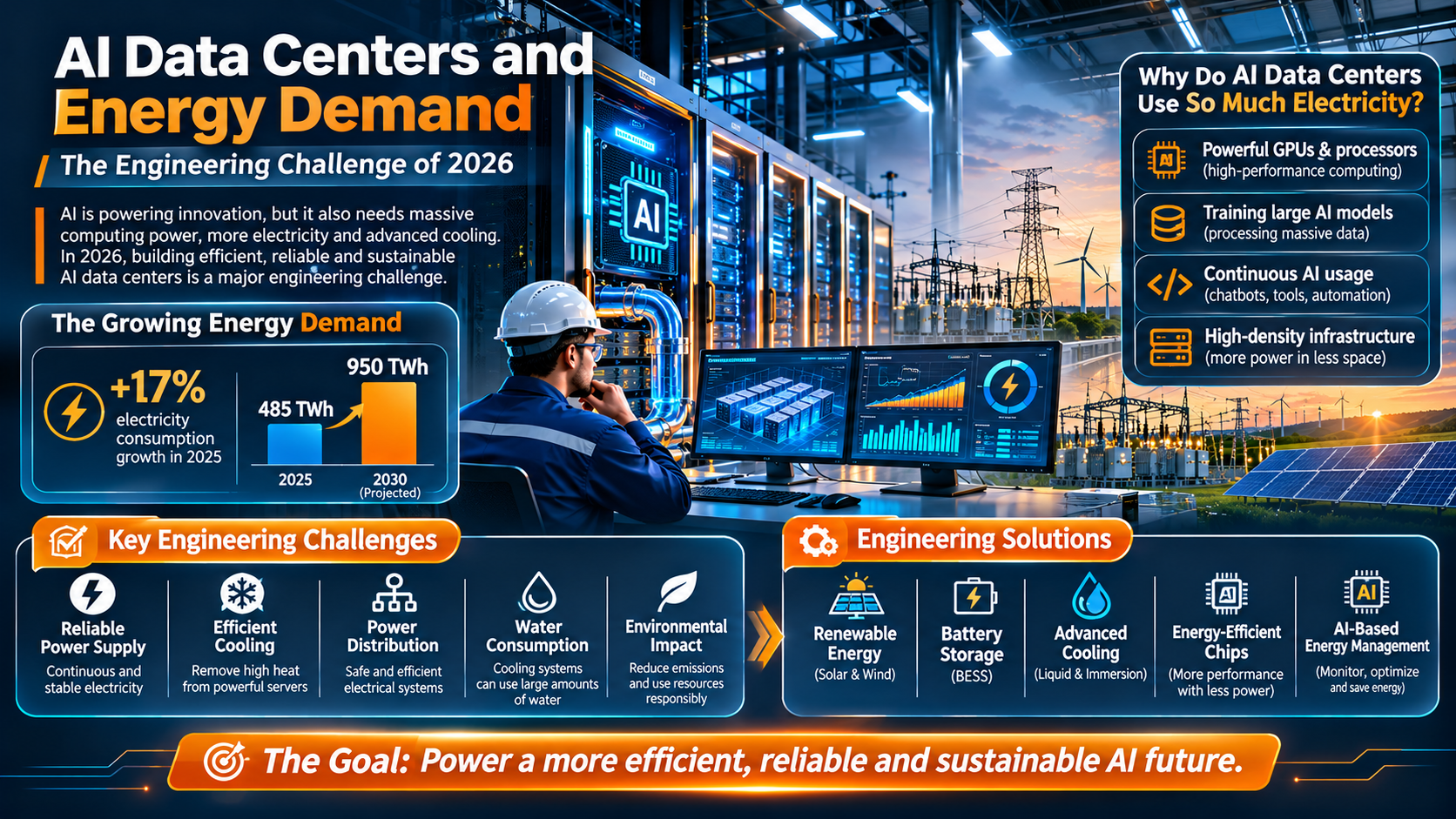
There are four major reasons behind the growing electricity demand.
Powerful GPUs and processors
AI data centers use special processors called Graphics Processing Units (GPUs). These processors can perform many calculations at the same time, making them useful for AI applications.
However, powerful processors also consume electricity and produce heat.
Training large AI models
Before an AI model can answer questions, it needs to learn from large amounts of information. This process is called AI training.
Training advanced models requires thousands of processors working together for long periods.
Running AI applications
Electricity is also needed whenever someone uses an AI application. Every question, image generation request or AI-powered task requires computing resources.
As millions of people use AI services, the total electricity demand increases.
More powerful data center equipment
Modern AI servers contain advanced processors, memory and networking equipment. These systems are designed to handle demanding workloads, which increases the need for electricity and cooling.
Category 2: The Growing Energy Demand in 2026
3. How Much Electricity Do Data Centers Need?
The growth of AI is creating a major change in global electricity consumption.
According to the International Energy Agency (IEA), global data center electricity consumption increased by approximately 17% in 2025.
The IEA estimates that data centers consumed around 485 terawatt-hours (TWh) of electricity in 2025. This figure could increase to approximately 950 TWh by 2030.
To understand this number, one terawatt-hour represents one trillion watt-hours of electricity.
This growth shows how important electricity has become for the future of artificial intelligence.
As AI applications become more advanced and widely used, engineers and energy companies will need to develop better ways to produce, distribute and manage electricity.
Category 3: Major Engineering Challenges
4. Challenge One: Providing Enough Electricity
One of the biggest problems for AI data centers is getting a continuous supply of electricity.
These facilities operate powerful computers throughout the day and night. Even a short power interruption can affect important computing operations.
Engineers need to design reliable electrical systems that can supply enough power to servers, cooling equipment and other infrastructure.
Important electrical systems include:
- Transformers to manage electrical voltage.
- UPS systems to provide temporary backup power.
- Backup generators for emergency situations.
- Battery storage systems for additional power support.
- Electrical distribution systems to deliver electricity safely.
Building reliable power infrastructure is becoming an important part of modern data center engineering.
5. Challenge Two: Keeping Servers Cool
Electricity is not the only challenge. Powerful computers also produce a large amount of heat.
Think about your laptop or smartphone. When you use it for heavy tasks, it becomes warm.
Now imagine thousands of powerful computers working together in one building. Without proper cooling, the temperature can become extremely high.
High temperatures can reduce performance and affect equipment reliability.
This is why data centers need advanced cooling systems.
Different types of cooling technologies include:
Air Cooling
Air cooling uses fans and ventilation systems to move hot air away from computer equipment. It is commonly used in traditional data centers.
Liquid Cooling
Liquid cooling uses special cooling liquids to remove heat from powerful processors. It is becoming increasingly important for high-performance AI servers.
Immersion Cooling
In this technology, suitable computer components are placed inside specially designed cooling liquids that do not conduct electricity.
This helps remove heat directly from the equipment.
Direct-to-Chip Cooling
This method uses cooling plates attached to processors. A liquid flows through these plates and carries heat away from the chip.
These technologies help engineers maintain suitable temperatures while supporting powerful computing systems.
6. Challenge Three: Managing Electricity Distribution
AI data centers need more than a connection to an electricity supply. They also need systems that distribute electricity safely to thousands of components.
For example, servers, processors, networking equipment and cooling systems all require a reliable power supply.
As AI systems become more powerful, the amount of electricity required by individual server racks also increases.
Engineers are exploring advanced electrical distribution technologies, including higher-voltage direct-current systems, to support future AI infrastructure.
The main goal is to deliver electricity efficiently while reducing unnecessary energy losses.
7. Challenge Four: Water Consumption and Environmental Impact
Cooling systems can also require large amounts of water, depending on their design.
Some data centers use water-based cooling systems to control temperatures. This can create additional pressure in areas where clean water is limited.
Data centers also have an environmental impact through their electricity consumption and equipment manufacturing.
Engineers are exploring different solutions to reduce these effects, including:
- Water-efficient cooling systems.
- Reusing and recycling water.
- Renewable electricity.
- Better facility designs.
- Improved energy monitoring.
The goal is to build data centers that support advanced technology while using natural resources more responsibly.
Category 4: Technologies Solving the Energy Problem
8. Renewable Energy: Using Cleaner Electricity
Renewable energy is becoming an important option for powering data centers.
Solar panels and wind turbines generate electricity using natural resources instead of relying entirely on fossil fuels.
Many technology companies are exploring renewable energy agreements to support their data center operations.
However, solar and wind energy depend on weather and environmental conditions.
This means renewable electricity often needs to work alongside battery storage and reliable electricity networks.
9. Battery Storage: Saving Electricity for Later
Battery Energy Storage Systems (BESS) allow electricity to be stored and used when required.
For example, a data center may store electricity when renewable energy production is high and use that stored energy when generation decreases.
Battery storage can help with:
- Backup electricity supply.
- Managing electricity demand.
- Supporting renewable energy.
- Reducing pressure during peak demand.
- Improving power reliability.
This technology can play an important role in future energy infrastructure.
10. AI Is Also Helping Data Centers Save Energy
Interestingly, artificial intelligence can help solve some of the energy problems created by AI itself.
AI-powered monitoring systems can analyze how data centers use electricity.
They can monitor server temperatures, cooling requirements, equipment performance and power consumption.
For example, if a particular area of a data center is becoming too hot, an intelligent monitoring system can identify the problem and help operators adjust cooling settings.
This can improve energy management and reduce unnecessary electricity usage.
11. Advanced Chips: Getting More Computing Power with Less Energy
Another important solution is developing more efficient computer processors.
Technology companies and semiconductor engineers are working to improve chip designs so that computers can perform more calculations while using less electricity.
Some important areas of development include:
- Advanced semiconductor manufacturing.
- Improved processor architecture.
- Better memory technology.
- Advanced chip packaging.
- Energy-efficient AI accelerators.
The aim is simple: deliver better computing performance without continuously increasing electricity requirements.
Category 5: The Future of AI Data Centers
12. What Will AI Data Centers Look Like in the Future?
The next generation of AI data centers will look different from traditional computer facilities.
They will use more advanced cooling systems, powerful electrical infrastructure and intelligent monitoring technologies.
Some important developments expected to influence future data center design include:
Smarter cooling systems: More facilities may adopt liquid cooling and advanced thermal management to handle powerful processors.
Better energy management: Intelligent systems will help operators understand electricity usage and identify areas where energy can be saved.
Renewable energy integration: Solar, wind and other low-carbon energy sources will become important parts of data center energy strategies.
Advanced electrical infrastructure: New power distribution technologies will help support increasingly powerful AI systems.
Sustainable facility design: Engineers will focus more on electricity efficiency, water management and environmental impact.
The future challenge will not simply be building bigger data centers. It will be building more efficient facilities that can support growing AI requirements.
13. How Will This Create Opportunities for Engineers?
The growth of AI infrastructure is creating new opportunities across different engineering fields.
Electrical Engineers
They will help design power distribution systems, transformers, backup power solutions and electrical infrastructure.
Mechanical Engineers
They will develop cooling systems, ventilation technologies and thermal management solutions.
Computer Engineers
They will work on advanced processors, AI hardware, networking systems and computing architecture.
Energy Engineers
They will help integrate renewable energy, battery storage and efficient power management systems.
Infrastructure Engineers
They will contribute to data center construction, facility planning and large-scale infrastructure development.
This means AI is not only creating opportunities in software development. It is also increasing the importance of traditional engineering disciplines.
Conclusion: Building a Better Future for Artificial Intelligence
Artificial Intelligence is growing rapidly, but its future depends on more than powerful software and advanced computer processors.
AI needs electricity, cooling systems, reliable infrastructure and efficient energy management.
As data center electricity consumption increases, engineers will need to develop better ways to generate, distribute and use energy.
Renewable electricity, battery storage, liquid cooling, advanced semiconductors and intelligent monitoring systems can all contribute to solving these challenges.
The future of AI will depend on how effectively technology and engineering work together.
Because building smarter AI is important, but building the infrastructure that powers it efficiently is equally important.
