Accurate timekeeping is essential for modern technology. Satellite navigation, telecommunications, scientific experiments, and many engineering systems depend on clocks that measure time with extreme precision.
For decades, atomic clocks have been among the most accurate timekeeping devices ever developed. Now, scientists are exploring a new technology called the nuclear clock, which could open the door to even more precise measurements.
In October 2026, researchers reported major progress toward working nuclear clocks based on thorium-229. These experiments demonstrated that a nuclear transition could be used as a practical frequency reference, bringing a long-standing scientific goal closer to reality. However, these early systems have not yet surpassed the best existing atomic clocks in overall performance. Source: Nature, October 2026
So, what exactly is a nuclear clock? How does it work? And could it eventually become more accurate than an atomic clock? Let’s explore these questions in simple terms.
1. What Is a Nuclear Clock?
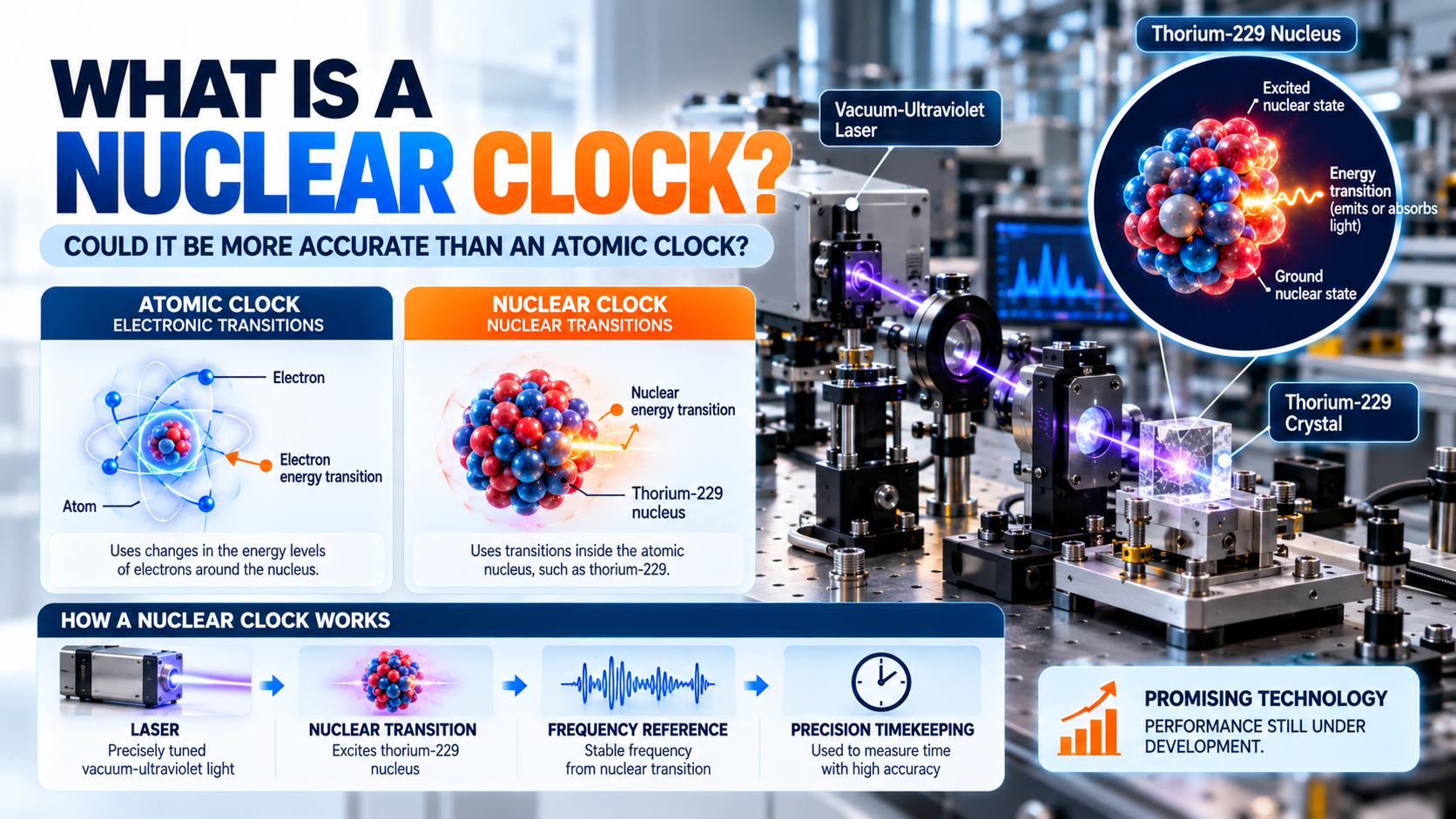
A nuclear clock is a highly precise timekeeping device that uses changes in the energy state of an atom’s nucleus to establish a stable frequency reference.
To understand this, remember that an atom has two main parts: a central nucleus and electrons surrounding it. The nucleus contains protons and neutrons, while electrons occupy energy levels around the nucleus.
Traditional atomic clocks generally use transitions involving electrons. A nuclear clock, in contrast, measures a transition between energy states inside the nucleus itself.
When a nucleus absorbs light at a specific frequency, it can move from one energy state to another. Scientists can use this carefully controlled transition to stabilize a laser’s frequency. That stable frequency can then serve as the reference for measuring time.
One of the most promising candidates is thorium-229, a particular isotope of thorium. Its nucleus has an unusually low-energy transition that can be addressed using specialized ultraviolet light, making it more practical for nuclear-clock experiments than most known nuclear transitions. Source: NIST
In simple words, a nuclear clock uses the behavior of a tiny atomic nucleus to create a highly stable reference for measuring time.
2. How Does a Nuclear Clock Work?
A nuclear clock uses specialized lasers and nuclear transitions to establish a precise frequency reference. Although the equipment is complex, the basic process can be understood in a few steps.
Step 1: Use a Suitable Atomic Nucleus
Scientists select a nucleus with a suitable energy transition. Thorium-229 is especially interesting because its nuclear transition requires much less energy than most other nuclear transitions.
This makes it possible to study the transition using specialized vacuum-ultraviolet laser technology.
Step 2: Direct Laser Light at the Nucleus
A precisely controlled laser sends light toward thorium-229 nuclei. When the laser frequency matches the required energy difference, it can excite the nucleus into a different energy state.
This is called a nuclear transition.
Step 3: Detect the Nuclear Response
Researchers measure how the nuclei respond to the laser. The observed response helps identify the frequency associated with the nuclear transition.
Because the transition occurs inside the nucleus, it offers a different way to establish a timekeeping reference than the electronic transitions used in conventional atomic clocks.
Step 4: Stabilize the Laser Frequency
A feedback system compares the laser with the nuclear transition and corrects frequency drift. This helps maintain a stable reference over time.
Step 5: Use the Stable Frequency for Timekeeping
Once the frequency reference is sufficiently stable, it can be used as the basis for a clock. Scientists evaluate its stability, reproducibility, and systematic uncertainty to determine how well it can measure time.
The important point is that detecting a nuclear transition is only one part of building a clock. The complete system must also control its laser, measure the signal reliably, and maintain stable operation.
3. Nuclear Clock vs Atomic Clock: What Is the Difference?
The biggest difference between these clocks is the part of the atom they use to measure time.
| Feature | Atomic Clock | Nuclear Clock |
|---|---|---|
| Main reference | Energy transitions involving electrons | Energy transitions inside the nucleus |
| Physical system | Atoms or ions | Nuclei, such as thorium-229 |
| How it works | Measures a highly stable electronic transition | Measures a nuclear transition using specialized laser systems |
| Environmental effects | Electronic transitions can be affected by external fields and temperature | Nuclear transitions may be less sensitive to some external disturbances |
| Current maturity | Highly developed and used in real-world systems | Emerging technology with early experimental clock demonstrations |
| Potential future benefits | Extremely accurate timekeeping and navigation | Potentially robust clocks and new tests of fundamental physics |
Both technologies rely on quantum physics and precise frequency measurements. Nuclear clocks are not automatically better in every respect, because the performance of the complete clock depends on the transition, lasers, materials, control systems, and measurement methods.
4. Could a Nuclear Clock Be More Accurate Than an Atomic Clock?
Potentially, yes—but this has not yet been established in practice.
Nuclear clocks have several theoretical advantages that could eventually make them competitive with, or even better than, certain atomic clocks.
The Nucleus Is Less Exposed to Some Environmental Disturbances
Electrons are influenced by their surroundings, including electromagnetic fields and temperature-related effects. These influences can shift the frequency of an electronic transition and introduce measurement errors.
The nucleus is much smaller and more shielded from many external disturbances. This could make a nuclear transition less sensitive to certain environmental effects and help researchers build a more stable clock. However, nuclear transitions are not completely immune to their surroundings.
Nuclear Transitions May Offer High Precision
A clock’s performance depends on how precisely its reference frequency can be measured and maintained. The properties of the thorium-229 transition make it an attractive candidate for precision measurements.
Researchers are working to improve the laser systems, crystal materials, signal detection, and feedback mechanisms needed to use this transition reliably.
Early Nuclear Clocks Are Now Being Demonstrated
In October 2026, research teams reported operational nuclear-clock systems based on thorium-229. One study demonstrated a nuclear clock synchronized to the thorium transition, while another reported a clock using a feedback loop to stabilize its operation. These are important milestones, but the systems remain experimental. Sources: Nature study 1 and Nature study 2
For now, the most accurate established atomic clocks remain ahead in demonstrated performance. Nuclear clocks offer a promising path for future improvements, but further testing is needed before scientists can determine whether they will become more accurate overall.
5. Why Is Thorium-229 Important for Nuclear Clocks?
Thorium-229 plays a special role because it has an unusually low-energy nuclear transition that researchers can excite with specialized laser light.
Most nuclear transitions require extremely high-energy radiation that is difficult to generate and control with the precision needed for a clock. The thorium-229 transition is unusual because its energy is low enough to be accessible using vacuum-ultraviolet light.
Scientists can incorporate thorium-229 into suitable crystals, allowing many nuclei to be studied in a solid material rather than relying only on a single isolated nucleus.
This solid-state approach may help researchers develop systems that are more compact and potentially easier to deploy than some highly specialized atomic-clock arrangements. Nevertheless, producing suitable crystals, controlling temperature-related effects, and generating the required ultraviolet light remain important engineering challenges.
Thorium-229 is therefore not just another experimental material. It is one of the key reasons a practical nuclear clock has become possible.
6. What Are the Potential Applications of Nuclear Clocks?
Nuclear clocks are still in an early stage of development, so most proposed applications require further research. If the technology becomes sufficiently stable, reliable, and practical, it could be useful in several areas.
More Precise Navigation
Satellite navigation systems depend on accurate timing to estimate distances and determine positions. Improvements in timekeeping could support future navigation and positioning technologies.
However, a nuclear clock would need to meet strict requirements for size, power consumption, reliability, and operation in space before it could be used in satellite systems.
Advanced Telecommunications
Communication networks use precise timing to synchronize equipment and coordinate data transmission. Future high-performance clocks could support specialized timing and synchronization applications.
The practical benefit would depend on whether nuclear clocks offer measurable advantages over existing timing technologies.
Fundamental Physics Research
One of the most exciting possibilities is using nuclear clocks to test the laws of physics with greater sensitivity.
Scientists can compare clock frequencies over time and look for extremely small changes that might reveal whether fundamental constants of nature vary. Such experiments could help investigate questions that current measurements cannot fully answer.
Scientific Measurement
Highly stable clocks can improve experiments that require precise frequency measurements. Nuclear clocks could become valuable tools in laboratories studying quantum physics, atomic and nuclear structure, and other fundamental processes.
Compact Precision Instruments
Solid-state nuclear clocks may eventually enable compact precision instruments. Their potential suitability for smaller systems is an important research goal, but commercial availability and real-world performance remain uncertain.
7. What Are the Challenges of Nuclear Clock Technology?
Despite recent progress, nuclear clocks face several challenges before they can compete with established atomic clocks or be used widely.
Specialized Laser Requirements
The thorium-229 transition requires vacuum-ultraviolet light. Producing and controlling this light with the necessary precision is technically difficult and requires specialized optical systems.
Frequency Stability and Measurement
A clock must maintain a reliable reference over time. Researchers need to reduce measurement noise, stabilize laser frequencies, and evaluate possible sources of error.
Material and Temperature Effects
When thorium-229 is placed inside a crystal, interactions with the surrounding material can influence the measured transition. Scientists must characterize these effects and identify suitable operating conditions.
Complex Experimental Equipment
Early nuclear clocks require specialized lasers, detectors, optical components, and control systems. Making these systems smaller, more robust, and easier to operate will be important for practical applications.
Proving Long-Term Performance
A promising laboratory result does not automatically establish that a clock will outperform existing systems. Researchers must compare clocks using consistent measurement methods and carefully evaluate their uncertainty, stability, and reproducibility.
These challenges do not mean nuclear clocks will fail. They show why the technology needs continued experimental development before its ultimate performance can be established.
8. What Does the Future Hold for Nuclear Clocks?
The future of nuclear clocks will depend on how effectively scientists improve their performance and simplify the equipment required to operate them.
Current research is focused on stabilizing laser systems, improving the reproducibility of thorium-229 transitions, understanding the influence of crystal materials, and refining the feedback systems that keep the clock frequency stable.
One possible direction is the development of solid-state nuclear clocks that can operate with less complex equipment than some existing precision-clock systems. Another is using their sensitivity to investigate fundamental physical constants and search for new physics.
It is important to distinguish between demonstrated results and future possibilities. Nuclear clocks have reached a significant experimental milestone in 2026, but they are not yet a routine replacement for atomic clocks.
If future systems demonstrate better performance under practical conditions, nuclear clocks could become an important new tool for precision measurement, scientific research, and specialized timing applications.
Conclusion: Are Nuclear Clocks the Future of Timekeeping?
Nuclear clocks are an emerging technology that uses energy transitions inside an atomic nucleus to establish a highly precise frequency reference. Unlike conventional atomic clocks, which generally rely on electronic transitions, nuclear clocks can use the thorium-229 nucleus as their reference.
In October 2026, researchers reported working experimental nuclear-clock systems, marking an important step toward practical nuclear timekeeping. Their potential advantages include reduced sensitivity to certain environmental disturbances and new opportunities for precision physics.
However, nuclear clocks have not yet proven that they can outperform the best atomic clocks in overall accuracy. Laser technology, material effects, stability, and long-term reliability remain important challenges.
For now, nuclear clocks should be viewed as a promising next-generation technology rather than a replacement that is ready for everyday use. As research continues, they could expand what scientists can measure and help answer some of the most fundamental questions in physics.
