Introduction
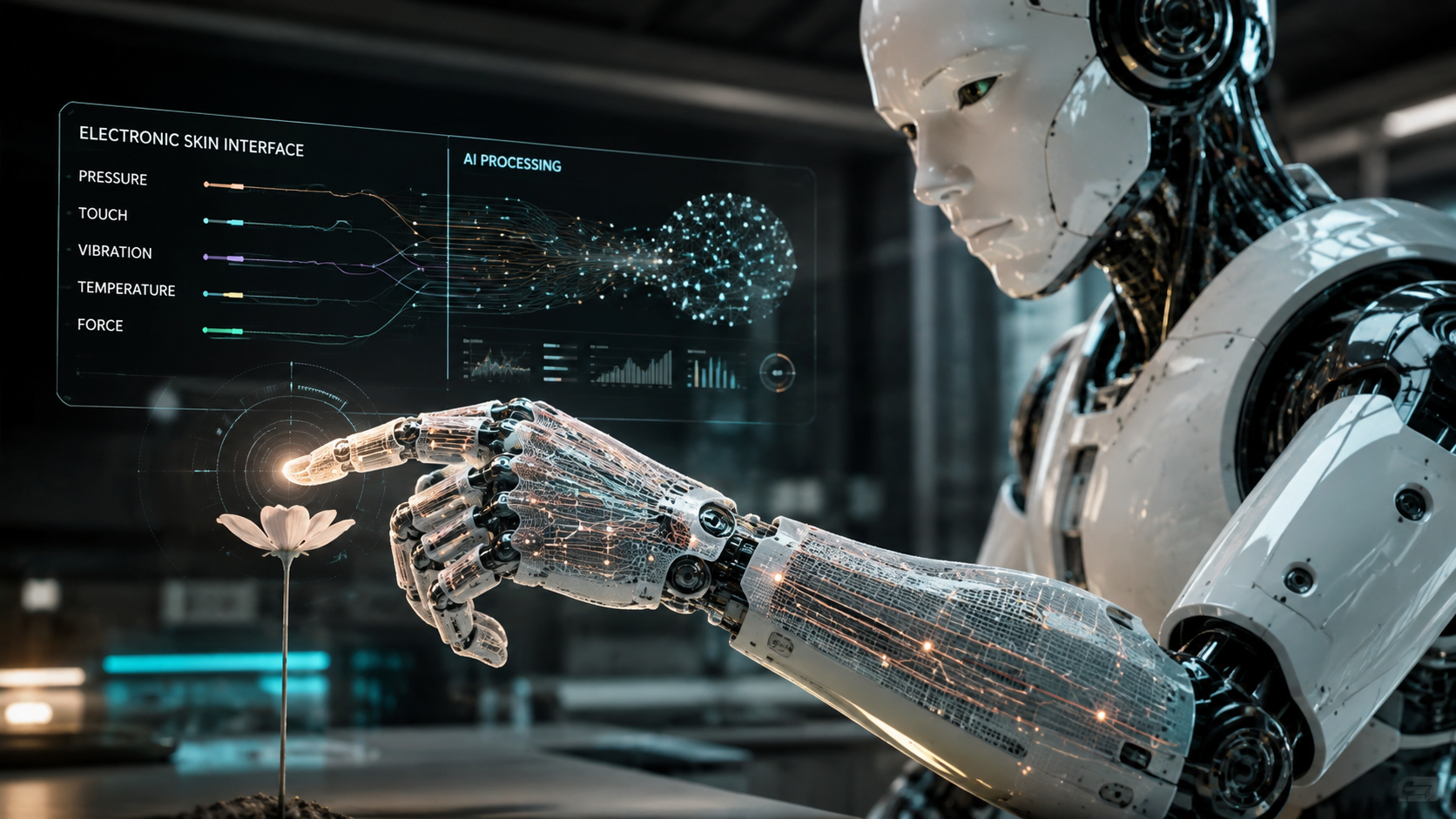
Imagine a robot that can not only see an object but also feel it. It could know whether something is soft or hard, detect how strongly it is holding an object, and even recognize when something starts slipping from its hand.
This is the idea behind electronic skin, or e-skin. Engineers and researchers are developing flexible sensors that can give robots a sense of touch similar to human skin. This technology could make future robots safer, smarter, and much better at interacting with people and objects.
What Is Electronic Skin?
Electronic skin is a thin, flexible layer of electronic sensors designed to copy some of the abilities of human skin.
Human skin can detect pressure, temperature, movement, vibration, and touch. Electronic skin tries to perform similar functions using sensors and electronic components.
These sensors can be placed on robotic hands, arms, humanoid robots, prosthetic limbs, and other machines. When the surface touches something, the sensors collect information and send it to the robot’s computer system.
In simple words, electronic skin gives machines a way to understand physical contact.
Why Do Robots Need Touch?
Most modern robots depend heavily on cameras and other sensors to understand their surroundings. Cameras are excellent for recognizing objects, but they cannot tell a robot everything about physical contact.
For example, a camera may tell a robot that it is holding an apple. But it cannot directly tell the robot whether it is squeezing the apple too hard or whether the apple is beginning to slip.
Humans solve this problem naturally through touch. We automatically adjust our grip when we hold a fragile or slippery object.
Electronic skin could give robots a similar ability.
How Does Electronic Skin Work?
Electronic skin usually contains many tiny sensors that detect physical changes.
When a robot touches an object, these sensors can detect things such as pressure, force, temperature, vibration, or stretching. The information is converted into electronic signals and sent to a processor.
The robot’s software or AI can then analyze those signals and decide what action to take.
A simple example is a robot picking up an egg. If its sensors detect that the egg is under too much pressure, the robot can reduce its grip. If the egg starts slipping, the robot can increase its grip.
This creates a simple process:
Touch → Sensors → Data → AI/Computer → Robot Action
What Can Electronic Skin Detect?
Modern e-skin research is exploring several types of sensing.
Pressure
Pressure sensors can tell a robot how strongly it is touching or holding something.
Temperature
Temperature sensors can help machines identify whether an object or surface is hot or cold.
Vibration
Vibration sensing can help robots detect movement or identify changes when objects touch their surfaces.
Stretch and Movement
Flexible sensors can detect when the artificial skin bends, stretches, or changes shape.
By combining these signals, robots can build a much better understanding of physical interactions.
Electronic Skin and Artificial Intelligence
Electronic skin becomes even more useful when combined with artificial intelligence.
A robotic hand could collect thousands of sensor readings while touching an object. Instead of simply receiving raw numbers, AI can learn what different patterns mean.
For example, an AI system could learn that a certain combination of pressure and vibration means an object is slipping.
The robot could then automatically adjust its grip.
This combination of e-skin, sensors, robotics, and AI could help create machines that respond to physical situations instead of simply following fixed instructions.
Where Can Electronic Skin Be Used?
Electronic skin has potential applications across many industries.
Humanoid Robots
Humanoid robots need to interact with objects and people in environments designed for humans.
Adding tactile sensors to robotic hands and bodies could help these robots pick up fragile objects, handle tools, open doors, and perform other physical tasks more carefully.
Industrial Robots
Factories use robots for assembly, packaging, inspection, and manufacturing.
Electronic skin could help industrial robots detect whether they are applying too much force or whether a component has moved from the correct position.
This could make robotic manufacturing more flexible and accurate.
Prosthetic Hands
Electronic skin could also improve advanced prosthetic limbs.
Sensors in a prosthetic hand could detect contact and pressure. In the future, this information could potentially be converted into feedback that helps users understand what their artificial hand is touching.
This could make prosthetic limbs feel more natural to use.
Healthcare Robots
Healthcare robots may need to physically interact with patients and medical equipment.
Tactile sensors could help these robots understand contact and apply appropriate amounts of force during certain tasks.
Soft Robots
Soft robots are designed to bend and deform instead of using only rigid structures.
Flexible electronic skin can work well with these robots because the sensors can be placed across curved and moving surfaces.
What Are the Challenges?
Electronic skin is promising, but engineers still face several difficult challenges.
Making It Flexible
Human skin can stretch, bend, and move continuously. Electronic components normally do not behave this way.
Engineers therefore need flexible materials and electronics that can continue working when stretched or bent.
Making It Sensitive
The sensors must be sensitive enough to detect very small touches but strong enough to handle larger forces.
Finding this balance is difficult.
Power Consumption
Large areas of electronic skin can contain many sensors. These sensors require energy to operate and process their data.
Researchers are therefore exploring more energy-efficient designs and self-powered technologies.
Processing Huge Amounts of Data
A robot covered with thousands of sensors could generate a huge amount of information.
The robot needs efficient hardware and AI systems to process this information quickly and turn it into useful actions.
Durability
Robots may touch thousands of objects during their lifetime.
Electronic skin needs to survive repeated bending, stretching, friction, and physical contact without losing its performance.
Electronic Skin vs Human Skin
Electronic skin does not currently match the complexity of real human skin.
Human skin combines touch, temperature, pressure, pain, and other sensory information and sends it directly to the nervous system.
Electronic skin uses sensors and computers to perform some similar functions.
However, researchers are continuously improving the technology. Future systems could become more sensitive, flexible, durable, and capable of detecting multiple types of physical information at the same time.
What Could the Future Look Like?
The future of electronic skin could be much more advanced than today’s systems.
Researchers are working on artificial skin that could be:
- More flexible
- More sensitive
- Self-powered
- Self-healing
- Wireless
- More durable
- Smaller and lighter
- Better integrated with AI
One exciting possibility is self-powered electronic skin. Instead of depending entirely on batteries, certain technologies could use energy generated by movement or touch.
Another important development is AI-powered tactile perception. Instead of simply detecting pressure, future robots could learn what different types of touch actually mean.
Why Electronic Skin Matters
Robots are increasingly moving from controlled factory environments into homes, hospitals, warehouses, construction sites, and other unpredictable environments.
In these situations, seeing an object is not always enough.
A robot may need to know whether an object is fragile, slippery, heavy, hot, or moving.
That is where touch becomes important.
Electronic skin could help robots move from simply seeing and identifying objects to actually understanding physical interaction.
Conclusion
Electronic skin is an exciting emerging technology that could give robots a sense of touch.
By combining flexible sensors, advanced materials, electronics, and artificial intelligence, engineers are developing machines that can detect pressure, temperature, vibration, movement, and other physical signals.
The technology is still developing, and many challenges remain. However, better electronic skin could have a major impact on humanoid robots, industrial automation, prosthetics, healthcare, and soft robotics.
The next generation of robots may not only see and think.
They may also feel and respond.
