Introduction
Artificial intelligence is becoming part of everyday life. From answering questions to writing emails and helping with work, AI tools are becoming more useful every year.
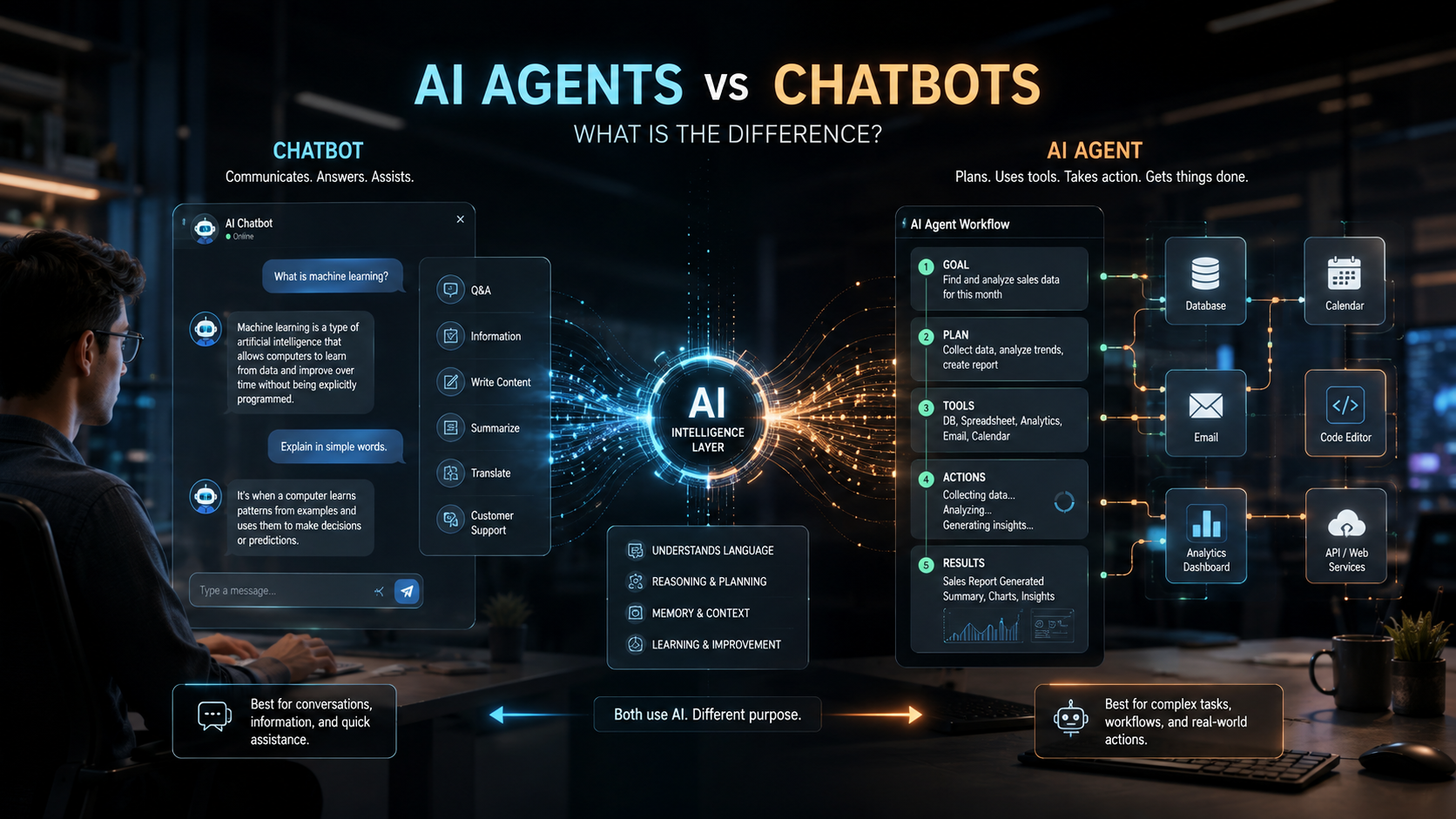
Two terms you will hear frequently are AI chatbots and AI agents. They may sound similar, but they are not exactly the same.
The simplest difference is this:
AI chatbot = Talks and answers.
AI agent = Plans and takes action.
A chatbot is mainly designed to communicate with you. An AI agent can go a step further by understanding a goal, deciding what needs to be done, using tools, and completing multiple steps.
What Is an AI Chatbot?
An AI chatbot is a computer program that communicates with people using natural language.
You ask a question or give it an instruction, and the chatbot generates a response. Modern AI chatbots often use large language models (LLMs) to understand what users are asking and create useful answers.
For example, you could ask a chatbot:
“Explain machine learning in simple words.”
The chatbot can explain the concept, provide examples, and answer follow-up questions.
Chatbots are especially useful for conversation, information, writing, brainstorming, and basic assistance.
What Can AI Chatbots Do?
AI chatbots can perform many useful tasks.
They can answer questions, summarize articles, translate text, write emails, generate ideas, explain technical concepts, help with learning, and provide customer support.
For example, a customer might ask:
“Where is my order?”
A chatbot can provide an answer if it has access to the required information.
However, a basic chatbot is generally focused on responding to the user’s request rather than independently completing a long sequence of actions.
What Is an AI Agent?
An AI agent is an AI system designed to work toward a specific goal.
Instead of only answering a question, an AI agent can potentially decide what steps are needed to complete a task.
For example, imagine asking:
“Find three good laptops for video editing under my budget and compare them.”
An AI agent could potentially search for products, collect specifications, compare prices and features, remove unsuitable options, and prepare a final comparison.
The important difference is that an agent can be designed to perform a workflow, not just generate a response.
How Does an AI Agent Work?
An AI agent usually works through several stages.
First, it understands the user’s goal. Then it creates a plan, selects the tools it needs, performs actions, checks the results, and continues until the task is complete or human approval is required.
A simple example looks like this:
Goal → Plan → Use Tools → Take Action → Check Result → Continue
Suppose you ask an AI agent to analyze your sales data.
The agent could access the data, calculate important numbers, identify trends, create a report, and present the results.
Instead of asking the AI to perform every individual step, you give it the overall goal.
AI Chatbots vs AI Agents: The Main Difference
The easiest way to understand the difference is to compare what you ask them to do.
With a chatbot, you might say:
“Tell me how to create a monthly sales report.”
The chatbot explains the process.
With an AI agent, you might say:
“Create this month’s sales report using our sales data.”
The agent can potentially access the required data, analyze it, prepare the report, and return the result.
So the basic difference is:
Chatbot → Gives information
AI Agent → Works toward completing a task
How Do AI Chatbots Work?
A simple chatbot interaction looks like this:
User → Question → AI Model → Answer
You provide a message, the AI processes it, and the chatbot generates a response.
Modern chatbots can also use additional information, tools, and memory, so the line between a chatbot and an agent can sometimes become less clear.
However, the main purpose of a chatbot is still natural-language interaction.
How Do AI Agents Work?
AI agents add more components to the process.
A typical agent may include an AI model, memory, planning capabilities, external tools, and a system for taking actions.
For example:
User Goal
↓
AI Understands the Goal
↓
AI Creates a Plan
↓
AI Uses Tools
↓
AI Performs Actions
↓
AI Checks the Results
↓
Task Completed
This allows an AI agent to handle more complex tasks with less step-by-step instruction from the user.
AI Agents Can Use External Tools
One of the biggest advantages of AI agents is their ability to work with external tools.
Depending on their permissions, agents can potentially connect to:
- APIs
- Databases
- Websites
- Email systems
- Calendars
- Spreadsheets
- CRM software
- Code repositories
- Business applications
For example, a customer-support agent could receive a complaint, look up the customer’s order, check the delivery status, and provide an appropriate response.
This is much more powerful than simply generating a text answer.
AI Agents Can Handle Multiple Steps
Another important difference is multi-step task execution.
Imagine you ask an AI:
“Plan a two-day business trip.”
A chatbot might give you suggestions for flights, hotels, restaurants, and activities.
An AI agent could potentially handle the workflow by researching options, comparing them, checking your calendar, organizing the schedule, and preparing an itinerary.
The agent is not necessarily doing everything automatically, but it can coordinate multiple steps toward one larger goal.
AI Agents and Memory
Memory can make AI agents more useful for ongoing tasks.
A chatbot can remember information within a conversation, depending on how it is designed. An AI agent can also be built to maintain information about previous tasks, user preferences, or the current state of a workflow.
For example, an AI personal assistant could remember that you prefer morning meetings and use that information when helping organize your schedule.
This allows an agent to work more like an ongoing assistant rather than a simple question-and-answer system.
What Are AI Chatbots Best Used For?
AI chatbots are ideal when you mainly need information or conversation.
Common uses include:
Customer Support
Chatbots can answer frequently asked questions about products, services, payments, shipping, and returns.
Education
Students can use chatbots to explain difficult topics, create examples, and practice questions.
Content Creation
Writers can use chatbots for brainstorming, outlining, rewriting, summarizing, and generating ideas.
Everyday Assistance
People can use chatbots to plan ideas, understand information, translate text, and solve simple problems.
What Are AI Agents Best Used For?
AI agents are more useful when a task involves multiple steps and actions.
Software Development
A coding agent can inspect a project, modify files, run tests, find errors, and make corrections.
Business Operations
An agent can collect information from different systems and prepare reports or summaries.
Customer Service
An agent can investigate customer issues, access approved information, and perform certain support actions.
Research
A research agent can search information, organize findings, compare sources, and create a structured report.
Simple Comparison: AI Agents vs Chatbots
| Feature | AI Chatbot | AI Agent |
|---|---|---|
| Conversation | Excellent | Excellent |
| Answer questions | Yes | Yes |
| Generate content | Yes | Yes |
| Make plans | Limited | Yes |
| Use external tools | Sometimes | Often |
| Perform multiple steps | Limited | Yes |
| Take actions | Limited | Yes |
| Work autonomously | Usually limited | More capable |
| Best for | Information and conversation | Task completion |
Do AI Agents Replace AI Chatbots?
Not necessarily.
Chatbots and AI agents solve different problems, and they can work together.
A chatbot can provide the conversation interface while an AI agent works in the background to complete a task.
For example, you could tell an AI assistant:
“I need to organize a business trip.”
The conversational AI understands what you want, while different specialized agents could handle travel research, hotel selection, calendar planning, and expense information.
To the user, it may feel like one AI assistant is doing everything.
What Are the Risks of AI Agents?
AI agents can be more powerful than traditional chatbots, but that also means they can create additional risks.
If an agent has access to important systems, an incorrect decision could cause problems.
Some major concerns include:
- Data privacy
- Security
- Incorrect actions
- AI hallucinations
- Excessive permissions
- Prompt injection
- Unauthorized access
- Lack of human supervision
For important tasks, organizations should use appropriate permissions, security controls, monitoring, and human approval.
An AI agent should not automatically receive unlimited access to sensitive systems.
Will AI Agents Become More Popular?
AI is increasingly moving from systems that simply generate content toward systems that can perform useful work.
Chatbots made it easier for people to communicate with computers using normal language.
AI agents take that idea further by connecting AI with software, data, APIs, and other tools.
Instead of saying:
“AI, tell me how to do this.”
People can increasingly say:
“AI, help me get this done.”
That change could have a major impact on software development, customer service, research, business operations, education, and personal productivity.
The Future of AI Agents and Chatbots
In the future, the difference between a chatbot and an AI agent may become less obvious.
A single AI assistant could combine:
- Natural conversation
- Reasoning
- Memory
- Planning
- Tool usage
- Data access
- Task execution
- Human approval
You could simply explain what you want, and the AI could determine which tools and steps are needed.
This could change the way people interact with software.
Instead of opening several applications and completing every step manually, users could describe their goal in natural language and let AI coordinate the workflow.
Conclusion
AI chatbots and AI agents are both important parts of modern artificial intelligence, but they have different roles.
AI chatbots are mainly designed to communicate, answer questions, and provide assistance. AI agents are designed to work toward goals by planning steps, using tools, and taking actions.
The simplest way to remember the difference is:
Chatbots help you talk to AI.
AI agents help AI get things done.
As AI continues to develop, we are likely to see more systems combining both capabilities. The future of AI may not just be about generating better answers—it may be about helping people complete real-world tasks with fewer manual steps.
