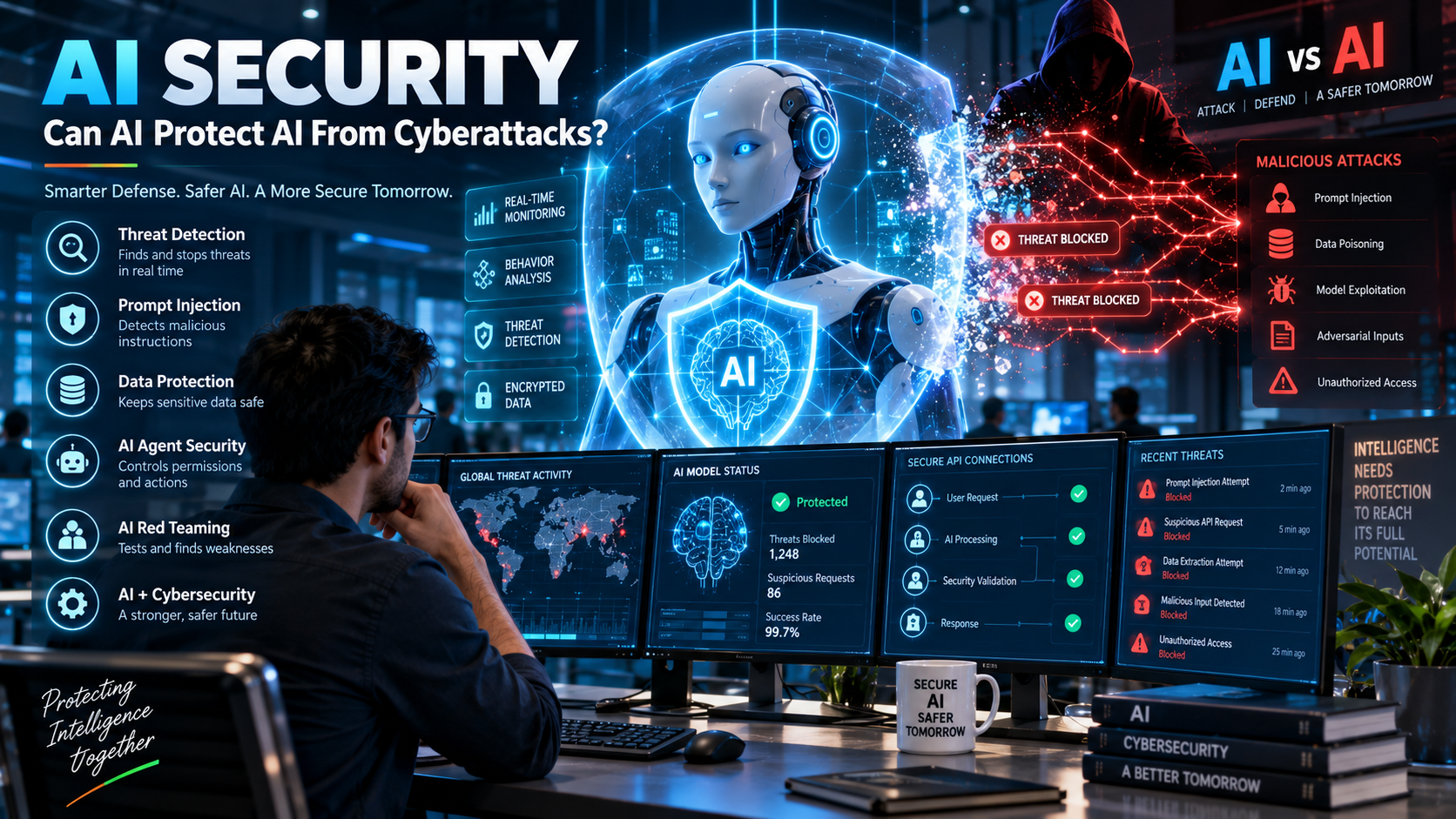
Artificial Intelligence is becoming a major part of modern technology. Companies are using AI for customer support, software development, banking, healthcare, cybersecurity, business automation, and many other areas.
But as AI becomes more powerful, it is also becoming a new target for hackers.
AI systems can process sensitive information, connect to databases, use external tools, and sometimes make decisions automatically. If attackers find a weakness in an AI system, they may try to manipulate its behavior or access information that they should not see.
At the same time, cybersecurity companies are using AI to detect threats and protect systems.
This creates an interesting question:
Can AI protect AI from cyberattacks?
What Is AI Security?
AI security means protecting AI models, applications, data, AI agents, and supporting systems from cyberattacks and misuse.
Traditional cybersecurity protects computers, networks, applications, and databases.
AI security adds some new areas that need protection, such as:
- AI models
- Training data
- Prompts
- AI-generated responses
- AI agents
- AI tools
- APIs
- AI memory
- Embeddings
- Model infrastructure
In simple words, AI security is cybersecurity designed for the AI era.
Why Does AI Need Special Security?
AI systems work differently from traditional software.
Traditional software usually follows predefined rules.
AI systems can understand natural language, analyze information, generate content, use external tools, and sometimes take actions automatically.
For example, an AI agent could potentially:
Read an email → Search company documents → Analyze information → Use an API → Update a record
If an attacker manipulates that AI agent, the attacker may be able to influence actions that the AI is authorized to perform.
This is why AI systems need additional security controls.
Can AI Be Used to Protect AI?
Yes.
AI can also be used as a cybersecurity tool.
Security systems can use AI to analyze huge amounts of information and look for unusual patterns.
For example, AI can analyze:
- Network activity
- Login attempts
- API requests
- Application logs
- User behavior
- Malware activity
- Security alerts
- AI model behavior
Because AI can process large amounts of information quickly, it can help security teams identify potential threats faster.
How Can AI Detect Cyberattacks?
AI-powered security systems can learn what normal activity looks like and look for unusual behavior.
For example, imagine an employee normally accesses 20 company files every day.
Suddenly, the same account starts downloading thousands of files.
An AI security system could recognize this unusual behavior and generate an alert.
AI can potentially detect:
- Suspicious login activity
- Unusual network traffic
- Abnormal API requests
- Malware behavior
- Account takeover attempts
- Large data transfers
- Suspicious AI-agent actions
The goal is to identify problems before they become serious security incidents.
What Is an AI Cyberattack?
An AI cyberattack is an attack that specifically targets an AI system or uses AI to help perform an attack.
Attackers may try to:
- Manipulate AI instructions
- Steal sensitive information
- Poison training data
- Exploit AI tools
- Abuse AI permissions
- Attack AI APIs
- Manipulate AI agents
- Bypass AI security controls
AI therefore creates a new security environment for both attackers and defenders.
What Is Prompt Injection?
One of the important security risks in AI applications is prompt injection.
Prompt injection happens when an attacker creates instructions designed to manipulate an AI system into ignoring its intended task or following an unwanted instruction.
For example, an AI assistant may be asked to summarize a document.
An attacker could place malicious instructions inside that document.
The AI might then treat those instructions as part of its task and behave unexpectedly.
This is similar to tricking the AI into following the attacker’s instructions instead of the user’s original request.
What Is AI Agent Security?
AI agents are becoming more powerful than simple chatbots.
A chatbot generally provides an answer.
An AI agent can potentially:
Understand → Plan → Use Tools → Make Decisions → Take Actions
For example, a business AI agent might have access to:
- Company documents
- Customer databases
- Business APIs
- Internal applications
If that agent is compromised, attackers could potentially misuse its permissions.
Therefore, protecting AI agents is becoming an important part of AI security.
Why Are AI Permissions Important?
Imagine an AI customer-support assistant.
It only needs permission to:
Read customer information → Create support tickets
But suppose it also has permission to:
Delete accounts → Change passwords → Transfer money
That would create unnecessary risk.
If the AI is manipulated, the attacker could potentially abuse those extra permissions.
A safer approach is:
Give AI only the permissions it needs.
This is sometimes called the principle of least privilege.
What Is Excessive Agency?
Excessive agency means giving an AI system too many permissions or capabilities.
For example, an AI assistant designed to answer customer questions probably does not need permission to delete a customer’s account.
The more powerful an AI agent becomes, the more important permission controls become.
Organizations should carefully decide:
- What the AI can access
- What the AI can change
- What tools the AI can use
- How much money it can spend
- Which users it can interact with
- Which actions require human approval
Can AI Detect Data Leaks?
AI can help identify potential data leaks.
AI security systems can monitor information and look for sensitive data such as:
- Passwords
- API keys
- Financial information
- Personal information
- Customer records
- Confidential documents
- Business secrets
For example, if an AI application accidentally includes confidential customer information in a response, a security system could potentially detect the sensitive information before it reaches the user.
This can help organizations protect valuable data.
What Is Data Poisoning?
AI systems depend heavily on data.
Attackers may try to manipulate the data used to train or operate an AI system.
This is called data poisoning.
For example, an attacker could introduce incorrect or malicious information into a dataset.
If that information is used by an AI system, it could influence the system’s future behavior.
Data poisoning is particularly important for organizations that build their own AI models or use large external datasets.
What Is AI Supply Chain Security?
Modern AI applications are rarely built from a single component.
An AI application may use:
AI Model + Dataset + Libraries + APIs + Cloud Services + Plugins + External Tools
Each component can introduce security risks.
For example, if a third-party library or AI model is compromised, attackers may be able to use that weakness to attack the larger application.
This is why companies need to understand and secure the entire AI supply chain.
Can AI Fight AI-Powered Cyberattacks?
This is one of the most interesting parts of AI cybersecurity.
Attackers can use AI to make some cyber activities faster and easier.
For example, AI could potentially help attackers:
- Generate malicious code
- Create phishing messages
- Analyze information
- Automate repetitive tasks
- Search for vulnerabilities
Defenders can also use AI.
AI can help security teams:
- Detect suspicious behavior
- Analyze security alerts
- Find vulnerabilities
- Identify malware
- Investigate incidents
- Automate some security responses
This creates a new cybersecurity race:
AI vs AI
Attackers can use AI to improve attacks, while defenders can use AI to improve protection.
How Does AI-Powered Threat Detection Work?
Traditional security systems often depend on predefined rules.
For example:
If activity X happens → Generate security alert.
AI can potentially identify more complicated patterns.
It can analyze large amounts of activity and identify behavior that looks different from normal activity.
For example:
Normal:
User logs in → Opens several files → Completes work → Logs out.
Suspicious:
User logs in → Accesses thousands of files → Downloads large amounts of data.
AI can recognize this difference and alert the security team.
Can AI Automatically Stop Cyberattacks?
AI can potentially automate some security responses.
For example, an AI security system could:
- Block suspicious requests
- Disable a compromised account
- Quarantine a suspicious file
- Restrict a network connection
- Revoke certain permissions
- Alert security professionals
However, automatic actions also create risks.
If AI incorrectly identifies a legitimate activity as an attack, it could block an important user or business service.
For this reason, organizations need appropriate controls and human oversight for high-risk actions.
Why Are Human Cybersecurity Experts Still Important?
AI can process information quickly, but human cybersecurity professionals still provide important judgment.
Humans can understand:
- Business risks
- Company policies
- Security priorities
- Legal requirements
- Attack context
- Customer impact
- Incident response decisions
For example, AI might identify suspicious activity.
A human security expert may need to decide:
“Is this actually an attack, and what should we do next?”
This is why the future of cybersecurity is likely to involve:
AI + Human Security Experts
What Are the Biggest AI Security Threats?
AI systems can face many different security risks.
Prompt Injection
Attackers attempt to manipulate AI instructions.
Data Poisoning
Attackers introduce malicious or incorrect information into AI data.
Sensitive Information Disclosure
AI accidentally exposes confidential information.
Excessive Agency
AI receives more permissions than it needs.
Supply Chain Attacks
Attackers exploit compromised AI models, libraries, datasets, or external tools.
Tool Misuse
Attackers manipulate AI into using connected tools in an unwanted way.
Account and Identity Attacks
Attackers attempt to gain access to the identity or permissions associated with an AI system.
Understanding these risks is an important part of building secure AI applications.
What Is AI Red Teaming?
AI red teaming means deliberately testing an AI system to find security weaknesses before real attackers discover them.
Security teams may try to:
- Manipulate the AI
- Bypass security controls
- Extract sensitive information
- Test prompt injection
- Abuse AI tools
- Test permission boundaries
- Trigger unexpected actions
The purpose is simple:
Find the weakness before the attacker does.
AI red teaming can therefore become an important part of developing secure AI applications.
How Can Companies Protect AI Systems?
Organizations can take several steps to improve AI security.
Limit AI Permissions
Give AI agents only the access they actually need.
Monitor AI Activity
Track what AI systems are doing and which tools they are using.
Protect Sensitive Data
Prevent confidential information from being unnecessarily exposed to AI systems.
Test AI Regularly
Perform security testing and red-team exercises.
Validate AI Outputs
Do not automatically trust every response or action generated by AI.
Secure AI Dependencies
Monitor models, libraries, APIs, datasets, and third-party tools.
Use Human Approval
Require human confirmation for high-risk actions.
Build Strong Authentication
Make sure AI agents and users are properly authenticated.
Can AI Protect AI Completely?
No.
AI can become a powerful cybersecurity tool, but it cannot guarantee complete protection.
New vulnerabilities can appear.
AI can make mistakes.
Security controls can be incorrectly configured.
Users can make mistakes.
Third-party services can become compromised.
Attackers can also develop new techniques.
Therefore, AI should be treated as one part of a complete cybersecurity strategy, not as a replacement for cybersecurity.
What Could the Future of AI Security Look Like?
The future could involve AI systems protecting other AI systems.
For example:
AI Agent → Performs a Business Task
Security AI → Monitors the AI Agent
Threat Detection AI → Identifies Suspicious Activity
Security Automation → Responds to the Threat
Human Expert → Handles Critical Decisions
This could create multiple layers of protection around AI applications.
But there is an interesting question:
Who protects the AI that protects the AI?
This could become one of the biggest challenges of future AI security.
Why Is AI Security Becoming More Important?
AI adoption is growing across businesses and industries.
As companies use AI for more important tasks, the consequences of an AI security failure can become larger.
Companies therefore need to think about more than simply building powerful AI models.
They also need to ask:
How do we protect the AI?
How do we protect its data?
How do we control its permissions?
How do we monitor its actions?
How do we know if someone is manipulating it?
These questions will become increasingly important as AI becomes more deeply connected to business systems.
AI Security Could Become as Important as AI Development
In the early stages of AI adoption, companies mainly focused on creating better models.
Today, organizations are increasingly thinking about both AI capabilities and AI security.
A powerful AI system is not useful if attackers can easily manipulate it.
Future AI development will therefore need to combine:
Performance + Security + Privacy + Reliability + Human Control
This could make AI security an important part of every major AI project.
AI vs AI: What Could the Future Look Like?
Cybersecurity could become an environment where artificial intelligence is used on both sides.
Attackers may use AI to automate and improve attacks.
Defenders may use AI to detect and respond to those attacks.
The difference could come down to:
- Better security architecture
- Stronger access controls
- Faster detection
- Better monitoring
- Secure AI development
- Human oversight
The goal is not simply to build smarter AI.
It is to build smarter and safer AI.
Conclusion
AI is becoming both a cybersecurity target and a cybersecurity tool.
AI can help security teams detect unusual behavior, analyze large amounts of data, identify potential threats, monitor AI agents, and automate some defensive tasks.
At the same time, attackers can use AI to create faster and more sophisticated cyber threats.
This means the future of cybersecurity could increasingly involve:
AI defending against AI-powered attacks.
However, AI cannot protect itself completely.
Organizations will still need strong authentication, access controls, data protection, monitoring, security testing, AI red teaming, and human oversight.
