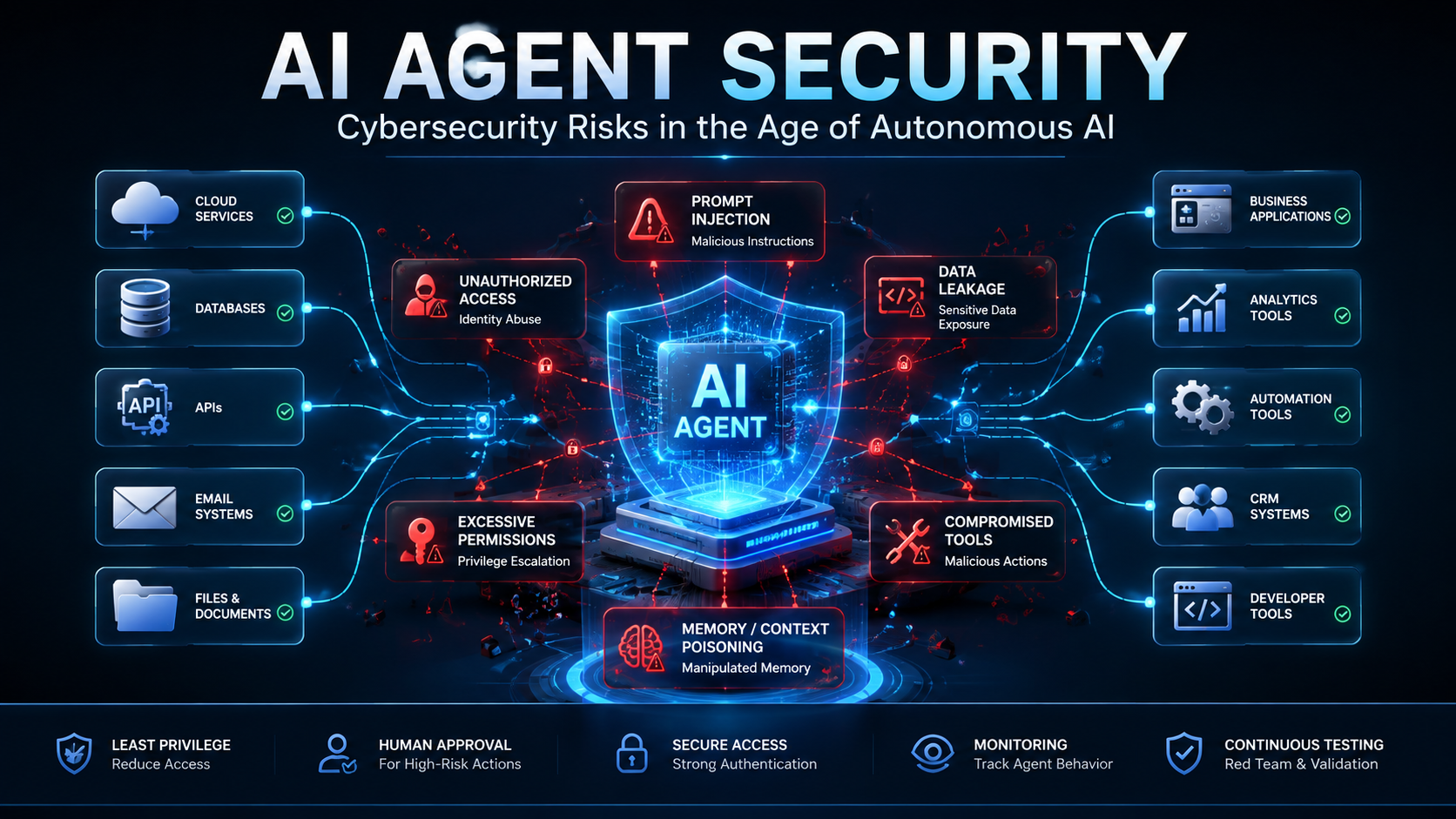
Artificial intelligence is changing quickly. Earlier, most people used AI tools mainly to ask questions, generate content, or analyze information. Today, AI is moving toward something more powerful: AI agents.
AI agents can understand a goal, make decisions, use different tools, access information, and complete tasks with less human involvement. This can save time and automate complex work, but it also creates new cybersecurity risks.
An AI agent with access to emails, databases, files, APIs, or business systems can do much more than a normal chatbot. If that agent is manipulated or poorly secured, the damage can also be much greater.
This is why AI agent security is becoming an important part of modern cybersecurity.
What Is an AI Agent?
An AI agent is a software system that can understand a task and take actions to complete it.
A traditional chatbot usually works like this:
User → Question → AI → Answer
An AI agent can work more like this:
User → Goal → AI Agent → Planning → Tools → Actions → Result
For example, imagine an AI assistant that manages your emails. Instead of simply telling you how to write an email, it could read your inbox, identify important messages, create a reply, and prepare the email for you.
Another agent could search company documents, collect information from a database, analyze it, and create a report.
This ability to take actions is what makes AI agents useful. It is also what makes their security more complicated.
Why AI Agent Security Matters
AI agents often need access to important systems to perform their jobs.
Depending on the application, an agent may have access to:
- Company documents
- Customer information
- Databases
- Emails
- Cloud services
- APIs
- Internal applications
- Source code
- Financial information
If an attacker tricks an AI agent into performing an unwanted action, the problem is no longer just an incorrect AI response.
The agent might actually perform an action that the attacker wants.
For example, a chatbot giving an incorrect answer may be annoying. But an AI agent with access to a database could potentially expose information, change records, or misuse a connected tool.
This difference makes AI agent security extremely important.
How AI Agents Create a New Attack Surface
Traditional applications already have security risks such as stolen passwords, vulnerable APIs, malware, and unauthorized access.
AI agents add another layer to this problem.
An agent can read information, interpret instructions, decide what to do, and call external tools. Every one of these steps can become a possible attack point.
For example:
Web Page → AI Agent → Decision → API → Database
If malicious information enters through the webpage and influences the agent’s decision, the attack could eventually reach the database.
This is one reason why securing AI agents requires more than simply protecting the AI model.
Prompt Injection Attacks
One of the most discussed AI security problems is prompt injection.
Prompt injection happens when someone places instructions inside content that an AI system processes.
Imagine an AI agent that is asked to summarize a webpage. The webpage contains hidden or malicious text telling the agent to ignore its original task and perform another action.
The agent may treat that content as an instruction instead of ordinary information.
This becomes especially dangerous when the agent has access to tools or sensitive information.
Prompt injection is therefore not just a problem for chatbots. It can become much more serious when an AI agent is able to take real actions.
Excessive Permissions
Another major problem is giving an AI agent too many permissions.
Imagine an AI assistant that only needs to read emails and create drafts.
It should not automatically have permission to delete emails, access financial records, change account settings, or send messages to everyone.
If an attacker gains control of the agent or successfully manipulates its instructions, unnecessary permissions can increase the possible damage.
The basic security rule is simple:
Give an AI agent only the permissions it actually needs.
This is known as the principle of least privilege.
AI Agents and Tool Misuse
AI agents often use external tools to complete tasks.
These tools could include:
- Search APIs
- Email systems
- Databases
- Payment services
- Cloud platforms
- Code execution environments
- Internal business applications
The AI decides when and how to use these tools.
This creates another security risk.
If an attacker manipulates the agent, the agent could potentially be encouraged to make an unsafe tool call.
For this reason, applications should not blindly trust every action suggested by an AI model.
Important actions should be checked by the application itself.
Identity and Access Risks
AI agents may use identities just like other software systems.
They might operate with:
- API keys
- OAuth tokens
- Service accounts
- Database credentials
- Cloud permissions
If these credentials are not properly protected, an attacker could potentially use them to gain access to other systems.
Security teams therefore need to treat an AI agent’s identity just as seriously as they treat a human user’s identity.
Authentication and authorization should happen outside the AI model and should be enforced by the application and connected systems.
AI Memory and Context Poisoning
Many modern AI agents can remember information from previous interactions.
Memory can make an agent much more useful because it does not need to start from zero every time.
However, memory can also create a new security problem.
Imagine an attacker manages to insert false or malicious information into an agent’s long-term memory.
The agent could later use that information when making decisions.
This is sometimes described as memory poisoning or context poisoning.
For this reason, developers need to carefully control what information is stored in agent memory and how that information is later retrieved.
Data Leakage
AI agents often work with large amounts of information.
An agent may have access to customer records, private documents, source code, business information, or internal conversations.
If the agent is manipulated or incorrectly configured, sensitive information could potentially be exposed.
Data security should therefore be considered from the beginning of the agent’s design.
Instead of asking only:
“Can the AI understand this data?”
developers should also ask:
“Does this AI agent really need access to this data?”
Limiting unnecessary data access can significantly reduce the potential impact of a security problem.
Rogue AI Agents
A rogue AI agent is an agent that starts behaving outside its intended boundaries.
This does not necessarily mean that the AI has suddenly become “evil.” In many cases, unexpected behavior can come from poor instructions, manipulated data, vulnerable tools, excessive permissions, or mistakes in the system design.
For example, an agent designed to organize files might accidentally modify or delete files because it has been given too much access.
The important point is that AI agents should always operate inside clearly defined boundaries.
Security Risks in Multi-Agent Systems
Some advanced AI applications use multiple agents instead of a single agent.
For example:
Research Agent → Analysis Agent → Writing Agent → Publishing Agent
Each agent performs a different task.
This can make the system more powerful, but it also creates additional security challenges.
If one agent is compromised or receives incorrect information, that information could be passed to another agent.
A small problem can therefore spread through the entire workflow.
Developers need to carefully control communication and trust between different AI agents.
Human Approval Still Matters
AI agents can automate many tasks, but not every action should happen automatically.
High-risk operations should often require human approval.
Examples include:
- Sending important emails
- Making payments
- Deleting important data
- Changing user permissions
- Deploying production code
- Accessing highly sensitive information
A useful approach is to let AI handle routine tasks while requiring a human to approve actions that could cause serious damage.
This creates a balance between automation and control.
How to Secure AI Agents
Securing an AI agent requires several layers of protection.
First, give the agent only the permissions it needs. Avoid giving one agent access to every system simply because it might be useful in the future.
Second, protect API keys, passwords, tokens, and other credentials. These should never be treated as ordinary AI-generated information.
Third, validate important tool calls before allowing them to execute.
Fourth, isolate risky operations. Code execution, file operations, and other sensitive tasks should run inside controlled environments whenever possible.
Finally, monitor what the agent is doing.
Security teams should be able to see which tools an agent uses, what data it accesses, what APIs it calls, and whether its behavior suddenly changes.
Testing AI Agents Against Attacks
AI agents should be tested before they are trusted with important tasks.
Security teams can intentionally test agents with malicious or unexpected inputs.
For example, they can test:
- Prompt injection
- Malicious documents
- Fake instructions
- Unauthorized tool requests
- Privilege escalation
- Malicious memory
- Sensitive data requests
This type of testing can help developers find weaknesses before real attackers discover them.
AI security testing should also continue after deployment because models, tools, data, and agent workflows can change over time.
The Future of AI Agent Security
AI agents are likely to become an important part of software, business automation, customer support, cybersecurity, development, research, and many other industries.
As agents become more capable, they will also receive access to more tools and systems.
That means cybersecurity will need to evolve with them.
The future of AI security will not only be about protecting AI models. It will also be about protecting agent identities, tools, permissions, memory, data, communication, and decision-making workflows.
Organizations that build AI agents should therefore treat security as part of the design process instead of adding it after the system is already deployed.
Final Thoughts
AI agents can make software much more powerful. They can research information, use tools, automate workflows, and complete tasks that previously required human effort.
But greater capability also means greater responsibility.
An AI agent with access to real systems must be treated as a security-sensitive application.
Prompt injection, excessive permissions, tool misuse, data leakage, memory poisoning, identity abuse, and multi-agent communication are some of the challenges developers need to consider.
The goal should not be to stop using AI agents. Instead, organizations should build them with strong permissions, careful monitoring, secure tool access, human approval for high-risk actions, and continuous security testing.
As autonomous AI becomes more common, AI agent security will become an essential part of modern cybersecurity.
