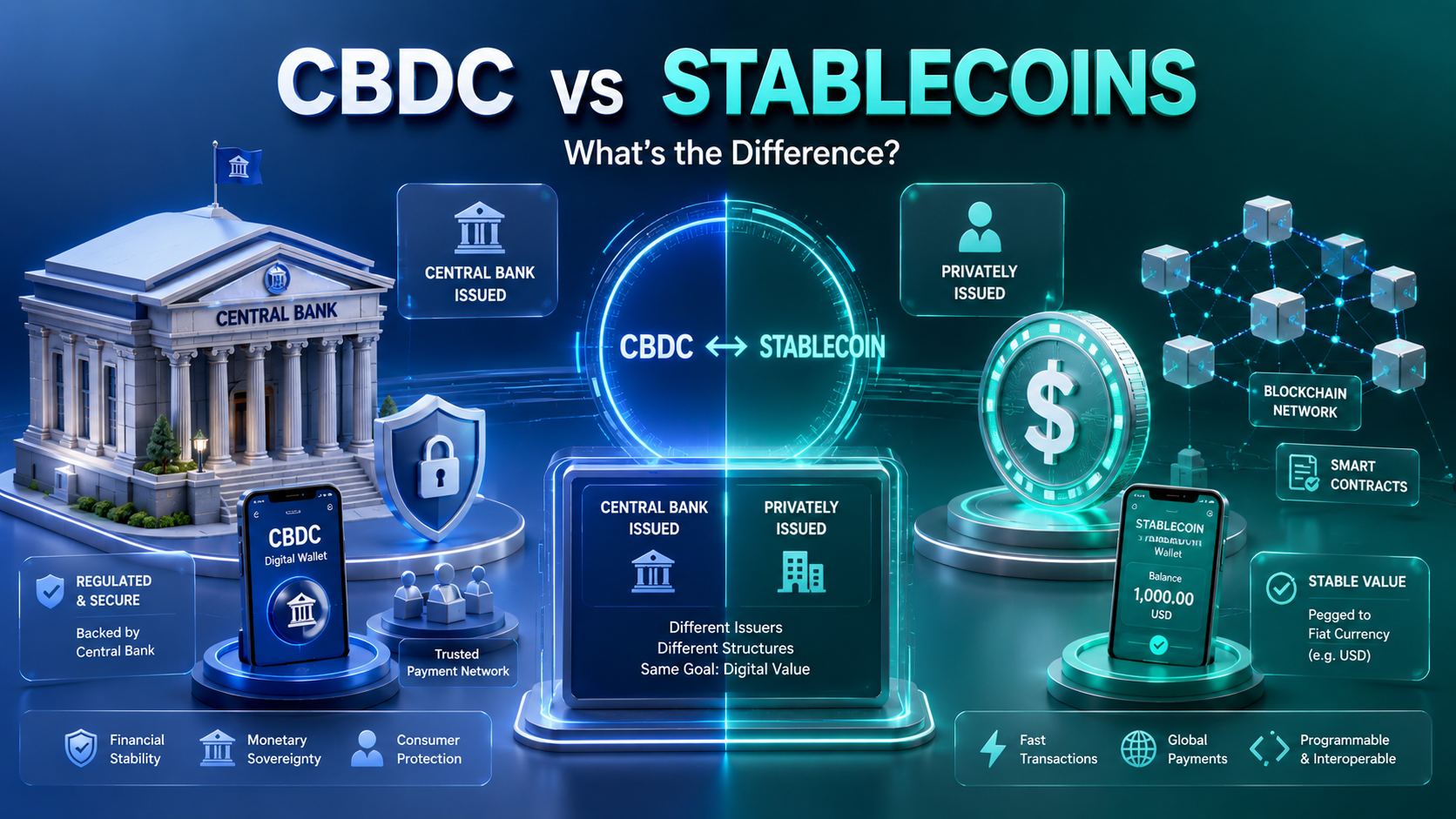
Money is becoming increasingly digital. People already use mobile banking, digital wallets, cards, and online payment apps every day. Now, two other forms of digital money are getting more attention: Central Bank Digital Currencies (CBDCs) and stablecoins.
At first, they may look similar because both can be used to represent digital value. However, they are very different in how they are created, who controls them, and how they work.
A CBDC is digital money issued by a country’s central bank, while a stablecoin is a digital token usually issued by a private company. Understanding this difference can help explain where digital payments and blockchain technology may be heading.
What Is a Central Bank Digital Currency?
A Central Bank Digital Currency, commonly called a CBDC, is a digital form of a country’s official currency issued by its central bank.
Think of it as a digital version of the money people already use. Instead of holding physical cash, a person could potentially hold and use digital central-bank money through an approved digital wallet or payment system.
The important point is that a CBDC is issued by a central bank. It is therefore different from cryptocurrencies such as Bitcoin, which are not issued by a central bank.
How Does a CBDC Work?
The exact design of a CBDC depends on the country and its central bank.
In a typical system, the central bank provides the underlying digital currency infrastructure, while banks or other approved organizations may provide wallets and payment services.
A simple example could look like this:
Central Bank → Digital Currency → Digital Wallet → Payment
A person could use the digital currency to make payments to another person or a business.
A CBDC does not necessarily need to use a public blockchain. Some CBDC systems may use distributed ledger technology, while others may use different centralized or hybrid technologies.
What Is a Stablecoin?
A stablecoin is a type of digital token designed to maintain a relatively stable value.
Many stablecoins are designed to stay close to the value of a national currency, especially the US dollar.
For example, a dollar-linked stablecoin may aim to maintain a value close to one US dollar.
Stablecoins are commonly used in cryptocurrency markets and blockchain applications. They can also be used for digital transfers, decentralized finance, trading, and other blockchain-based activities.
How Do Stablecoins Work?
Stablecoins are usually issued by private companies or organizations rather than central banks.
The issuer generally holds assets or reserves that are intended to support the stablecoin and help users redeem it according to the terms of the system.
A simplified model looks like this:
Private Issuer → Stablecoin → Blockchain Wallet → Digital Payment
The exact design can differ between stablecoins, so users need to understand how a particular stablecoin is backed, how redemption works, and what risks are involved.
The Biggest Difference Between CBDCs and Stablecoins
The easiest way to understand the difference is to ask one question:
Who issues the digital money?
A CBDC is issued by a central bank.
A stablecoin is generally issued by a private organization.
This difference is important because it affects how the money is backed, who is responsible for it, and what users need to trust.
A CBDC represents a direct liability of the central bank. A stablecoin is a private digital token whose stability depends on its issuer, reserves, redemption arrangements, legal structure, and market confidence.
CBDC vs Stablecoin: Simple Comparison
| Feature | CBDC | Stablecoin |
|---|---|---|
| Issuer | Central bank | Private issuer |
| Type | Digital central-bank money | Private digital token |
| Main goal | Digital form of official currency | Stable digital value |
| Value | Based on the national currency | Usually linked to a currency or asset |
| Blockchain required? | No | Often uses blockchain networks |
| Common uses | Payments and digital money | Payments, trading and blockchain applications |
| Main trust factor | Central bank | Issuer, reserves and rules |
| Programmability | Depends on the design | Often supports blockchain-based applications |
The table gives a simple overview, but the exact features can vary depending on the CBDC or stablecoin being discussed.
Why Are CBDCs Becoming Important?
People are using cash less frequently in many parts of the world and relying more on digital payments.
This has encouraged central banks to study whether official money should also have a digital form.
A CBDC could potentially provide a digital version of central-bank money that works alongside cash and traditional bank deposits.
Central banks are exploring different models, including systems designed for everyday payments and other systems focused on financial institutions.
Why Are Stablecoins Becoming Popular?
Stablecoins have become an important part of the blockchain and cryptocurrency ecosystem.
One reason is that cryptocurrencies such as Bitcoin and Ether can experience significant price changes. Stablecoins are designed to reduce that price volatility by linking their value to another asset or currency.
For example, traders may use stablecoins to move value within crypto markets without immediately converting their funds back into traditional bank money.
Stablecoins are also being explored for payments, cross-border transfers, digital commerce, and blockchain-based financial services.
CBDCs and Stablecoins for Digital Payments
Both CBDCs and stablecoins could play a role in the future of digital payments, but they approach the problem differently.
A CBDC provides digital money issued by a central bank.
A stablecoin provides a blockchain-based digital token issued by a private organization.
Stablecoins can be particularly useful in blockchain ecosystems because they can interact with smart contracts and decentralized applications.
CBDCs, depending on their design, could provide a trusted digital form of official currency for everyday payments.
Are Stablecoins the Same as Cryptocurrency?
Stablecoins are part of the broader cryptocurrency and digital-asset ecosystem, but they are different from highly volatile cryptocurrencies.
Bitcoin, for example, does not attempt to maintain a fixed value against the US dollar.
A dollar-linked stablecoin, on the other hand, is specifically designed to maintain a relatively stable value against the dollar.
This makes stablecoins useful for people who want to use blockchain technology without taking the same level of price risk associated with many other crypto assets.
However, “stable” does not mean completely risk-free.
What Are the Risks of Stablecoins?
Stablecoins have their own risks.
Users need to understand what supports a stablecoin and whether the issuer can meet redemption requests.
Questions about the quality of reserves, transparency, regulation, cybersecurity, and the issuer’s financial structure can all be important.
There can also be risks if a stablecoin loses its intended price peg.
For this reason, people should not assume that every stablecoin works in exactly the same way.
What Are the Risks of CBDCs?
CBDCs also raise important questions.
One major topic is privacy. Since CBDC payments are digital, policymakers need to decide how transaction information is collected, stored, and protected.
Cybersecurity is another major concern. A CBDC system would need strong protection because it could become an important part of a country’s financial infrastructure.
There are also questions about access, offline payments, financial inclusion, and how CBDCs could affect banks and existing payment systems.
CBDCs vs Stablecoins and Privacy
Privacy is one of the major differences that can depend heavily on system design.
A CBDC could be designed with specific privacy rules determined by the government and central bank.
Stablecoins operate through private issuers and blockchain networks, where transaction activity may be recorded on-chain.
This does not automatically mean one is more private than the other.
The actual level of privacy depends on the technology, regulations, wallet design, identity requirements, and other controls used by the system.
Can CBDCs and Stablecoins Coexist?
Yes. CBDCs and stablecoins do not necessarily have to replace each other.
The future financial system could contain several forms of digital money at the same time.
People could use:
- CBDCs for certain everyday payments
- Stablecoins for blockchain-based transactions
- Bank deposits for traditional banking
- Digital wallets for different types of payments
- Tokenized assets for digital investments
Different forms of digital money may serve different purposes.
CBDCs vs Stablecoins for Businesses
Businesses could also benefit from both technologies in different ways.
A CBDC could potentially make certain digital payments more direct and efficient.
Stablecoins could be useful for companies working with blockchain networks, digital assets, smart contracts, and international transactions.
For example, a global company could potentially use blockchain-based stablecoins to move digital value between different markets.
However, businesses still need to consider regulations, accounting, taxes, cybersecurity, compliance, and transaction costs before adopting any digital currency system.
Will CBDCs Replace Stablecoins?
It is too early to say that CBDCs will replace stablecoins.
They are built around different models and serve different purposes.
CBDCs are based on central-bank money, while stablecoins are privately issued digital tokens.
Stablecoins may continue to have an important role in blockchain applications and digital finance, while CBDCs may focus more on digital versions of official currencies and payment infrastructure.
The two could eventually exist alongside each other.
The Future of Digital Money
The future of money is becoming increasingly digital.
CBDCs, stablecoins, bank deposits, digital wallets, and tokenized assets could all become part of the financial system.
The important question is not simply whether money will become digital. It already is in many ways.
The bigger question is which forms of digital money people, businesses, banks, and governments will choose to use.
As technology and regulations develop, CBDCs and stablecoins could both play important roles in the next generation of digital payments.
Final Thoughts
CBDCs and stablecoins may look similar because both represent digital value, but their foundations are very different.
A CBDC is digital money issued by a central bank, while a stablecoin is a privately issued digital token designed to maintain a relatively stable value.
CBDCs could provide a digital form of official money, while stablecoins can connect digital payments with blockchain networks and applications.
Neither technology is automatically the perfect solution for every situation. Both come with benefits, limitations, and security considerations.
As blockchain, financial technology, and digital payments continue to develop, understanding the difference between CBDCs and stablecoins will become increasingly important for anyone interested in the future of money.
