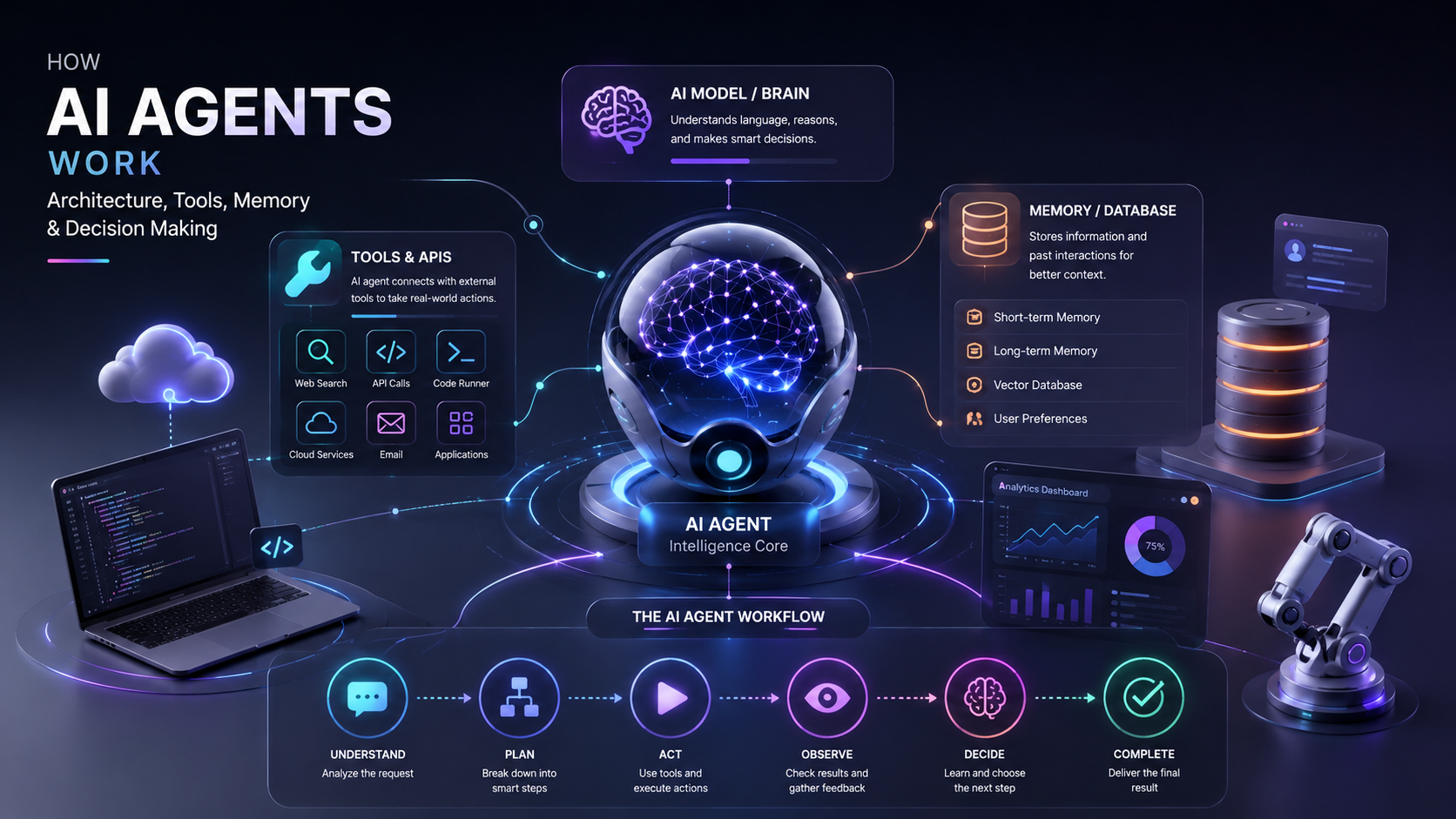
Artificial intelligence is moving beyond simple chatbots. Today, AI can do much more than answer questions. AI agents can understand a goal, make decisions, use tools, remember information, and complete tasks with less human involvement.
From coding and customer support to research and business automation, AI agents are becoming an important part of modern technology.
But how do AI agents actually work?
Let’s understand AI agents in simple words.
What Is an AI Agent?
An AI agent is a software system that can understand a task, decide what needs to be done, and take actions to complete that task.
A normal chatbot usually follows a simple process: you ask a question, and it gives you an answer.
An AI agent can go a step further. It can understand your goal, break the task into smaller steps, use external tools, check the results, and continue working until the task is completed.
For example, if you ask an AI agent to research a product, it could search for information, compare different options, organize the results, and give you a final recommendation.
In simple terms, an AI agent is like a digital assistant that can think through a task and take action instead of only giving you a response.
How Does an AI Agent Work?
An AI agent usually works through a continuous process.
First, it understands the user’s request. Then, it decides what needs to be done. If additional information is required, it can use tools such as search engines, APIs, databases, or code execution systems.
After using a tool, the agent looks at the result and decides what to do next.
The basic process looks like this:
Understand → Plan → Act → Check → Decide → Repeat
This process allows an AI agent to handle tasks that may require several steps.
The AI Model Behind the Agent
The AI model is one of the most important parts of an AI agent.
Large language models and other AI models help the agent understand instructions, analyze information, reason about a problem, and decide what action may be useful.
For example, imagine you tell an AI coding agent:
“Find the login problem and fix it.”
The AI model can understand the request and determine that it may need to inspect the login code, check error messages, find the related files, and test a possible solution.
The model provides the intelligence, while the agent’s surrounding system gives it the ability to interact with the outside world.
How AI Agents Make Decisions
One of the biggest differences between AI agents and traditional chatbots is decision making.
An AI agent does not always need to follow one fixed path. It can look at the current situation and decide what should happen next.
For example, suppose an agent is asked to create a report.
It might first collect information. After looking at the results, it may realize that more data is needed. It can then search for additional information before continuing.
This creates a simple cycle:
Think → Act → Observe → Decide → Act Again
The agent keeps checking the results of its actions and adjusts its next step when necessary.
Tools Give AI Agents the Ability to Act
An AI model by itself cannot automatically perform every real-world task.
This is where tools become important.
AI agents can be connected to external tools that allow them to perform actions such as searching the web, accessing databases, calling APIs, running code, reading files, or working with business applications.
For example, a customer-support AI agent could receive a customer’s question and then use a company database to check the customer’s order status.
The process could look like:
Customer Question → AI Agent → Database → Order Information → AI Agent → Customer Response
Tools effectively give AI agents the ability to interact with external systems.
Why Memory Is Important for AI Agents
Memory helps an AI agent keep track of useful information.
Without memory, an agent may struggle to understand information from earlier parts of a conversation or a long-running task.
There are different ways AI systems can manage memory.
Short-Term Memory
Short-term memory usually contains information from the current conversation or task.
For example, you might tell an AI assistant that you are looking for a laptop and then mention your budget in the next message.
The agent needs the earlier information to understand the complete request.
Long-Term Memory
Long-term memory allows an AI system to store useful information for future tasks.
Depending on the application, this could include preferences, previous tasks, project information, or other relevant data.
Databases and vector databases are commonly used to store and retrieve information that an AI agent may need later.
What Is the Role of an AI Agent’s Architecture?
AI agent architecture describes how all the different parts of an agent work together.
A basic AI agent can contain an AI model, memory, tools, a planning system, and an orchestration layer.
The user provides a goal. The agent sends the relevant information to the AI model. The model decides what should happen next. If an external action is required, the agent uses the appropriate tool.
The tool returns a result, and the agent evaluates that result before continuing.
A simplified architecture looks like this:
User → Agent → AI Model → Tools / Memory → Result → Agent → User
The exact architecture can become much more advanced depending on the application.
How AI Agents Learn From Results
AI agents often use feedback from their actions to decide what to do next.
For example, imagine an agent trying to access an API. If the API returns an error, the agent can analyze the error and potentially try another approach.
This makes agents more flexible than systems that simply follow a fixed sequence of instructions.
However, this does not mean an AI agent always makes the correct decision. Good agent systems still need proper testing, monitoring, permissions, and safety controls.
AI Agents vs Traditional Chatbots
Traditional chatbots are mainly designed to communicate with users and provide responses.
AI agents are designed to achieve goals and perform tasks.
A chatbot might answer:
“What is the weather today?”
An AI agent could potentially use a weather service, check the current conditions, compare them with the forecast, and provide a recommendation based on the user’s request.
The main difference is simple:
Chatbots mainly provide answers. AI agents can take actions to complete tasks.
Real-World Uses of AI Agents
AI agents can be useful in many different industries.
AI Agents for Software Development
Coding agents can help developers understand code, find bugs, create files, write code, run tests, and assist with development tasks.
This can reduce repetitive work and allow developers to spend more time on complex problems.
AI Agents for Customer Support
Customer-support agents can understand questions, find customer information, check orders, answer common questions, and route more complicated issues to human employees.
This can help businesses provide faster support while reducing repetitive manual work.
AI Agents for Business Automation
Businesses can use AI agents to automate tasks such as report generation, document processing, data analysis, email workflows, and internal operations.
Instead of manually completing every step, employees can give the system a goal and let the agent handle parts of the workflow.
AI Agents for Research
Research agents can help collect information from different sources, organize findings, compare information, and create summaries.
This can be useful when working with large amounts of information.
AI Agents in Robotics
AI agents can also be connected to physical robots.
In robotics, an AI system can combine information from cameras and sensors with planning and decision making to determine what the robot should do.
This could help robots perform more complex tasks in factories, warehouses, healthcare, and other environments.
Challenges of AI Agents
AI agents have great potential, but they also come with challenges.
One major problem is AI hallucination. An agent can sometimes make incorrect assumptions or use inaccurate information.
Another challenge is security. If an AI agent has access to databases, files, APIs, or business systems, those permissions need to be carefully controlled.
Cost can also become an issue. A complex task may require multiple AI model requests and several tool calls, which can increase both processing time and API costs.
Reliability is another important concern. Businesses need to test agents carefully before allowing them to perform important tasks without human approval.
Why AI Agent Security Matters
Giving an AI system the ability to take action also means giving it some level of access to external systems.
That access must be controlled.
For example, an AI agent that can read information may not need permission to delete information. Similarly, an agent that can create an email draft may not need permission to send emails automatically.
Using clear permissions, monitoring, validation, and human approval for sensitive actions can make AI agent systems safer.
The Future of AI Agents
AI agents are changing the way people think about artificial intelligence.
Instead of using AI only to generate text or answer questions, people can use AI systems to complete larger tasks.
Future AI agents are expected to become better at planning, using tools, remembering information, working with multiple types of data, and cooperating with other AI agents.
This could lead to AI systems that handle more complex workflows across software development, business, research, customer service, healthcare, robotics, and other industries.
Final Thoughts
AI agents are essentially AI systems that can understand goals, make decisions, use tools, remember information, and take action.
The combination of AI models, tools, memory, planning, and feedback makes them much more capable than simple question-and-answer systems.
For developers and businesses, understanding how AI agents work is becoming increasingly important as AI moves from simple conversations toward more practical and autonomous task completion.
