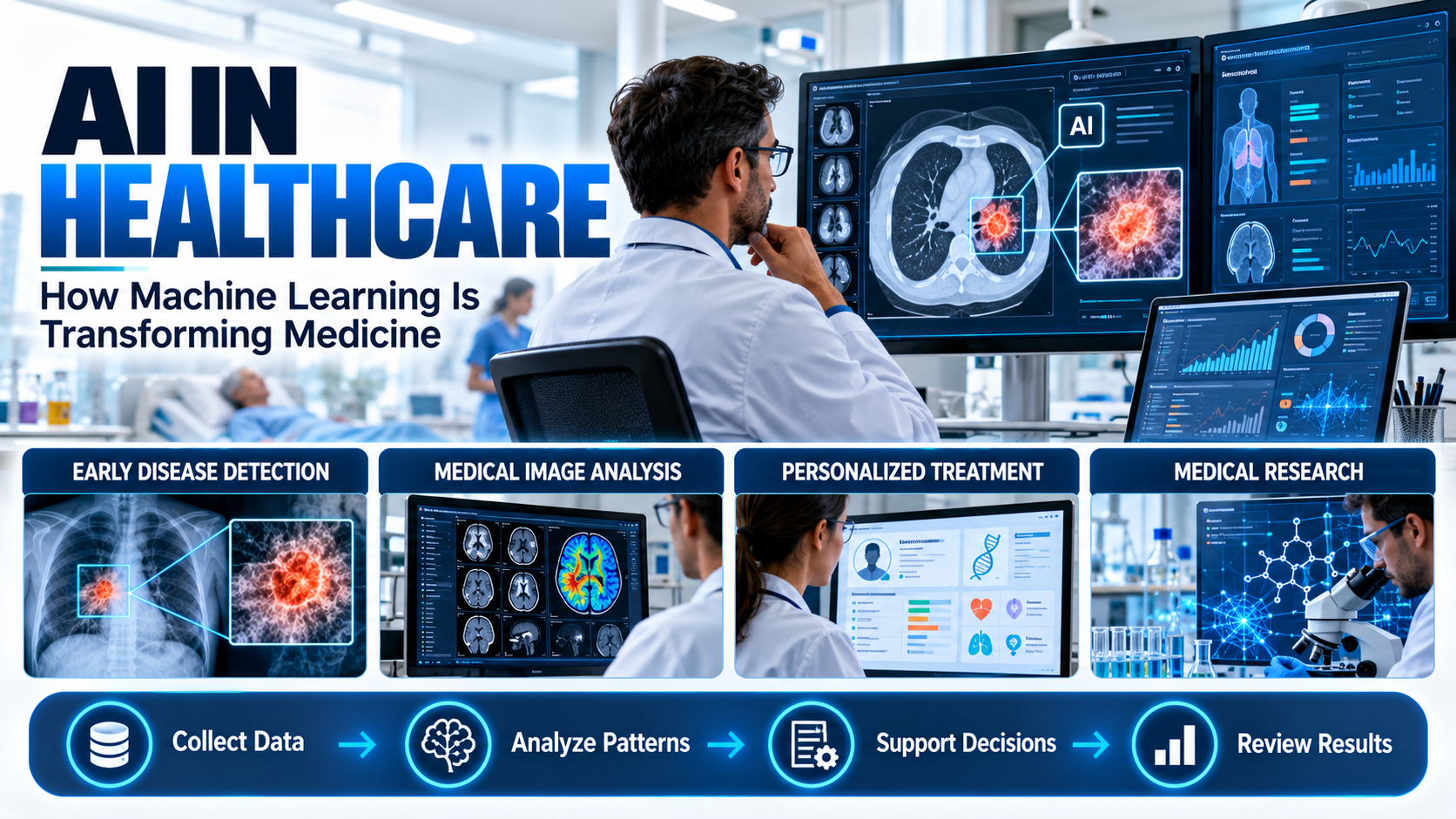
Artificial intelligence (AI) is changing how healthcare professionals understand diseases, examine medical reports, and care for patients. Hospitals and healthcare organizations are increasingly exploring AI technologies to improve medical services and support better decision-making.
One important technology behind this change is machine learning (ML). It allows computers to learn patterns from data and use those patterns to make predictions or identify information that might otherwise be difficult to detect.
For example, machine learning systems can help analyze medical images, identify possible health risks, and support the discovery of new medicines. These technologies can help healthcare professionals work more efficiently, but they do not replace the need for medical expertise.
In this article, we will explore how AI and machine learning work in healthcare, their major applications, their benefits and challenges, and what the future may hold.
1. What Is Artificial Intelligence in Healthcare?
Artificial intelligence in healthcare refers to the use of computer systems to perform tasks that normally require human intelligence. These tasks include analyzing information, recognizing patterns, understanding language, and supporting decisions.
For example, an AI-powered system may examine a medical image and highlight an area that requires a doctor’s attention. Another system may help organize patient records or summarize medical information.
AI can support healthcare professionals in different ways, including medical research, hospital administration, patient monitoring, and clinical decision-making. Its role depends on the technology, the task, and the evidence supporting its use.
The main goal of AI in healthcare is to support medical professionals, improve efficiency, and help provide better patient care.
2. What Is Machine Learning in Healthcare?
Machine learning is a branch of AI that enables computers to learn patterns from data instead of relying only on manually written rules.
In healthcare, machine learning models can be trained using data such as medical images, laboratory results, patient records, and other relevant information. The models learn patterns from this data and use them to make predictions or classify new information.
For example, researchers can train a machine learning model using medical images that have been reviewed by qualified specialists. The model may then analyze new images and highlight patterns that could be associated with a particular condition.
However, the quality of the training data matters. If the data is incomplete, inaccurate, or unrepresentative of the patients who will use the system, its predictions may be unreliable.
Machine learning therefore needs appropriate testing, validation, and monitoring before it can be used in real healthcare settings.
3. How Does Machine Learning Work in Healthcare?
Machine learning follows a process that helps computers learn from healthcare data and generate useful results.
Step 1: Collect Healthcare Data
The process begins with collecting relevant data, such as medical images, laboratory results, health records, or information from approved monitoring devices.
This data must be collected and handled according to applicable privacy and security requirements.
Step 2: Prepare the Data
The collected data is checked for errors, missing information, and inconsistencies. Preparing the data helps researchers create a more reliable dataset for training and evaluation.
Step 3: Train the Machine Learning Model
The model analyzes examples in the training data and learns patterns that may be useful for a particular task.
For example, a model designed to analyze medical images may learn to identify patterns that specialists associate with certain abnormalities.
Step 4: Test the Model
Researchers evaluate the model using data that was not used to train it. This helps them understand how well it performs on unfamiliar examples.
Testing should reflect the intended use of the system and the patients it is expected to serve.
Step 5: Use the Results to Support Healthcare
After appropriate evaluation and authorization where required, a machine learning system may help analyze new information and provide predictions, alerts, or recommendations.
Healthcare professionals must interpret these results in the context of the patient’s condition and other available evidence.
4. How AI and Machine Learning Are Transforming Healthcare
AI and machine learning have several applications across healthcare. Their usefulness depends on the task, the quality of the technology, and how it is integrated into medical practice.
4.1 Early Disease Detection
Machine learning can help identify patterns associated with certain diseases. Some systems analyze medical images, laboratory results, or other clinical information to highlight findings that need further examination.
For example, an AI-enabled imaging system may help identify a suspicious area in a scan so that a radiologist can review it more closely.
Earlier identification of a possible problem may help healthcare professionals investigate it sooner. However, AI predictions are not always correct, and a model cannot guarantee early detection of every disease.
4.2 Medical Image Analysis
Medical imaging is one of the important areas where machine learning is being applied.
AI systems can analyze images from technologies such as X-rays, CT scans, MRI scans, and mammography. Depending on the system, they may help identify abnormalities, measure structures, compare images, or prioritize certain cases for review.
For example, an AI tool may highlight a possible abnormality on a chest image. A qualified medical professional can then review the highlighted area and determine its clinical significance.
The US Food and Drug Administration maintains a list of AI-enabled medical devices authorized for marketing in the United States, including devices used in medical imaging. The list demonstrates that AI is already being used in real medical products, although authorization and permitted uses vary by device.
4.3 Personalized Treatment
Every patient has different medical needs. Factors such as age, medical history, test results, lifestyle, and response to previous treatments can affect healthcare decisions.
Machine learning can help analyze these factors and identify patterns that may support more personalized care.
For example, a clinical decision-support system may help a medical team compare patient information with relevant clinical evidence when considering treatment options.
AI should not make treatment decisions without appropriate clinical oversight. Healthcare professionals must consider individual circumstances, medical guidelines, and the limitations of the available data.
4.4 Predicting Health Risks
Machine learning models can analyze patient information to estimate the likelihood of certain future events or complications.
For example, a validated system may help a hospital identify patients who could require closer monitoring based on relevant clinical information.
These predictions can help healthcare teams prioritize attention and plan care. However, a prediction indicates a possibility rather than a certainty. Incorrect predictions can occur, so systems must be evaluated carefully before being used to guide clinical decisions.
4.5 Drug Discovery and Development
Developing a new medicine can require extensive research, laboratory experiments, and clinical studies.
AI and machine learning can help researchers analyze biological information, identify potential drug candidates, study molecular structures, and prioritize experiments.
For example, a machine learning model may help researchers estimate which chemical compounds are worth investigating further.
This can make parts of the research process more efficient. However, AI-generated predictions do not prove that a medicine is safe or effective. Promising candidates still require appropriate laboratory studies, clinical trials, and regulatory review.
4.6 Remote Patient Monitoring
Remote patient monitoring allows healthcare professionals to receive health information from patients outside traditional clinical settings.
Wearable devices and connected medical equipment may collect information such as heart rate, activity, or other measurements, depending on the device.
Machine learning can help analyze these readings and identify patterns that may require attention.
For example, a monitoring system may flag an unusual change in a patient’s measurements so that a healthcare professional can review it.
These alerts must be interpreted carefully. A device reading or AI-generated warning alone cannot establish a diagnosis.
4.7 Virtual Health Assistants
AI-powered virtual assistants can help patients access general health information, find relevant services, manage appointments, and understand administrative instructions.
Some systems can also help healthcare staff organize information or summarize documents.
For example, a virtual assistant may help a patient locate appointment instructions or explain how to prepare for a scheduled visit.
However, AI assistants can produce inaccurate or incomplete information. They should not replace qualified medical advice, particularly when symptoms may indicate an urgent medical problem.
4.8 Hospital Management and Administrative Tasks
Hospitals manage large amounts of information, appointments, medical records, staff schedules, and billing activities.
AI tools can help automate certain administrative tasks, organize information, forecast demand, and support resource planning.
For example, a hospital may use predictive analytics to estimate how many appointments or beds could be needed during a particular period.
These tools can help staff plan more efficiently, but their results depend on accurate data and appropriate human review.
5. Benefits of AI and Machine Learning in Healthcare
When properly developed and implemented, AI and machine learning can offer several benefits.
Faster Information Analysis
AI systems can analyze large amounts of data and highlight relevant patterns. This may help healthcare professionals review information more efficiently.
Support for Medical Decisions
AI tools can provide additional information that healthcare professionals may consider when evaluating a patient’s condition. They support decisions rather than automatically making every clinical decision.
Improved Workflow Efficiency
Automating selected administrative and data-processing tasks can reduce repetitive work and give healthcare staff more time for other responsibilities.
Better Research Support
Machine learning can help researchers examine complex datasets, identify potential research directions, and prioritize experiments.
More Consistent Data Analysis
A properly validated model can apply the same analytical process to many records or images. Nevertheless, consistent processing does not guarantee accurate results, so ongoing evaluation remains important.
Support for Remote Care
AI-assisted monitoring tools may help healthcare teams review patient measurements collected outside hospitals and identify cases that require further attention.
Important: These benefits are potential outcomes, not guarantees. Results depend on the system’s accuracy, the healthcare setting, the quality of the data, and how professionals use the technology.
6. Challenges of Using AI in Healthcare
Although AI offers opportunities, healthcare organizations must address several important challenges before relying on these systems.
6.1 Patient Data Privacy
Healthcare information is highly sensitive. Medical records, test results, and personal details must be protected against unauthorized access and misuse.
Healthcare organizations should use appropriate access controls, secure storage, data protection measures, and approved processes for using patient information in AI systems.
6.2 Biased or Incomplete Data
Machine learning models learn from the data used to develop them. If that data does not adequately represent different patient populations, the model may perform less accurately for some groups.
Developers and healthcare organizations should evaluate performance across relevant populations and investigate differences in accuracy.
6.3 Incorrect Predictions
AI systems can make mistakes. A model may miss an important finding or flag something that is not clinically significant.
These errors can affect patient care if the results are accepted without proper review. Appropriate testing, monitoring, and clinical oversight are therefore essential.
6.4 High Implementation Costs
Introducing AI into a hospital may require software, computing resources, staff training, technical support, and integration with existing systems.
Organizations must evaluate whether a particular solution offers sufficient practical value to justify its cost.
6.5 Lack of Clear Explanations
Some machine learning models are difficult to interpret. Healthcare professionals may find it challenging to understand why a model produced a particular result.
Clear documentation, appropriate explanations, and evidence about system performance can help healthcare teams evaluate AI recommendations.
6.6 Legal and Ethical Responsibilities
Healthcare AI must be used responsibly. Organizations need to consider patient consent where applicable, privacy requirements, safety, accountability, and relevant regulations.
They should also clearly define who is responsible for reviewing AI outputs and responding when a system produces an incorrect result.
7. Real-World Uses of AI in Healthcare
AI in healthcare is not limited to experimental research. Some applications are already used in medical devices and healthcare workflows.
AI-Enabled Medical Devices
Certain medical devices use AI to analyze medical information and support specific clinical tasks. Their intended uses and regulatory status vary, so healthcare organizations should verify the evidence and authorization for each device.
The US FDA’s official AI-enabled medical device list provides examples of devices authorized for marketing in the United States. It is updated periodically and is not a complete list of every AI system used in healthcare.
AI-Assisted Medical Imaging
Some imaging systems use machine learning to identify, measure, or highlight findings in medical images. These tools may help specialists review information, but the clinician remains responsible for interpreting the findings in context.
Machine Learning in Medical Research
Researchers use machine learning to analyze complex biological and clinical datasets. Depending on the research question, these methods may help identify patterns, generate hypotheses, or prioritize experiments for further investigation.
These examples show how AI can support different healthcare activities. They do not mean that every AI application is suitable for every patient or medical setting.
8. The Future of AI and Machine Learning in Healthcare
The role of AI in healthcare is likely to continue evolving as researchers develop new methods and organizations gain experience with existing systems.
More Personalized Healthcare
Future systems may help healthcare teams combine different types of patient information to support more individualized assessments and treatment planning.
The value of these systems will depend on clinical evidence, data quality, and whether they improve outcomes in real settings.
Improved Medical Research
AI may help researchers analyze complex biological data and explore possible connections between diseases, genes, medicines, and treatment responses.
These discoveries will still need to be verified through appropriate scientific research.
Better Integration of Health Information
AI tools may help organize information from medical records, laboratory systems, imaging platforms, and approved monitoring devices.
Connecting these sources could make relevant information easier for healthcare professionals to review, provided that privacy, accuracy, and compatibility are addressed.
More AI-Assisted Clinical Workflows
Healthcare organizations may increasingly use AI for tasks such as summarizing records, supporting image analysis, and organizing clinical information.
Successful adoption will require reliable systems, appropriate training, and clear rules for human oversight.
Greater Focus on Safety and Accountability
As AI becomes more widely used, healthcare organizations will need to pay greater attention to validation, bias, privacy, transparency, and ongoing performance monitoring.
The future of healthcare AI will depend not only on how advanced the technology becomes, but also on how safely and effectively it is used.
9. How AI and Machine Learning Can Support Healthcare in India
India has a large and diverse healthcare system, making access, affordability, and efficient service delivery important considerations.
AI tools may help support medical image analysis, hospital administration, remote monitoring, and healthcare research. They could also help healthcare teams organize information and prioritize cases for further assessment.
However, AI cannot solve every healthcare challenge on its own. Reliable infrastructure, trained professionals, secure patient data, appropriate clinical validation, and access to medical services remain essential.
Healthcare organizations in India should assess AI tools according to their intended use, supporting evidence, patient population, and applicable Indian regulations.
Conclusion
Artificial intelligence and machine learning are creating new opportunities across healthcare. From analyzing medical images and supporting research to monitoring patients and improving hospital workflows, these technologies can help healthcare professionals work with information more effectively.
However, AI is not perfect. Incorrect predictions, biased data, privacy risks, high implementation costs, and limited transparency must be addressed before these systems can be trusted in important medical settings.
The most effective approach is to use AI as a supporting technology alongside qualified healthcare professionals, reliable clinical evidence, and appropriate safety measures.
As the technology develops, responsible implementation will be essential to making healthcare AI more useful, trustworthy, and accessible.
