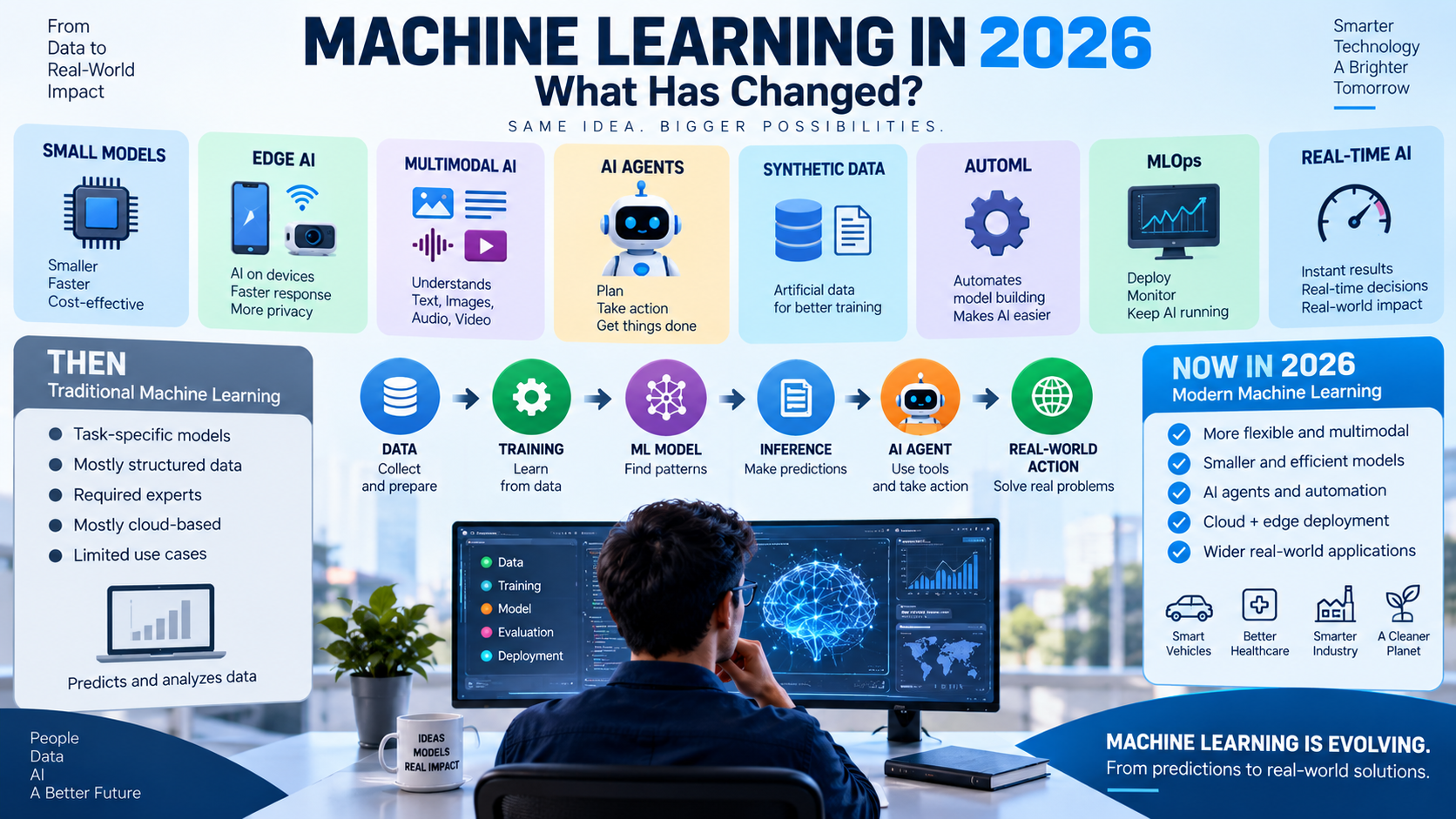
Machine learning has been an important part of artificial intelligence for many years. It helps computers learn patterns from data and use those patterns to make predictions, recommendations and decisions.
But machine learning is changing quickly in 2026. It is no longer limited to traditional prediction systems. Modern machine learning is becoming closely connected with generative AI, AI agents, multimodal systems, edge computing and automation.
So, what has really changed in machine learning, and how is it different from the technology we used a few years ago?
Understanding Machine Learning
What Is Machine Learning?
Machine learning is a technology that allows computers to learn from data instead of being programmed with instructions for every possible situation.
For example, an online shopping website can use machine learning to understand what products a customer likes and recommend similar products.
Machine learning is used in many areas, including:
- Fraud detection
- Product recommendations
- Spam detection
- Image recognition
- Sales forecasting
- Customer analysis
- Predictive maintenance
The basic idea is simple:
Data → Learning → Model → Prediction
How Machine Learning Has Changed
What Was Machine Learning Like Before?
Traditional machine learning was usually designed for a specific task.
For example, one model might detect fraudulent transactions, while another predicts customer demand.
These systems can be very useful, but they are usually built around a particular problem.
Modern AI is becoming more flexible. A single AI system can increasingly work with different types of information and perform multiple tasks.
This is one of the biggest changes happening in machine learning.
Is Machine Learning Becoming More Powerful?
Yes, but the focus is no longer only on making models bigger.
The AI industry is increasingly looking at performance, cost, speed, efficiency and real-world usefulness.
Gartner’s 2026 research highlights small reasoning models, domain-specific models, agentic AI and multimodal capabilities as important areas of development.
This means the question is changing from:
“How big can an AI model become?”
to:
“How efficiently can an AI model solve a real problem?”
Machine Learning and Generative AI
How Is Generative AI Changing Machine Learning?
Traditional machine learning is often used to predict something.
For example:
Will this transaction be fraudulent?
Generative AI can go further and create new content.
It can:
- Write text
- Generate images
- Create code
- Generate audio
- Summarize documents
- Analyze information
This has expanded the role of machine learning from prediction and classification to generation, reasoning and interaction.
AI Agents
Are AI Agents Changing Machine Learning?
AI agents are becoming an important part of the AI ecosystem in 2026.
A traditional ML model might receive information and produce a prediction.
An AI agent can use AI models to understand a goal, plan steps, use tools and complete a task.
A simple workflow looks like:
Understand → Plan → Act → Check → Continue
For example, an AI agent could receive a business request, search company information, analyze data, create a report and present the result.
This is one reason machine learning is increasingly becoming part of complete AI systems, rather than operating as a standalone model.
Smaller AI Models
Are Smaller Machine Learning Models Becoming More Important?
One of the biggest changes in 2026 is the growing focus on smaller and more efficient AI models.
For many years, bigger models received most of the attention. But large models can require significant computing power and can be expensive to operate.
Smaller models can be useful when a company needs:
- Lower costs
- Faster responses
- Less computing power
- Better privacy
- Local processing
- A model designed for a specific task
Gartner and IBM both highlight smaller, efficient and specialized models as important directions for AI development in 2026.
Why Are Small AI Models Useful?
Imagine a company only needs an AI system to classify customer support messages.
It may not need the biggest model available.
A smaller model trained or optimized for that particular task could potentially provide the required performance while using fewer resources.
This is leading to greater interest in task-specific and domain-specific machine learning models.
Edge AI
What Is Edge AI?
Edge AI means running an AI or machine learning model closer to where the data is created.
Instead of sending everything to a cloud server, some processing can happen directly on:
- Smartphones
- Cars
- Cameras
- Smartwatches
- Industrial machines
- IoT devices
- Drones
For example, a security camera could analyze video locally instead of sending every frame to the cloud.
Why Is Edge AI Important in 2026?
Edge AI can provide several advantages:
Faster response + lower latency + better privacy + less cloud dependency
Smaller and more efficient models are making local AI processing more practical.
IBM’s 2026 technology analysis identifies edge AI and hardware-efficient models as important developments as the industry looks for ways to reduce computing requirements.
Multimodal Machine Learning
Can Machine Learning Understand More Than Text?
Yes.
Modern AI systems are increasingly designed to work with multiple types of information.
This is called multimodal AI.
A multimodal system can work with:
- Text
- Images
- Audio
- Video
- Code
- Sensor information
For example, an AI system could look at a machine’s image, analyze its maintenance history and listen to an unusual sound to help identify a possible problem.
This creates a much richer understanding of real-world information.
Why Is Multimodal AI Important?
Humans naturally use multiple senses to understand the world.
We can see something, hear something and read information about it at the same time.
AI is increasingly moving toward similar multimodal capabilities.
IBM’s 2026 technology outlook describes multimodal systems as increasingly connecting language, vision and action.
Synthetic Data
What Is Synthetic Data?
Synthetic data is artificially created data that can be used to train or test machine-learning systems.
For example, a company developing an autonomous vehicle system could generate artificial driving situations that are difficult to collect in the real world.
Synthetic data can help when:
- Real data is expensive.
- Real data is difficult to collect.
- Privacy is important.
- Rare situations are difficult to capture.
However, synthetic data does not automatically replace real-world data. The quality of the generated data and the way it is used still matter.
Automated Machine Learning
What Is AutoML?
AutoML stands for Automated Machine Learning.
It uses software to automate parts of the machine-learning development process.
Depending on the tool, AutoML can help with:
- Selecting models
- Preparing data
- Choosing parameters
- Training models
- Comparing results
This can make machine learning easier for teams that do not have large data-science teams.
However, humans still need to define the business problem and check whether the model produces useful results.
MLOps
Why Is MLOps Important?
Building a machine-learning model is only one part of the job.
A company also needs to deploy, monitor and update the model.
This is where MLOps becomes important.
MLOps combines machine learning with software development and operations.
It helps teams manage:
- Model deployment
- Model monitoring
- Data pipelines
- Model versions
- Performance
- Updates
- Security
A model that works well during development may behave differently when it starts receiving real-world data.
Training vs Inference
What Is AI Inference?
There are two important stages in machine learning.
Training means teaching the model using data.
Inference means using the trained model to produce an answer, prediction or decision.
As AI applications become more widely used, companies need to process huge numbers of inference requests.
This is increasing interest in:
- Faster inference
- Smaller models
- Quantization
- Model optimization
- Specialized AI chips
- Edge AI
The goal is to make AI not only powerful but also fast and affordable to operate. IBM’s 2026 analysis specifically highlights hardware-aware and efficient models as an important direction.
Domain-Specific AI
Are Specialized Models Becoming More Important?
Yes.
Not every company needs one general AI model for every task.
A healthcare company may need a model optimized for medical information, while a manufacturing company may need a model focused on industrial data.
Examples include:
- Healthcare AI
- Financial AI
- Manufacturing AI
- Legal AI
- Retail AI
- Cybersecurity AI
Specialized models can focus on a specific industry, language, workflow or task.
Gartner’s 2026 research identifies domain-specific models as an important direction for enterprise AI adoption.
Privacy and Machine Learning
Is Machine Learning Becoming More Privacy-Focused?
Privacy is becoming increasingly important as machine learning is used with personal and business data.
One approach is to process information directly on the device.
Other techniques include:
- Federated learning
- Privacy-preserving machine learning
- On-device AI
- Data minimization
The goal is to gain the benefits of machine learning while reducing unnecessary exposure of sensitive information.
Federated Learning
What Is Federated Learning?
Federated learning is a machine-learning approach where models can learn from data stored in different locations without necessarily moving all raw data into one central database.
For example, multiple devices could contribute to improving a model while keeping their individual data locally.
This can be useful when privacy and data security are important.
Real-Time Machine Learning
Is Machine Learning Becoming More Real-Time?
Yes.
Many modern applications need AI decisions almost immediately.
Examples include:
- Fraud detection
- Smart cameras
- Autonomous vehicles
- Industrial machines
- Robotics
- Voice assistants
- Healthcare devices
This is another reason why fast inference and edge AI are becoming increasingly important.
Machine Learning and Robotics
How Is Machine Learning Helping Robots?
Machine learning is also moving into the physical world.
AI-powered robots can use cameras and sensors to understand their surroundings and make decisions.
Machine learning can help robots:
- Recognize objects
- Understand environments
- Learn movements
- Detect problems
- Adapt to changes
- Perform tasks
This connects machine learning with Physical AI and embodied AI.
Explainable AI
Can Humans Understand AI Decisions?
Sometimes AI systems can produce an answer without making it obvious why they reached that conclusion.
Explainable AI, or XAI, focuses on making AI decisions easier for humans to understand.
This can be particularly important in areas such as:
- Banking
- Healthcare
- Insurance
- Hiring
- Government services
When an AI decision has a major impact on a person, understanding the reasoning behind it can become especially important.
What Are the Biggest Challenges?
Is Machine Learning Perfect in 2026?
No.
Machine learning has become more capable, but important challenges remain.
These include:
- Poor-quality data
- Bias
- Privacy
- Security
- High computing costs
- Energy consumption
- Model reliability
- AI hallucinations
- Lack of explainability
- Difficult model monitoring
- Human oversight
Stanford’s 2026 AI Index notes that AI capabilities are advancing quickly, but reliability remains a challenge, particularly for systems performing complex tasks.
Machine Learning: Then vs 2026
| Earlier Machine Learning | Machine Learning in 2026 |
|---|---|
| Mostly task-specific | More general and specialized systems |
| Mainly prediction | Prediction + generation + reasoning |
| Mostly centralized | Cloud + edge |
| Bigger models emphasized | Efficiency also matters |
| Mainly structured data | Text + image + audio + video + sensor data |
| Human-driven workflows | Increasingly agentic workflows |
| Focus on model training | Training + inference + deployment |
| Standalone models | Integrated AI systems |
This shows that the biggest change is not one individual technology.
It is the way different AI technologies are being combined.
What Is the Future of Machine Learning?
Will Machine Learning Become More Intelligent?
The future of machine learning is likely to involve several technologies working together.
We could see:
Small Models + Large Models + Multimodal AI + Edge AI + AI Agents + Domain-Specific Models
Different models can be selected for different tasks.
A smartphone might use a small model locally, while a complex enterprise application might use a larger model in the cloud.
AI agents could then connect these models to software tools and business workflows.
IBM’s 2026 outlook similarly points toward systems that combine multiple models, tools and workflows instead of relying on one model for everything.
Machine Learning in 2026: What Has Changed?
The Big Picture
Machine learning has moved beyond being just a technology for making predictions.
In 2026, it is increasingly becoming part of intelligent systems that can:
Understand → Predict → Generate → Reason → Act
The biggest changes include the growth of generative AI, AI agents, multimodal systems, smaller models, edge AI, synthetic data and automated ML workflows.
At the same time, businesses are paying more attention to cost, speed, security, privacy and measurable results. Gartner’s 2026 research notes that AI spending is increasingly being examined through factors such as cost, latency, performance and reliability.
Conclusion
Machine learning in 2026 is very different from traditional machine learning.
The technology is becoming more flexible, more efficient and more connected to other AI technologies.
Instead of focusing only on creating bigger models, the industry is increasingly exploring smaller specialized models, multimodal AI, edge computing, AI agents and efficient inference.
The future of machine learning may therefore not belong to one giant model.
Instead, it could involve different AI models working together, with the right model used for the right task.
The biggest change is simple:
Machine learning is moving from standalone prediction to intelligent systems that can understand information, generate content, make decisions and increasingly take action.
