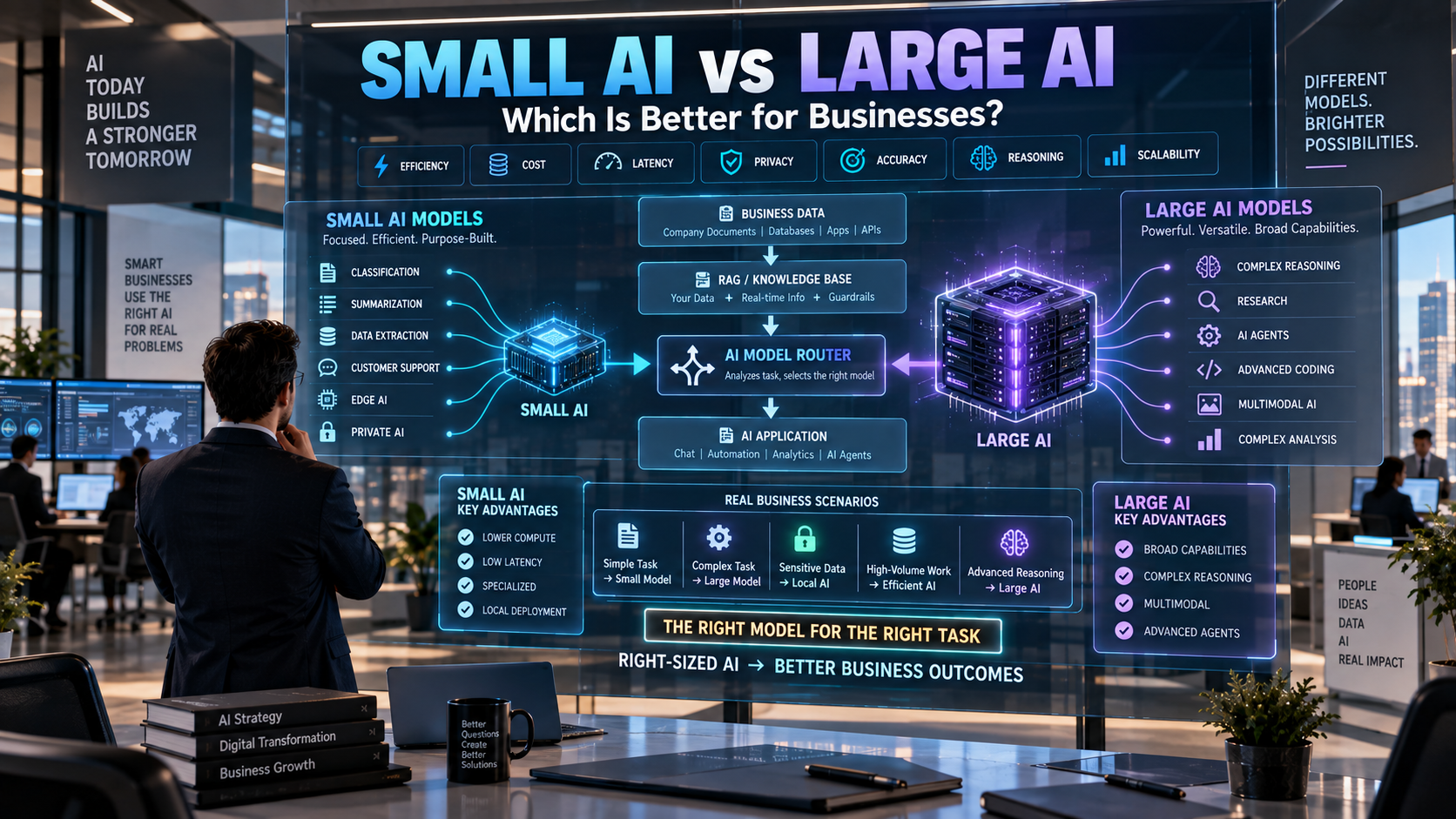
Artificial intelligence is becoming an important part of modern business. Companies are using AI for customer service, document processing, software development, data analysis, search, automation, and many other tasks.
But as AI adoption grows, businesses face an important question: Should they use a small AI model or a large AI model?
For a long time, bigger AI models received most of the attention because they could handle complex instructions and a wide range of tasks. Today, smaller AI models are becoming increasingly useful because they can be faster, more efficient, easier to deploy locally, and well suited to specific business tasks.
The answer is not simply that one type is better than the other. The better choice depends on what the business wants the AI to do.
What Are Small AI Models?
Small AI models are compact artificial intelligence models designed to perform tasks using fewer computing resources than large models.
When they are designed for language tasks, they are commonly called Small Language Models (SLMs). They can be trained or fine-tuned for specific tasks such as classification, summarization, information extraction, customer support, and search.
Because they are smaller, they can require less memory and computing power. This makes them useful for applications running on local devices, private infrastructure, or environments where fast responses are important.
What Are Large AI Models?
Large AI models are designed to handle a much wider range of tasks.
They generally have more parameters and require more computing resources. Their larger capacity can make them useful for complex reasoning, advanced content generation, difficult coding tasks, research, and applications that need broad knowledge.
For example, a company could use a large model to build an advanced AI assistant that understands complex questions, works with multiple tools, analyzes information, and completes multi-step tasks.
Large models are therefore valuable when a business needs broad and powerful AI capabilities.
Small AI Models vs Large AI Models
The biggest difference is the trade-off between capability and efficiency.
Small models are generally easier to run and can be suitable for focused tasks. Large models can provide stronger capabilities for more complicated workloads but usually require more computational resources.
| Feature | Small AI Models | Large AI Models |
|---|---|---|
| Model size | Smaller | Larger |
| Computing requirements | Lower | Higher |
| Response time | Often faster | Can require more processing |
| Cost | Often lower for suitable workloads | Usually higher |
| Specialized tasks | Very suitable | Suitable |
| Complex reasoning | More limited | Generally stronger |
| Local deployment | Easier | More demanding |
| Edge devices | Well suited | More difficult |
| Broad capabilities | More limited | Generally broader |
| Customization | Useful for focused tasks | Powerful but potentially more complex |
The exact performance depends on the model, hardware, application design, and workload. Model size alone does not determine which option will deliver the best business result.
Why Are Businesses Looking at Small AI Models?
One major reason is efficiency.
Imagine a company processing hundreds of thousands of simple customer requests every month. Sending every request to a highly capable large model may not always be necessary.
A smaller model could classify messages, extract information, summarize content, or answer routine questions while using fewer resources.
Microsoft Research has argued that many enterprise workloads are structured and subject to strict cost, latency, and reliability requirements, making a modular approach potentially more suitable than using a large language model for every task.
Are Small AI Models Cheaper?
Small models can be cheaper to operate when they require fewer computational resources for the required workload.
However, businesses should not look only at the model’s advertised price.
The real cost can include:
Model usage + infrastructure + computing + storage + latency + monitoring + engineering + maintenance
A smaller model that cannot perform the task correctly may create additional costs through retries, human intervention, or poor results.
Therefore, businesses should compare cost per successful task, not simply cost per AI request.
Are Small AI Models Faster?
Small models can often provide faster responses because they generally require less computation.
This can be particularly useful for applications where users expect immediate responses.
For example, a mobile application could use a compact AI model to classify text or summarize information directly on the device.
Microsoft notes that local models can reduce network-related latency, although their performance is limited by the hardware available on the device.
Can Small AI Models Run Locally?
Yes.
One of the interesting advantages of smaller models is that they can be deployed closer to the user.
Instead of sending every request to a remote cloud service, businesses can potentially run an appropriate small model:
- On a laptop
- On a smartphone
- On an edge device
- On an internal server
- In a private cloud
- Inside a private application environment
Microsoft provides examples of deploying small language models locally within application environments, particularly where privacy, predictable latency, and reduced external dependencies are important.
What About Data Privacy?
Data privacy is another reason businesses may consider smaller or locally deployed AI models.
A company handling confidential customer information may prefer an architecture where sensitive data stays within its own controlled environment.
Local AI can potentially reduce the need to send sensitive information to an external AI service. However, a small model is not automatically secure.
Businesses still need:
- Access controls
- Encryption
- Authentication
- Monitoring
- Data governance
- Secure infrastructure
- Model security
- Human oversight
The model size is only one part of the overall security architecture.
When Should Businesses Use Small AI Models?
Small AI models are often a good fit when a task is specific, repetitive, high-volume, or latency-sensitive.
For example, consider an online store receiving thousands of customer messages every day.
A small AI model could identify whether each message is about:
Orders → Returns → Payments → Delivery → Product Questions
Only complicated requests could then be sent to a more capable model or a human employee.
This type of architecture can reduce unnecessary use of expensive computing resources.
When Should Businesses Use Large AI Models?
Large AI models are useful when the task requires broader capabilities.
Examples include:
- Complex reasoning
- Advanced coding
- Research
- Complex document analysis
- Long instructions
- Multistep problem solving
- Advanced AI assistants
- Sophisticated AI agents
- Multimodal applications
For example, a company building an AI research assistant may need a powerful model to understand complex questions, analyze information, use tools, and produce detailed responses.
Can Businesses Use Small and Large Models Together?
Yes, and this may become one of the most practical approaches.
Instead of choosing one model for the entire company, businesses can build a multi-model AI system.
For example:
User Request → AI Router → Select Model
Simple task:
Small Model → Fast Response
Complex task:
Large Model → Advanced Reasoning
This allows businesses to use more expensive models only when they are actually needed.
Microsoft’s guidance on local and cloud AI also describes hybrid approaches where applications can use a local model first and fall back to a larger cloud model when the task requires greater capability.
Can Small Models Be Specialized?
Yes.
A small model does not need to know everything.
Instead, it can be optimized for one particular business requirement.
For example, a company could use a specialized model for:
- Invoice classification
- Customer support
- Legal document extraction
- Product categorization
- Internal search
- Manufacturing documents
- Financial data processing
- Software testing
Research from Microsoft has explored fine-tuning small language models for enterprise search relevance tasks, showing how smaller models can be useful for focused enterprise applications.
What About AI Agents?
AI agents introduce another interesting use case.
Modern AI agents can perform multiple steps instead of simply generating an answer. They may plan tasks, use tools, execute commands, inspect results, and continue working.
A large model can be useful as the main reasoning engine.
But smaller models can also perform specialized jobs inside an agent system.
For example:
Main AI Agent → Small Search Agent → Small Testing Agent → Small Classification Agent
This means a large model does not necessarily need to perform every individual operation.
Research published by Microsoft in 2026 is exploring whether specialized small models can handle certain agentic execution tasks effectively, including terminal-based software-development work.
Is Bigger AI Always Better?
No.
A bigger model may have more capabilities, but that does not mean it is the best choice for every business task.
If a company only needs to classify documents, detect categories, extract information, or perform another focused task, using a very large model may be unnecessary.
The better question is:
What is the smallest model that can reliably complete this task?
If a small model meets the required quality level, it may provide a more efficient solution.
If the task requires advanced reasoning or broad capabilities, a larger model may be more appropriate.
What About Accuracy?
Accuracy depends on the task.
Large models generally have an advantage when a problem requires broad knowledge or complex reasoning.
Small models can perform very well when they are trained or fine-tuned for a specific domain.
For example, a specialized small model trained for a company’s document classification system may perform extremely well at that particular task.
This is why businesses should test models using their own real-world data and evaluation criteria instead of choosing a model only because it is larger.
What About AI Model Customization?
Businesses increasingly want AI systems that understand their own data, terminology, processes, and requirements.
One option is to use techniques such as:
Fine-tuning + Retrieval-Augmented Generation (RAG) + Business Data + Guardrails
A smaller model can be particularly useful when the task is narrow and the organization wants a focused system.
Microsoft’s 2026 guidance on fine-tuning emphasizes using task-specific data to customize model behavior for enterprise applications.
How Should Businesses Choose an AI Model?
Businesses should evaluate several factors before selecting a model.
1. Task Complexity
Is the task simple or does it require advanced reasoning?
2. Accuracy Requirements
How accurate does the system need to be?
3. Cost
How much will the system cost at the expected usage level?
4. Speed
Does the application require instant responses?
5. Privacy
Can business data be processed through an external service?
6. Infrastructure
Does the company have the hardware required to run the model?
7. Scalability
Can the solution handle thousands or millions of requests?
8. Maintenance
How difficult will it be to update, monitor, and operate?
9. Security
What security controls are required around the model and its data?
10. Business Impact
Does the AI actually improve the business process?
Small AI Models vs Large AI Models: A Simple Example
Imagine a company wants to build an AI customer-support system.
A simple architecture could look like this:
Customer Message
↓
Small AI Model
↓
Is it a simple request?
YES → Answer Automatically
NO → Send to Large AI Model
↓
Complex Reasoning
↓
Human Review When Required
This approach allows the business to use the right amount of AI power for each request.
The Future May Be a Combination of Models
The future of enterprise AI may not be about choosing between small and large models.
Instead, businesses may use several models together.
A future AI architecture could look like:
Small Models
→ Classification and extraction
Large Models
→ Complex reasoning
AI Router
→ Chooses the appropriate model
RAG
→ Provides company-specific knowledge
AI Agents
→ Execute multistep tasks
Human Experts
→ Handle important decisions and exceptions
IBM’s 2026 enterprise model work also reflects this broader direction, combining different model capabilities and specialized components rather than relying on a single model for every workload.
So, Which Is Better for Businesses?
There is no single answer.
Small AI models can be useful when businesses need efficiency, lower latency, specialized capabilities, local deployment, or high-volume processing.
Large AI models can be useful when businesses need broad knowledge, advanced reasoning, complex generation, or sophisticated AI agents.
The most practical strategy may be to match the model to the task.
Instead of asking:
“Which is the biggest AI model we can use?”
Businesses may increasingly ask:
“Which AI model can complete this task reliably at the right cost and speed?”
Conclusion
The AI industry is moving toward a more practical approach to model selection.
Large AI models will continue to play an important role in complex applications, but small AI models are becoming increasingly valuable for focused business workloads. They can offer advantages in efficiency, latency, local deployment, and specialization when the task fits their capabilities.
For many businesses, the future may not be Small AI vs Large AI.
It may be:
Small AI + Large AI + AI Agents + Business Data + Human Expertise
The goal is not to use the biggest model.
The goal is to build an AI system that delivers the right level of intelligence for the right job.
