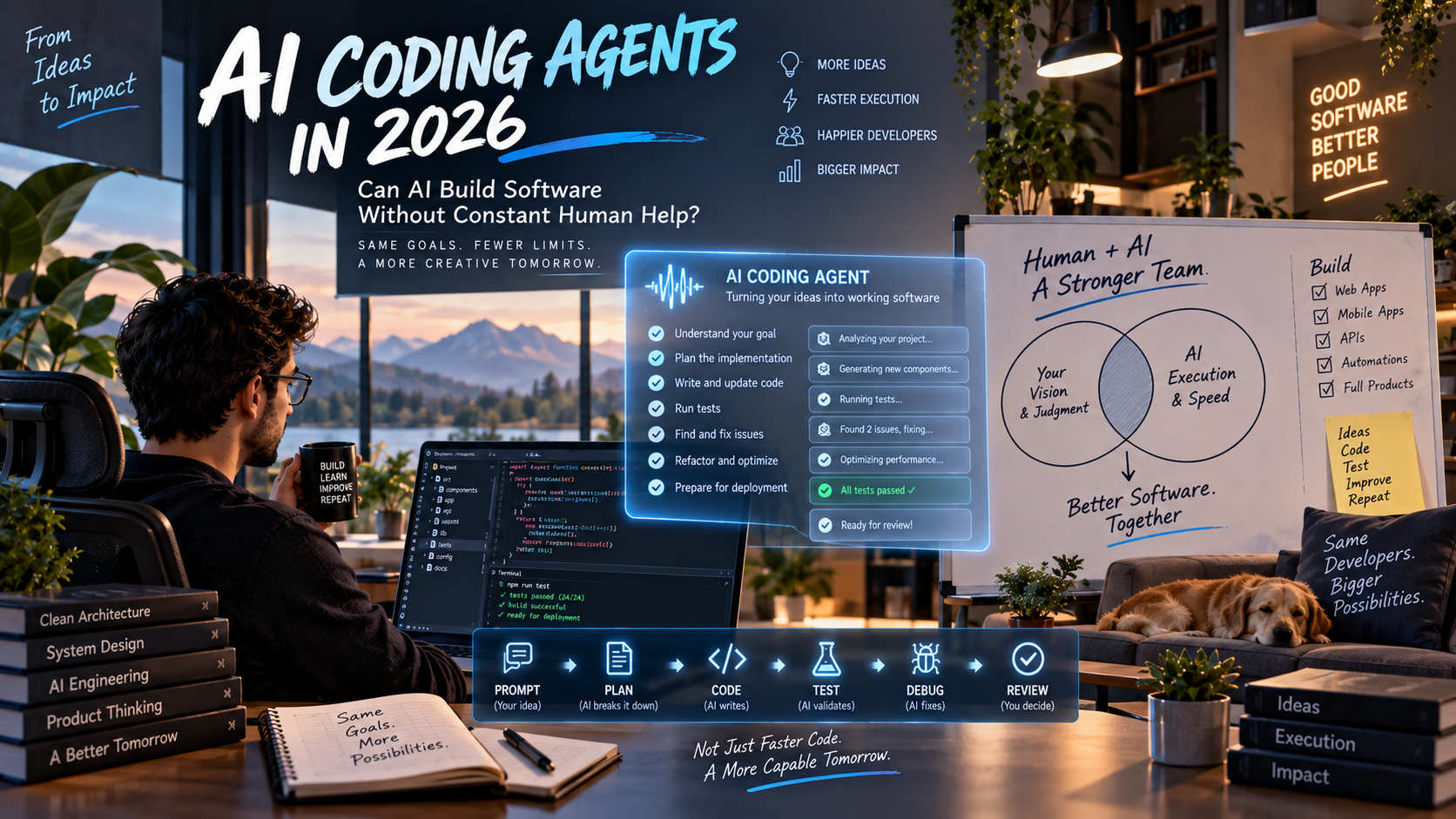
Artificial intelligence is changing the way software is created.
In the past, AI coding tools mainly helped developers complete a line of code, write a function, or explain an error. Today, AI coding agents can do much more.
They can understand a project, plan a task, change multiple files, run commands, execute tests, find errors and make additional changes.
This creates an important question:
Can AI coding agents build software without constant human help?
In 2026, AI can handle more parts of software development than before, but human developers are still important for decisions, architecture, security and final review.
What Are AI Coding Agents?
How Are Coding Agents Different From AI Assistants?
An AI coding assistant usually helps a developer write code.
For example, a developer might ask:
“Create a login form in React.”
The AI can generate the component.
An AI coding agent can go further.
It may:
- Understand the existing project
- Find the relevant files
- Create a development plan
- Write or modify code
- Run commands
- Run tests
- Find errors
- Fix problems
- Review its changes
The simple difference is:
AI assistant → helps you write code
AI coding agent → works on a coding task
This shift from code suggestions to task-based development is one of the major changes happening in software development.
How Do AI Coding Agents Work?
From a Simple Request to a Working Feature
A typical coding-agent workflow can look like this:
Developer gives a task
↓
AI studies the project
↓
AI creates a plan
↓
AI changes the required files
↓
AI runs tests
↓
AI finds problems
↓
AI fixes the problems
↓
Developer reviews the result
The important part is that the agent can perform several connected steps instead of simply returning a code snippet.
Can AI Coding Agents Understand a Whole Project?
AI Can Work With More Than One File
Modern software projects can contain hundreds or thousands of files.
A coding agent can inspect relevant parts of a repository to understand how the application works.
It may look at:
- Frontend code
- Backend code
- APIs
- Database models
- Configuration files
- Package dependencies
- Tests
- Documentation
- Project structure
For example, adding a user profile feature might require changes to the:
Frontend → API → Backend → Database → Tests
An AI agent can potentially work across several of these areas.
However, developers still need to check whether the changes match the project’s architecture and requirements.
Can AI Agents Build Complete Features?
AI Can Handle Larger Development Tasks
AI coding agents are becoming useful for tasks that involve multiple development steps.
For example, a developer might ask an agent to:
“Add dark mode to the application and save the user’s preference.”
The agent could potentially:
- Find the existing settings system
- Create the dark-mode logic
- Update UI components
- Store the preference
- Update styles
- Run tests
- Fix errors
This is very different from asking AI to generate one small function.
Can AI Coding Agents Debug Software?
AI Can Investigate Some Software Problems
Debugging is another useful application.
Imagine an application produces this error:
“API returns an error when a user uploads a PDF.”
An AI coding agent can investigate the project and look for:
- API routes
- Upload functions
- Error messages
- File-processing code
- Dependencies
- Tests
- Related components
It can then suggest or implement a fix and run tests to check the result.
This can make repetitive debugging work faster.
Can AI Coding Agents Run Tests?
AI Can Use Development Tools
One of the biggest advantages of coding agents is their ability to work with development tools.
Depending on the environment, an agent can use tools such as:
- Terminal
- Git
- Package managers
- Test runners
- Linters
- Build systems
- Code search
- Development environments
This allows an agent to create an edit → test → fix cycle.
For example:
Write code → Run test → Find error → Fix code → Run test again
This makes AI coding agents more useful than simple code-generation systems.
Are Developers Actually Using AI Coding Agents?
AI Coding Is Becoming Part of Normal Development
AI coding agents are no longer limited to experiments.
JetBrains’ 2026 Developer Ecosystem Survey, based on more than 15,000 professional developers worldwide, reported that 90% were using AI coding agents at work at least weekly, while 68% reported using them daily during May–July 2026.
This shows that AI agents are becoming part of everyday software-development workflows.
Is AI Writing Most of the Code?
Developers Are Increasingly Delegating Coding Tasks
AI-generated code is becoming a larger part of software development.
JetBrains’ 2026 research found that surveyed developers reported roughly 47% of their code was fully generated by AI agents, while about 38% was written by developers with some AI assistance. The figures varied significantly between developers and experience levels.
This does not mean that every developer has stopped writing code manually.
Instead, many developers are moving toward a mixed workflow:
Developer + AI-generated code + Human review
Can AI Agents Work Without a Developer?
What Does AI Autonomy Really Mean?
An AI agent can perform many tasks with limited human interaction.
But there are different levels of autonomy.
Low Autonomy
The developer gives instructions for every step.
Medium Autonomy
The developer gives a task and reviews the result.
High Autonomy
The AI plans, codes, tests and fixes problems with minimal human interaction.
The more freedom an agent receives, the more important permissions, testing and security controls become.
Why Are AI Coding Agents Becoming Popular?
Developers Can Delegate Repetitive Work
Software development includes many repetitive activities.
Examples include:
- Writing boilerplate code
- Creating tests
- Updating documentation
- Refactoring code
- Fixing simple bugs
- Creating components
- Updating dependencies
- Converting existing code
AI agents can take over some of these tasks.
This allows developers to spend more time on:
Architecture + Product Decisions + System Design + Complex Problems
Can AI Coding Agents Build an Application From a Prompt?
Simple Applications Are Becoming Easier to Create
AI tools can generate a large amount of code from natural-language instructions.
For example:
“Build a task-management application with user authentication, a dashboard and a database.”
An AI agent may be able to create much of the initial implementation.
But a production application is more complicated.
It also needs:
- Security
- Error handling
- Performance
- Testing
- Database reliability
- Monitoring
- Deployment
- Maintenance
So a single prompt does not remove the need for software engineering.
Can AI Agents Replace Software Developers?
Software Engineering Is More Than Writing Code
Writing code is only one part of software development.
Developers also need to understand:
- What users need
- Business requirements
- System architecture
- Security
- Performance
- Scalability
- User experience
- Data structures
- Infrastructure
An AI agent can generate technically valid code but still misunderstand the actual business requirement.
Human developers therefore remain important for direction, judgment and responsibility.
What Are the Biggest Risks of AI Coding Agents?
AI Can Still Make Mistakes
AI coding agents are powerful, but they are not perfect.
They can produce:
- Incorrect code
- Security vulnerabilities
- Poor architecture
- Missing edge cases
- Broken dependencies
- Unnecessary complexity
- Incorrect assumptions
AI can also make changes that appear correct but create problems somewhere else in the application.
This is why testing and human review remain important. Recent analysis of AI-generated code has also highlighted the risks of deploying code without sufficient verification.
What About AI Coding Security?
Giving AI Access to a Codebase Creates New Risks
Coding agents may need access to:
- Source code
- Local files
- Terminals
- APIs
- Development environments
- Git repositories
That creates a security question:
What should an AI agent be allowed to access?
A poorly configured agent could potentially expose sensitive information or perform actions that it should not perform.
A recent security incident involving an AI coding assistant highlighted concerns about local code repositories being uploaded without user consent. The company later said the issue had been patched.
This shows why AI coding systems need strong security controls.
What Is an AI Coding Sandbox?
A Safer Environment for AI Agents
A sandbox is an isolated environment where an AI agent can run code without having unrestricted access to the developer’s computer or production systems.
A safer workflow could look like:
AI Agent → Sandbox → Run Code → Test → Review → Production
Instead of:
AI Agent → Full System Access
Gartner has identified agentic development sandbox platforms as an emerging area specifically focused on reducing security risks and protecting development environments.
Can Multiple AI Agents Work Together?
The Rise of Multi-Agent Software Development
Instead of using one AI agent for every task, developers can use multiple specialized agents.
For example:
Frontend Agent → UI
Backend Agent → APIs
Testing Agent → Tests
Security Agent → Security Checks
Documentation Agent → Documentation
A coordinator can manage these different tasks.
This could allow software teams to delegate multiple development tasks at the same time.
What Will Happen to Developers?
Developers May Become AI Supervisors
The developer’s role may change as AI becomes more capable.
Instead of manually writing every line, developers may spend more time:
- Defining requirements
- Designing systems
- Planning architecture
- Giving instructions to agents
- Reviewing code
- Testing software
- Checking security
- Managing AI workflows
In other words:
Less repetitive coding
More engineering and decision-making
Will AI Make Software Development Faster?
AI Can Automate Many Development Steps
AI agents can reduce the amount of manual work needed for certain tasks.
For example, a developer can ask:
“Add authentication, create protected routes, add login tests and update the documentation.”
An agent can potentially work through several of these tasks.
The amount of time saved depends on the project, task complexity and how much review is required.
Does Faster Coding Mean Better Software?
Speed and Quality Are Different
AI can help developers produce code faster.
But faster code generation does not automatically mean better software.
Good software still requires:
Testing + Code Review + Security + Architecture + Monitoring
The goal should not be:
“Write more code faster.”
The goal should be:
“Build reliable software more efficiently.”
What Is the Difference Between AI Coding Assistants and Coding Agents?
| AI Coding Assistant | AI Coding Agent |
|---|---|
| Suggests code | Works on coding tasks |
| Usually responds to individual requests | Can perform multiple steps |
| Developer controls most actions | Agent can perform actions |
| Generates snippets | Can modify multiple files |
| Limited tool interaction | Can use development tools |
| Mostly reactive | More autonomous |
| Developer drives the workflow | Developer can delegate tasks |
The main difference is agency.
An assistant helps the developer code.
An agent can take a larger task and work through multiple steps.
What Are the Benefits of AI Coding Agents?
Faster Development
AI can automate repetitive coding work.
Faster Prototyping
Developers can turn ideas into working prototypes quickly.
Automated Testing
Agents can create and run tests.
Faster Debugging
Agents can investigate and attempt to fix errors.
Easier Refactoring
AI can make changes across multiple files.
Developer Productivity
Developers can focus more on complex engineering decisions.
Continuous Assistance
AI agents can work through tasks without requiring the developer to manually control every step.
What Are the Challenges?
Accuracy
AI can still generate incorrect solutions.
Security
Agents may require access to sensitive project resources.
Testing
Generated code needs proper verification.
Architecture
AI may not fully understand long-term system requirements.
Context
Large and complicated projects can be difficult to understand completely.
Cost
Running powerful AI agents repeatedly can increase infrastructure and model costs.
Human Oversight
Important software still needs people who understand what the system should do.
What Is Changing in Software Development?
From Code Completion to Task Completion
Traditional AI coding tools focused on:
“Complete this code.”
Modern coding agents are moving toward:
“Complete this development task.”
That is a major change.
Instead of generating one function, an agent can potentially plan a task, modify several files, run tests and iterate on the result.
Gartner describes this transition as a move from AI-assisted development toward agentic software development across the software-development lifecycle.
Could AI Coding Become Autonomous?
What Would Fully Autonomous Development Look Like?
Imagine giving an AI system this instruction:
“Build a customer-management application.”
A highly autonomous system could potentially:
- Understand the requirements
- Design the application
- Create the project
- Build the frontend
- Build the backend
- Create database structures
- Write tests
- Run security checks
- Fix errors
- Prepare deployment
This is still a challenging goal.
The more complex the application becomes, the more important human oversight becomes.
What Could the Future of Software Development Look Like?
Humans and AI Agents Working Together
The future may not be:
Humans vs AI
It may be:
Humans + AI Agents
A developer could define the goal.
AI agents could handle implementation.
Testing agents could check the software.
Security systems could scan the result.
The developer could then review and approve the final product.
This creates a new software-development model:
Human Direction → AI Execution → Automated Testing → Human Review
Will Developers Stop Coding?
Coding Skills Will Still Matter
Even if AI writes more code, understanding software will remain important.
Developers need to know enough about programming to:
- Review AI-generated code
- Find mistakes
- Understand architecture
- Identify security problems
- Debug difficult issues
- Give better instructions
- Make technical decisions
The role may change, but software engineering knowledge remains valuable.
Why Is 2026 an Important Year for AI Coding Agents?
AI Agents Are Moving Into Real Development Workflows
2026 is an important period because AI coding agents are moving beyond simple autocomplete.
Developers are increasingly using agents for longer and more complex tasks. OpenAI reported in June 2026 that more than 70% of Codex users in May had asked it to complete tasks estimated to take a person more than one hour.
At the same time, enterprise AI coding is becoming a significant software category, with companies exploring agents across planning, coding, reviewing and other parts of the software lifecycle.
Can AI Build Software Without Constant Human Help?
The Simple Answer
AI coding agents can now handle many software-development tasks with less continuous human input.
They can plan, code, test, debug and modify software.
But that does not mean developers can completely step away.
For complex or important software, humans still need to provide:
Requirements + Architecture + Security + Review + Final Decisions
The future is likely to involve developers delegating more work to AI while remaining responsible for the quality and direction of the software.
Conclusion
AI coding agents are changing software development in 2026.
They are moving beyond simple code suggestions and becoming systems that can work through larger development tasks.
They can understand project context, modify multiple files, run tests, investigate errors and iterate on their work.
But AI-generated code still needs verification.
The most important question is no longer simply:
“Can AI write code?”
The bigger question is:
“How much of software development can developers safely delegate to AI?”
In 2026, the answer is becoming increasingly large.
The future of software development may be a combination of human engineers, AI coding agents, automated testing and intelligent development tools working together.
