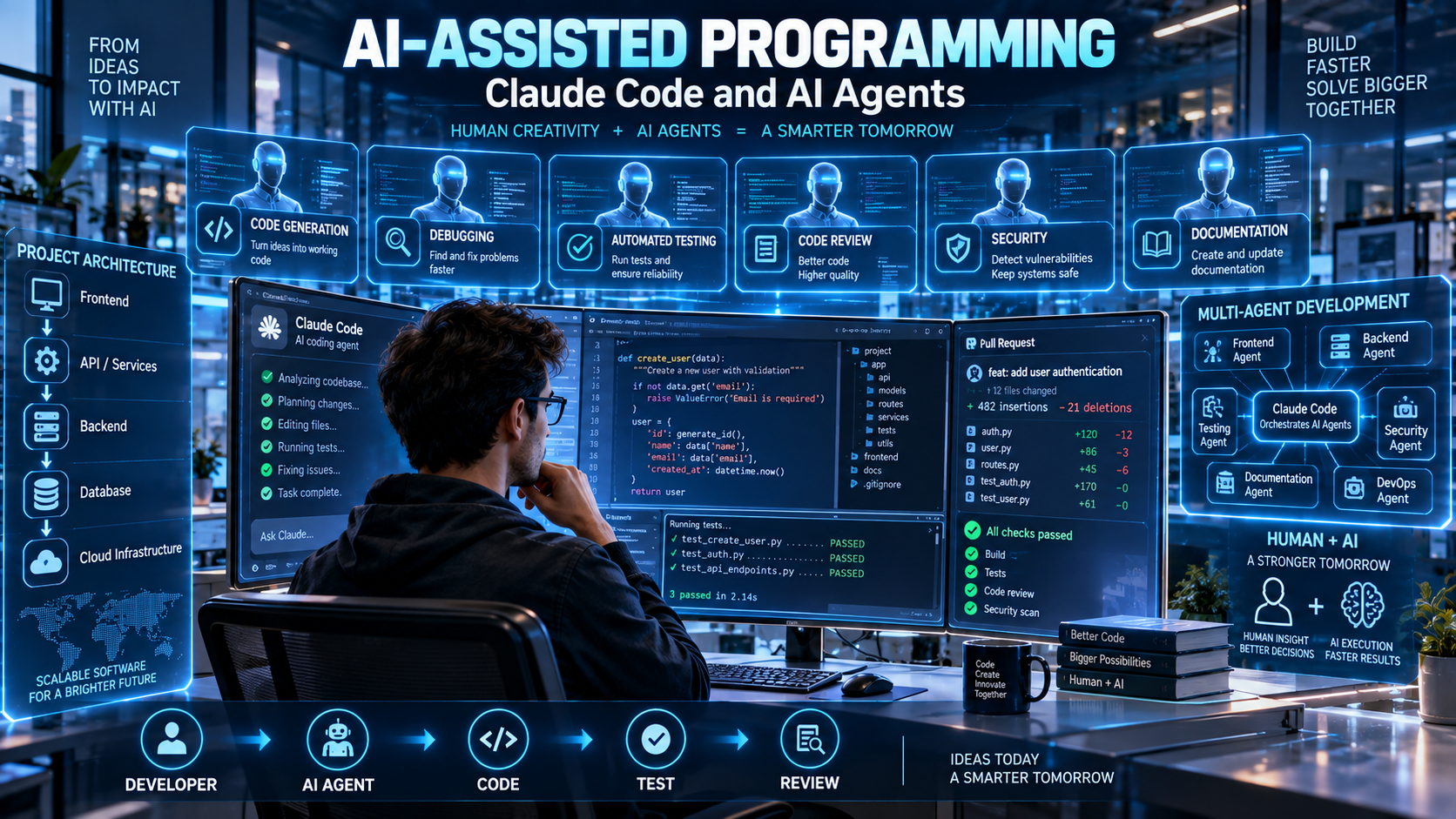
Software development is changing quickly because of artificial intelligence. AI is no longer used only for answering programming questions or suggesting the next line of code.
New AI coding tools can understand a software project, edit files, run commands, write tests, find errors, and work through multiple steps to complete a development task.
One of the tools getting attention in this area is Claude Code, an agentic coding tool from Anthropic.
This leads to an important question:
Could AI agents change the way developers build software in the future?
What Is AI-Assisted Programming?
AI-assisted programming means using artificial intelligence to help developers create and maintain software.
A developer can use AI to:
- Write code
- Explain code
- Find bugs
- Create tests
- Refactor existing code
- Generate documentation
- Review code
- Understand an unfamiliar project
Traditional AI coding assistants usually help developers while they are writing code.
AI coding agents take this idea further. They can work through a larger development task and perform several actions instead of waiting for the developer to ask about every individual step.
What Is Claude Code?
Claude Code is an AI-powered coding agent created by Anthropic.
It can work with a developer’s codebase and development environment. It can read files, search through a project, edit code, run commands, work with tests, and help complete larger programming tasks. Anthropic describes it as an agentic coding tool that operates in the terminal and repository.
For example, instead of asking:
“How can I create a login page?”
a developer could give Claude Code a larger task:
“Add authentication to this application, create the login page, update the API, add validation, write tests, and fix any errors.”
The AI can then work through the task step by step.
What Is an AI Coding Agent?
An AI coding agent is an AI system that can take a software development goal and perform multiple actions to reach that goal.
A simple workflow looks like this:
Developer gives a goal → AI understands the project → AI creates a plan → AI changes code → AI runs tests → AI finds problems → AI improves the code
This is different from simple code autocomplete.
The AI agent can use available tools and make decisions about the steps needed to complete the task.
Anthropic describes AI agents as systems that can pursue goals and control their own processes and tool usage with relatively little human input.
How Is Claude Code Different From a Normal AI Coding Assistant?
The biggest difference is the amount of work the AI can perform.
A normal coding assistant might suggest a function or a few lines of code.
An AI coding agent can work on a complete task.
| Normal AI Coding Assistant | AI Coding Agent |
|---|---|
| Suggests code | Works on development tasks |
| Generates snippets | Can modify multiple files |
| Helps while coding | Can plan and execute steps |
| Usually needs frequent instructions | Can work through a larger task |
| Focuses mainly on code generation | Can code, test and debug |
| Developer controls most actions | AI can perform more actions |
This does not mean traditional coding assistants are disappearing.
Instead, AI coding tools are becoming more capable and moving toward agent-based development.
How Does Claude Code Help Developers?
Imagine a developer is working on an online shopping application.
They want to add a product review feature.
Instead of manually creating every part, an AI coding agent could help with tasks such as:
- Finding the existing product model.
- Understanding the database structure.
- Creating the review API.
- Updating the frontend.
- Adding form validation.
- Creating tests.
- Running the tests.
- Finding errors.
- Fixing problems.
- Preparing the changes for review.
The developer still needs to check the result, but the AI can handle many repetitive implementation steps.
Can AI Agents Understand an Existing Codebase?
Yes.
This is one of the important differences between an AI agent and a simple code generator.
An agent can inspect project files and search for existing components, functions, APIs and configuration.
For example, if a developer says:
“Add dark mode to the existing dashboard.”
the agent can first inspect the project to understand how the UI, styles and components are organized.
It can then make changes based on the existing structure rather than creating an unrelated example from scratch.
Can Claude Code Debug Software?
AI coding agents can also help developers debug applications.
For example, a developer might provide an error such as:
“The API returns a 500 error when creating a new user.”
The agent can investigate the relevant files, follow the code path, identify possible causes, make a change and run tests.
This creates a development loop:
Find problem → Investigate → Change code → Test → Check result → Fix again if necessary
Claude Code has specifically been designed for tasks such as debugging, testing and larger code changes.
Can AI Agents Write Software Tests?
Yes.
AI agents can help developers create different types of tests.
For example, after creating a new API endpoint, an agent can help:
- Create unit tests
- Create integration tests
- Run the test suite
- Investigate failed tests
- Fix implementation problems
- Run the tests again
This is important because faster code generation also creates a greater need for reliable testing.
Anthropic has described using Claude Code with hooks that can automatically trigger actions such as testing or linting during development workflows.
What Are Subagents?
A subagent is a smaller AI agent that can be given a specific task.
Instead of one AI doing everything, a main agent can delegate different jobs to specialized agents.
For example:
Main AI Agent
→ Frontend subagent
→ Backend subagent
→ Testing subagent
→ Security subagent
→ Documentation subagent
This can make large development tasks easier to organize.
Claude Code supports subagents for specialized tasks and parallel workflows.
Could Multiple AI Agents Build Software Together?
This is one of the most interesting developments in AI-assisted programming.
Instead of having:
One developer + one AI assistant
a development team could eventually work with:
Developers + multiple specialized AI agents
For example, one agent could work on the frontend while another works on the backend and another checks tests.
Anthropic’s 2026 agentic-coding research identifies multi-agent coordination as an important direction for software development.
GitHub is also building workflows where developers can use coding agents from different providers within GitHub and VS Code.
Will AI Agents Replace Software Developers?
This is one of the biggest questions around AI coding.
AI agents can already perform many programming tasks, but software development is more than writing code.
Developers still need to understand:
- What the customer actually needs
- How the application should work
- System architecture
- Security
- Performance
- Database design
- User experience
- Business requirements
- Testing
- Long-term maintenance
AI can help with implementation, but humans still need to make important decisions.
Anthropic’s research on Claude Code found that people generally make most of the planning decisions, while Claude makes more of the execution decisions.
Will Developers Write Less Code?
AI-assisted programming could reduce the amount of code developers manually type.
Instead of writing every function from the beginning, developers may increasingly describe what they want and let AI generate the initial implementation.
The workflow could become:
Developer describes the requirement → AI creates the implementation → Developer reviews it → AI tests and improves it
This does not mean developers stop programming.
Instead, programming could become more focused on problem solving, architecture, review and decision-making.
What Skills Will Developers Need in the AI Era?
AI-assisted programming may change which skills developers use most often.
Software Architecture
Developers need to understand how different parts of an application should work together.
Problem Solving
Developers must still identify the actual problem and determine the right solution.
Code Review
AI-generated code needs to be checked for correctness, maintainability and security.
Testing
Developers need to know how to verify that AI-generated software actually works.
Security
AI-generated code can still contain vulnerabilities, so security knowledge remains important.
AI Collaboration
Developers will increasingly need to know how to give AI agents useful instructions, context and constraints.
Can AI Agents Make Developers More Productive?
AI agents can potentially reduce the amount of time spent on repetitive development work.
They can help with tasks such as:
- Creating boilerplate
- Refactoring code
- Writing tests
- Generating documentation
- Investigating bugs
- Updating dependencies
- Creating components
- Working with APIs
- Understanding unfamiliar code
Anthropic’s 2026 analysis of about 400,000 Claude Code sessions found increasing use of more end-to-end agentic workflows, including deploying and running code and analyzing data.
However, productivity depends on the quality of the instructions, project context, testing and human review.
Why Is Human Review Still Important?
AI-generated code is not automatically correct.
An AI agent can misunderstand a requirement or make a change that appears to work but creates another problem.
For example, an AI-generated solution could:
- Break an existing feature
- Introduce a security problem
- Use the wrong library
- Create unnecessary complexity
- Make incorrect assumptions
- Produce difficult-to-maintain code
This is why human review remains important.
A useful development model is:
AI executes → Human reviews → AI improves → Human approves
Anthropic has also highlighted the need for human oversight because greater agent autonomy can introduce new risks and unintended actions.
What About AI Coding Security?
Security becomes even more important when AI agents can access files, terminals, repositories and external tools.
An AI agent with more permissions can perform more useful tasks, but it can also create greater risks if something goes wrong.
For example, an agent could encounter malicious instructions hidden inside a file, tool response or external content.
This is known as prompt injection.
Modern agentic development therefore needs:
- Permission controls
- Sandboxing
- Human approval
- Secure tool access
- Code review
- Testing
- Monitoring
Anthropic has introduced security mechanisms around agent actions and prompt-injection detection as Claude Code becomes more autonomous.
What Is the Future of AI-Assisted Programming?
The future of AI-assisted programming may develop through several stages.
Stage 1: Code Completion
AI predicts and suggests code.
Stage 2: AI Coding Assistant
AI writes larger sections of code and explains existing software.
Stage 3: AI Coding Agent
AI can plan and complete multi-step development tasks.
Stage 4: Multi-Agent Development
Multiple specialized AI agents work on different parts of a project.
Stage 5: AI-Native Software Development
Development environments may be designed around humans managing and reviewing AI agents from the beginning.
Anthropic’s 2026 Agentic Coding Trends Report describes this broader transition as software development moving from simply writing code toward orchestrating agents that write code, while retaining human judgment and oversight.
Could AI Agents Change the Role of a Software Engineer?
The role of a software engineer could become more focused on high-level technical decisions.
Instead of spending most of the day manually writing code, a developer might spend more time on:
Requirements → Architecture → AI instructions → Review → Testing → Security → Deployment
The developer becomes the person responsible for making sure the system is built correctly.
AI becomes a powerful implementation partner.
What Could a Future Software Team Look Like?
A future development team could include both humans and AI agents.
For example:
Product Manager
↓
Human Software Architect
↓
AI Development Agents
↓
Frontend + Backend + Testing + Security Agents
↓
Human Review
↓
Production
In this model, humans remain responsible for important decisions while AI agents handle more implementation and repetitive work.
Is Claude Code the Future of Programming?
Claude Code is one example of a much larger trend.
Other companies are also developing AI coding agents and agent-based developer tools. GitHub, for example, has introduced workflows that allow developers to use multiple coding agents within its development ecosystem.
So the future is not necessarily about one specific AI tool.
The bigger change is the movement from:
AI that helps you write code
to:
AI that helps you complete software development tasks.
What Are the Biggest Challenges?
AI-assisted programming also has several challenges.
Accuracy
AI can produce incorrect code.
Security
Agents need carefully controlled permissions.
Testing
Generated code still needs proper testing.
Cost
Large AI workflows can require significant computing and API usage.
Complexity
Multiple agents can create coordination problems.
Maintenance
Quickly generated software can become difficult to maintain if architecture is ignored.
Human Oversight
Developers still need to understand and review important changes.
The goal is therefore not simply to give AI unlimited control.
The goal is to create a workflow where AI can do more work while humans maintain appropriate control.
Claude Code and AI Agents: What Has Changed?
The biggest change is not simply that AI can write code.
AI has been generating code for years.
The important change is that AI agents can increasingly understand a development goal, inspect a project, use development tools, modify code, run tests and continue working toward a result.
That makes them different from simple autocomplete tools.
AI is becoming less like a coding calculator and more like a software development collaborator.
What Could Programming Look Like in the Future?
The traditional approach looks like:
Developer → writes code → tests code → fixes bugs
The emerging AI-assisted approach could look like:
Developer → defines goal → AI plans → AI writes code → AI tests → AI fixes problems → Developer reviews
This could allow developers to focus more on architecture, product requirements, security and technical decisions.
In other words, developers may write less code manually while becoming more involved in directing, reviewing and validating AI-generated software.
Conclusion
Claude Code and other AI coding agents are changing the way developers think about software development.
AI is moving beyond simple code suggestions and becoming capable of working through larger programming tasks.
The future may not be about AI replacing every software developer.
Instead, it may be about developers working together with increasingly capable AI agents.
Developers could spend less time writing repetitive code and more time solving problems, designing systems, reviewing software and making technical decisions.
The most important programming skill of the future may therefore not be simply knowing how to write every line of code.
It may be knowing what needs to be built, how it should work, how to guide AI to build it, and how to verify that the final software is correct.
