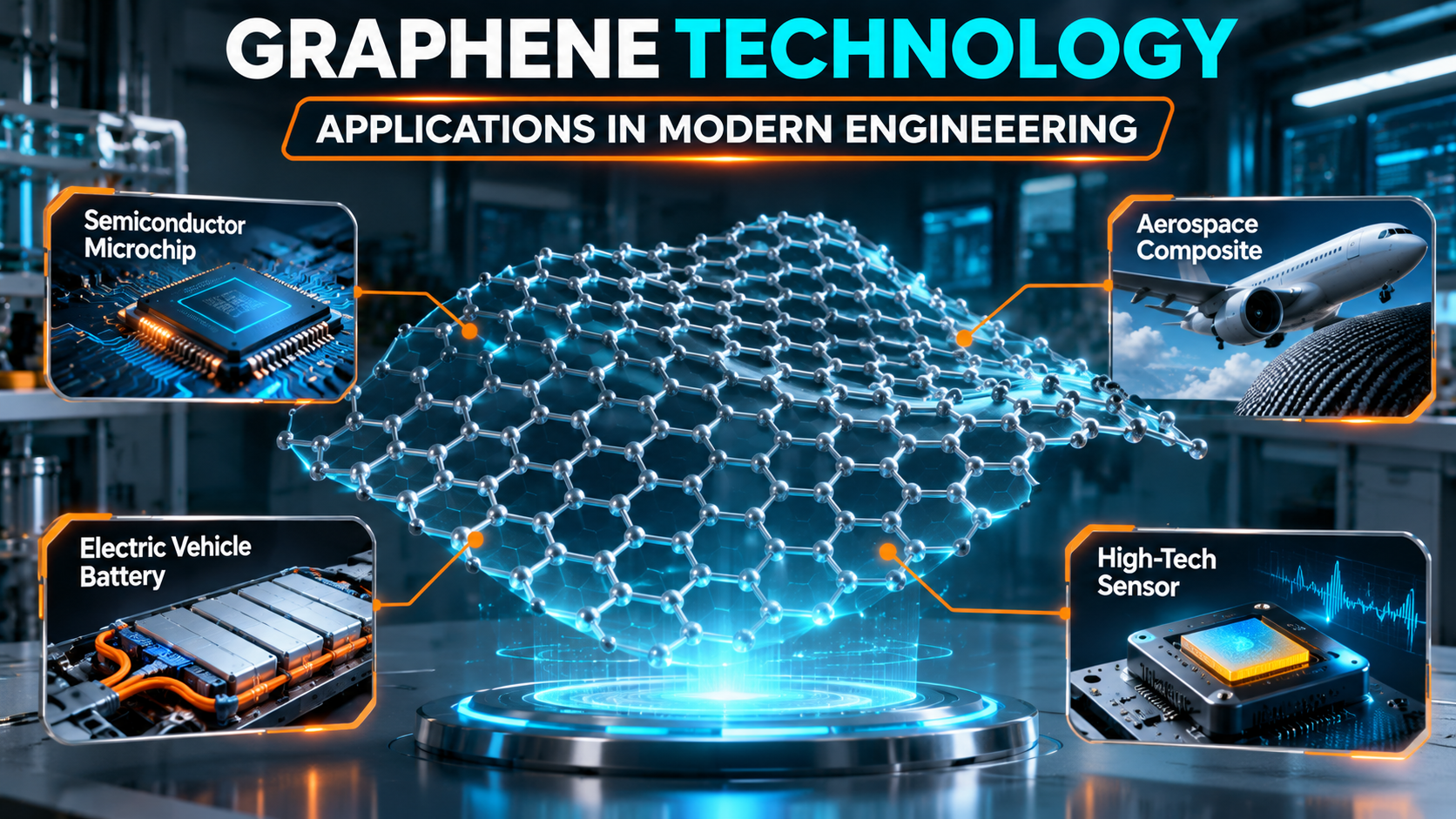
Modern engineering is continuously searching for materials that are lighter, stronger, more flexible, and more efficient. From smartphones and electric vehicles to aerospace systems and renewable energy technologies, engineers need advanced materials that can deliver better performance with fewer limitations.
One material attracting significant attention is graphene.
Graphene is an extremely thin material made of carbon atoms arranged in a two-dimensional honeycomb structure. Despite being only one atom thick, it has exceptional mechanical strength, electrical conductivity, thermal conductivity, and flexibility.
These properties make graphene an exciting material for developing next-generation electronic devices, advanced batteries, lightweight aircraft components, high-performance sensors, and innovative construction materials.
But what exactly is graphene, how does it work, and why is it important for modern engineering?
Let’s explore its structure, properties, manufacturing methods, applications, benefits, and future potential.
What Is Graphene Technology?
Graphene technology refers to the development and application of graphene-based materials in engineering, electronics, energy systems, manufacturing, and other industries.
Graphene itself is a single layer of carbon atoms arranged in a hexagonal honeycomb pattern. Each carbon atom is connected to three neighbouring carbon atoms through strong chemical bonds.
This unique atomic arrangement gives graphene its remarkable properties.
Graphene is often described as a two-dimensional material because its thickness is limited to a single atomic layer, while its length and width can extend across much larger areas.
It was experimentally isolated in 2004 by researchers Andre Geim and Konstantin Novoselov at the University of Manchester. Their work helped establish graphene as an important material in modern nanotechnology and materials science.
How Does Graphene Work?
The performance of graphene comes from its atomic structure and the way its electrons behave.
Every carbon atom in graphene forms three strong bonds with neighbouring carbon atoms. These bonds create a stable hexagonal network.
The remaining electron from each carbon atom contributes to an electronic system that allows charge carriers to move efficiently across the material.
This structure helps explain why graphene has several unusual characteristics:
- Strong atomic bonding provides excellent mechanical strength.
- Mobile electrons support high electrical conductivity.
- Its atomic structure allows efficient heat transfer.
- Its thin structure provides flexibility and a very high surface-area-to-volume ratio.
Graphene’s behaviour can also be modified through chemical functionalisation, layering, doping, and combining it with other materials.
This makes it useful for developing different types of graphene-based engineering products.
Key Properties of Graphene
Graphene has attracted engineering interest because of its combination of physical, electrical, and chemical properties.
1. Exceptional Mechanical Strength
Graphene has an extremely high tensile strength when measured as a defect-free material.
Its strong carbon-carbon bonds help it resist mechanical deformation and make it an interesting candidate for lightweight composite materials.
2. High Electrical Conductivity
Graphene can conduct electricity very efficiently.
Its electronic properties make it useful for research into flexible electronics, transparent conductive films, high-frequency devices, and advanced sensors.
3. Excellent Thermal Conductivity
Graphene can transfer heat efficiently along its atomic structure.
This property makes it promising for thermal management applications, including electronic devices, semiconductor systems, and heat-spreading materials.
4. Lightweight Structure
Because graphene is only one atom thick, it has an extremely low mass for a given surface area.
When incorporated into suitable composites, it may help engineers improve material performance without adding significant weight.
5. Flexibility and Transparency
Graphene combines electrical conductivity with flexibility and optical transparency.
These characteristics make it interesting for flexible displays, wearable electronics, touch-sensitive surfaces, and transparent electrodes.
6. Large Specific Surface Area
Graphene has a very high theoretical specific surface area.
This can make it useful in applications involving electrochemical reactions, energy storage, filtration, and chemical sensing.
However, actual performance depends on the graphene form, quality, surface chemistry, and manufacturing process.
How Is Graphene Manufactured?
Producing graphene with consistent quality and at an industrial scale is one of the major challenges in graphene technology.
Several manufacturing methods are used to produce graphene or graphene-related materials.
1. Mechanical Exfoliation
Mechanical exfoliation separates individual graphene layers from graphite using mechanical force.
This method was used in the early experimental isolation of graphene.
It can produce high-quality graphene samples, but it is not generally suitable for large-scale industrial production.
2. Chemical Vapour Deposition (CVD)
Chemical Vapour Deposition is an important technique for producing large-area graphene films.
In this process, carbon-containing gases are introduced into a controlled high-temperature environment, often using a metal substrate such as copper.
Carbon atoms form a graphene layer on the surface.
CVD is particularly interesting for applications requiring graphene films, including transparent conductive coatings and electronic devices.
3. Liquid-Phase Exfoliation
Liquid-phase exfoliation separates graphite layers in a suitable liquid medium using techniques such as sonication or shear mixing.
It can produce graphene flakes or few-layer graphene dispersions.
This method is useful for developing inks, coatings, composites, and conductive materials.
4. Chemical Reduction of Graphene Oxide
Graphene oxide can be produced by chemically modifying graphite.
A reduction process then removes some oxygen-containing groups to produce reduced graphene oxide.
This material is useful in certain applications, although it generally contains more structural defects than high-quality graphene produced through other methods.
5. Epitaxial Growth
Epitaxial growth produces graphene by heating suitable silicon carbide substrates under controlled conditions.
Silicon atoms are removed from the surface, allowing carbon atoms to reorganise into graphene layers.
This approach is being explored for specialised electronic and semiconductor applications.
Applications of Graphene Technology in Modern Engineering
Graphene has potential applications across several engineering industries. Its properties make it particularly interesting when conventional materials cannot meet specific performance requirements.
1. Electronics and Semiconductor Engineering
Graphene’s electrical conductivity, flexibility, and thin structure make it a promising material for advanced electronic devices.
Potential applications include:
- Flexible electronic circuits
- Transparent conductive films
- High-frequency electronic components
- Advanced sensors
- Wearable electronic devices
- Experimental transistor technologies
Graphene may support certain electronic applications where traditional materials face limitations.
However, graphene does not naturally have the same useful electronic bandgap as conventional silicon semiconductor materials. This makes it challenging to use as a direct replacement for silicon in standard digital logic transistors.
2. Battery and Energy Storage Technology
Energy storage is another important area of graphene research.
Graphene and graphene-based materials are being investigated for use in batteries and supercapacitors.
Potential benefits include:
- Improved electrical conductivity in electrodes
- Better charge-transfer performance
- Enhanced electrode surface area
- Improved power delivery in certain designs
- Potential improvements in charging and discharging performance
Graphene can be incorporated into electrode materials to improve their electrical pathways.
However, it does not automatically make every battery faster, safer, or longer-lasting. Results depend on the complete battery chemistry and electrode design.
3. Aerospace and Aviation Engineering
Aerospace engineering requires materials that combine high strength with low weight.
Graphene-based composites are being researched for aircraft structures, protective coatings, and specialised components.
Potential applications include:
- Lightweight composite structures
- Electrically conductive aircraft coatings
- Thermal management systems
- Electromagnetic shielding
- Protective surface materials
If graphene-based composites can be manufactured reliably and economically, they may help improve performance in selected aerospace applications.
4. Automotive and Electric Vehicle Engineering
The automotive industry is exploring graphene for applications involving weight reduction, electrical performance, and thermal management.
Potential applications include:
- Battery electrode enhancements
- Conductive automotive coatings
- Lightweight composite components
- Thermal management materials
- Electromagnetic interference shielding
- Advanced vehicle sensors
Graphene-based materials may help engineers develop more efficient vehicle components, particularly in electric mobility systems.
5. Construction and Civil Engineering
Graphene is also being investigated as an additive for construction materials.
Researchers are studying how graphene-based additives can influence the mechanical properties, durability, and performance of cement-based materials.
Potential applications include:
- Graphene-enhanced concrete
- Protective coatings
- Corrosion-resistant materials
- Conductive construction surfaces
- Smart infrastructure monitoring
Graphene additives may improve selected properties of cement composites, but the results depend on dispersion, dosage, production methods, and testing conditions.
6. Water Filtration and Environmental Engineering
Graphene oxide membranes and other graphene-based materials are being researched for water purification and separation technologies.
Their structures and surface chemistry can be engineered to interact with different molecules and contaminants.
Potential applications include:
- Water filtration membranes
- Desalination research
- Industrial wastewater treatment
- Selective molecular separation
- Environmental pollutant detection
Commercial use depends on membrane performance, durability, operating costs, and the ability to manufacture consistent products.
7. Medical Engineering and Healthcare Technology
Graphene-based materials are being explored in biomedical research and medical engineering.
Researchers are investigating their potential in:
- Biosensors
- Medical diagnostic devices
- Drug delivery research
- Tissue engineering
- Flexible health-monitoring devices
- Biomedical electrodes
However, biomedical applications require careful evaluation of toxicity, biocompatibility, exposure, and long-term safety.
Graphene should not be considered automatically safe for every medical application.
8. Sensors and Smart Engineering Systems
Graphene’s high surface sensitivity and electrical properties make it useful for developing advanced sensing technologies.
Graphene-based sensors are being researched to detect:
- Chemical substances
- Environmental pollutants
- Gas concentrations
- Pressure and mechanical strain
- Temperature changes
- Biological molecules
These sensors could support smart manufacturing, environmental monitoring, industrial safety, and connected infrastructure.
Graphene vs Traditional Materials
Graphene is often compared with materials such as copper, aluminium, steel, and silicon.
However, these materials perform different engineering roles, so graphene should not be treated as a universal replacement.
| Property | Graphene | Copper | Aluminium | Silicon |
|---|---|---|---|---|
| Structure | Two-dimensional carbon layer | Metal | Metal | Semiconductor |
| Electrical behaviour | Highly conductive | Excellent conductor | Good conductor | Semiconductor |
| Mechanical strength | Very high in ideal samples | Relatively low | Moderate | Brittle |
| Weight | Extremely low per unit area | High density | Low density | Moderate density |
| Flexibility | Flexible in thin films | Ductile | Ductile | Brittle |
| Main engineering uses | Advanced materials, sensors, research electronics | Wiring and electrical systems | Structures and transport | Semiconductor devices |
The right material depends on the required application, manufacturing method, cost, and operating environment.
Benefits of Graphene Technology
Graphene offers several potential advantages for engineering and industrial development.
1. Better Material Performance
Graphene can enhance selected mechanical, electrical, or thermal properties when incorporated into suitable composite materials.
2. Lightweight Engineering Solutions
Its low mass and high performance make graphene-based composites attractive for aerospace, automotive, and portable electronic applications.
3. Improved Electrical Applications
Graphene can support the development of conductive films, sensors, electrodes, and flexible electronics.
4. Advanced Thermal Management
Its heat-transfer properties make it useful for investigating new cooling and heat-spreading solutions in electronic systems.
5. Innovation Across Multiple Industries
Graphene can be combined with polymers, metals, ceramics, and other materials to develop specialised engineering products.
Challenges and Limitations of Graphene Technology
Despite its impressive properties, graphene still faces several challenges before it can be widely adopted across all industries.
1. High Production Costs
Producing high-quality graphene with consistent properties can be expensive.
The manufacturing process, equipment, raw materials, and quality-control requirements influence the final cost.
2. Large-Scale Manufacturing
Producing graphene in laboratory conditions is different from manufacturing it consistently at industrial scale.
Engineers need reliable production methods that maintain quality across large quantities.
3. Material Defects
Defects, impurities, and variations in layer structure can affect graphene’s electrical, mechanical, and thermal performance.
4. Dispersion Challenges
Graphene sheets can form clusters or aggregate when mixed with other materials.
Achieving uniform dispersion is important for developing reliable graphene-based composites.
5. Integration with Existing Systems
Graphene-based products may require new manufacturing processes, specialised equipment, and compatibility testing.
Integrating them into existing production systems can be difficult.
6. Health and Environmental Considerations
The safety of graphene materials depends on factors such as particle size, surface chemistry, exposure route, and manufacturing conditions.
Proper handling, worker protection, environmental assessment, and lifecycle evaluation are important.
7. Commercialisation Challenges
Not every laboratory breakthrough becomes a commercially successful product.
Businesses must demonstrate that graphene provides measurable advantages over existing materials while remaining cost-effective and reliable.
The Future of Graphene Technology
Graphene research continues to expand across materials science, electronics, energy storage, and advanced manufacturing.
Several developments could influence its future engineering applications.
1. Next-Generation Electronics
Researchers are investigating graphene-based flexible circuits, transparent electrodes, and specialised electronic devices.
2. Advanced Energy Storage
Graphene-based electrode materials may contribute to future battery and supercapacitor designs with improved electrical performance.
3. Smart and Functional Materials
Combining graphene with polymers and other materials could create composites with sensing, conductive, thermal, or protective properties.
4. More Efficient Manufacturing
Improvements in chemical vapour deposition, liquid-phase processing, and quality-control techniques may help reduce manufacturing limitations.
5. Advanced Sensors
Graphene-based sensing technologies could become useful in industrial monitoring, healthcare research, environmental systems, and smart infrastructure.
6. Sustainable Engineering
Graphene research may support lightweight components, energy systems, filtration technologies, and more efficient industrial materials.
The long-term impact will depend on manufacturing economics, safety, performance validation, and commercial demand.
Is Graphene the Future of Modern Engineering?
Graphene has the potential to influence several areas of modern engineering because of its unusual combination of strength, conductivity, flexibility, and thermal performance.
From advanced electronics and energy storage to aerospace composites and environmental sensors, researchers and engineers are exploring ways to turn its unique properties into practical products.
However, graphene is not a universal replacement for traditional engineering materials. Production costs, quality control, material integration, and long-term reliability remain important challenges.
The future of graphene technology will depend on how effectively researchers and manufacturers overcome these limitations and develop applications that provide clear advantages over existing solutions.
As manufacturing techniques improve, graphene could become an increasingly valuable material in the next generation of engineering innovation.
Frequently Asked Questions (FAQs)
1. What is graphene technology?
Graphene technology involves using graphene, a single atomic layer of carbon atoms, to develop advanced materials and engineering applications such as electronics, batteries, sensors, and composite structures.
2. Why is graphene considered a revolutionary material?
Graphene attracts attention because of its combination of high mechanical strength, electrical conductivity, thermal conductivity, flexibility, and extremely low thickness.
3. Where is graphene used in modern engineering?
Graphene is being researched and used in selected applications involving electronics, energy storage, aerospace composites, automotive materials, sensors, coatings, filtration, and biomedical devices.
4. Is graphene stronger than steel?
Ideal defect-free graphene has a much higher tensile strength than conventional steel when compared under appropriate material-testing conditions. However, real-world graphene products and graphene composites do not automatically have the same strength.
5. Can graphene improve battery performance?
Graphene can improve electrical conductivity and electrode characteristics in certain battery designs. Its actual impact on charging speed, energy density, lifespan, and safety depends on the complete battery system.
6. How is graphene manufactured?
Graphene can be manufactured using methods such as mechanical exfoliation, chemical vapour deposition, liquid-phase exfoliation, chemical reduction of graphene oxide, and epitaxial growth.
7. Is graphene expensive?
The cost depends on its quality, purity, layer count, production process, and intended application. High-quality graphene films and specialised materials can be expensive to manufacture.
8. Can graphene replace silicon in electronics?
Graphene has excellent electrical properties, but its lack of a natural electronic bandgap creates challenges for conventional digital logic applications. It is more likely to complement existing semiconductor technologies in specialised applications than replace silicon completely.
9. Is graphene environmentally friendly?
Graphene’s environmental impact depends on its production method, chemical processing, energy consumption, handling, and disposal. Its potential benefits must be evaluated across the complete product lifecycle.
10. What is the future of graphene technology?
Potential future developments include flexible electronics, advanced batteries, lightweight composites, high-performance sensors, filtration membranes, and specialised semiconductor devices.
Conclusion
Graphene is one of the most interesting advanced materials being explored in modern engineering. Its unique atomic structure provides a combination of mechanical, electrical, and thermal properties that could support innovation across multiple industries.
Although manufacturing costs, quality control, and commercialisation remain challenges, ongoing research continues to expand the possibilities of graphene-based materials.
As engineering technology evolves, graphene could play an important role in creating lighter, smarter, and more efficient products for the future.
