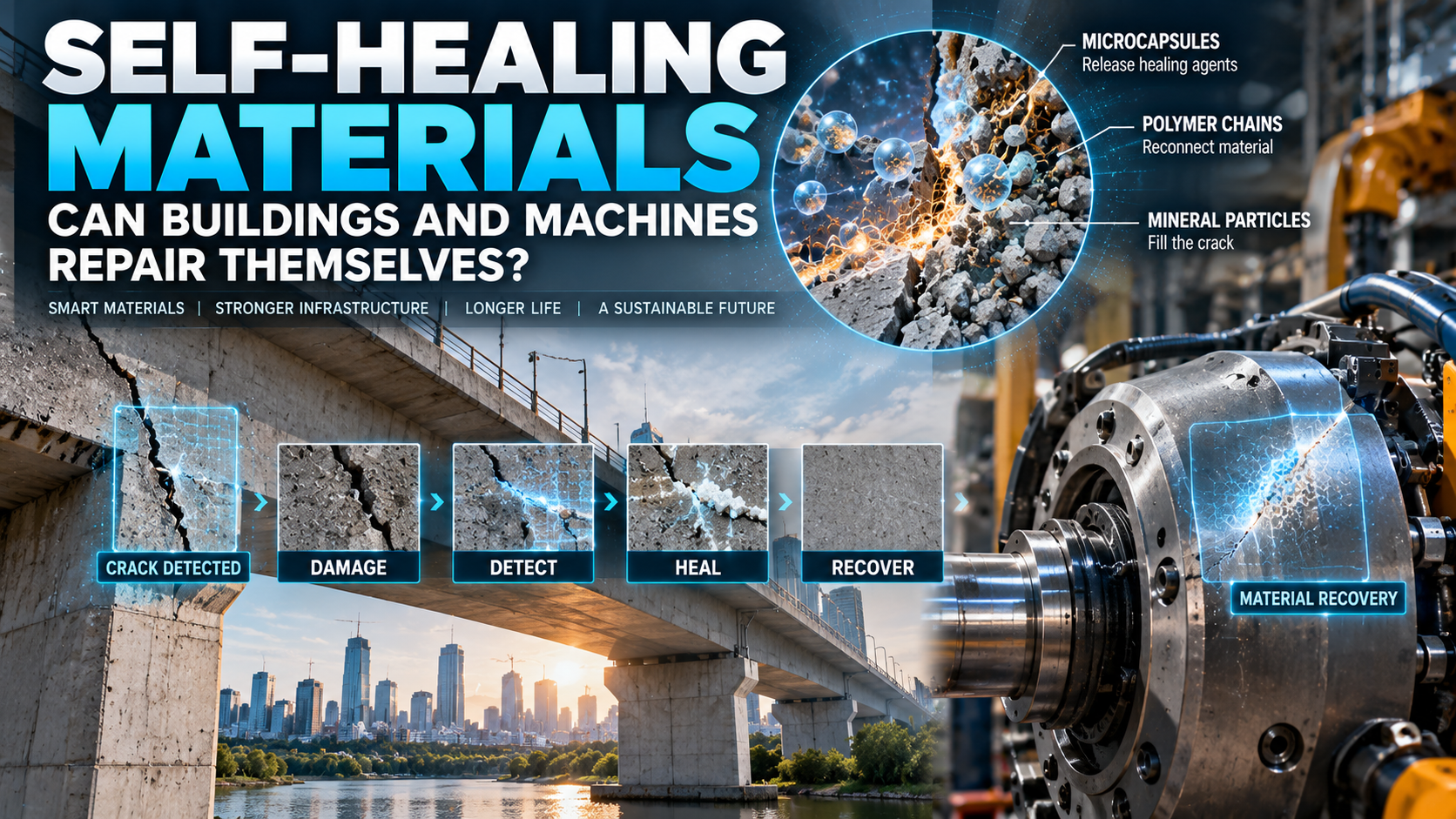
Imagine a building that develops a small crack but does not always need a worker to repair it. Imagine a machine whose material can recover after minor damage. This may sound like science fiction, but engineers and researchers are developing self-healing materials that can repair certain types of damage automatically.
Self-healing materials are designed to respond to cracks, scratches or other forms of damage and restore part of their original properties. Researchers are working on these materials for concrete, polymers, electronics, robots, batteries and other engineering applications.
But can buildings and machines really repair themselves?
The answer is partly. Today’s self-healing materials cannot rebuild a seriously damaged building or completely repair a broken machine. Instead, they are mainly designed to handle specific and often smaller types of damage.
What Are Self-Healing Materials?
Self-healing materials are advanced materials that can repair some damage without traditional manual repair.
The idea is similar to how the human body responds to a small injury. A self-healing material has a built-in mechanism that can respond when damage occurs.
For example, when a small crack forms in a special concrete, the material may activate a chemical, biological or physical process that helps close the crack.
The basic idea is:
Damage → Healing Process → Crack or Defect Closes → Material Recovers
Different materials use different healing mechanisms, so there is no single technology called self-healing material.
Why Are Engineers Developing Self-Healing Materials?
Materials naturally become damaged over time.
Concrete can develop cracks. Machines experience vibration and wear. Electronics can suffer physical damage. Polymers can become scratched or torn.
Normally, the process looks like this:
Damage → Inspection → Repair → Cost → Downtime
Self-healing materials try to reduce some of this maintenance.
If a material can automatically repair small damage, engineers may be able to increase durability, reduce maintenance and extend the useful life of products and infrastructure.
This is one reason self-healing materials are becoming an important area of advanced materials research.
How Do Self-Healing Materials Work?
Self-healing materials can use different methods to repair damage.
Some materials contain special chemicals that react when a crack appears. Others contain tiny capsules filled with healing agents. Some concrete systems use bacteria or mineral-forming processes. Other advanced polymers use reversible chemical bonds that allow the material to reconnect after damage.
A simple process is:
1. Damage occurs
A crack, scratch or defect appears.
2. The material responds
The healing mechanism becomes active.
3. Healing material moves toward the damaged area
A chemical, polymer, mineral or other material fills or reconnects the damaged region.
4. The damage is reduced
The crack becomes smaller or the material regains some of its original properties.
The exact process depends on the material being used.
Can Concrete Heal Itself?
Concrete is one of the most important areas of self-healing material research.
Small cracks can naturally close under certain conditions. This is often called autogenous self-healing.
Engineers are also developing autonomous self-healing concrete, where special materials are added to improve the healing process.
Current research includes approaches using polymers, bacteria, mineral additives, microcapsules and other healing systems.
The goal is not to make concrete completely indestructible. Instead, the goal is to help concrete deal with certain cracks before they become larger problems.
How Does Self-Healing Concrete Repair Cracks?
Different self-healing concrete systems work in different ways.
For example, some systems can use materials that react with water and form new mineral products that help close cracks.
Other systems use special capsules containing healing agents. When a crack reaches a capsule, the capsule can break and release its contents into the damaged area.
The process can be simplified as:
Crack forms → Healing agent activates → Crack fills → Concrete becomes more resistant to further damage
Researchers are also investigating crystalline waterproofing materials and other cement-based additives for autonomous crack healing.
Can Bacteria Repair Concrete?
One of the most interesting approaches is bacteria-based self-healing concrete.
Certain bacteria can help produce minerals such as calcium carbonate under suitable conditions. These minerals can help fill cracks in concrete.
The basic concept is:
Crack forms → Suitable conditions activate the bacteria → Minerals are produced → Crack is gradually sealed
Researchers are continuing to study how bacterial type, concrete composition, moisture and crack size affect the healing process. Recent 2026 research is still exploring bio-enhanced concrete and bacterial mineralization as ways to improve durability.
So, it is not accurate to think of this as bacteria simply “eating” or magically repairing concrete. It is a carefully engineered material system.
What Are Microcapsule-Based Self-Healing Materials?
Another approach uses extremely small capsules containing healing materials.
These capsules are mixed into the material during manufacturing.
When a crack reaches one of the capsules:
Crack → Capsule breaks → Healing material is released → Crack is sealed
Think of these capsules as tiny repair kits built into the material.
Researchers have studied microcapsule-based systems for concrete and other materials, although questions around cost, repeatability and real-world performance still need to be addressed.
What Is Polymer-Based Self-Healing Concrete?
Polymers are another interesting direction.
In 2026, researchers reported a cement composite using a very small amount of polymer that forms reversible interactions inside the cement. The researchers described this as a molecular-scale “Velcro” network that can redistribute toward cracks and support repeated healing.
In laboratory testing, the material demonstrated rapid crack closure under specific experimental conditions.
This approach is interesting because it aims to achieve healing without relying on traditional capsules or large quantities of healing agents.
However, laboratory results do not automatically mean that the material is ready for widespread use in buildings and bridges.
Could Buildings Use Self-Healing Concrete?
Potentially, yes.
Self-healing concrete could be useful in structures where small cracks are difficult or expensive to repair.
Possible applications include:
- Bridges
- Roads
- Tunnels
- Buildings
- Parking structures
- Dams
- Marine structures
- Underground infrastructure
The main benefit would be helping control small cracks before they allow more water or harmful chemicals to enter the material.
Researchers are actively studying how self-healing concrete could improve durability and reduce maintenance requirements.
Can Machines Use Self-Healing Materials?
Self-healing technology is not limited to buildings.
Engineers are also investigating self-healing materials for machines and advanced devices.
Potential applications include:
- Robots
- Sensors
- Batteries
- Electronics
- Flexible circuits
- Wearable devices
- Aerospace components
- Industrial equipment
Self-healing polymers and composites are being studied because they can potentially recover from certain mechanical damage while maintaining important properties.
This could make future machines more durable and reduce the need for frequent replacement.
Can Robots Repair Themselves?
Robotics is another exciting application.
Robots experience physical stress during operation. A robotic arm can repeatedly move, a gripper can experience impacts, and a soft robot can bend thousands of times.
Researchers are therefore exploring self-healing materials that can recover after mechanical damage.
In the future, a robot could potentially have:
Self-Healing Body Materials + Self-Healing Sensors + AI Monitoring
If a small damaged area is detected, the material could begin its own recovery process.
This would not mean the robot could fix a broken motor or replace a damaged circuit board by itself. Instead, the material could potentially repair certain types of surface or structural damage.
Can Self-Healing Materials Be Used in Electronics?
Yes, researchers are also exploring self-healing electronics.
Flexible electronics are particularly interesting because they can experience repeated bending, stretching and physical stress.
A self-healing electronic material could potentially restore part of a damaged conductive path or connection.
This could be useful for:
- Wearable electronics
- Flexible displays
- Smart sensors
- Medical devices
- Soft robotics
- Flexible circuits
The goal is to make electronic systems more resistant to physical damage and extend their useful life.
Can Batteries Use Self-Healing Materials?
Batteries experience repeated charging and discharging.
Over time, their internal materials can experience chemical and mechanical changes.
Researchers are exploring self-healing polymers and other advanced materials that could potentially repair certain types of internal damage and help maintain battery performance.
Possible future applications include:
- Electric vehicle batteries
- Wearable batteries
- Flexible batteries
- Large energy-storage systems
However, self-healing battery technology remains an active research area and should not be confused with batteries that can currently repair themselves in everyday products.
Can AI Make Self-Healing Materials Smarter?
AI could become an important part of the future of self-healing materials.
Machine learning can help researchers analyze large amounts of experimental data and search for better material combinations.
For example, AI could help engineers investigate:
- Which materials heal faster
- Which mixture produces stronger concrete
- How temperature affects healing
- How moisture affects healing
- Which material combination provides better durability
- How many healing cycles a material can survive
Researchers are already exploring machine-learning approaches for predicting and optimizing self-healing concrete.
This creates an interesting future combination:
AI + Sensors + Advanced Materials + Self-Healing
Could Buildings Detect Their Own Damage?
This is where self-healing materials could become even more interesting.
Imagine a bridge containing sensors that continuously monitor its condition.
The sensors could detect:
- Cracks
- Stress
- Temperature
- Moisture
- Vibration
- Structural movement
AI could analyze this information and identify unusual changes.
If the material also has self-healing properties, the system could potentially combine damage detection with material recovery.
The future concept could look like:
Sense → Detect → Analyze → Heal → Monitor
This could lead to smarter infrastructure that does not simply wait for humans to discover damage during periodic inspections.
Could Self-Healing Materials Make Construction More Sustainable?
One possible benefit is longer material life.
If a structure needs fewer repairs or replacements, it could potentially reduce the materials, labor and energy required over its lifetime.
Researchers are also investigating self-healing concrete using lower-carbon materials and industrial by-products.
Recent research is exploring combinations of self-healing technology with more sustainable cementitious materials to improve durability while reducing environmental impact.
However, the overall environmental benefit depends on how the material is manufactured, what additives are used and how well it performs over its complete life cycle.
What Are the Limitations of Self-Healing Materials?
Self-healing materials are promising, but they are not magic.
There are still several important challenges.
Limited Damage Size
Many self-healing systems work best with relatively small cracks or defects.
A major structural failure still requires professional inspection and repair.
Cost
Some advanced materials and manufacturing processes can be expensive.
Environmental Conditions
Temperature, moisture, pressure and other environmental conditions can affect the healing process.
Repeatability
Some materials may have limited healing cycles or reduced performance after repeated damage.
Manufacturing
Adding special healing materials to concrete, polymers or other products can make manufacturing more complicated.
Real-World Testing
A material that performs well inside a laboratory needs to be tested under real environmental and structural conditions.
Standards
Engineers also need reliable testing methods and standards before many self-healing materials can become widely used.
Recent reviews continue to identify scalability, cost, long-term durability and standardized testing as important challenges for self-healing concrete.
Can Self-Healing Materials Replace Traditional Repairs?
No, not completely.
Self-healing materials should currently be viewed as a supporting technology, not a replacement for professional maintenance.
For example:
Small crack → Self-healing may help
Minor surface damage → Self-healing may help
Major structural failure → Professional inspection and repair are required
This distinction is important because self-healing materials are designed to reduce or manage certain types of damage, not eliminate every maintenance requirement.
What Will the Future of Self-Healing Materials Look Like?
The future could combine several technologies into one intelligent system.
Imagine a bridge with:
Self-Healing Concrete
↓
Embedded Sensors
↓
AI Damage Detection
↓
Automatic Healing Response
↓
Continuous Structural Monitoring
The same idea could be applied to robots, machines, batteries, electronics and other engineering systems.
Instead of designing materials only to resist damage, engineers could increasingly design materials that can respond to damage.
Could Materials Become More Like Living Systems?
This is the long-term idea behind self-healing materials.
Living organisms can detect damage and respond to it.
Engineers are trying to create materials that can perform a much simpler version of this process.
The material would not actually become alive. Instead, it would contain engineered mechanisms that respond automatically when specific conditions occur.
That could lead to materials that are:
- More durable
- More adaptive
- Easier to maintain
- More sustainable
- More resilient
Conclusion: Can Buildings and Machines Repair Themselves?
Self-healing materials are changing how engineers think about durability and maintenance.
From self-healing concrete and bacteria-based systems to polymers, electronics, batteries and robotic materials, researchers are developing technologies that can respond to certain types of damage.
But today’s technology is still far from a building that can completely repair itself after major damage.
The more realistic future is one where materials can automatically handle small cracks, defects and certain forms of wear, while humans continue to handle major inspections and repairs.
The most exciting possibility is the combination of:
Advanced Materials + Sensors + AI + Self-Healing
Instead of simply asking how strong a material is, future engineers may also ask:
“What happens when the material gets damaged?”
If materials can detect damage, respond to it and recover some of their original performance, they could make future buildings, machines and infrastructure more durable and intelligent.
