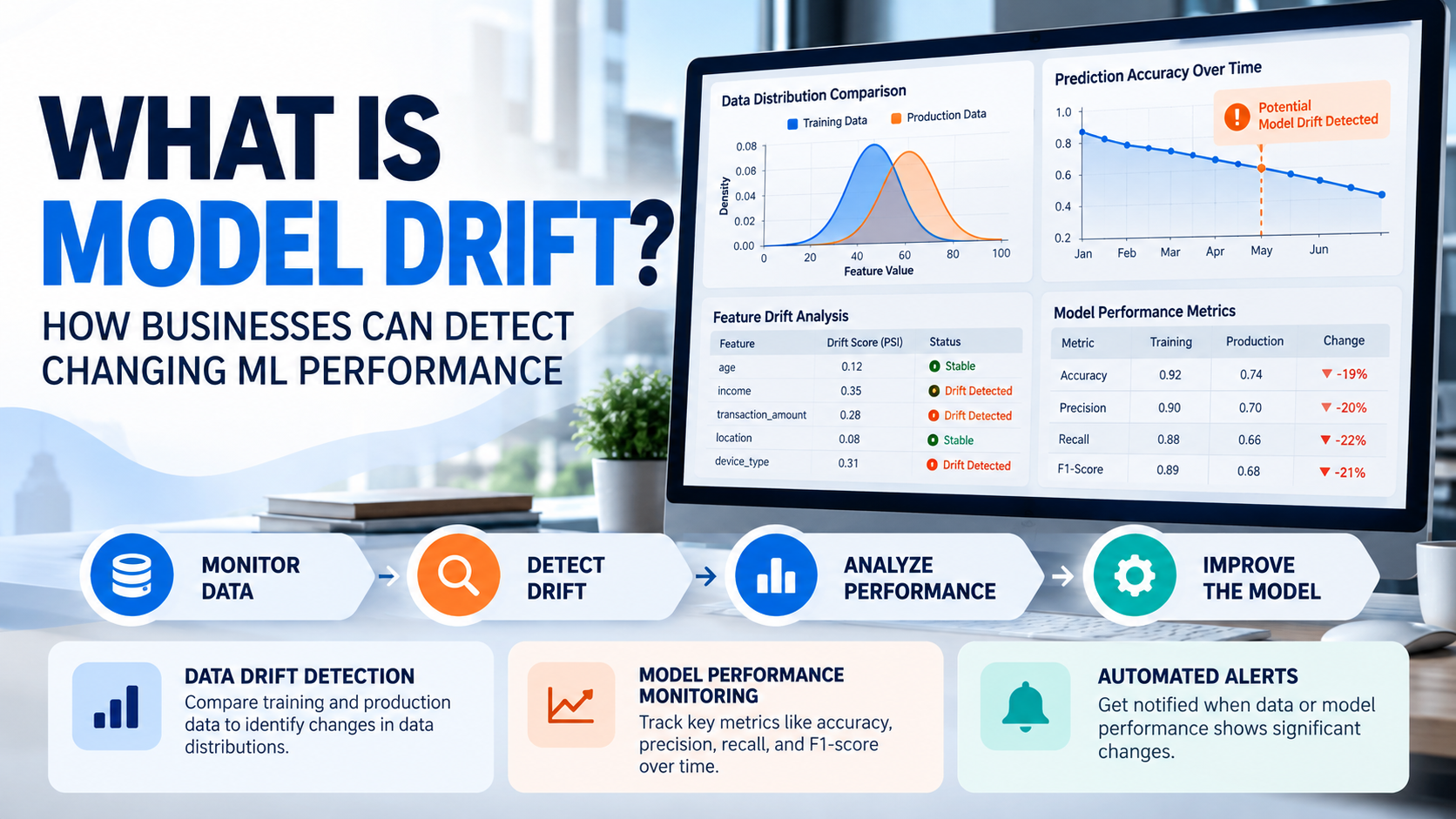
Have you ever wondered why a machine learning model that performed accurately a few months ago starts making incorrect predictions today? A model may initially deliver excellent results, but its performance can decline as customer behavior, market conditions, and real-world data change.
This problem is known as model drift in machine learning.
Model drift is a growing concern for businesses that rely on artificial intelligence (AI) and machine learning (ML) to automate decisions, forecast demand, detect fraud, and improve customer experiences. Without proper monitoring, changes in data and real-world patterns can make machine learning predictions less reliable over time.
For example, an e-commerce company may use machine learning to recommend products based on customer preferences. However, when shopping habits change, the model may continue recommending products based on outdated behavior, resulting in fewer clicks and lower sales.
Understanding model drift helps businesses identify performance issues early, maintain reliable AI systems, and make better data-driven decisions.
In this article, we will explain what model drift is, explore its different types and causes, and discuss how businesses can detect, monitor, and manage model drift effectively.
1. What Is Model Drift in Machine Learning?
Model drift refers to changes in the data or underlying patterns that can cause a deployed machine learning model’s predictions or performance to become less reliable over time.
Machine learning models learn patterns from historical data during training. After deployment, they use these learned patterns to make predictions on new data. However, real-world conditions constantly change, and the data a model receives may eventually differ from the data it learned from.
When these changes affect the model’s ability to make useful predictions, businesses may experience model drift.
For example, a bank may train a machine learning model to identify fraudulent transactions using historical transaction records. Over time, fraudsters may develop new techniques that differ from previously observed patterns. As a result, the model may fail to recognize certain fraudulent activities.
This situation highlights why machine learning models need continuous monitoring after deployment.
Model drift can affect several business applications, including:
-
Fraud detection and financial risk assessment.
-
Customer behavior prediction and segmentation.
-
Product recommendation systems.
-
Sales forecasting and demand planning.
-
Predictive maintenance in manufacturing.
-
AI-powered customer support systems.
The key point is that building an accurate model is only one part of successful machine learning. Businesses must also ensure that the model remains useful as real-world conditions evolve.
2. What Are the Different Types of Model Drift?
Understanding the types of model drift helps businesses determine what has changed and which detection techniques are appropriate.
2.1. Data Drift
Data drift occurs when the distribution of input features changes between the training data and the production data.
For example, an online retailer may train a customer purchasing model using data collected primarily from mobile users. Later, the number of desktop users increases significantly, changing the distribution of incoming customer data.
The model may then encounter patterns that were less common during training.
Data drift does not automatically mean that a model’s accuracy has decreased. However, it can indicate that the model needs further investigation.
2.2. Concept Drift
Concept drift occurs when the relationship between input features and the target outcome changes over time.
For example, a credit risk model may learn from historical financial behavior. However, changing economic conditions can affect the relationship between a customer’s financial characteristics and their likelihood of defaulting on a loan.
The model’s previous assumptions may no longer accurately represent current conditions.
Concept drift can be particularly challenging because monitoring input data alone may not reveal whether the underlying relationship has changed.
2.3. Prediction Drift
Prediction drift occurs when the distribution of a model’s predictions changes over time.
For example, a customer churn prediction model may begin classifying a much larger percentage of customers as high-risk than it did previously.
This change could result from changing customer behavior, differences in input data, or other factors affecting the model.
Prediction drift is a useful warning signal, but it does not independently confirm that the model has become less accurate.
3. What Causes Model Drift?
Model drift can develop because of changes in business environments, customer behavior, data collection processes, and the relationships represented in training data.
3.1. Changing Customer Behavior
Customer preferences and purchasing habits evolve over time. Recommendation systems and customer segmentation models may become less effective when they rely on outdated behavioral patterns.
For instance, customers may shift from purchasing through desktop websites to mobile applications, changing how they interact with products and services.
3.2. Market and Economic Changes
Economic conditions, inflation, competition, and changing market demand can influence business predictions.
A sales forecasting model trained during a period of stable demand may struggle when economic uncertainty changes customer spending patterns.
3.3. Changes in Data Sources
Businesses frequently update applications, databases, APIs, and data collection processes.
These changes can affect feature definitions, data formats, missing-value rates, or the distribution of incoming data. Consequently, a model may receive data that differs from its original training dataset.
3.4. Seasonal Variations
Customer activity, sales, website traffic, and product demand often change during holidays, festivals, and seasonal promotions.
A model may perform differently during these periods if its training data does not adequately represent the relevant seasonal patterns.
3.5. New Fraud and Security Techniques
Fraudsters and cybercriminals continually adapt their methods. Detection models may become less effective when malicious behavior changes beyond the patterns represented in historical data.
3.6. Changes in Business Policies
Changes in pricing, eligibility criteria, marketing strategies, or operational workflows can influence the patterns a model needs to recognize.
Businesses should therefore consider operational changes when investigating unexpected model behavior.
4. Why Should Businesses Detect Model Drift Early?
Model drift can affect more than prediction accuracy. It may also influence business costs, customer satisfaction, and operational reliability.
Some important consequences include:
-
Reduced prediction accuracy: Models may produce less reliable results as real-world patterns change.
-
Financial losses: Incorrect financial forecasts or fraud predictions can lead to costly decisions.
-
Poor customer experiences: Recommendation engines may deliver irrelevant products or services.
-
Operational inefficiencies: Predictive maintenance systems may fail to identify developing equipment problems.
-
Increased business risk: Automated decision-making systems may rely on outdated assumptions.
-
Reduced trust in AI: Employees and customers may become less confident in machine learning systems.
Early detection allows businesses to investigate these problems before they significantly affect operations.
For this reason, model monitoring should be treated as an ongoing part of the machine learning lifecycle rather than a one-time task completed during model deployment.
5. How Can Businesses Detect Model Drift?
Businesses can detect model drift by monitoring incoming data, evaluating predictions, comparing model outputs with actual outcomes, and investigating unusual changes.
5.1. Monitor Input Data Distributions
The first step is to compare production data with the data used during model training.
Businesses should monitor important features such as transaction amounts, customer activity, product demand, and website engagement.
Statistical methods can help identify changes in these distributions.
Common techniques include:
-
Population Stability Index (PSI).
-
Kolmogorov–Smirnov test.
-
Jensen–Shannon divergence.
-
Statistical summaries of numerical and categorical features.
For example, a sudden change in average transaction value or customer age distribution may indicate that incoming data no longer resembles the training dataset.
However, these changes should be investigated rather than automatically treated as proof of model failure.
5.2. Track Model Performance Metrics
Businesses should evaluate model performance using metrics appropriate to the machine learning task.
| ML Application | Useful Performance Metrics |
|---|---|
| Classification | Accuracy, precision, recall, F1-score |
| Fraud detection | Precision, recall, false-positive rate |
| Sales forecasting | Mean Absolute Error (MAE), Root Mean Squared Error (RMSE) |
| Regression | MAE, RMSE, coefficient of determination (R²) |
| Recommendation systems | Click-through rate, conversion rate, ranking metrics |
For example, a fraud detection model may experience a decline in recall, meaning it identifies a smaller proportion of actual fraudulent transactions.
Monitoring these metrics can help businesses determine whether predictive quality has deteriorated.
Some metrics require actual outcome labels, which may only become available hours, days, or months after predictions are made.
5.3. Monitor Prediction Patterns
Another useful approach is to track how model predictions change over time.
Businesses can monitor:
-
The distribution of predicted classes.
-
Prediction confidence scores.
-
High-risk and low-risk classifications.
-
Forecasted sales or demand.
-
Recommendation and conversion patterns.
For instance, if a model suddenly classifies substantially more customers as high-risk, the monitoring system can alert the team to investigate.
Prediction monitoring is particularly useful when actual outcomes are not immediately available. However, changes in predictions do not necessarily mean that accuracy has declined.
5.4. Set Up Automated Drift Alerts
Manually checking model performance is difficult when businesses operate multiple machine learning models.
Automated monitoring systems can track selected metrics and notify teams when predefined thresholds are exceeded.
An effective alert should identify the affected model, the metric that changed, the time period involved, and the potential severity of the issue.
For example, a business could configure an alert when a key feature distribution changes significantly or a performance metric falls below an approved threshold.
Thresholds should be based on historical behavior, validation results, and business risk rather than arbitrary values.
5.5. Compare Predictions With Actual Outcomes
Comparing predictions with real outcomes is one of the most direct ways to evaluate whether a model remains effective.
For example, a sales forecasting model may predict monthly revenue of ₹10 lakh, while actual revenue reaches only ₹7 lakh.
A single difference does not prove model drift. However, a consistent increase in forecasting errors may indicate that the model’s learned patterns no longer reflect current business conditions.
Businesses should evaluate these differences across appropriate time periods and investigate whether changes in data, market conditions, or model behavior explain the results.
6. What Is the Process for Detecting Model Drift?
A structured monitoring workflow helps businesses detect changes, investigate causes, and take corrective action.
Step 1: Collect Production Data
Capture incoming features and model predictions.
Step 2: Compare Data and Metrics
Check distributions, predictions, and available performance labels.
Step 3: Identify Potential Drift
Trigger alerts when meaningful changes exceed monitoring thresholds.
Step 4: Investigate the Cause
Check data pipelines, business changes, and model performance.
Step 5: Take Corrective Action
Fix data issues, adjust the model, or retrain and validate it when necessary.
This process helps businesses move from simply identifying unusual changes to understanding their causes and improving model reliability.
7. Best Practices for Managing Model Drift
Detecting model drift is only the beginning. Businesses also need a practical strategy to manage it.
7.1. Establish Baseline Metrics
Record the model’s initial performance and relevant training-data distributions. These baselines provide a reference point for future comparisons.
7.2. Monitor Models Continuously
Choose a monitoring frequency that reflects how quickly data changes and how much risk an incorrect prediction could create.
High-risk applications may require frequent or near-real-time monitoring, while other models can be reviewed at scheduled intervals.
7.3. Use Automated Monitoring Tools
Monitoring platforms can help businesses track feature distributions, model performance, prediction patterns, and data quality.
Automation reduces the need for manual checks and helps teams identify issues consistently.
7.4. Retrain Models When Necessary
When investigation confirms that a model no longer performs adequately, retraining with relevant and representative data may help.
However, retraining should not be automatic for every drift alert. Teams should first identify the underlying cause and confirm that the new training data is suitable.
7.5. Validate Before Deployment
Evaluate an updated model against relevant validation datasets and compare its performance with the existing production model.
Testing should include important business scenarios, data quality checks, and appropriate safeguards before the new version is deployed.
7.6. Maintain Model Versioning
Keep records of model versions, training datasets, features, evaluation metrics, and deployment changes.
Versioning helps teams investigate performance changes and roll back to a previously validated model if necessary.
7.7. Include Human Oversight
For high-impact applications, human review and escalation processes can help prevent unreliable model predictions from causing unnecessary harm.
The appropriate level of oversight depends on the application, the potential consequences of errors, and applicable business or regulatory requirements.
8. Which Tools Can Businesses Use to Detect Model Drift?
Several tools help businesses monitor data quality, detect distribution changes, and evaluate deployed machine learning models.

Evidently AI
An open-source toolkit for evaluating data quality, analyzing data drift, and generating machine learning monitoring reports.
Best suited to teams that want customizable monitoring and evaluation workflows.
NannyML
Provides methods for monitoring data drift and estimating model performance when actual outcome labels are delayed or unavailable, depending on the supported method.
Useful for applications where actual results arrive later than predictions.

WhyLabs
Offers AI observability capabilities for monitoring data behavior and identifying potential issues in machine learning and AI systems.
Useful for teams looking for ongoing visibility into production AI systems.

Arize AI
Provides machine learning observability and evaluation capabilities for investigating prediction behavior, data issues, and model performance.
Useful for teams monitoring deployed models and troubleshooting performance problems.
The best tool depends on your machine learning infrastructure, deployment environment, monitoring requirements, and budget. Before choosing a platform, evaluate its supported metrics, integration options, and ability to handle your specific model types.
9. Practical Example: Detecting Model Drift in an E-Commerce Business
Consider an e-commerce company that uses a machine learning model to recommend products to customers.
Initially, the recommendation system performs well because it learns from customers’ historical purchases, browsing activity, and product preferences.
After several months, customer behavior changes. New products become popular, competitors introduce different offers, and customers begin purchasing through different channels.
The company notices that recommendation click-through rates and conversion rates are declining.
Here is how the business can investigate the issue:
| Step | Business Action |
|---|---|
| Identify the problem | Monitor declining recommendation clicks and conversions. |
| Check input data | Compare recent customer activity with historical training data. |
| Evaluate performance | Analyze recommendation quality and available outcome metrics. |
| Investigate the cause | Check changing preferences, product availability, and data pipeline issues. |
| Select a solution | Correct data problems, update features, or retrain the model if justified. |
| Validate the changes | Compare the updated model with the existing model before deployment. |
This approach helps the company avoid unnecessary retraining and focus on the changes that are actually affecting business results.
10. What Is the Difference Between Model Drift and Data Drift?
Model drift and data drift are closely related terms, but they do not always describe the same problem.
| Feature | Data Drift | Model Drift |
|---|---|---|
| Meaning | Input data distributions change | Broader changes affecting model behavior or reliability |
| Main focus | Incoming data | Prediction behavior and model usefulness |
| Detection | Compare training and production data | Monitor data, predictions, and actual outcomes |
| Impact | May indicate a potential problem | May involve declining prediction quality |
| Response | Investigate changed data | Diagnose the cause and select corrective action |
The terminology can vary between organizations. Some use model drift as an umbrella term for several types of change, including data drift and concept drift.
The important distinction is that a change in incoming data does not automatically mean the model has become less accurate. Businesses should combine drift monitoring with appropriate performance evaluation.
Conclusion: How Can Businesses Keep Machine Learning Models Reliable?
Model drift is an important challenge for businesses that depend on machine learning to make predictions and automate decisions.
As customer behavior, market conditions, data sources, and business processes evolve, models trained on historical data may become less reliable. Without monitoring, these changes can affect forecasting, fraud detection, recommendations, and other critical business activities.
Businesses can detect model drift by monitoring input data distributions, tracking performance metrics, analyzing prediction patterns, and comparing predictions with actual outcomes. Automated alerts and model monitoring tools can make this process more efficient.
However, not every drift alert requires retraining. Businesses should investigate the cause, evaluate the impact, and choose the appropriate response before changing a production model.
Ultimately, effective machine learning requires more than training an accurate model. It requires a continuous process of monitoring, evaluation, validation, and improvement.
By adopting a proactive model drift detection strategy, businesses can maintain more reliable AI systems, reduce avoidable risks, and make better data-driven decisions over time.
