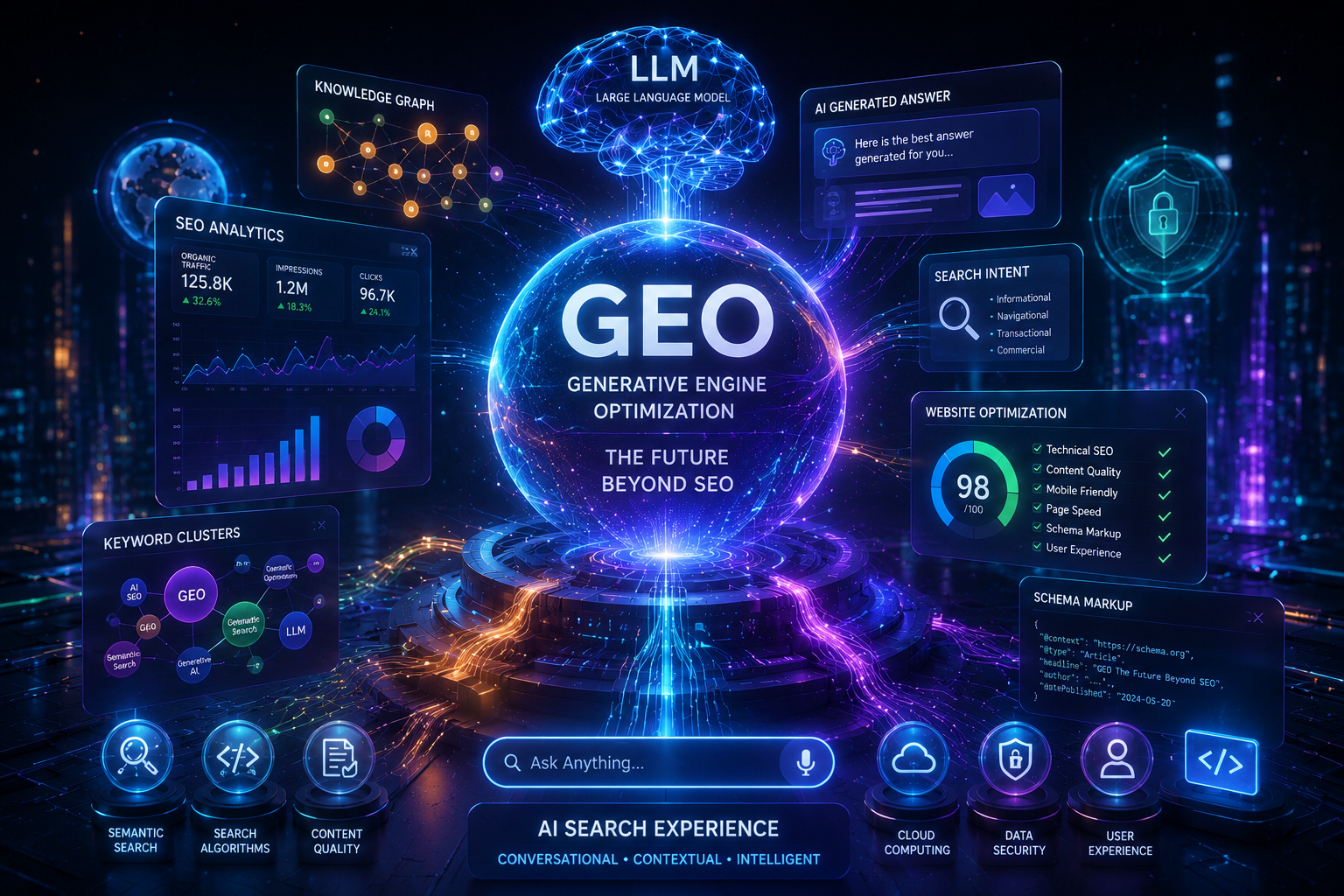
Artificial Intelligence is transforming the way people search for information online. Instead of scrolling through pages of search results, users are increasingly relying on AI-powered search engines and assistants like ChatGPT, Google AI Overviews, Gemini, Claude, Perplexity AI, and Microsoft Copilot to provide direct, conversational answers.
This shift is creating a new digital marketing strategy known as Generative Engine Optimization (GEO). While traditional Search Engine Optimization (SEO) focuses on improving website rankings in search results, GEO is about making your content more likely to be selected, cited, and summarized by AI systems.
In this guide, we’ll explore what GEO is, how it differs from SEO, why it matters, and how to prepare your website for the future of AI-driven search.
What is Generative Engine Optimization (GEO)?
Generative Engine Optimization (GEO) is the practice of creating and structuring content so that AI-powered search engines and large language models (LLMs) can easily understand, trust, and reference it in their generated responses.
Rather than simply aiming for the #1 position on Google, GEO focuses on becoming a trusted source that AI systems use when answering users’ questions.
For example:
Traditional Search
A user searches:
“Best project management software”
Google displays a list of web pages.
The user clicks one or more websites to compare information.
AI Search
The same user asks:
“What is the best project management software for a small business?”
An AI assistant instantly provides a summarized answer mentioning several products, their pros and cons, and recommendations—often without requiring the user to visit multiple websites.
Your goal with GEO is to ensure your content becomes one of the sources AI relies on when generating that answer.
Why GEO Matters
AI-powered search is changing how people discover information.
Instead of:
- Clicking 10 blue links
- Reading multiple articles
- Comparing information manually
Users now receive:
- Instant summaries
- Direct answers
- Personalized recommendations
- Context-aware explanations
As AI adoption grows, websites that optimize for AI discoverability may gain visibility even if users click through less frequently. That makes becoming a trusted source increasingly important alongside traditional rankings.
GEO vs Traditional SEO
| Traditional SEO | Generative Engine Optimization |
|---|---|
| Focuses on search rankings | Focuses on AI-generated answers |
| Optimizes for Google algorithms | Optimizes for AI understanding |
| Prioritizes keywords | Prioritizes topics, entities, and context |
| Measures clicks and rankings | Measures citations, mentions, visibility, and authority |
| Targets search results | Targets AI-generated responses |
The future isn’t about replacing SEO—it’s about combining strong SEO fundamentals with GEO best practices.
How AI Search Engines Work
Modern AI search systems typically follow these steps:
1. Understand the User’s Question
Instead of matching exact keywords, AI identifies the user’s intent.
For example:
“Which CRM is best for startups?”
AI understands the user wants:
- CRM software
- Startup-friendly pricing
- Ease of use
- Features
- Recommendations
2. Gather Information
The AI may retrieve information from:
- Trusted websites
- Documentation
- Knowledge graphs
- Structured content
- News and current sources (when applicable)
3. Generate an Answer
Instead of listing links, AI creates a conversational response that combines information from multiple sources.
This is why content quality, clarity, and credibility are increasingly important.
Key Principles of GEO
1. Write for Humans First
Avoid keyword stuffing.
Instead:
- Answer real questions.
- Use natural language.
- Explain concepts clearly.
- Provide practical examples.
AI systems favor content that is genuinely helpful and easy to understand.
2. Build Topical Authority
Instead of publishing one article about AI, create a connected library of content.
For example:
- What is Machine Learning?
- Deep Learning Explained
- AI Agents Explained
- Large Language Models Guide
- Prompt Engineering Guide
- RAG Explained
- Fine-Tuning AI Models
- AI Model Optimization
This interconnected content signals expertise in a subject area.
3. Structure Content Clearly
AI can better interpret content that uses:
- Clear headings (H2, H3)
- Bullet points
- Numbered steps
- Tables
- FAQs
- Concise summaries
Well-structured content benefits both readers and AI systems.
4. Demonstrate Expertise
Support your content with:
- Original insights
- Real-world examples
- Case studies
- Statistics from reputable sources
- Expert opinions
Content that demonstrates experience and expertise is more likely to be trusted.
5. Use Structured Data
Schema markup helps search engines understand:
- Articles
- FAQs
- Products
- Organizations
- Reviews
- Authors
While schema doesn’t guarantee AI citations, it improves machine readability.
GEO Best Practices
To improve your content’s chances of being referenced by AI systems:
- Answer questions directly near the beginning of sections.
- Cover topics comprehensively.
- Use descriptive headings.
- Include comparison tables where appropriate.
- Add FAQs based on real user questions.
- Keep information accurate and up to date.
- Cite trustworthy sources when making factual claims.
- Maintain a logical internal linking structure.
- Ensure pages load quickly and work well on mobile devices.
Common GEO Mistakes
Avoid these pitfalls:
- Writing only for keywords.
- Publishing thin or repetitive content.
- Using clickbait headlines that don’t match the content.
- Ignoring updates to outdated articles.
- Neglecting author credibility and source quality.
- Failing to answer the user’s actual question.
The Future of GEO
Generative AI is expected to become a standard part of how people search for information. As AI assistants improve, users will increasingly expect direct, trustworthy answers rather than lists of links.
Businesses that create authoritative, well-structured, and genuinely useful content will be better positioned to remain visible in this evolving search landscape.
Rather than replacing SEO, Generative Engine Optimization complements it. The strongest strategy is to combine technical SEO, high-quality content, user experience, and GEO principles so your website performs well in both traditional search results and AI-generated responses.
Conclusion
Generative Engine Optimization (GEO) represents the next evolution of search optimization. As AI-powered search becomes more common, success will depend not only on ranking in search engines but also on creating content that AI systems understand, trust, and reference.
By focusing on user intent, topical authority, clear structure, factual accuracy, and helpful content, you can prepare your website for the future of AI-driven discovery while continuing to benefit from strong SEO foundations.
