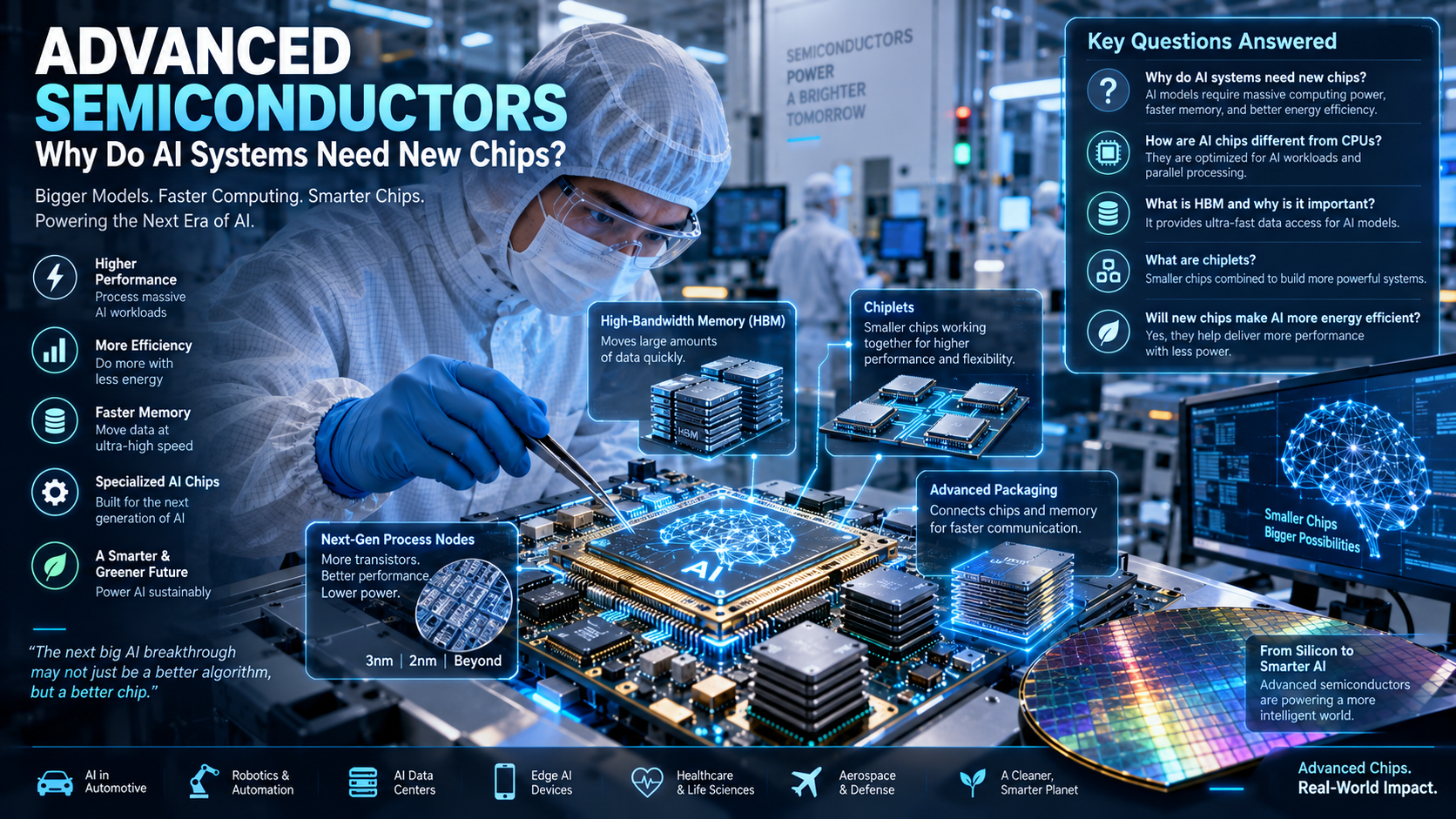
Artificial Intelligence is becoming more powerful every day. AI can now generate text and images, understand speech, write code, analyze information, power robots, and support many other applications.
But powerful AI needs powerful hardware.
Large AI models require huge amounts of computing power, memory, and electricity. This is one reason engineers and semiconductor companies are developing a new generation of advanced chips specifically designed for AI.
Technologies such as AI accelerators, GPUs, custom chips, chiplets, high-bandwidth memory, and advanced chip packaging are becoming increasingly important.
But what exactly makes these chips different, and why does AI need them?
1. What Are Semiconductors?
Semiconductors are the tiny electronic components that form the foundation of modern technology.
They are used inside:
- Smartphones
- Computers
- Cars
- Servers
- Robots
- Smart devices
- Data centers
- Industrial machines
A semiconductor chip contains millions or billions of tiny electronic components called transistors. These transistors help the chip process and control information.
In simple words, semiconductors are the building blocks of modern electronic devices.
2. What Are Advanced Semiconductors?
Advanced semiconductors are newer and more sophisticated chip technologies designed to deliver better performance, efficiency, or specialized capabilities.
For AI, advanced semiconductor technology includes:
- AI accelerators
- GPUs
- Custom AI processors
- ASICs
- Chiplets
- High-Bandwidth Memory (HBM)
- Advanced packaging
- 3D chip technologies
- Specialized processors
The main goal is to make AI computing faster, more efficient, and easier to scale.
3. Why Does AI Need New Chips?
Traditional computer chips can run AI applications, but modern AI workloads can be extremely demanding.
Large AI models perform enormous numbers of calculations and need to move huge amounts of data between processors and memory.
As AI models become larger, the hardware needs to process more information while using energy efficiently.
This creates a major engineering challenge:
How can we make AI faster without making computers consume enormous amounts of power?
Advanced semiconductor technology is one of the answers.
4. CPU vs AI Chips: What’s the Difference?
A CPU (Central Processing Unit) is a general-purpose processor. It can perform many different types of computing tasks.
AI workloads often benefit from processors designed to perform many calculations in parallel.
This is why AI systems commonly use specialized hardware.
In simple terms:
CPU → General-purpose computing
GPU → Large-scale parallel computing
AI Accelerator → Specialized AI computing
Modern AI systems can combine these different types of processors depending on the workload.
5. Why Are GPUs Important for AI?
GPUs were originally designed mainly for computer graphics.
However, GPUs are very good at performing many calculations at the same time. This makes them useful for training and running AI models.
AI systems perform huge numbers of mathematical operations, and parallel computing can help complete these operations efficiently.
As AI has grown, GPUs have become a major part of AI data centers.
However, GPUs are not the only solution. Companies are also developing custom AI chips and specialized accelerators for particular AI workloads.
6. AI Needs Fast Memory Too
A powerful processor is not enough.
AI systems also need to access large amounts of data very quickly.
Imagine a chef who can cook extremely fast but has to walk across the building every time they need an ingredient. The chef’s speed does not matter if the ingredients cannot arrive quickly.
AI systems can face a similar problem.
Fast processor + slow memory = wasted computing performance.
This is why memory technology has become a critical part of modern AI hardware.
7. What Is High-Bandwidth Memory?
High-Bandwidth Memory (HBM) is a type of memory designed to move large amounts of data very quickly.
AI processors need to access model information and other data at very high speeds. HBM helps provide the required bandwidth.
Modern AI systems can place HBM very close to the main processor using advanced packaging technologies.
In simple terms:
AI processor = Brain
HBM = Fast information storage nearby
The closer and faster the data can move, the more efficiently the AI system can work.
8. What Are Chiplets?
Another important development in semiconductor engineering is the chiplet.
Traditionally, engineers often designed a large chip containing many different functions.
With chiplet technology, engineers can divide those functions into smaller chip components and connect them together inside one package.
For example, a system could contain separate chiplets for:
- AI processing
- General computing
- Memory
- Input/output
- Networking
These components can work together as one computing system.
9. Why Are Chiplets Useful for AI?
AI hardware is becoming increasingly complex.
Instead of creating one enormous chip for everything, chiplets can allow engineers to combine different specialized components.
This can provide greater flexibility and can help engineers build systems for different workloads.
For AI, chiplets can be especially useful because modern systems need a combination of compute, memory, networking, and high-speed communication.
This makes chiplet technology an important part of next-generation semiconductor engineering.
10. What Is Advanced Chip Packaging?
A semiconductor is not simply a piece of silicon placed inside a computer.
Modern chips can contain multiple processors, memory components, and other technologies that need to communicate extremely quickly.
Advanced packaging provides ways to connect these components efficiently.
For AI systems, advanced packaging can help bring processors and memory closer together, reducing the distance data needs to travel.
This can improve performance and help engineers build more powerful computing systems in a smaller space.
11. Why Are Smaller Chips Important?
You may have heard terms such as:
3nm, 2nm, and other advanced process nodes.
These numbers refer to generations of semiconductor manufacturing technology.
Smaller process technologies can allow engineers to place more transistors into a given area and potentially improve performance and energy efficiency.
However, making smaller chips is extremely difficult and expensive.
This is why semiconductor manufacturing has become one of the world’s most advanced engineering industries.
12. AI Chips Need Better Energy Efficiency
AI computing can consume a lot of electricity, especially when large models are trained or operated at massive scale.
As AI data centers grow, energy consumption becomes an increasingly important issue.
Therefore, chip designers are not only trying to make processors faster.
They are also trying to make them:
- More energy efficient
- More compact
- Faster at moving data
- Better at specialized AI tasks
- Easier to cool
The future of AI hardware will depend heavily on achieving more performance per unit of energy.
13. Why Are Custom AI Chips Becoming Important?
Not every AI application needs the same type of hardware.
A company training a huge AI model may have very different requirements from a company running AI on a smartphone, car, robot, or industrial machine.
This is why companies are developing custom AI chips.
A custom chip can be designed specifically for a particular type of AI workload.
This can potentially improve performance and efficiency compared with using general-purpose hardware for every task.
14. AI Chips in Data Centers
Large AI models often run inside powerful data centers.
An AI data center may contain many different components working together:
CPU + GPU/AI Accelerator + HBM + Networking + Storage + Cooling + Power Systems
Every component matters.
For example, a powerful processor cannot perform at its best if the memory is too slow or the networking system cannot move data quickly enough.
This means AI hardware is becoming a complete system-engineering challenge, not just a processor problem.
15. AI Is Also Moving to Smaller Devices
AI does not always have to run in a large cloud data center.
Some AI processing can happen directly on devices such as:
- Smartphones
- Cars
- Robots
- Cameras
- Smartwatches
- Industrial machines
- Wearable devices
This is known as Edge AI or on-device AI.
Running AI directly on a device can reduce delays and reduce the need to send every request to a remote server.
However, edge devices have limited battery power, space, and cooling capacity. This creates another challenge for semiconductor engineers.
16. Why Is Cooling Important for AI Chips?
More computing power usually means more heat.
AI data centers can contain large numbers of powerful processors running continuously.
If the chips become too hot, performance can decrease and hardware can potentially be damaged.
This is why AI infrastructure increasingly needs advanced cooling technologies.
Engineers are exploring solutions such as:
- Liquid cooling
- Improved heat sinks
- Better thermal materials
- More efficient chip packaging
- Advanced data-center designs
So the AI hardware challenge is not simply:
“Can we build a faster chip?”
It is also:
“Can we power and cool that chip efficiently?”
17. Can Advanced Chips Make AI Faster?
Yes, advanced hardware can help improve AI performance.
Better processors can perform calculations faster.
Faster memory can provide data to processors more quickly.
Advanced packaging can improve communication between chips.
Specialized AI accelerators can be optimized for particular AI operations.
When these technologies work together, AI systems can potentially become faster and more energy efficient.
18. Could Better Chips Make AI Cheaper?
Advanced chips can be expensive to design and manufacture, so new technology does not automatically make AI cheaper.
However, better hardware efficiency can potentially reduce the computing resources required for certain AI workloads.
If an AI system can perform more work using less electricity and fewer computing resources, the cost of operating that system can decrease.
This is especially important for large-scale AI services and data centers.
19. What Does the Future of AI Hardware Look Like?
The future of AI computing will probably not depend on one single type of processor.
Instead, AI systems could combine many technologies:
AI Accelerators + GPUs + CPUs + HBM + Chiplets + Advanced Packaging + 3D Integration + High-Speed Networking
Each technology can perform a different role.
The result could be highly specialized computing systems designed specifically for AI.
20. Will AI Change the Future of Computer Engineering?
AI is already influencing how engineers think about computer hardware.
Future computers may be designed around AI workloads from the beginning instead of simply adding AI capabilities to traditional systems.
Engineers will increasingly focus on:
- AI acceleration
- Memory bandwidth
- Energy efficiency
- Faster data movement
- Specialized computing
- Advanced packaging
- Smaller and more efficient chips
This means AI is not only changing software.
AI is also changing the way computers themselves are engineered.
Conclusion
AI systems are becoming more powerful, but this growth requires better hardware.
Large AI models need enormous computing power, fast memory, efficient data movement, and better energy efficiency. This is why the semiconductor industry is developing advanced AI chips, GPUs, custom processors, chiplets, HBM, smaller process technologies, and advanced packaging.
The future of AI will depend on both smarter software and better hardware.
A more intelligent AI model may get the attention, but behind that model are billions of transistors working together.
The next big AI breakthrough may therefore not only come from a better algorithm.
It could come from a better chip that makes AI faster, more efficient, and more accessible.
