Introduction
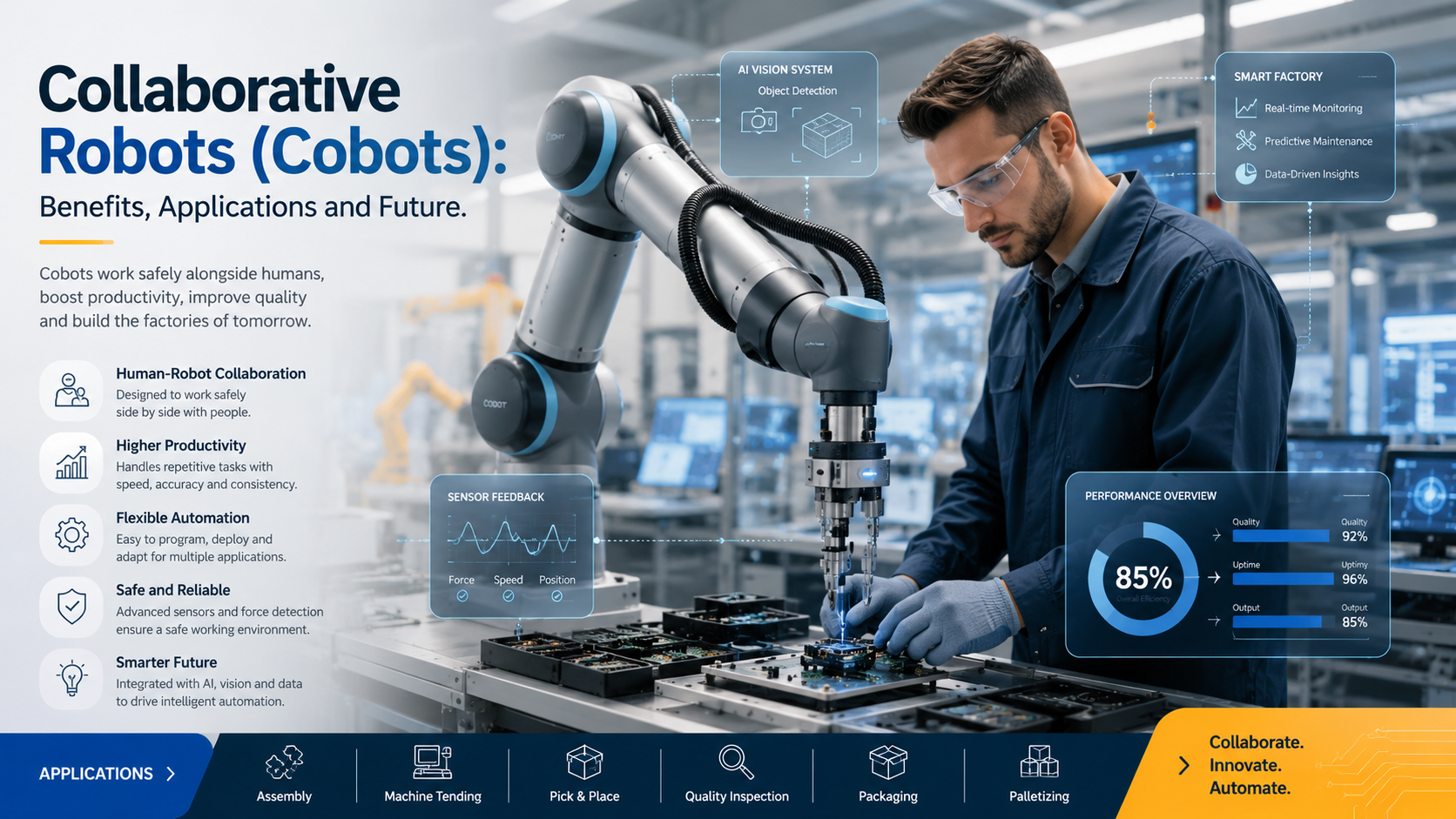
Robots are no longer limited to large factories or science-fiction movies. Today, robots are becoming an important part of manufacturing, warehouses, healthcare, and many other industries. One of the most interesting types of robots is the collaborative robot, commonly called a cobot.
Unlike traditional industrial robots that usually work separately from people, cobots are designed to work alongside human workers. They can handle repetitive, tiring, or precise tasks while people focus on tasks that require experience, decision-making, and creativity.
As artificial intelligence (AI) and automation continue to improve, cobots are becoming smarter, more flexible, and easier for businesses to use.
What Are Collaborative Robots?
A collaborative robot is a robot designed to work together with humans in the same working environment.
Traditional factory robots often need a separate area with safety barriers because they can move very quickly and carry heavy objects. Cobots, on the other hand, are designed with technologies such as sensors and force detection that can help them detect people or unexpected contact.
For example, a worker could place parts in front of a cobot, and the cobot could pick up those parts and assemble them. The worker and robot can then work on different parts of the same process.
Why Are Cobots Becoming Popular?
Businesses are looking for ways to increase productivity while reducing repetitive manual work. Cobots provide a flexible way to introduce automation without completely replacing existing workflows.
They can often be moved or reprogrammed for different tasks. This makes them especially useful for businesses that produce different products or frequently change their manufacturing processes.
The growth of AI, computer vision, sensors, and smart manufacturing is also making cobots more capable than earlier generations of collaborative robots.
How Do Cobots Work?
Cobots use a combination of hardware and software to perform tasks and interact with their surroundings.
Sensors
Sensors help the robot detect objects and people around it. They provide information that allows the robot to understand what is happening in its workspace.
Force Detection
Many cobots can detect unexpected force or contact. If the robot detects something unusual, it can slow down or stop depending on its safety configuration.
Cameras and Computer Vision
Some cobots use cameras and computer vision to identify objects, inspect products, or determine where an object is located.
Software and Programming
Cobots can be programmed to perform specific tasks. Many modern cobots use user-friendly software that makes programming easier for operators.
Artificial Intelligence
AI can make robotic systems more flexible by helping them recognize objects, understand environments, plan movements, and adapt to changing situations.
Benefits of Collaborative Robots
1. Better Support for Workers
Cobots can take care of repetitive and physically demanding tasks. This allows workers to spend more time on tasks that require human judgment, problem-solving, and creativity.
The goal is not always to replace workers. In many situations, cobots are used as assistants that work alongside people.
2. Increased Productivity
A cobot can perform repetitive tasks consistently for long periods. This can help businesses increase production and maintain consistent processes.
For example, a cobot can repeatedly pick products from one location and place them in another while employees handle other parts of the production process.
3. Flexible Automation
One major advantage of cobots is flexibility.
A cobot can potentially be programmed for one task today and another task later. This makes them useful for businesses that frequently change products or production requirements.
4. Easy to Program
Many modern cobots are designed to be easier to program than traditional industrial robots.
Some systems allow operators to teach movements through simple interfaces or guided programming rather than writing complex robotic code.
5. Reduced Repetitive Work
Repetitive work can be tiring for employees. Cobots can handle tasks such as picking, sorting, packaging, and assembly.
This allows workers to focus on more valuable and less repetitive activities.
6. Useful for Different Business Sizes
Cobots are not limited to large manufacturing companies. Their flexibility can make them useful for small and medium-sized businesses that want to automate specific tasks.
The actual cost and suitability still depend on the robot, application, integration requirements, and safety setup.
Applications of Collaborative Robots
Cobots can be used in many industries because they are flexible and can perform different types of tasks.
Manufacturing
Manufacturing is one of the biggest application areas for cobots. They can help with assembly, machine tending, material handling, screwdriving, and product inspection.
Automotive Industry
Automotive manufacturers can use cobots for tasks such as component assembly, fastening, inspection, and handling parts.
Electronics Manufacturing
Electronics production often requires precision. Cobots can assist with small-part assembly, testing, handling, and quality inspection.
Warehouses and Logistics
Cobots can help with packaging, sorting, picking, and palletizing. When combined with other automation technologies, they can help warehouses move products more efficiently.
Food and Beverage
Cobots can be used for packaging, sorting, handling products, and palletizing boxes.
Healthcare and Laboratories
Robotic automation can also support laboratories and healthcare environments by handling repetitive material movement, sample handling, and other controlled processes.
Cobots vs Traditional Industrial Robots
Cobots and traditional industrial robots both perform automated tasks, but they are designed for different working environments.
Traditional industrial robots are often designed for high-speed and heavy-duty operations. They commonly operate inside controlled areas with safety barriers.
Cobots are designed with human collaboration in mind. They are generally more flexible and can be easier to deploy for certain applications.
However, cobots are not automatically safe for every situation. Every robotic application needs an appropriate safety assessment based on the robot, tools, speed, payload, workspace, and task.
The Role of AI in Collaborative Robots
AI is becoming an important technology in modern robotics.
Traditional robots generally follow predefined instructions. AI can help robots become more adaptable.
For example, a robot using computer vision can identify different objects instead of relying only on fixed positions. AI can also help robotic systems recognize patterns, understand environments, and make better decisions within defined tasks.
This combination of AI + robotics is helping create a new generation of intelligent automation.
Challenges of Cobots
Cobots offer many benefits, but they also have limitations.
Speed and Payload
Some cobots cannot move as quickly or carry as much weight as heavy-duty industrial robots. Businesses need to select the right robot based on their specific requirements.
Safety Requirements
Even though cobots are designed for collaboration, safety cannot be ignored. Proper installation, risk assessment, programming, and workplace safeguards are still important.
Integration
Connecting a cobot with existing machines, sensors, software, and production systems can require technical knowledge and planning.
Initial Cost
Buying a cobot is only one part of the investment. Businesses may also need to pay for tools, sensors, software, integration, training, and maintenance.
Handling Complex Tasks
Cobots can perform many useful tasks, but highly unpredictable or complex physical tasks can still be difficult for robotic systems.
Future of Collaborative Robots
The future of cobots is closely connected with AI, computer vision, edge computing, digital twins, and the Industrial Internet of Things (IIoT).
Future robots are expected to become better at understanding their surroundings and adapting to changing tasks.
Instead of programming every movement manually, future robotic systems may increasingly use AI to understand instructions, identify objects, plan actions, and adjust their movements.
This could make robots useful in more environments, including factories, warehouses, laboratories, healthcare facilities, and other workplaces.
Cobots and Physical AI
One of the most important developments in robotics is the growth of Physical AI.
Generative AI can create text, images, and other digital content. Physical AI focuses on AI systems that can understand and interact with the physical world.
For robots, this means combining AI with cameras, sensors, motors, and robotic hardware.
As this technology develops, cobots could become more capable of understanding what is happening around them and adapting their actions accordingly.
Are Cobots Replacing Human Workers?
Cobots are often described as robots that replace human workers, but that is not always the goal.
In many workplaces, cobots are designed to work alongside people.
A worker can provide judgment, creativity, experience, and decision-making, while a cobot handles repetitive or physically demanding activities.
This human-robot collaboration can create a more efficient workflow where each side focuses on what it does best.
Conclusion
Collaborative robots are changing the way businesses approach automation. They can help with repetitive tasks, improve productivity, support workers, and provide flexible automation for different industries.
The combination of cobots, AI, computer vision, and smart manufacturing could make robotic systems even more capable in the future.
As technology continues to improve, cobots may become a common part of workplaces where humans and robots work together rather than separately.
