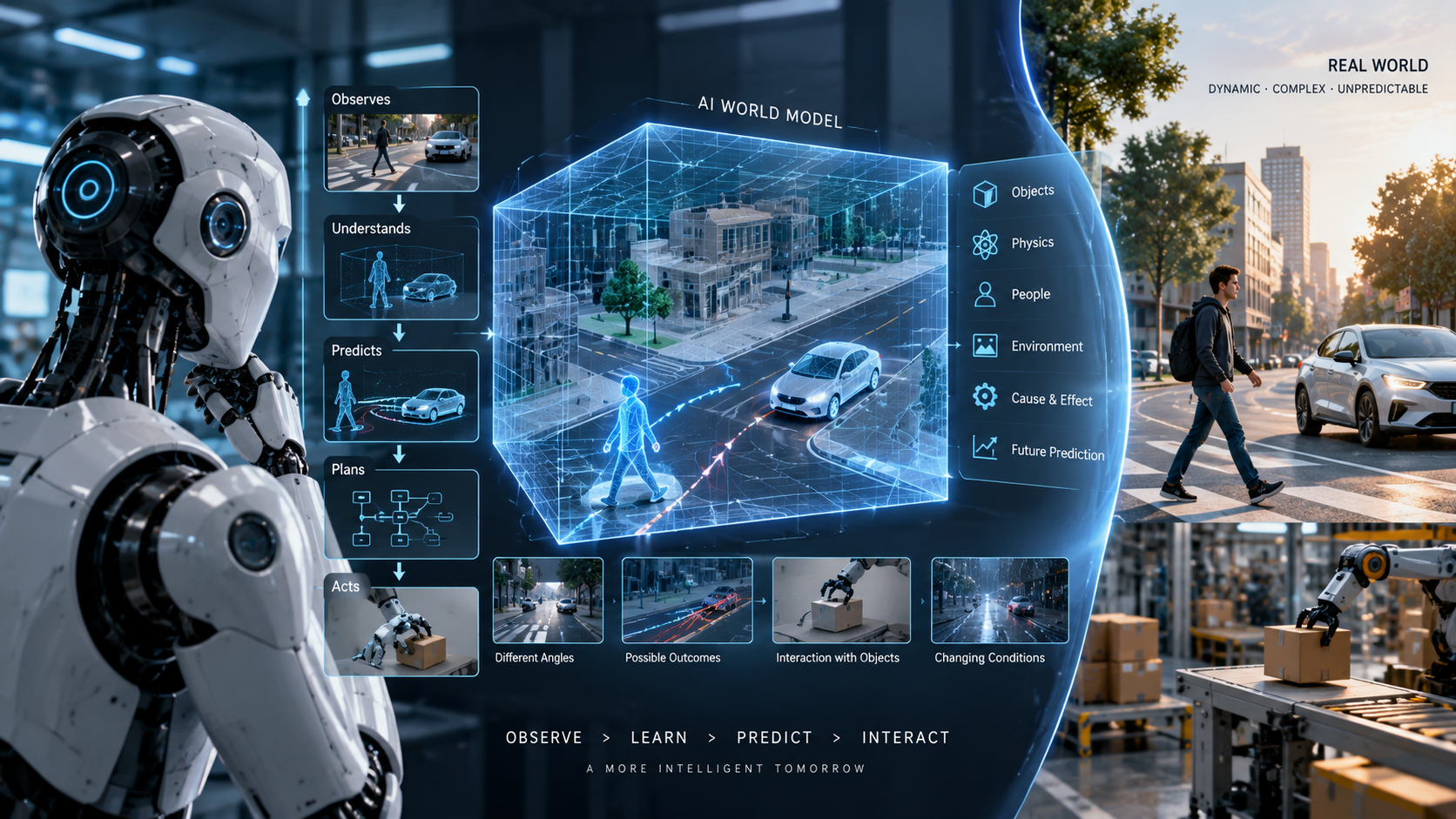
Artificial intelligence has become very good at understanding text, images, videos, and other digital information. But understanding the real physical world is a much bigger challenge.
The real world is constantly changing. People move, cars change direction, objects fall, weather changes, and machines interact with their surroundings. To work safely in this environment, AI needs to understand more than what it can see. It needs to understand what is happening, why it is happening, and what could happen next.
This is where AI World Models come into the picture.
What Are World Models?
A world model is an AI system that tries to build an internal understanding of how the world works.
Think of it as a kind of digital map inside an AI system. It can learn about objects, people, environments, movement, and the relationships between different events.
For example, if an AI sees a person holding a glass near the edge of a table, it could learn that the glass may fall if it is pushed. The goal is to help AI understand not only what it sees, but also what could happen next.
How Do World Models Work?
World models learn from large amounts of information. This can include videos, images, sensor data, simulations, and information collected from real-world environments.
The AI studies how things change over time. It looks for patterns between different actions and their results.
For example, by watching thousands of driving situations, an AI can learn that vehicles usually slow down at red lights, pedestrians may cross roads, and cars can change direction when another vehicle is nearby.
Over time, the AI builds a better understanding of how different situations are connected.
Why Does AI Need World Models?
Most traditional AI systems are designed to perform specific tasks.
For example, an AI image system might identify a car in a photograph. A language AI might explain what a car is.
But an intelligent machine operating in the real world needs to understand much more.
It needs to know where the car is, how fast it is moving, what direction it may take, and what could happen if another vehicle suddenly appears.
World models can help AI predict possible future situations instead of simply reacting to what is happening at the moment.
World Models vs Traditional AI
The difference can be explained with a simple example.
A traditional AI system might look at an image and say:
“There is a person and a car.”
A world-model-based system could go further:
“The person is standing near the road, the car is approaching, and the person may cross the road.”
The first system mainly identifies objects. The second tries to understand the relationship between objects and possible future events.
This ability could be extremely useful for robots, autonomous vehicles, and other intelligent machines.
How Do World Models Help Robots?
Robots need to operate in the physical world. They need to understand objects, spaces, movement, and their own actions.
Imagine a robot trying to pick up a cup.
The robot needs to identify the cup, understand where it is located, move its hand toward it, decide how much force to use, and predict what could happen if the cup moves.
A world model could help the robot think through different possibilities before taking action.
Instead of simply reacting, the robot could use its understanding of the environment to plan what it should do next.
World Models and Autonomous Vehicles
Self-driving vehicles are another important application.
An autonomous vehicle needs to understand roads, traffic lights, cars, cyclists, pedestrians, road conditions, and many other factors.
Simply detecting a pedestrian is not enough.
The vehicle also needs to estimate what that pedestrian might do next.
For example, if someone is standing beside a crosswalk, the vehicle needs to consider whether the person could cross the road. Understanding possible future actions can help an autonomous vehicle make safer decisions.
World Models and Physical AI
World models are closely connected to Physical AI.
Physical AI refers to AI systems that can understand and interact with the physical world through robots, vehicles, machines, and other devices.
The relationship can be simplified like this:
Observe → Understand → Predict → Plan → Act
The AI observes the environment, builds an understanding of what is happening, predicts possible outcomes, plans an action, and then allows the physical machine to act.
This could become an important foundation for future intelligent robots and autonomous machines.
World Models Can Help AI Learn in Virtual Environments
Training intelligent machines in the real world can be expensive and sometimes dangerous.
For example, a robot learning to walk could fall thousands of times during training. Repeating those experiments with a physical robot would take time and could damage the hardware.
Virtual simulations can provide a safer environment for AI systems to experiment.
The AI can test different actions in a simulated environment and learn what works and what does not.
This combination of world models and simulation could make the development of autonomous machines faster and more efficient.
Where Could World Models Be Used?
World models could eventually be useful in many different industries.
Robotics
Robots could use world models to understand their surroundings, predict how objects will move, and plan tasks before performing them.
Autonomous Vehicles
Self-driving cars could use predictive models to understand traffic situations and anticipate the actions of pedestrians and other vehicles.
Manufacturing
Factories could use world models to simulate production processes, predict machine behavior, and identify possible problems before they occur.
Healthcare
AI-powered robots and medical technologies could potentially use models of physical environments to assist with complex tasks.
Gaming and Virtual Worlds
World models could help create virtual environments that respond more realistically to user actions and changes.
Smart Cities
AI could model traffic, buildings, energy systems, and other infrastructure to predict changes and improve efficiency.
What Are the Challenges of World Models?
World models are still developing, and several challenges need to be solved.
One of the biggest challenges is accuracy. If an AI makes an incorrect prediction about what will happen, the resulting decision could also be wrong.
Another challenge is the amount and quality of data required. AI systems need diverse information to understand different environments and situations.
There is also a problem called generalization. A model may work well in one environment but struggle when it encounters a completely new situation.
Computing power is another challenge because understanding and predicting complex physical environments can require significant resources.
Can World Models Make AI Smarter?
World models could make AI systems more capable of understanding and interacting with the real world, but they do not automatically create human-level intelligence.
Their main advantage is that they can help AI develop a better representation of objects, environments, actions, and possible outcomes.
This could allow AI systems to make better decisions when they need to operate outside the digital world.
What Does the Future Look Like?
The future of AI could go beyond understanding text and images.
Future AI systems may increasingly understand space, movement, objects, physics, and cause and effect.
This could lead to robots that learn from their surroundings, autonomous vehicles that make better predictions, and machines that can test possible actions before performing them.
As AI models, sensors, robotics, and simulation technologies improve, world models could become an important part of the next generation of intelligent machines.
Conclusion
World models represent an important step toward AI that can better understand the physical world.
Instead of simply recognizing what is happening, AI can use world models to build an understanding of its environment and predict what could happen next.
From robots and self-driving cars to smart factories and autonomous machines, this technology could have a major impact on how machines interact with the real world.
In simple terms, a world model gives AI an internal understanding of how the world works and how it might change.
The technology is still evolving, but it could become one of the key building blocks of Physical AI, robotics, autonomous systems, and the future of intelligent machines.
