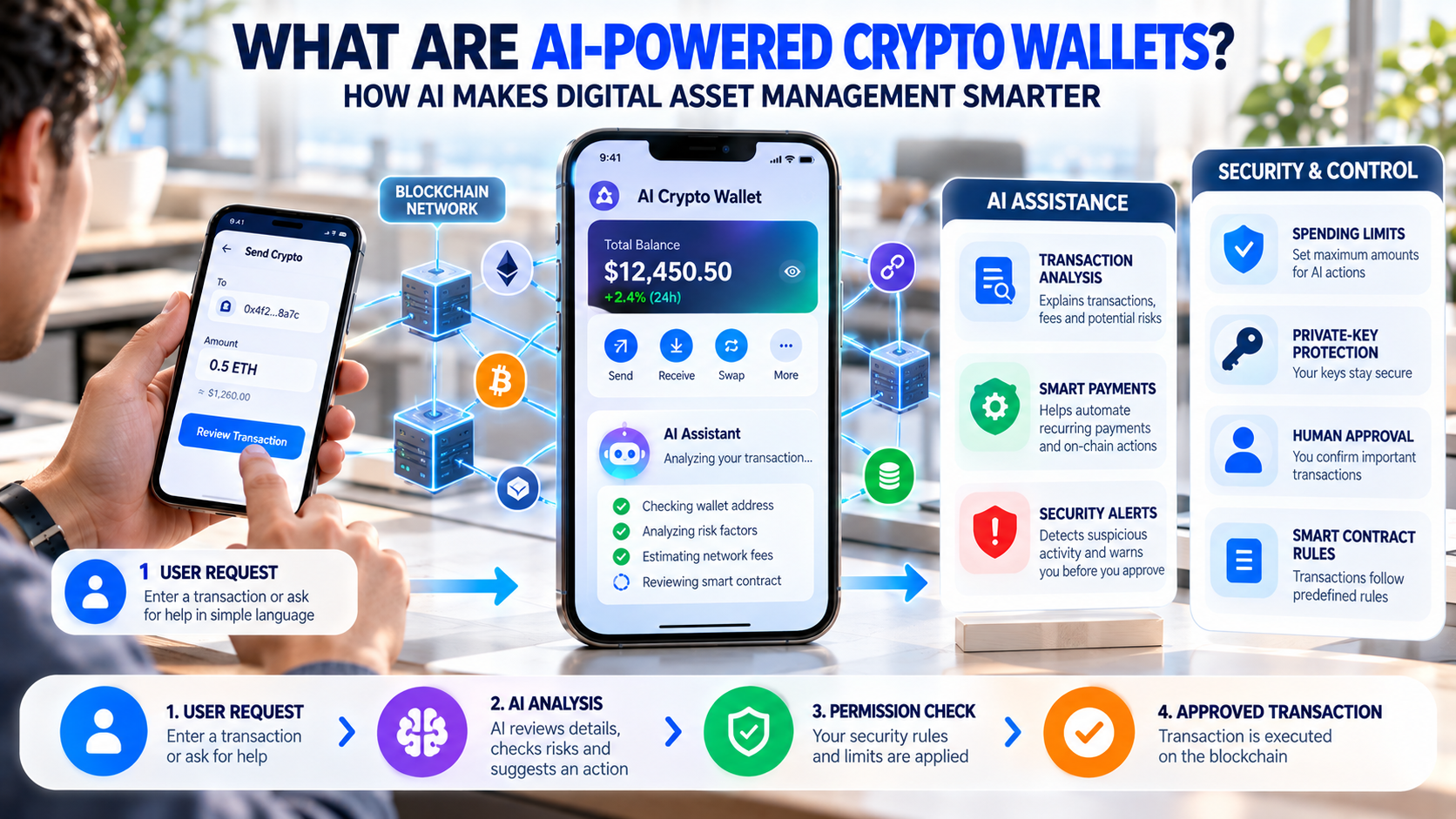
crypto wallets combine several technologies to provide their features.
First, the wallet connects to blockchain data or other permitted information sources. An AI system can analyze this information to identify patterns, explain transactions or recommend an action.
If the wallet supports automation, it may also connect to transaction tools or smart contracts that allow certain actions to be performed.
A simplified workflow looks like this:
Collect Data → Analyze Information → Identify an Action → Check Permissions → Execute or Request Approval
For example, an AI system might detect an unusual token approval and warn the user before they continue.
If a wallet supports automated transactions, it should also enforce clear permission limits rather than allowing an AI model to perform unrestricted financial actions.
What Is the Difference Between a Traditional Crypto Wallet and an AI-Powered Wallet?
A traditional crypto wallet provides the basic features needed to manage digital assets, including receiving cryptocurrency, sending transactions and connecting to decentralized applications.
An AI-powered wallet adds features such as intelligent assistance, transaction analysis, risk alerts or automation.
For example, a traditional wallet may display a transaction fee. An AI-powered wallet might explain why the fee is high and suggest checking another available transaction option.
However, AI does not automatically make a wallet safer. Security still depends on private-key protection, wallet design, smart-contract security and the permissions granted to connected tools.
What Is an AI Agent Wallet?
An AI agent wallet, sometimes called an agentic wallet, is a wallet architecture designed to let an AI agent prepare or perform blockchain transactions within defined permissions.
Unlike an ordinary chatbot, an AI agent can use tools and work through multiple steps to complete a task.
For example, a user might authorize an agent to pay for a digital service using a specific token, subject to spending limits and other restrictions.
The agent could identify the payment requirement, prepare a transaction and submit it through the wallet’s permitted execution process.
The important difference is that an AI agent wallet may have authority to act, not just provide recommendations. The exact level of authority depends on the wallet architecture and its security controls.
What Can AI-Powered Crypto Wallets Do?
1. Analyze Transactions
AI can help users understand blockchain transactions by explaining transfers, identifying unusual patterns and summarizing wallet activity.
For example, a wallet could flag a transaction that differs significantly from a user’s usual activity.
However, an AI-generated warning is not proof that a transaction is fraudulent. Users should verify important details before approving any action.
2. Detect Suspicious Activity
AI systems can analyze transaction patterns and available risk signals to help identify potentially suspicious activity.
A wallet might warn users about an unfamiliar address, unusual token approvals or a transaction pattern that deserves further investigation.
These systems can make mistakes. They may miss malicious transactions or flag legitimate activity, so AI detection should complement—not replace—security checks.
3. Explain Blockchain Fees
Blockchain transaction fees can be confusing, especially for beginners.
An AI-powered wallet could explain why a transaction costs a certain amount, describe network congestion or help users compare available transaction options.
Actual fees depend on the blockchain network, transaction type and current conditions. AI estimates should not be treated as guaranteed costs.
4. Monitor Digital Assets
Some AI-enabled wallet systems can analyze portfolio information and summarize changes in asset balances or transaction activity.
For example, an AI assistant could explain how a recent transfer affected a user’s portfolio.
These features can help users understand their activity, but they cannot guarantee investment performance or predict future prices accurately.
5. Automate Approved Transactions
More advanced wallet systems can allow AI agents to perform specific blockchain actions automatically.
Depending on the wallet, these actions could include paying for digital services, interacting with supported smart contracts or completing permitted transfers.
Such automation should operate within clearly defined rules, such as approved destinations, spending limits, token restrictions and transaction approval requirements.
Can AI-Powered Crypto Wallets Make Payments Automatically?
Yes, some AI agent wallet systems are designed to initiate or execute payments without requiring a person to approve every individual transaction.
For example, an AI agent could be authorized to pay for a software service or computing resource when certain conditions are met.
The wallet may enforce rules such as a maximum payment amount, a list of approved destinations or a limited period during which the agent can act.
This can make automated digital payments more practical, particularly when software services need to communicate and pay each other.
However, automatic payment capabilities vary between wallets. Users should understand exactly which actions an AI agent can perform before enabling them.
How Do Smart Contracts Help AI Crypto Wallets?
Smart contracts are programs that run on a blockchain and execute according to predefined conditions.
In some AI wallet designs, smart contracts can enforce rules that limit what an AI agent is allowed to do.
For example, a wallet could be configured to allow transactions only up to a particular spending limit or require additional authorization for certain actions.
This is important because an AI model can make mistakes or misunderstand a request. Security rules enforced by the wallet or smart contract can help restrict the damage an incorrect decision might cause.
Ethereum’s account-abstraction approach supports programmable wallet behavior, including flexible authorization rules and transaction batching.
However, smart contracts can also contain vulnerabilities. Their security depends on correct implementation, testing and ongoing maintenance.
What Is Account Abstraction in AI Crypto Wallets?
Account abstraction is a blockchain concept that allows wallet behavior and transaction authorization to be more flexible than a basic account controlled by a single private key.
On Ethereum, account-abstraction techniques enable smart-contract wallets to support features such as account recovery, flexible security rules and sponsored transaction fees.
These capabilities can help developers build wallets that are easier to use and more suitable for automation.
For AI agent wallets, account abstraction can provide a way to define which actions an agent may perform and under what conditions.
However, account abstraction does not automatically make a wallet AI-powered. It is a wallet technology that can support advanced security and automation features.
Can AI-Powered Crypto Wallets Help Beginners?
AI-powered wallets may make cryptocurrency easier to understand for people who are new to blockchain technology.
For example, an AI assistant could explain transaction details in simple language, describe the purpose of a smart contract or help users understand why a transaction failed.
It could also explain the difference between sending cryptocurrency and granting a smart contract permission to access tokens.
However, beginners should not blindly trust an AI assistant. A convincing explanation can still be incorrect, and malicious applications may imitate legitimate wallet interfaces.
Users should always verify the recipient address, token, network and transaction permissions before confirming important actions.
What Are the Security Risks of AI-Powered Crypto Wallets?
AI-powered crypto wallets introduce additional risks because they combine financial assets, software automation and AI-generated decisions.
AI Errors
An AI model may misunderstand a request, select the wrong transaction or produce an incorrect explanation.
Prompt Injection
Malicious instructions hidden in websites, documents or other external content may attempt to manipulate an AI agent into taking an unsafe action.
Private-Key Exposure
If private keys or recovery phrases are exposed, attackers may gain control of the associated assets. AI features do not remove this fundamental risk.
Excessive Permissions
Giving an AI agent unrestricted access to funds or transaction signing can increase the damage caused by an error or attack.
Malicious Smart Contracts
An AI agent might interact with an unsafe contract or approve a transaction that grants excessive token permissions.
False Security Warnings
AI can miss suspicious activity or incorrectly classify a legitimate transaction as dangerous.
These risks make permission management, secure key storage, transaction simulation, monitoring and human approval important parts of wallet design.
How Can Users Keep AI Crypto Wallets Secure?
Users should follow basic security practices when using AI-powered crypto wallets.
- Use wallets with a clear security model and trustworthy development history.
- Never share private keys or recovery phrases with an AI chatbot.
- Set strict spending limits for automated agents.
- Restrict agents to approved tokens, contracts and destination addresses where supported.
- Require additional approval for large or sensitive transactions.
- Review token approvals and smart-contract permissions regularly.
- Verify transaction details independently before signing.
- Keep wallet software and related security components updated.
- Test automated workflows with small amounts before relying on them for important tasks.
Most importantly, AI should not receive more control over your cryptocurrency than it actually needs.
Are AI-Powered Crypto Wallets Better Than Traditional Wallets?
AI-powered wallets may provide a more convenient experience for users who want transaction explanations, monitoring or automation.
Traditional wallets may be preferable for users who want straightforward control over their assets without additional AI features.
The right choice depends on what you need. An AI assistant can help explain blockchain activity, but it does not guarantee better investment decisions or stronger security.
For users who enable automated actions, the quality of the wallet’s permission controls may be more important than the sophistication of its AI model.
What Is the Future of AI-Powered Crypto Wallets?
AI-powered crypto wallets could become more important as AI agents begin interacting with financial services, decentralized applications and other software systems.
Future wallet designs may combine transaction monitoring, programmable permissions, automated payments and more understandable security warnings.
For example, an AI agent might pay for an approved digital service, track the transaction and report the result to its user.
Such systems could support machine-to-machine payments, where one software system pays another for data, computing power or digital services.
However, wider adoption will depend on reliable AI behavior, secure wallet architecture, blockchain infrastructure, regulatory requirements and user trust.
AI may make crypto wallets easier to use, but strong security and clear human control will remain essential.
Conclusion
AI-powered crypto wallets combine traditional cryptocurrency management with artificial intelligence to help users understand transactions, monitor activity and automate selected tasks.
Some wallets focus on analysis and assistance, while more advanced agentic wallets can prepare or execute blockchain transactions within predefined permissions.
These capabilities could make cryptocurrency more convenient and help software agents interact with digital financial services. However, AI can make mistakes, and automated transactions can result in permanent financial losses if the wallet’s security controls are inadequate.
The best approach is to use AI as a helpful layer while keeping private keys protected, permissions limited and sensitive transactions properly verified.
In simple words, AI-powered crypto wallets aim to make digital assets easier to manage, but smarter automation must always be supported by strong security.
