Artificial Intelligence is transforming how businesses develop software, automate operations, analyse information, and interact with customers. From AI chatbots and content generation to predictive analytics and intelligent automation, AI models are becoming an important part of modern technology.
However, when developers and businesses decide to integrate artificial intelligence into their applications, they face an important question: should they use an open-source AI model or a proprietary AI model?
Both approaches offer different advantages.
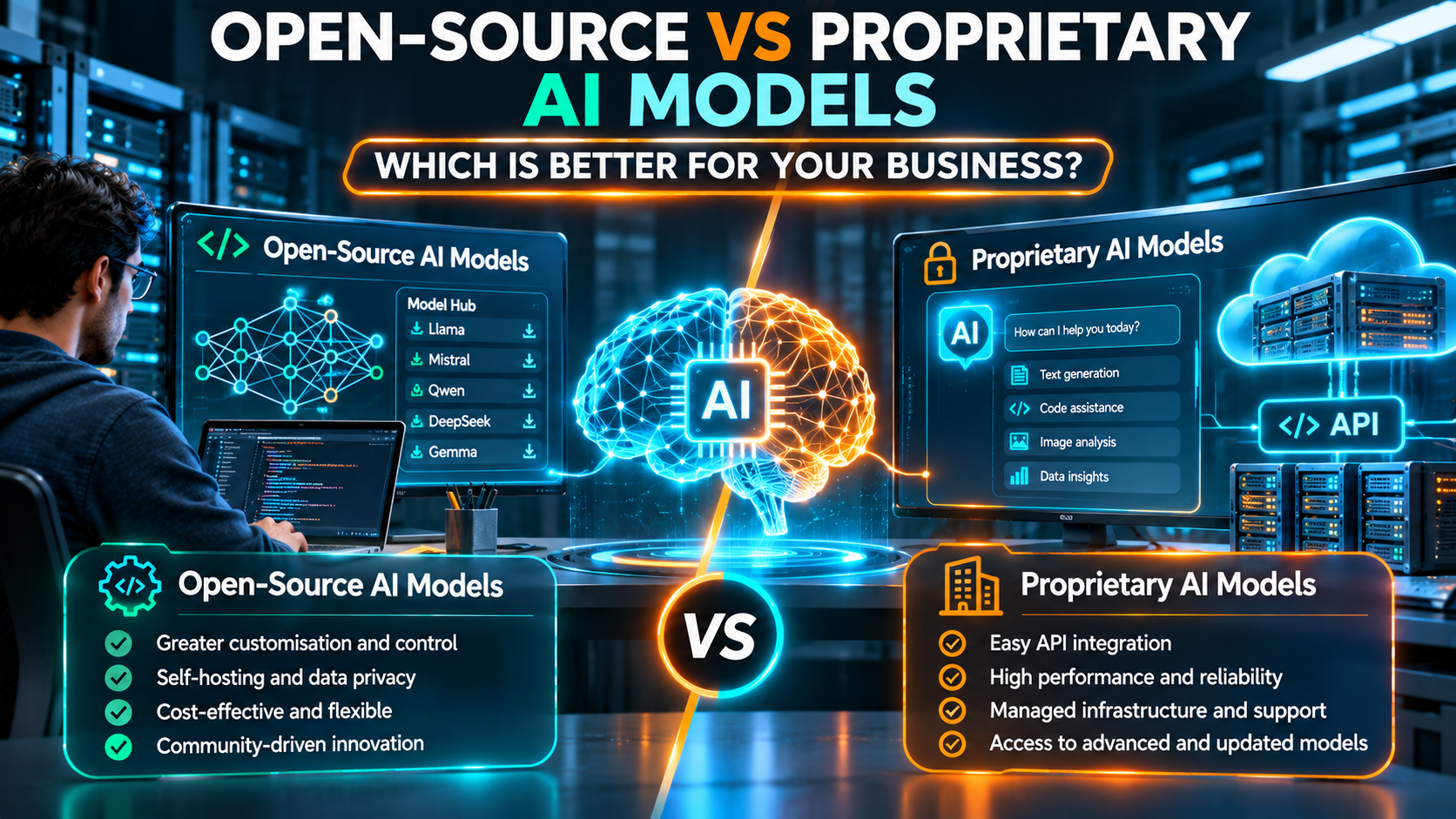
Open-source AI models provide opportunities for customisation, self-hosting, experimentation, and greater control over deployment. Proprietary AI models generally provide managed services, convenient APIs, commercial support, and access to advanced capabilities without requiring businesses to manage the underlying infrastructure.
Choosing the right option depends on several factors, including project requirements, budget, privacy, technical expertise, scalability, and performance.
In this article, we will explore open-source AI models vs proprietary AI models, understand how they work, compare their differences, examine popular examples, and discover which approach is better for different applications.
What Are Open-Source AI Models?
Open-source AI models are AI models whose developers make certain model-related resources publicly available under a licence that permits specified forms of access, use, modification, or redistribution.
Depending on the model and its licence, developers may be able to download model weights, inspect parts of the implementation, customise the model, and deploy it on their own infrastructure.
These models are commonly used by researchers, developers, startups, and businesses that want more control over their AI systems.
Some open-weight models provide access to downloadable trained parameters, allowing developers to run them locally or on cloud infrastructure.
However, an important distinction exists between open-source software and open-weight AI models. A model with publicly available weights is not necessarily fully open-source. Training data, development methods, code, and other components may not be publicly available.
Key Features of Open-Source AI Models
- Publicly accessible model weights for eligible models.
- Greater flexibility for custom deployment.
- Opportunities for fine-tuning and customisation.
- Ability to run models on private infrastructure.
- Community-driven development and experimentation.
- More control over hosting and operational configuration.
Examples of Open-Source and Open-Weight AI Models
1. Llama
Meta’s Llama family includes downloadable AI models designed for different language-processing and development applications. Access and usage are governed by the applicable model licence.
2. Mistral Models
Mistral AI provides several models, including models with open weights that developers can download and integrate into applications.
3. Qwen
The Qwen model family offers a range of models for language understanding, coding, reasoning, and multimodal applications. Availability and licence terms vary by model.
4. DeepSeek
DeepSeek provides several models and model weights for applications involving reasoning, coding, and general-purpose AI tasks. Individual releases have their own licence conditions.
5. Gemma
Google’s Gemma family includes lightweight and more capable models designed for developers and researchers. These models are distributed under specific terms rather than being universally unrestricted.
What Are Proprietary AI Models?
Proprietary AI models are artificial intelligence systems controlled and distributed by organisations under commercial or restricted licences.
Unlike many downloadable open-weight models, proprietary models are commonly accessed through APIs, hosted platforms, subscription services, or dedicated enterprise environments.
Users can send prompts or data to the provider’s service and receive generated responses without managing the underlying model infrastructure.
The provider generally controls the model architecture, weights, training process, and deployment environment.
This approach allows developers to integrate advanced AI capabilities into their applications without independently managing model hosting and infrastructure.
Key Features of Proprietary AI Models
- Managed access through APIs or hosted platforms.
- Provider-controlled model infrastructure.
- Commercial support and service agreements may be available.
- Regular model improvements and updates.
- Convenient integration with software applications.
- Less responsibility for maintaining model-serving infrastructure.
Examples of Proprietary AI Models
1. GPT Models
OpenAI provides GPT models through ChatGPT and its API platform. Developers can integrate these models into applications without independently hosting their underlying infrastructure.
2. Claude
Anthropic’s Claude models provide capabilities for reasoning, writing, coding, analysis, and other AI applications through supported products and APIs.
3. Gemini
Google’s Gemini models support text, image, audio, video, and other multimodal AI applications through Google’s products and developer platforms.
4. Grok
xAI’s Grok models provide conversational AI and reasoning capabilities through supported products and developer services.
5. Other Commercial AI Models
Several companies offer proprietary models through hosted AI platforms, enterprise subscriptions, and specialised APIs.
Not every model from a particular company follows the same distribution model. Always check the licence and access conditions for the specific model.
How Do Open-Source and Proprietary AI Models Work?
Both approaches use artificial intelligence techniques such as machine learning, deep learning, neural networks, and transformer architectures.
The main difference is how users access, deploy, and manage the models.
How Open-Source AI Models Work
Open-source or open-weight AI models can often be downloaded and deployed on compatible hardware.
A typical workflow includes:
Step 1: Select a Model
Developers choose an appropriate model based on its capabilities, size, licence, hardware requirements, and intended application.
Step 2: Download Model Weights
The model weights are downloaded from an authorised repository or distribution platform.
Step 3: Set Up Infrastructure
Developers configure the required hardware, software libraries, inference engine, and deployment environment.
Step 4: Integrate the Model
The model is connected to an application, backend service, chatbot, or other software system.
Step 5: Customise the Model
Where supported and permitted by the licence, developers can fine-tune the model, configure its behaviour, or connect it with external knowledge sources.
Step 6: Monitor and Maintain
The development team manages performance, security, infrastructure, model updates, and operational costs.
How Proprietary AI Models Work
Proprietary models are commonly accessed through a hosted platform or API.
A typical workflow includes:
Step 1: Choose an AI Provider
The developer selects an AI provider based on model capabilities, pricing, data policies, and service requirements.
Step 2: Create API Access
The developer obtains an API key or configures access through an approved enterprise platform.
Step 3: Integrate the API
The application sends prompts and relevant data to the provider’s API.
Step 4: Receive AI Responses
The provider processes the request using its model and returns the generated response.
Step 5: Process the Output
The application validates and uses the response for tasks such as content generation, summarisation, classification, or customer support.
Step 6: Monitor Usage
The business monitors API consumption, latency, costs, service availability, and application performance.
Open-Source AI Models vs Proprietary AI Models: Key Differences
Both approaches can support advanced AI applications, but they differ in accessibility, customisation, infrastructure, and operational responsibility.
| Comparison | Open-Source / Open-Weight Models | Proprietary AI Models |
|---|---|---|
| Accessibility | Weights or other resources may be publicly available | Access is generally controlled by the provider |
| Customisation | Often offers greater deployment and fine-tuning flexibility | Depends on provider-supported features |
| Deployment | Can often be self-hosted | Commonly accessed through hosted services or APIs |
| Infrastructure | Users may manage their own infrastructure | Provider generally manages the model infrastructure |
| Initial cost | Some models are available without a model-access fee | May require subscription or API payments |
| Operating costs | Hardware, hosting, electricity, and maintenance | API usage, subscription, or enterprise fees |
| Privacy control | Self-hosting can provide greater control over data flow | Depends on provider policies and deployment options |
| Maintenance | Users manage hosting and updates | Provider manages much of the underlying service |
| Transparency | Varies by model and available documentation | Internal model details are often restricted |
| Technical expertise | Self-hosting and customisation may require more expertise | API integration can be simpler |
| Scalability | Depends on infrastructure and deployment design | Provider infrastructure can simplify scaling |
| Support | Community or commercial support may be available | Commercial support may be available through provider plans |
Advantages of Open-Source AI Models
Open-source and open-weight models offer several advantages for developers and organisations.
1. Greater Customisation
Developers can adapt eligible models to specific applications.
For example, a company can fine-tune a language model using domain-specific examples to improve its performance on specialised tasks.
This can be useful in healthcare administration, customer support, manufacturing, and enterprise software.
2. Greater Deployment Control
Businesses can deploy supported models on their own servers, private cloud environments, or local machines.
This provides greater control over infrastructure, model versions, access permissions, and deployment configuration.
3. Data Privacy and Control
Self-hosting can help organisations keep certain data within infrastructure they control.
This can be valuable when applications process confidential business information or sensitive internal documents.
However, self-hosting does not automatically guarantee privacy. Access control, encryption, logging, monitoring, and infrastructure security are still necessary.
4. Flexible Cost Management
Some open-weight models can be downloaded without paying a per-request model-access fee.
Businesses can choose suitable hardware and manage their own inference infrastructure.
For high-volume workloads, this may offer cost advantages, although hardware, hosting, electricity, engineering, and maintenance expenses must be considered.
5. Community and Research Opportunities
Developers and researchers can experiment with supported models, build applications, compare performance, and contribute improvements where licences permit.
This can encourage innovation and technical learning.
6. Reduced Dependence on a Single Provider
Businesses that host their own models can have more control over model versions and deployment decisions.
This may reduce certain forms of provider dependency, although the model may still depend on particular software, hardware, or specialised infrastructure.
Advantages of Proprietary AI Models
Proprietary AI models also offer important benefits, especially for businesses that want convenient access to advanced AI capabilities.
1. Easy Integration
Many proprietary AI services provide APIs and software development tools that simplify integration.
Developers can connect AI capabilities to websites, mobile applications, CRM systems, and enterprise software without managing model weights.
2. Managed Infrastructure
The AI provider handles much of the underlying infrastructure, including model serving, capacity management, and service operations.
This reduces the operational responsibility placed on application developers.
3. Access to Advanced Capabilities
Commercial AI platforms may offer advanced reasoning, multimodal processing, tool use, and other capabilities through managed services.
The exact capabilities vary by model and provider.
4. Convenient Scaling
Hosted AI platforms can simplify scaling applications as demand increases.
Businesses do not need to independently purchase and maintain all the hardware required for model inference.
5. Provider Support
Commercial plans may include technical support, service-level agreements, administrative controls, and enterprise integration options.
6. Reduced Infrastructure Management
Developers can focus on building application features rather than configuring GPUs, managing model-serving software, and maintaining inference infrastructure.
Disadvantages of Open-Source AI Models
Despite their flexibility, open-source and open-weight AI models have some limitations.
1. Infrastructure Requirements
Running larger models can require powerful GPUs, sufficient memory, storage, and specialised deployment software.
This can create significant infrastructure expenses.
2. Technical Complexity
Self-hosting requires knowledge of model deployment, inference optimisation, hardware configuration, security, and monitoring.
Smaller teams may find these responsibilities challenging.
3. Maintenance Responsibility
The organisation must manage model updates, infrastructure maintenance, security patches, backups, and service availability.
4. Variable Model Performance
Not every open-weight model provides the same accuracy, reasoning ability, coding performance, or multimodal capabilities as leading commercial models.
Performance must be evaluated against the actual application requirements.
5. Licensing Restrictions
Some models have usage restrictions, redistribution conditions, attribution requirements, or commercial-use limitations.
Developers should carefully review each model’s licence before integrating it into a business product.
Disadvantages of Proprietary AI Models
Proprietary models also introduce certain risks and limitations.
1. Ongoing API Costs
Many hosted AI services charge according to input tokens, output tokens, usage volume, subscription plans, or other pricing structures.
High-volume applications can generate significant recurring expenses.
2. Limited Internal Transparency
Users may not have access to the model weights, complete training data, or internal architecture.
This can make independent inspection and customisation more difficult.
3. Provider Dependency
Applications built around a specific provider’s API may become dependent on its pricing, service availability, supported features, and model lifecycle.
4. Data Governance Considerations
Sending information to an external AI provider requires careful evaluation of data retention, processing, access, and privacy policies.
Businesses should review provider terms and applicable compliance requirements before sending sensitive information.
5. Limited Customisation
Some proprietary platforms offer fine-tuning and configuration options, but users generally cannot modify every part of the underlying model.
6. Service Availability and Rate Limits
Hosted AI services may impose usage limits, request quotas, or rate limits.
Applications need suitable error handling, retries, caching, and fallback strategies.
Open-Source vs Proprietary AI Models: Cost Comparison
Cost is one of the most important factors when selecting an AI model.
However, the cheapest model-access option is not necessarily the cheapest solution overall.
Open-Source AI Model Costs
Businesses using self-hosted models may need to pay for:
- GPU servers or cloud computing.
- Storage and networking.
- Electricity and infrastructure operations.
- Model deployment and optimisation.
- Engineering and maintenance.
- Security and monitoring.
Some models have no direct download fee, but their deployment can still be expensive.
Proprietary AI Model Costs
Businesses using commercial AI models may need to pay for:
- API input and output usage.
- Monthly subscriptions.
- Enterprise service plans.
- Additional platform features.
- Higher usage limits.
- Integration and application development.
The provider generally manages the underlying model infrastructure.
Which Approach Is More Affordable?
For small projects and early prototypes, a hosted AI API may be more economical because it avoids infrastructure investment.
For high-volume workloads, a self-hosted model may become attractive if the organisation has sufficient technical expertise and infrastructure.
The correct decision requires comparing total cost of ownership rather than considering only API or model-access pricing.
Popular Open-Source and Proprietary AI Models
Understanding real-world examples makes the comparison easier.
Open-Source and Open-Weight AI Models
Llama: Meta’s model family offers downloadable models for language and other AI applications under model-specific licensing conditions.
Mistral: Mistral AI provides several downloadable models, including options for coding, language processing, and other applications.
Qwen: The Qwen family includes models for language understanding, coding, reasoning, and multimodal tasks.
DeepSeek: DeepSeek offers models designed for reasoning, coding, and general-purpose AI applications.
Gemma: Google’s Gemma models provide developers with downloadable AI models for experimentation and application development under specific terms.
Proprietary AI Models
GPT: OpenAI’s GPT models are available through ChatGPT and supported API services.
Claude: Anthropic’s Claude models support reasoning, writing, coding, and analysis.
Gemini: Google’s Gemini models support multimodal AI applications and integration through Google’s developer platforms.
Grok: xAI’s Grok models provide conversational and reasoning capabilities through supported services.
Availability, licensing, model versions, and capabilities can change. Always check the official documentation before choosing a model.
Real-World Applications of Both AI Approaches
Both open-source and proprietary models can be used across multiple industries.
1. AI Chatbots and Customer Support
Businesses can use AI models to build chatbots that answer customer questions, explain products, and assist with support requests.
Open-weight models may be self-hosted for greater infrastructure control, while proprietary APIs can simplify integration and deployment.
2. Software Development
AI models can assist developers with code generation, debugging, documentation, and test creation.
For example, a software company can integrate a proprietary AI API into its development platform or deploy an eligible open-weight coding model on private infrastructure.
3. Enterprise Knowledge Management
Businesses can connect AI models to internal documents, policies, manuals, and databases using Retrieval-Augmented Generation (RAG).
A self-hosted model may suit organisations that want greater control over their infrastructure. A hosted proprietary model may reduce the effort required to operate the AI system.
4. Healthcare Applications
AI can support administrative workflows, document summarisation, information retrieval, and research assistance.
Healthcare applications require strict privacy, security, accuracy, and regulatory controls regardless of the model type.
5. Financial Services
Financial organisations can use AI for document analysis, customer support, internal knowledge search, and selected risk-analysis workflows.
Model outputs must be validated, particularly when they influence financial decisions or regulated processes.
6. Education and Research
Researchers and educational institutions can use open-weight models for experimentation, fine-tuning, and academic projects.
Proprietary models can also provide convenient access to advanced reasoning and content-generation capabilities.
Open-Source AI Models vs Proprietary AI Models: Which Should Developers Choose?
The right choice depends on the application, technical requirements, and available resources.
Choose Open-Source or Open-Weight Models When:
- You need greater control over model deployment.
- You want to experiment with fine-tuning.
- Your organisation has suitable infrastructure.
- You need to run models within a controlled environment.
- You want to customise model behaviour.
- You have engineering resources to maintain the system.
Choose Proprietary AI Models When:
- You want quick API integration.
- You do not want to manage model infrastructure.
- You need a managed AI service.
- You prefer provider-supported capabilities.
- You want to start with a small development team.
- You need convenient access to advanced AI features.
Choose a Hybrid Approach When:
- Different application tasks require different models.
- Some information must remain within private infrastructure.
- You want to combine self-hosted models with commercial AI APIs.
- You need flexibility across cost, performance, and privacy requirements.
For many businesses, a hybrid approach can provide a practical balance.
How to Choose the Right AI Model for Your Project
Before selecting an AI model, developers and businesses should evaluate the following factors.
1. Define the Application Requirements
Understand what the AI system needs to do.
Is it a chatbot, coding assistant, document-processing system, image recognition application, or enterprise knowledge platform?
Different tasks require different model capabilities.
2. Evaluate Performance
Test candidate models using representative application data.
Compare response quality, accuracy, reasoning ability, latency, and reliability.
3. Calculate Total Cost
Estimate infrastructure expenses, API usage, engineering time, maintenance, and scaling costs.
4. Review Privacy and Security
Understand where information is processed, how it is stored, who can access it, and what security controls are available.
5. Check Licensing and Usage Rights
Review commercial-use permissions, redistribution requirements, acceptable-use conditions, and other licence restrictions.
6. Test Scalability
Determine whether the chosen model can support expected traffic, request volume, response times, and future growth.
7. Consider Maintenance Requirements
Evaluate whether your team can manage model updates, monitoring, infrastructure, and security.
The Future of Open-Source and Proprietary AI Models
The AI industry is evolving quickly, and both open-source and proprietary models are likely to remain important.
Several developments may influence their future.
1. Smaller and More Efficient AI Models
Smaller language models are becoming increasingly important because they can support specialised tasks with lower infrastructure requirements.
They may make local AI deployment more practical for certain applications.
2. On-Device AI
AI models are increasingly being designed to run directly on laptops, smartphones, and other devices.
This can reduce dependence on continuous cloud connectivity and support certain privacy-focused applications.
3. More Advanced Reasoning Models
AI systems are developing improved capabilities for multi-step problem-solving, coding, analysis, and complex task execution.
Both commercial and downloadable model ecosystems are exploring these capabilities.
4. Growth of Agentic AI
AI agents can use tools, access information, and perform multi-step tasks.
Developers may combine different model types to build systems that automate business workflows.
5. Enterprise AI Adoption
Businesses are exploring AI models for internal knowledge management, software development, customer service, analytics, and operational automation.
Model selection will increasingly depend on governance, security, cost, and measurable business value.
6. Hybrid AI Infrastructure
Organisations may combine local models, private cloud deployments, and hosted AI services to balance performance, privacy, and operating costs.
Conclusion
Open-source AI models vs proprietary AI models is an important decision for developers and businesses building modern AI-powered applications.
Open-source and open-weight models offer flexibility, customisation, and greater deployment control. Proprietary AI models provide managed infrastructure, convenient APIs, and access to commercial AI capabilities.
Neither approach is universally better.
The right choice depends on project requirements, performance expectations, privacy needs, infrastructure availability, licensing, and total cost of ownership.
For many organisations, a hybrid AI strategy may provide the best balance by combining the flexibility of self-hosted models with the convenience of commercial AI platforms.
As artificial intelligence continues to evolve, understanding both approaches will help developers and businesses make smarter technology decisions.
