Introduction
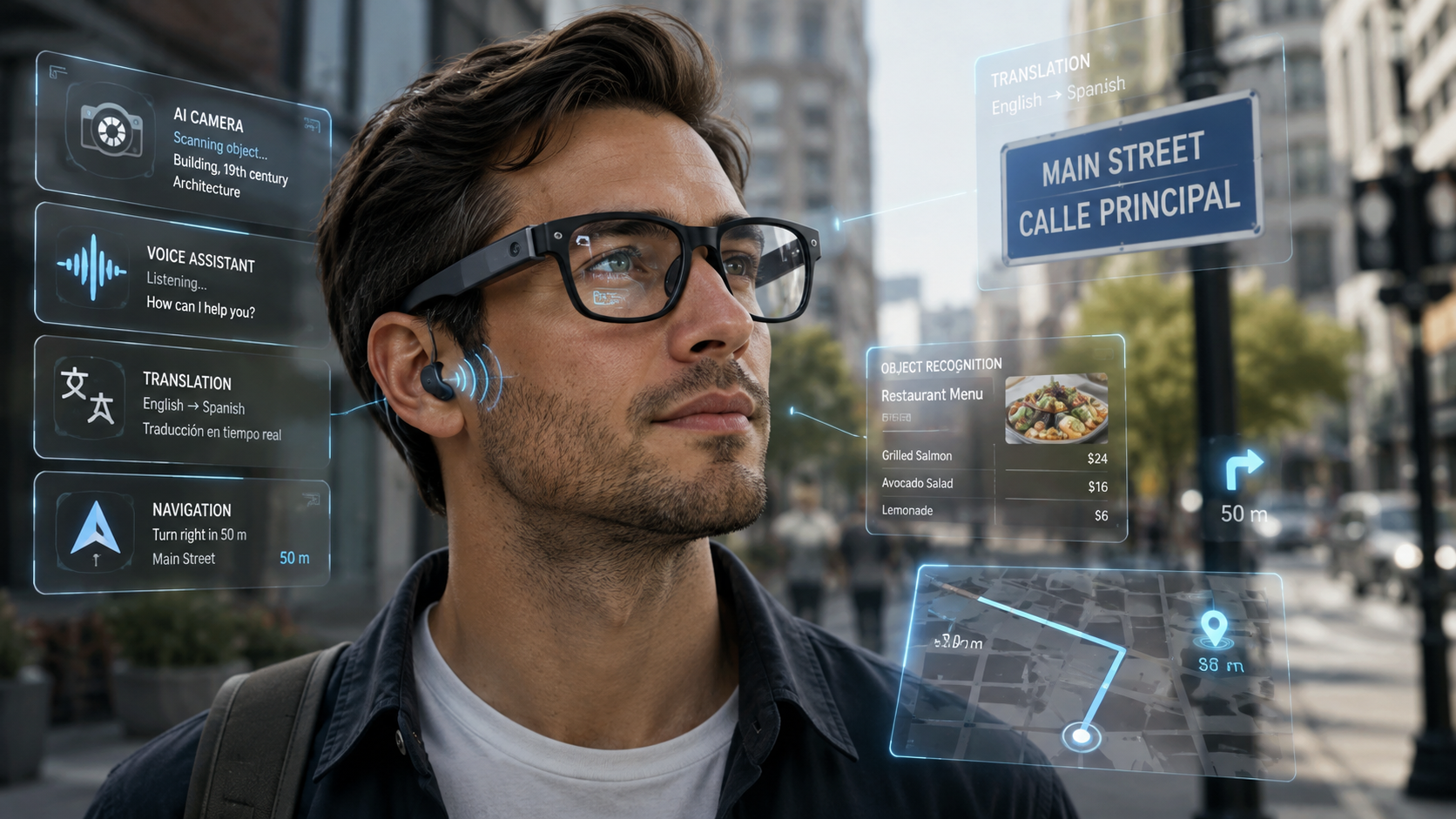
AI glasses are becoming one of the most interesting types of wearable technology. They look similar to normal glasses, but they can include cameras, microphones, speakers, sensors, and artificial intelligence. These features allow the glasses to understand voice commands, recognize things around you, answer questions, take photos, translate languages, and provide hands-free assistance.
Unlike traditional smart glasses that mainly focused on music, notifications, or photography, modern AI glasses are designed to understand both what you say and what you see. This makes them more like a personal AI assistant that you can wear.
What Are AI Glasses?
AI glasses are smart glasses that use artificial intelligence to provide useful information and assistance. They can connect to your smartphone or the internet and use AI services to understand your questions and surroundings.
For example, you could look at a restaurant menu and ask, “Which dishes are vegetarian?” The camera can capture the menu, AI can understand the text, and the glasses can tell you the answer through their speakers or display.
In simple terms, AI glasses combine ordinary eyewear with cameras, sensors, connectivity, and AI technology.
How Do AI Glasses Work?
AI glasses generally work through a combination of cameras, microphones, speakers, sensors, and AI software. The camera can capture information from your surroundings, while microphones listen to your voice.
When you ask a question, the system processes your voice and sends the information to an AI system. The AI understands your request and creates a response. That response can then be delivered through the glasses’ speakers or, in some models, through a small display.
The basic process is:
You ask → AI understands → AI processes the information → Glasses respond
Some processing can happen on the device, while more complex AI tasks may use a connected smartphone or cloud-based services.
Cameras: Letting AI Understand What You See
One of the most useful features of AI glasses is the built-in camera. Traditional cameras simply capture photos and videos, but AI-powered cameras can do much more.
AI can analyze what the camera sees and provide information about it. For example, you could point your glasses toward a sign and ask the AI to read it for you. You could also ask about an object, product, building, or menu.
AI cameras can be useful for:
- Taking photos and videos
- Reading signs and menus
- Recognizing objects
- Understanding text
- Identifying places
- Answering questions about your surroundings
This makes the camera more than a photography tool. It becomes a way for AI to see and understand the world around you.
Voice Assistants Without Taking Out Your Phone
AI glasses can also work as hands-free voice assistants. Instead of unlocking your smartphone and typing a question, you can simply speak to your glasses.
You might ask:
“What is the weather today?”
“Call John.”
“What building is this?”
“Remind me to send an email later.”
The glasses can listen to the command, send it to the AI assistant, and provide the response through built-in speakers.
This can be especially useful when you’re walking, traveling, cooking, working, or doing something where using your phone is inconvenient.
AI Glasses Can Help With Translation
Language translation is another interesting use of AI glasses.
Imagine traveling to another country where you don’t understand the local language. Instead of constantly opening a translation app on your phone, AI glasses could help translate signs, menus, or spoken conversations.
For example, you could look at a restaurant menu and ask the glasses to translate it. Some advanced glasses can also provide translated speech or display translated text.
This could make AI glasses useful for:
- International travel
- Business meetings
- Tourism
- Learning languages
- Reading foreign signs
- Understanding menus
Real-time translation could eventually become one of the most useful everyday features of AI-powered eyewear.
Navigation Without Constantly Looking at Your Phone
AI glasses could also make navigation more convenient.
Instead of repeatedly checking Google Maps or another navigation app, you could receive directions through your glasses. Audio-based glasses can provide spoken instructions, while display-equipped glasses can potentially show information directly in your field of view.
For example, you could ask:
“Where is the nearest coffee shop?”
The AI could use your location to find nearby places and help guide you there.
This hands-free approach could be particularly useful while walking, traveling, cycling, or exploring a new city.
AI Glasses Can Help With Accessibility
AI glasses could also become an important accessibility tool.
Because they can use cameras and AI to understand the environment, they can potentially describe objects, read text, identify signs, and provide spoken information.
For people with visual difficulties, this type of technology could provide another way to understand their surroundings.
For example, AI glasses could potentially read a document aloud, describe an object, or help identify information on a sign.
This shows that AI glasses are not only about entertainment and futuristic features. They could also have practical benefits for everyday accessibility.
AI Glasses With and Without Displays
Not all AI glasses work in the same way. Some glasses focus mainly on audio, while others include a small display.
Audio AI Glasses
Audio-focused AI glasses use microphones, speakers, cameras, and AI assistants. Instead of showing information in front of your eyes, they tell you the answer through audio.
These glasses can be lighter and look more like normal eyewear.
AI Glasses With Displays
Display-equipped glasses can show information directly in front of the wearer.
Depending on the technology, they could display:
- Navigation directions
- Translated text
- Notifications
- Captions
- AI responses
- Other visual information
This is where AI glasses begin moving closer to augmented reality experiences.
Are AI Glasses the Same as AR Glasses?
Not necessarily.
AI glasses mainly focus on artificial intelligence and hands-free assistance, while AR glasses are designed to place digital information or graphics into your view of the real world.
Some products can combine both technologies.
For example, a future pair of glasses could understand what you’re looking at using AI and then display useful information about it using AR.
So while AI and AR glasses can overlap, they are not exactly the same thing.
AI Glasses vs Smartphones
Will AI glasses replace smartphones?
For most people, probably not—at least not immediately.
Smartphones are still better for activities that require a large screen, such as watching videos, editing photos, browsing websites, playing games, and working with documents.
AI glasses are better suited for quick and hands-free tasks.
For example:
Smartphone:
Open an app → type a question → read the answer.
AI glasses:
Ask a question → AI responds.
The future is therefore more likely to involve AI glasses working together with smartphones rather than completely replacing them.
Privacy Is a Major Concern
AI glasses also raise important privacy questions.
Because many AI glasses include cameras and microphones, people may be concerned about being recorded without their knowledge.
Important questions include:
- When is the camera recording?
- Where are photos and videos stored?
- Is information uploaded to the cloud?
- How is AI processing visual information?
- Who can access the collected data?
Manufacturers are adding indicators and privacy controls to make recording more visible, but privacy will remain an important issue as these products become more common.
The success of AI glasses will depend not only on how powerful their AI becomes but also on how well companies protect user privacy.
What Can AI Glasses Do in the Future?
AI glasses are still developing, and their capabilities are likely to become much more advanced.
Future AI glasses could offer:
- Better object recognition
- More accurate translation
- Smarter navigation
- Real-time captions
- Personalized AI assistants
- Better accessibility features
- Improved cameras
- Smaller and lighter designs
- Longer battery life
- Better displays
- More natural conversations with AI
The biggest change could be context-aware AI.
Instead of waiting for you to explain everything, future glasses may understand more about your surroundings and provide useful information at the right moment.
Are AI Glasses Worth Buying?
Whether AI glasses are worth buying depends on what you expect from them.
They can be useful for people who want hands-free photography, voice assistance, translation, navigation, accessibility features, or quick access to AI.
However, they still have limitations. Battery life, AI accuracy, camera quality, privacy, price, smartphone compatibility, and regional availability are all important factors to consider.
Instead of asking only “Do these glasses have AI?”, it is better to ask:
“What can the AI actually do for me?”
That question will help you choose a device that provides real value rather than simply buying a gadget because it sounds futuristic.
The Future of AI Glasses
AI glasses are moving wearable technology in a new direction. Instead of simply displaying notifications or tracking fitness data, they can potentially understand your voice, see your surroundings, and provide useful information when you need it.
Cameras, voice assistants, translation, navigation, accessibility, and AI-powered visual understanding could make glasses an important part of future personal technology.
However, the technology still needs to overcome challenges such as battery life, privacy, cost, accuracy, and social acceptance.
The future of AI glasses will ultimately depend on one important question: Can they become useful enough to wear every day without becoming intrusive?
If manufacturers can solve that problem, AI glasses could become one of the most important wearable technologies of the next few years.
