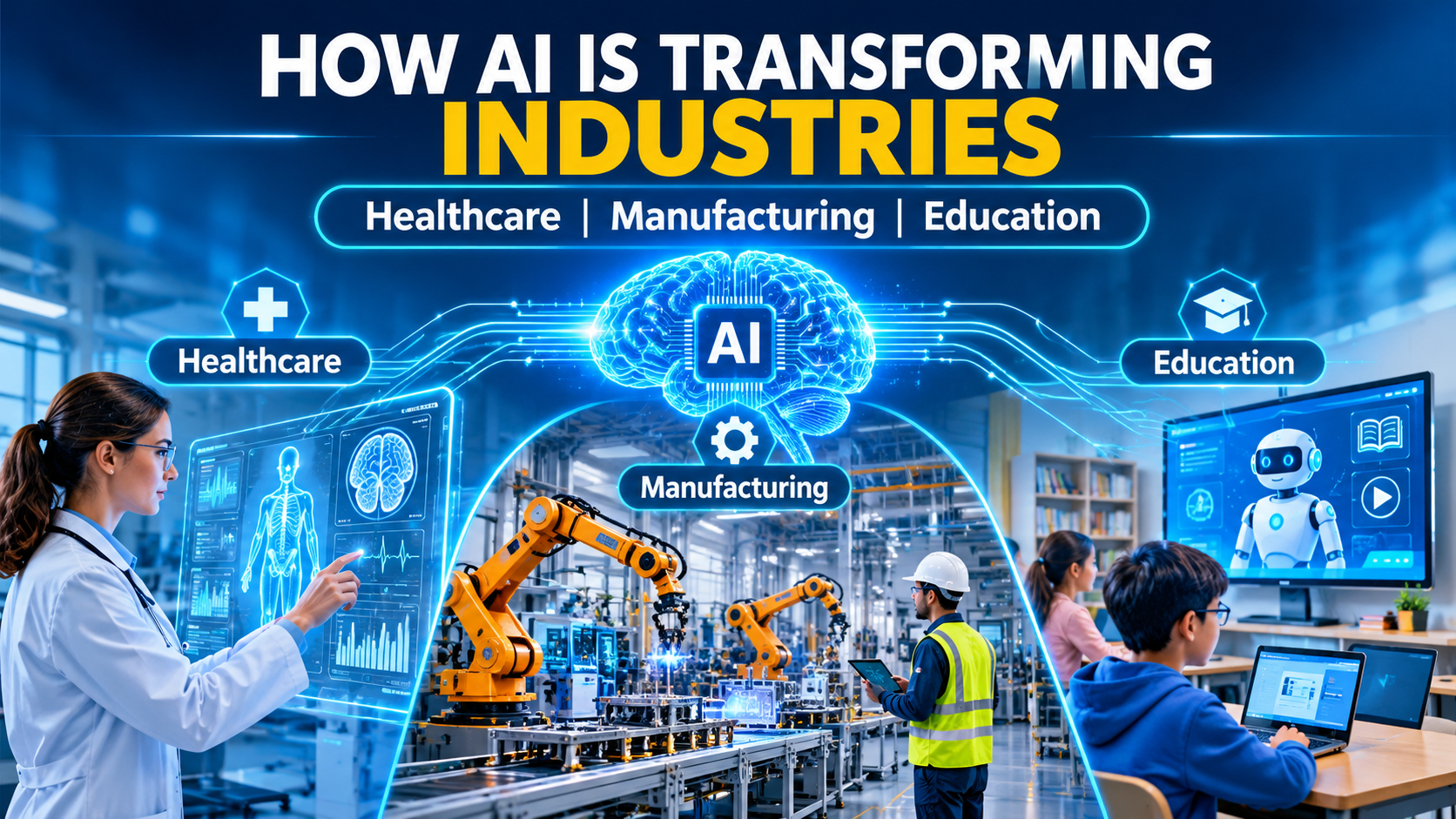
Artificial Intelligence (AI) is changing the way people live, work, and learn. Today, AI is becoming an important part of many industries, including healthcare, manufacturing, and education. It helps people complete tasks faster, reduce manual work, and make better decisions.
From helping doctors identify diseases to improving factory production and making education more personalized, AI is creating new opportunities in different fields. With technologies like Machine Learning, Deep Learning, and Generative AI, industries are becoming smarter and more efficient.
Let’s understand how Artificial Intelligence is transforming these three major industries.
Category 1: AI in Healthcare
Artificial Intelligence is making healthcare services smarter and more effective. It helps doctors understand medical information, supports disease detection, and improves patient care. AI-powered tools can analyze large amounts of medical data and provide useful information to healthcare professionals.
1. Early Disease Detection
AI can help doctors identify possible health problems by analyzing medical images such as X-rays, CT scans, and MRI scans. It can recognize unusual patterns that may be difficult to notice quickly. This helps medical professionals examine patients more effectively and make informed decisions.
2. Personalized Patient Care
Every patient has different health needs. AI can analyze medical history, test results, and other health information to help doctors understand individual patient conditions. Based on this information, healthcare professionals can consider more personalized treatment options.
3. Virtual Health Assistants
AI-powered chatbots and virtual assistants help patients get basic healthcare information. They can answer common questions, provide appointment details, and send reminders for medicines or checkups. This makes it easier for patients to access healthcare services.
4. Better Hospital Management
Hospitals handle a large amount of information every day. AI can help manage patient records, organize appointments, predict patient demand, and improve resource planning. This allows hospital staff to manage daily activities more efficiently.
Benefits of AI in Healthcare
- Helps doctors analyze medical information.
- Supports early disease detection.
- Improves patient care and communication.
- Reduces repetitive administrative work.
- Helps hospitals manage their resources.
Category 2: AI in Manufacturing
Artificial Intelligence is helping manufacturing companies improve the way products are made. Modern factories use AI-powered machines, robots, and software to monitor production, identify problems, and reduce unnecessary costs.
1. Smart Manufacturing Automation
AI-powered machines and robots can perform repetitive tasks such as assembling products, moving materials, and packaging goods. These systems help factories complete production activities more efficiently while reducing manual effort.
2. Predictive Machine Maintenance
Machine breakdowns can slow down production and increase repair costs. AI can monitor machine performance, temperature, and vibration to identify unusual changes. This helps companies detect possible problems early and plan maintenance before major breakdowns happen.
3. Automatic Quality Checking
Product quality is important for every manufacturing company. AI-powered cameras and computer vision systems can examine products and identify visible defects, scratches, or manufacturing errors. This helps companies improve product quality and reduce defective products.
4. Inventory and Stock Management
Manufacturing companies need raw materials and other supplies to keep production running. AI can analyze stock levels, sales information, and customer demand to help companies plan inventory. It can also help identify when materials need to be reordered.
5. Better Production Planning
AI can analyze production data, available materials, machine capacity, and customer orders. This helps manufacturers prepare better production schedules, use resources effectively, and reduce unnecessary delays.
Benefits of AI in Manufacturing
- Improves production efficiency.
- Reduces manual and repetitive work.
- Helps prevent unexpected machine breakdowns.
- Improves product quality.
- Supports better inventory management.
- Reduces unnecessary material waste.
Category 3: AI in Education
Artificial Intelligence is changing traditional education methods by making learning more flexible and interactive. Students can use AI-powered tools to understand difficult topics, practice new skills, and receive learning support. Teachers can also use AI to manage educational activities more efficiently.
1. Personalized Learning
Every student learns at a different speed. AI-powered learning platforms can understand student performance and suggest learning materials based on individual needs. This helps students focus on topics they find difficult and improve their knowledge.
2. AI-Powered Learning Assistants
AI learning assistants can help students understand difficult subjects by providing simple explanations, examples, and practice questions. Students can use these tools to learn outside classroom hours and get additional support whenever needed.
3. Automatic Assignment Checking
Teachers spend a lot of time checking assignments and tests. AI tools can help evaluate objective questions, organize student results, and provide basic feedback. This saves time and allows teachers to focus more on teaching.
4. Smart Classroom Management
AI-powered software can help educational institutions manage attendance records, student performance, schedules, and learning materials. It makes everyday administrative work easier and helps institutions organize their activities.
5. Easy Access to Learning Resources
Students can use AI tools to summarize study materials, explain complex concepts, translate information, and find useful learning resources. This makes education more accessible and helps students learn in different ways.
Benefits of AI in Education
- Makes learning more personalized.
- Helps students understand difficult topics.
- Saves teachers’ time.
- Provides faster learning feedback.
- Improves access to educational resources.
Category 4: Challenges of Using AI in Different Industries
Although Artificial Intelligence offers many advantages, using it also comes with some challenges. Companies, hospitals, and educational institutions need to understand these challenges before adopting AI technology.
1. Data Privacy and Security
AI systems use large amounts of information. Organizations must protect personal, medical, business, and educational data from unauthorized access and misuse.
2. High Implementation Costs
Developing and maintaining AI systems can require expensive software, hardware, infrastructure, and skilled professionals. Smaller organizations may find it difficult to manage these costs.
3. Need for Skilled Professionals
AI technology requires people who understand how to develop, operate, and manage AI systems. Organizations need to train employees and improve their technical skills.
4. Human Supervision
AI systems can sometimes provide incorrect or incomplete information. Human professionals must review important decisions, especially in healthcare, manufacturing safety, and education.
Category 5: What Is the Future of AI in These Industries?
Artificial Intelligence will continue to create new opportunities in healthcare, manufacturing, and education.
In healthcare, AI may support faster medical analysis, improved patient monitoring, and more personalized healthcare services.
In manufacturing, smart robots, automated production systems, and predictive maintenance technologies may help factories improve productivity and product quality.
In education, AI-powered tutors and personalized learning platforms may help students learn more effectively according to their individual needs.
As AI technology develops, the combination of human knowledge and intelligent machines will become increasingly important.
Conclusion
Artificial Intelligence is changing the way healthcare, manufacturing, and education industries work. It helps doctors analyze medical information, supports manufacturers in improving production, and gives students new ways to learn.
AI is not only about automation. It is also about making everyday work easier, improving decision-making, and creating better opportunities for the future.
However, successful AI adoption requires proper planning, data security, skilled professionals, and human supervision.
As technology continues to grow, Artificial Intelligence and Machine Learning will play an important role in building smarter, more efficient, and more connected industries.
