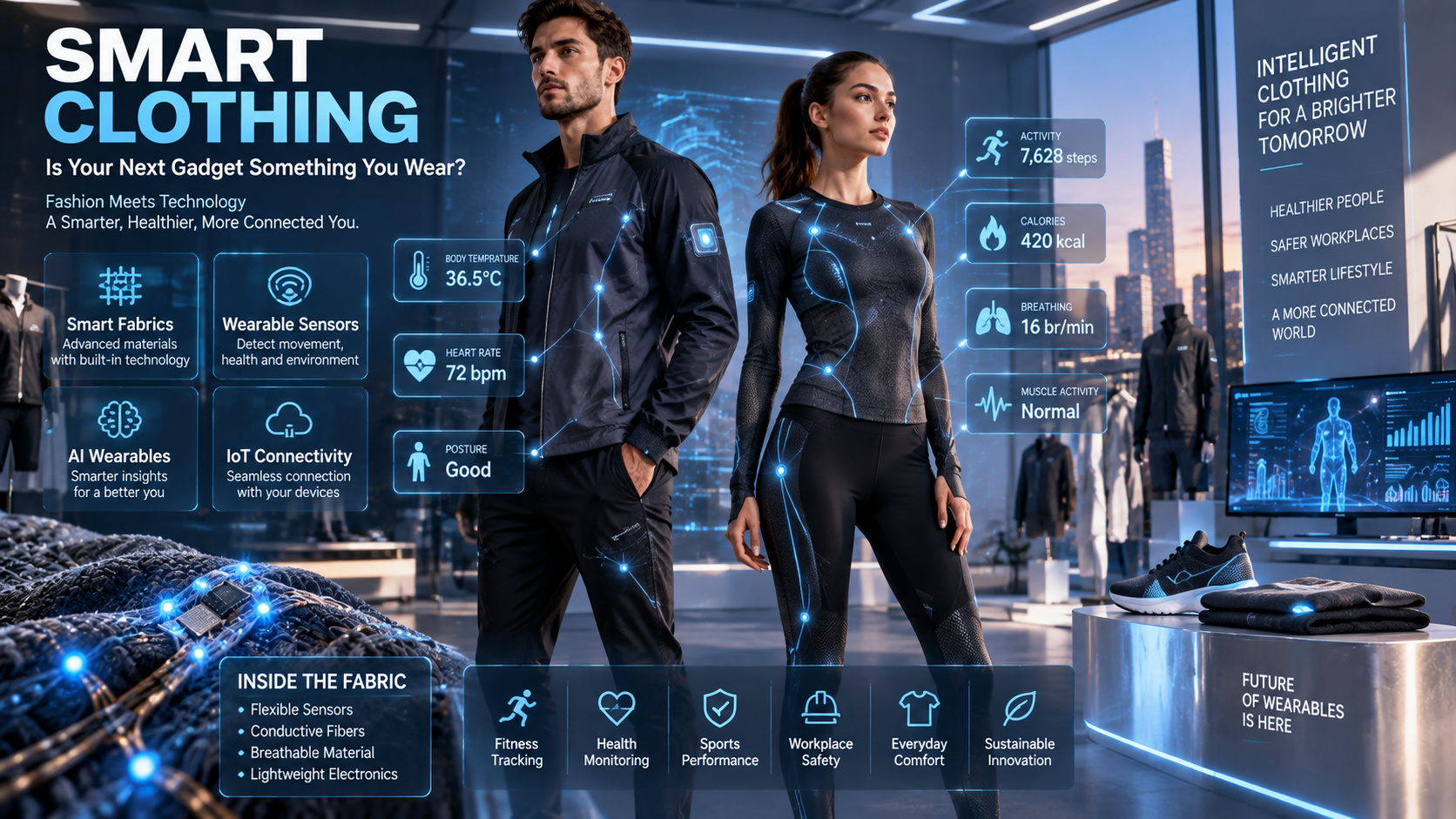
Wearable technology has already changed the way we use gadgets. Smartwatches, fitness bands, smart rings, and smart glasses are becoming increasingly common. But the next generation of wearable technology may not look like a traditional gadget at all.
Smart clothing brings technology directly into the clothes we wear. Shirts, jackets, shoes, socks, and other garments can include sensors and electronic components that collect information and connect with smartphones or other devices.
This raises an interesting question: Could your clothes become your next smart device?
What Is Smart Clothing?
Smart clothing is clothing that includes technology such as sensors, electronic components, connectivity, or smart fabrics.
Normal clothes are mainly designed for comfort, protection, and style. Smart clothing adds another function: it can collect information or respond to information using technology.
For example, a smart shirt could contain sensors that monitor movement or physical activity and send that information to a smartphone.
In simple words:
Smart clothing is clothing with technology built into it.
How Does Smart Clothing Work?
Smart clothing usually combines several technologies.
Small sensors can be placed inside or attached to the fabric. These sensors collect information from the body or surrounding environment.
A small electronic system can process this information, while wireless technologies such as Bluetooth can send the data to a smartphone, smartwatch, or another device.
Some advanced smart clothing systems can also use artificial intelligence to analyze the collected information.
The basic process is:
Sensors → Data Collection → Wireless Connection → AI or App Analysis → Useful Information
What Can Smart Clothing Track?
The capabilities depend on the type of smart clothing and the sensors it contains.
Smart clothing can potentially track information such as:
- Movement
- Body posture
- Physical activity
- Exercise performance
- Body temperature
- Breathing patterns
- Heart-related signals
- Muscle activity
- Sleep-related information
- Environmental conditions
Not every smart garment can measure all of these things. The capabilities depend on its design and technology.
Smart Clothing vs Smartwatch
Smart clothing and smartwatches both belong to the wearable technology category, but they work differently.
A smartwatch is a separate electronic device worn on the wrist. Smart clothing integrates technology directly into the garment.
For example, a smartwatch can track activity from the wrist, while a smart shirt could use sensors positioned across the body.
This means smart clothing could potentially collect information from areas that a wrist-worn device cannot easily monitor.
How Can AI Make Smart Clothing Smarter?
Artificial intelligence could make smart clothing more useful.
Sensors can collect large amounts of information, but raw data is not always easy for people to understand. AI can analyze that information and identify patterns.
For example, AI could analyze movement during exercise and identify changes in posture or activity patterns.
This creates an interesting combination:
Smart Fabric + Sensors + AI = Intelligent Wearable Technology
AI could eventually help smart clothing provide more personalized information instead of simply displaying numbers.
Smart Clothing for Fitness
Fitness is one of the most promising applications of smart clothing.
A smart fitness shirt could monitor movement, posture, exercise intensity, or other performance-related information.
Athletes and fitness enthusiasts could use this information to better understand how their bodies move during training.
Smart clothing could also work together with smartphones and fitness applications to create a more detailed picture of physical activity.
Could Smart Clothing Be Used in Healthcare?
Healthcare is another area where smart clothing could become useful.
Specialized garments can potentially use sensors to collect certain physical signals over time. This could support remote monitoring and other healthcare applications.
For example, a sensor-equipped garment could collect information that can later be reviewed through a connected digital system.
However, there is an important difference between consumer wearable technology and medical devices. Medical applications require appropriate testing, validation, safety measures, privacy protections, and regulatory approval where applicable.
What Are Smart Fabrics?
Smart fabrics are materials designed to interact with technology.
Traditional fabrics mainly provide comfort, protection, and appearance. Smart fabrics can include conductive fibers, sensors, electronic components, or other technologies.
These materials could allow clothing to collect information, communicate with other devices, or respond to changes in the environment.
Smart fabrics are therefore an important part of the future of smart clothing.
Could Smart Clothing Generate Its Own Power?
Power is one of the biggest challenges for wearable electronics.
Researchers are exploring ways to collect small amounts of energy from sources such as body movement, body heat, or the surrounding environment.
The idea is to reduce dependence on traditional batteries in some wearable applications.
However, producing enough reliable energy to continuously power advanced electronics remains a major technical challenge.
Could Smart Clothing Replace Smartwatches?
Smart clothing does not necessarily need to replace smartwatches.
In the future, both technologies could work together.
For example, smart clothing could contain sensors across the body, while a smartwatch could provide a screen, controls, notifications, and connectivity.
This could create a larger wearable ecosystem where different devices share information.
Smart Shoes and Other Wearable Products
Smart clothing is not limited to shirts and jackets.
Technology can potentially be integrated into many everyday products, including:
- Smart shoes
- Smart socks
- Smart jackets
- Smart gloves
- Smart sportswear
- Smart helmets
- Smart uniforms
- Smart bags
For example, smart shoes could potentially monitor movement, pressure, balance, or running patterns.
Smart Clothing for Athletes
Professional athletes could benefit from clothing that provides detailed movement information.
Instead of relying only on a smartwatch or fitness tracker, athletes could potentially use sensor-equipped clothing to collect information from different parts of the body.
Coaches and athletes could then use the data to understand training patterns and movement.
AI could make this information easier to analyze by identifying changes or patterns in performance.
Smart Clothing for Workplace Safety
Smart clothing could also have applications in workplaces such as factories, warehouses, construction sites, and other industrial environments.
Connected clothing could potentially monitor movement, environmental conditions, or other safety-related information.
For example, specialized workwear could help identify unusual movement or provide information about the worker’s environment.
However, workplace monitoring must be designed carefully because collecting employee data creates important privacy and security considerations.
Could Smart Clothing Help Workers?
Smart clothing could eventually provide workers with more hands-free technology.
Instead of constantly checking a smartphone or computer, workers could potentially receive information through connected clothing and other wearable devices.
When combined with AI, augmented reality, and smart glasses, clothing could become part of a larger hands-free workplace system.
Can Smart Clothing Change the Fashion Industry?
Smart clothing could create a new connection between fashion and technology.
Future garments could potentially react to environmental conditions, change certain visual properties, provide interactive features, or connect with other digital devices.
This could create a new type of fashion where clothing is not only designed for appearance but also performs digital functions.
What Are the Benefits of Smart Clothing?
Smart clothing could offer several potential benefits.
More Natural Wearable Technology
Instead of wearing another separate gadget, technology can be integrated directly into clothing.
More Sensors
Sensors can potentially be distributed across different parts of the body.
Better Fitness Tracking
Smart clothing could collect detailed movement and exercise information.
Hands-Free Technology
Users could potentially access information without constantly holding a smartphone.
AI-Powered Insights
AI could analyze sensor data and provide more useful information.
Workplace Applications
Smart garments could potentially support productivity and safety in specialized environments.
What Are the Challenges of Smart Clothing?
Smart clothing also faces several challenges.
Comfort is extremely important. Electronics should not make clothes heavy or uncomfortable.
Durability is another challenge because clothing needs to handle movement, moisture, and regular use.
Washing can also be difficult when electronic components are integrated into fabric.
Battery life is another major issue.
There are also concerns around privacy, security, cost, and data management.
Can Smart Clothes Be Washed?
This depends on the design.
Traditional clothes are designed to be washed regularly, but electronic components can be sensitive to water, heat, and detergents.
Manufacturers therefore need to develop technologies that can survive normal washing or provide removable electronic components.
Improving washability and durability will be important if smart clothing is going to become an everyday product.
What About Privacy?
Privacy could become one of the biggest concerns surrounding smart clothing.
Imagine clothing continuously collecting information about your movement, activity, body signals, or daily routines.
Users need to understand:
- What information is being collected?
- Where is it stored?
- Who can access it?
- Is it shared with third parties?
- Can users delete their information?
- How is the data protected?
As smart clothing becomes more advanced, strong privacy and security protections will become increasingly important.
Could Smart Clothing Become an AI Interface?
This could be one of the most interesting developments.
Today, people interact with technology mainly through smartphones, computers, smartwatches, and other screens.
Smart clothing could become another interface between humans and computers.
Sensors could collect information from the body, AI could analyze it, and connected devices could respond automatically.
This could help move technology toward a more hands-free and ambient computing experience.
Smart Clothing and the Internet of Things
Smart clothing can also become part of the Internet of Things (IoT).
IoT means physical objects are connected to digital systems and can exchange information.
A smart shirt could communicate with a smartphone. A smart shoe could send activity information to an application. A smart uniform could connect with workplace systems.
This could make clothing part of a much larger connected ecosystem.
What Could Smart Clothing Look Like in the Future?
Future smart clothing could combine several technologies:
Smart Fabrics + Sensors + AI + IoT + Wireless Connectivity
Imagine putting on a smart jacket that automatically connects with your devices.
Imagine a fitness shirt that understands your workout.
Imagine work clothing that provides safety information.
These concepts are still developing, but they demonstrate how clothing could become an important part of future wearable technology.
Will Smart Clothing Become Mainstream?
Smart clothing still has several challenges before it can become as common as smartphones and smartwatches.
Manufacturers need to improve:
- Comfort
- Battery life
- Durability
- Washability
- Cost
- Privacy
- Data security
- Sensor accuracy
If these challenges can be addressed, smart clothing could become more practical for everyday users.
Is Smart Clothing the Future of Wearables?
Smart clothing is unlikely to completely replace smartwatches, smart rings, or smart glasses.
Instead, the future may involve multiple wearable devices working together.
A smartwatch could provide the display. Smart glasses could provide visual information. A smart ring could monitor certain signals, while smart clothing could collect information from across the body.
Together, these devices could create a more connected personal technology system.
Conclusion
Smart clothing represents an exciting direction for wearable technology.
Instead of simply attaching a gadget to your body, smart clothing attempts to integrate technology directly into the clothes you already wear.
From fitness and healthcare to workplace safety, fashion, IoT, and AI, smart clothing could have many different applications.
The biggest opportunity could come from combining smart fabrics, sensors, artificial intelligence, and connected devices.
The future of wearable technology may not only be about what we put on our wrists or face.
It could also be about what we wear every day.
