Artificial intelligence is becoming an increasingly important part of modern software. Two terms you’ll often hear are AI chatbots and AI agents. Although they can both understand natural language and interact with users, their capabilities and purposes are different.
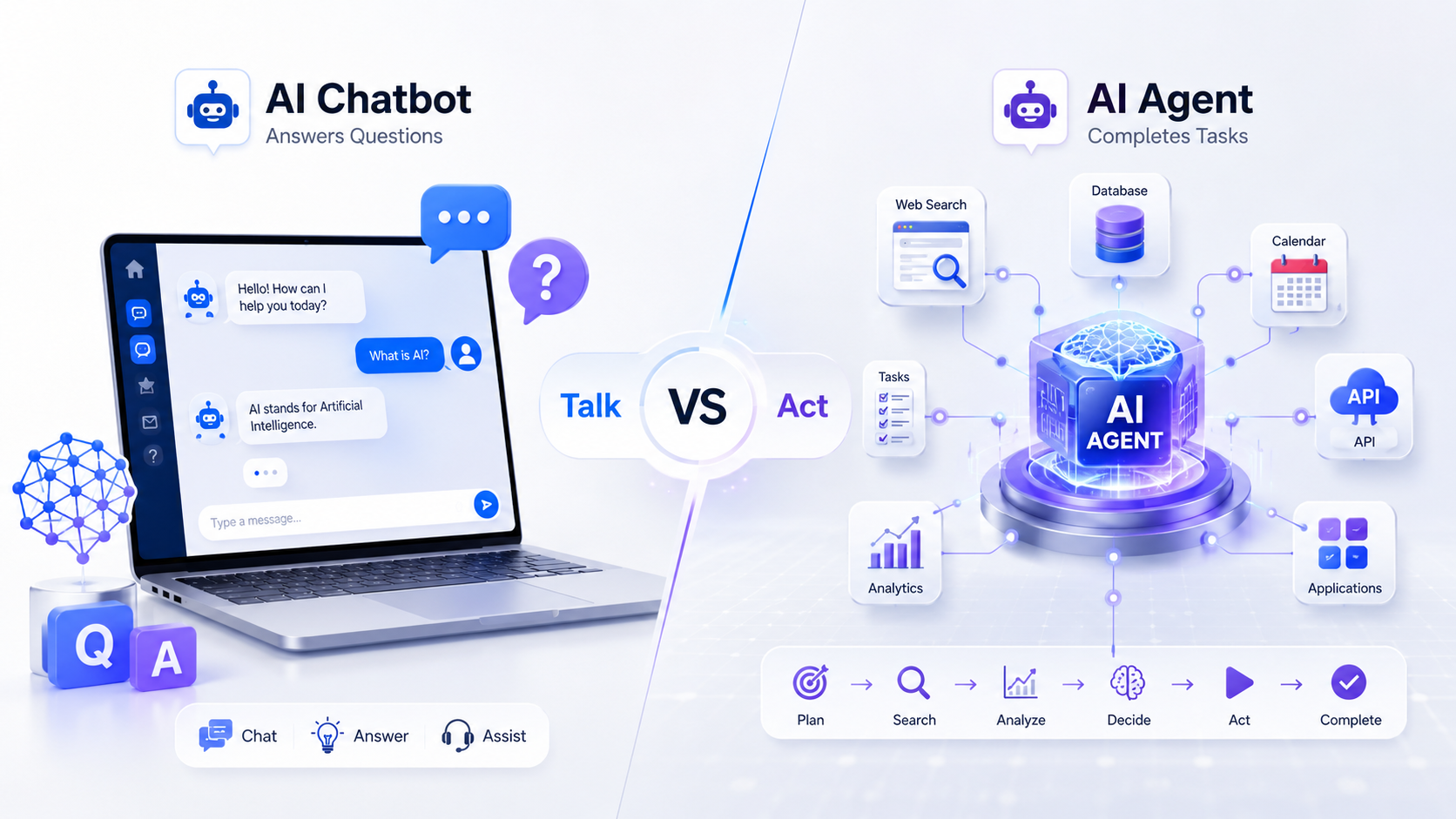
An AI chatbot is primarily designed to communicate, answer questions, and provide information. An AI agent goes a step further by understanding a goal, planning tasks, using tools, and taking actions to accomplish that goal.
Understanding the difference between AI chatbots and AI agents can help businesses, developers, and everyday users choose the right technology for a particular task.
What Is an AI Chatbot?
An AI chatbot is software that communicates with users through text or voice. It understands a user’s request and generates a response using its AI model, available information, and instructions.
For example, you might ask a customer-service chatbot:
“What time does your store open?”
The chatbot can provide the business hours without requiring a human employee to respond.
AI chatbots are commonly used for:
- Customer support
- Frequently asked questions (FAQs)
- Product recommendations
- Website assistance
- Basic information and guidance
- Employee support
- Conversational experiences
In simple terms, an AI chatbot is primarily designed to have a conversation with you.
What Is an AI Agent?
An AI agent is designed to do more than communicate. It can receive a goal, determine the steps required, use connected tools or systems, and take actions to achieve the desired outcome.
For example, you could tell an AI agent:
“Find the best laptop under ₹70,000 and compare three options.”
Instead of simply explaining what to consider when buying a laptop, an AI agent could potentially search available information, compare specifications and prices, organize the results, and recommend an option.
In simple terms, an AI agent is designed to help you complete a task, not just answer a question.
AI Chatbot vs AI Agent: What Is the Main Difference?
The biggest difference between an AI chatbot and an AI agent is what they are designed to accomplish.
A chatbot generally responds to a user’s questions and continues the conversation. An AI agent can take a broader goal and work through multiple steps to achieve it.
AI Chatbot Example
“Here are some ways to book a flight.”
The chatbot primarily provides information.
AI Agent Example
“I found flights that match your requirements and compared the available options.”
The agent can potentially perform research, compare information, and take actions using connected tools.
The chatbot mainly provides answers, while the AI agent can work toward completing a task.
How Do AI Chatbots Work?
AI chatbots generally follow a straightforward interaction process:
User Message → AI Understands Request → Processes Information → Generates Response
For example, if you ask:
“How can I reset my password?”
The chatbot can understand the request and provide the relevant instructions.
Modern AI chatbots powered by large language models can understand natural conversations, follow context, and generate more detailed responses than traditional rule-based chatbots.
However, a chatbot’s ability to perform actions depends on the tools and integrations available to it. This is important because the difference between a chatbot and an agent is not simply the AI model being used. A chatbot can also be connected to tools; an agent typically uses those tools as part of a broader goal-oriented workflow.
How Do AI Agents Work?
AI agents generally operate through a more complex workflow:
Goal → Planning → Information Gathering → Tool Use → Action → Result → Evaluation
Suppose you tell an AI agent:
“Prepare a report about our website traffic this month.”
Depending on its integrations and permissions, the agent could:
- Determine what information is required.
- Access website analytics data.
- Analyze traffic numbers and trends.
- Identify important findings.
- Create a summary.
- Generate a report.
- Review the result and potentially make corrections.
This ability to plan and act across multiple steps is one of the key characteristics of AI agents.
Can AI Agents Use Tools?
Yes. Tool usage is one of the capabilities that can make AI agents more powerful.
Depending on how an agent is designed, it may connect to:
- Databases
- APIs
- Search engines
- Calendars
- Business applications
- Analytics platforms
- Software-development environments
- Customer relationship management (CRM) systems
- Internal company systems
For example, a software-development AI agent could potentially inspect a codebase, identify an issue, modify the code, run tests, and evaluate the results.
The AI model provides the reasoning and decision-making capabilities, while connected tools allow the agent to interact with external systems and take actions.
Do AI Agents Think Like Humans?
No. Despite the term “agent,” AI agents do not think like humans.
They use AI models to process information, reason through tasks, generate plans, and select actions based on their instructions, available data, tools, and operating environment.
Their behavior can appear intelligent because they can handle multiple steps and respond to changing results. However, they do not have human consciousness, emotions, or human-like understanding.
A better way to think about an AI agent is:
An AI agent is software that can make decisions within a defined environment to accomplish a specific goal.
AI Chatbot vs AI Agent: Simple Comparison
| Feature | AI Chatbot | AI Agent |
|---|---|---|
| Answers questions | Yes | Yes |
| Holds conversations | Yes | Yes |
| Understands natural language | Yes | Yes |
| Handles multiple steps | Limited to moderate | Yes |
| Uses external tools | Sometimes | Frequently |
| Takes actions | Limited | Yes |
| Makes task-based decisions | Limited | More capable |
| Completes goals | Limited | Designed for this |
| Automation | Basic to moderate | Advanced |
| Human supervision | Often higher | Can be lower, depending on the task |
Important: These categories can overlap. A chatbot can have tool integrations, and an AI agent can communicate through a chatbot-style interface. The distinction is mainly about the system’s level of autonomy, planning, tool use, and goal completion.
Where Are AI Chatbots Used?
AI chatbots are already widely used across many industries.
Businesses use them to:
- Answer customer questions
- Provide product information
- Handle FAQs
- Recommend products
- Help users navigate websites
- Support employees
- Provide basic customer-service assistance
For example, an online store could use a chatbot to answer questions about delivery times, return policies, product availability, and order information.
Because chatbots can provide immediate conversational support, they remain an important part of modern customer-service and business software.
Where Are AI Agents Used?
AI agents are particularly useful when a task requires multiple steps, decisions, or actions.
Potential AI agent use cases include:
- Software development
- Research
- Customer service
- Business automation
- Data analysis
- Scheduling
- Workflow management
- Cybersecurity
- Operations
- Content and document workflows
For example, an AI agent supporting a customer-service team could potentially:
- Read a customer request.
- Check the customer’s account.
- Find relevant information.
- Create a support ticket.
- Prepare a response.
- Escalate the issue when necessary.
The actual capabilities depend on the agent’s tools, permissions, integrations, and level of human oversight.
Are AI Agents Replacing AI Chatbots?
Not necessarily.
AI chatbots and AI agents serve different purposes, so one does not automatically replace the other.
If you need a system that answers questions and communicates with customers, an AI chatbot may be sufficient.
If you need software that can perform multiple actions and complete a larger task, an AI agent may be more appropriate.
In many applications, the two technologies can work together.
A user could interact with a familiar chatbot-style interface while an AI agent works behind the scenes to research information, access systems, and complete tasks.
AI Chatbot vs AI Agent: A Real-World Example
Imagine you run an online clothing store.
What a Chatbot Could Do
A customer asks:
“Do you have this shirt in medium?”
The chatbot could check the product database and tell the customer whether the size is available.
What an AI Agent Could Do
The customer asks:
“Find me a black formal shirt under ₹2,000, add the best option to my cart, and prepare it for checkout.”
An AI agent could potentially:
- Search available products.
- Filter black formal shirts.
- Check prices.
- Compare suitable options.
- Select the best match.
- Add the product to the cart.
- Prepare the order for checkout.
This illustrates the fundamental difference:
A chatbot answers the request, while an AI agent can work toward completing the request.
AI Chatbots and AI Agents: Which One Should You Choose?
The right technology depends on what you want the system to accomplish.
Choose an AI Chatbot When You Need:
- FAQ automation
- Customer conversations
- Basic support
- Information retrieval
- Website assistance
- Product recommendations
- Simple conversational workflows
Choose an AI Agent When You Need:
- Multi-step workflows
- Automated decision-making
- Tool and API usage
- Data analysis
- System interactions
- Task execution
- Goal-oriented automation
In some cases, the best solution is a combination of both: a conversational interface for the user and an AI agent working behind the scenes.
What Is the Future of AI Agents?
AI agents are becoming an important part of the next generation of software.
Traditional software often requires users to understand how to use an application. Users need to navigate menus, find features, enter information, and complete individual steps themselves.
Agent-based software could increasingly allow users to describe what they want to accomplish in natural language.
Traditional Software
Open application → Find feature → Enter information → Submit → Check result
Agent-Based Software
“Analyze this data and create a summary.”
The agent can potentially determine and perform many of the intermediate steps.
This shift could make software more task-oriented and reduce the amount of manual work required from users.
However, greater autonomy also creates new challenges, including accuracy, security, privacy, permissions, reliability, and human oversight. For important tasks, businesses should carefully control what an agent is allowed to access and change.
Frequently Asked Questions
Is ChatGPT a chatbot or an AI agent?
An AI system can function as a chatbot, an agent, or a combination of both depending on its capabilities, tools, and configuration. A conversational interface alone does not determine whether a system is an agent.
Are AI agents better than chatbots?
Not always. AI agents are better suited to complex, multi-step tasks, while chatbots can be simpler and more effective for straightforward conversations, FAQs, and customer support.
Can a chatbot use tools?
Yes. A chatbot can be connected to databases, APIs, search systems, and other tools. Tool access alone does not automatically make a system a fully autonomous AI agent.
What is the biggest advantage of AI agents?
The biggest advantage is their ability to work toward a goal across multiple steps, potentially using tools, evaluating results, and taking actions with less manual intervention.
Will AI agents replace traditional software?
AI agents are unlikely to replace all traditional software. Instead, they are more likely to become another layer of interaction and automation that works alongside existing applications, databases, APIs, and business systems.
Final Thoughts
AI chatbots and AI agents are both valuable AI technologies, but they are designed for different purposes.
AI chatbots are primarily focused on conversation and providing answers. AI agents are focused on completing goals by planning tasks, using tools, making decisions, and taking actions.
Chatbots are a strong choice for customer support, FAQs, information retrieval, and conversational experiences. AI agents are more useful when software needs to manage complex, multi-step workflows.
As AI continues to evolve, we will likely see more applications combining chatbots, AI agents, automation, and traditional software into a single experience.
The easiest way to remember the difference is:
Chatbots are built to talk. AI agents are built to act.
