Introduction
Modern warehouses are becoming faster and more automated. Instead of having workers move every product manually, many warehouses now use robots to transport items, organize inventory, and support order fulfillment.
But what if hundreds of robots could work together instead of operating independently?
That is the idea behind robot swarms.
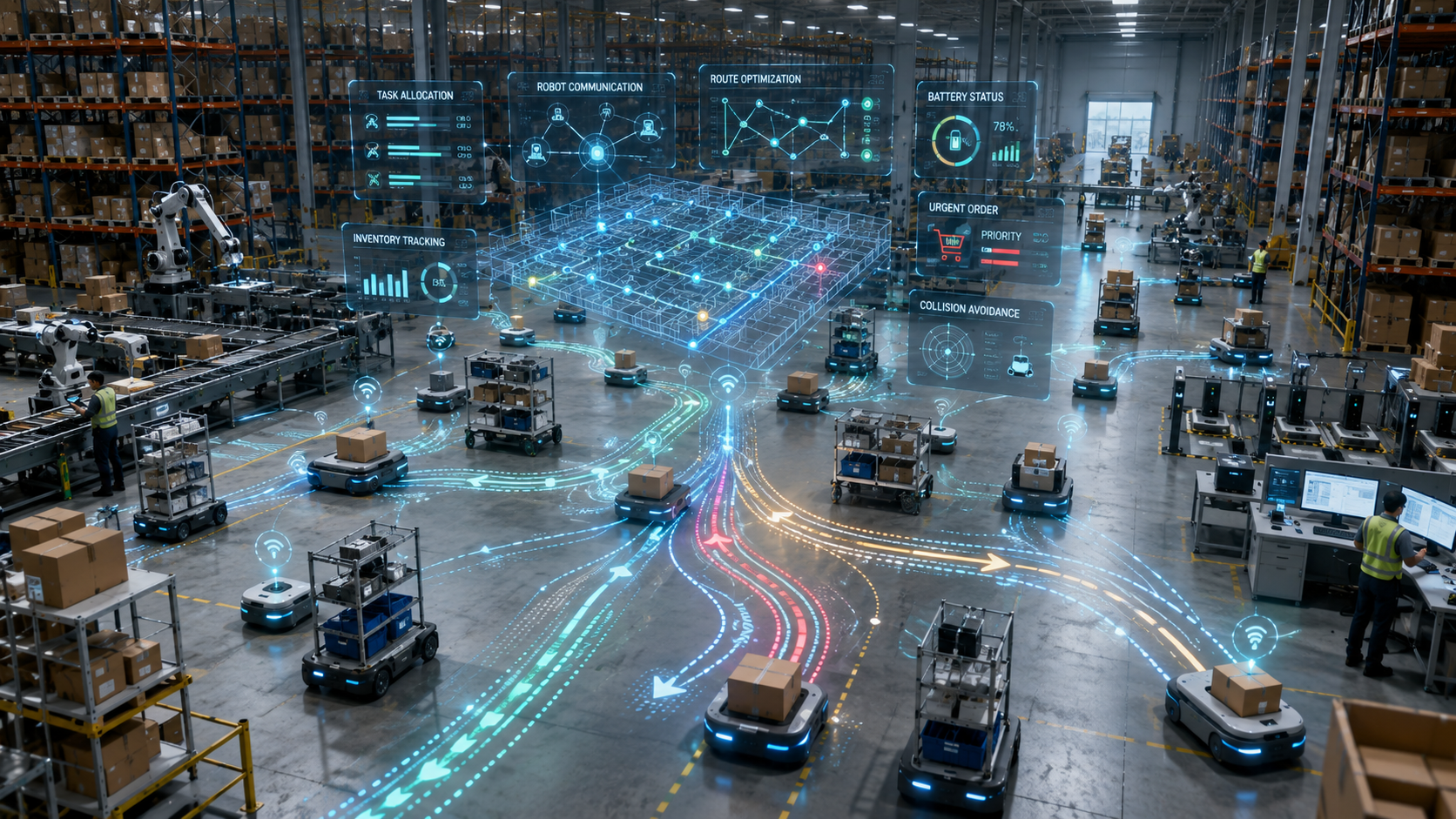
A robot swarm is a group of autonomous robots that communicate, coordinate their movements, and work together to complete tasks. In warehouses, these robots can help move products, retrieve inventory, avoid traffic, and support workers.
The goal is simple: make warehouse operations faster, smarter, and more flexible.
What Are Robot Swarms?
Robot swarms are groups of robots that work together as a team.
Instead of controlling every robot individually, software allows the robots to share information and coordinate their activities.
Think about a group of ants.
No single ant controls the entire colony, but the ants can still work together to find food, avoid obstacles, and complete tasks.
Robot swarms use a similar idea.
Each robot can understand its surroundings, communicate with other robots, and decide what action to take based on the current situation.
How Do Robot Swarms Work?
Robot swarms combine several technologies, including:
- Artificial intelligence
- Sensors
- Cameras
- Wireless communication
- Navigation systems
- Warehouse software
- Machine learning
Each robot can understand where it is, where other robots are, and what task it needs to complete.
The system can then decide which robot should perform a particular task and which route it should take.
For example:
Find product → Choose robot → Plan route → Pick product → Deliver product → Receive next task
This process can happen hundreds or thousands of times across a large warehouse.
Why Do Warehouses Need Robot Swarms?
Large warehouses can contain thousands or even millions of products.
Workers and machines need to find, move, sort, and prepare these products for shipping.
As online shopping continues to grow, companies need to process orders quickly while keeping operating costs under control.
Robot swarms can help because many robots can work at the same time.
Instead of one machine completing one task at a time, a large fleet can handle many tasks simultaneously.
How Do Robots Move Products?
One of the most common warehouse applications is product transportation.
A robot can travel to a storage location, collect a product or move a storage shelf, and bring it to another location.
With a robot swarm, hundreds of these tasks can happen at the same time.
For example:
Robot A → Moves Product A
Robot B → Retrieves Product B
Robot C → Delivers Product C
Robot D → Brings a Storage Shelf
The robots can continue working while new tasks are assigned.
This can help warehouses process more orders in less time.
How Robot Swarms Help With Order Picking
Order picking means finding the products required for a customer’s order.
In a traditional warehouse, workers may walk long distances to find products.
Robots can reduce some of this movement.
A robot can travel to the correct storage location, retrieve a product, and bring it to a worker or packing station.
If an order contains several products, different robots can retrieve different items and bring them together.
This can reduce unnecessary walking and help workers focus on packing, checking, and other tasks.
Dynamic Routing: How Robots Avoid Traffic
Imagine hundreds of robots moving through the same warehouse.
If every robot follows the same route, traffic jams can happen.
Robot swarm systems can solve this problem with dynamic routing.
The robots can monitor their surroundings and change routes when necessary.
For example:
Normal route → Traffic detected → AI chooses another route → Robot continues
This allows the robotic fleet to respond to changing warehouse conditions.
Dynamic routing becomes especially important as the number of robots increases.
How Robots Communicate With Each Other
Communication is an important part of swarm robotics.
Robots can share information about:
- Their location
- Current tasks
- Available routes
- Obstacles
- Warehouse traffic
- Battery levels
This information helps robots coordinate their movements.
For example, if one robot detects a blocked path, other robots may receive updated route information and choose a different direction.
This helps prevent unnecessary delays.
What Happens If One Robot Stops Working?
One advantage of a large robot fleet is that the system does not have to depend on a single machine.
If one robot has a problem, another robot may be able to take over its task.
For example:
Robot A stops → Task becomes available → Robot B accepts the task → Work continues
This can make warehouse automation more flexible and resilient.
However, the exact behavior depends on how the warehouse’s robotic management system is designed.
How AI Makes Robot Swarms Smarter
Artificial intelligence can help robot swarms make better decisions.
AI can be used for:
- Route planning
- Task assignment
- Object recognition
- Traffic management
- Collision avoidance
- Inventory movement
- Predictive maintenance
Instead of following the same instructions all the time, robots can respond to changing conditions.
For example, if one warehouse area becomes crowded, the system can redirect robots to another area.
If an urgent order arrives, the system can prioritize it.
This makes the warehouse more adaptive.
Smart Tags Can Help Robots Prioritize Orders
Not every package in a warehouse has the same priority.
For example, a normal product may be able to wait, while a medical product or time-sensitive shipment may need to be moved immediately.
Smart tags and IoT sensors can provide robots with additional information about products.
A robotic system could use information such as:
Priority + Location + Distance + Available Robots
to determine which task should be completed first.
This can make robot swarms more intelligent than systems that simply send the nearest robot to the nearest product.
Robot Swarms and Human Workers
Robot swarms do not necessarily mean warehouses will have no human workers.
Humans are still valuable for tasks that require judgment and flexibility.
Workers may focus on:
- Quality checking
- Problem-solving
- Supervising robots
- Handling unusual products
- Maintenance
- Packing
- Managing exceptions
Robots can handle repetitive transportation and retrieval work.
This creates a human-robot collaboration model, where machines handle repetitive physical work and people focus on tasks that require human judgment.
What Types of Robots Can Work Together?
A future smart warehouse may use several types of robots.
Autonomous Mobile Robots
AMRs can move around warehouses independently and transport products or materials.
Automated Guided Vehicles
AGVs follow predefined routes and are useful for structured transportation tasks.
Robotic Arms
Robotic arms can pick, sort, pack, and handle products.
Mobile Manipulators
These robots combine movement with robotic arms, allowing them to travel around a warehouse and interact with objects.
Inventory Drones
Drones may be used for inventory scanning and warehouse monitoring.
These different machines can potentially work together through warehouse management and fleet-control software.
Robot Swarms vs Traditional Warehouse Automation
Traditional warehouse automation often depends on fixed systems such as conveyor belts and stationary machines.
These systems can be very efficient, but changing the warehouse layout may require significant modifications.
Robot swarms offer more flexibility because mobile robots can change their routes through software.
For example, if a warehouse adds a new storage area, robots can potentially be given new maps and routes without rebuilding the entire automation system.
This flexibility is one of the biggest advantages of mobile robotic systems.
Benefits of Robot Swarms
Robot swarms can provide several benefits to warehouses.
Faster Order Processing
Many robots can work at the same time, helping warehouses process more orders.
Greater Flexibility
Robots can change routes and tasks when warehouse conditions change.
Easy Scaling
Companies can potentially add more robots as order volumes increase.
Less Repetitive Work
Robots can handle many repetitive transportation tasks.
Better Resilience
If one robot stops working, another may be able to continue the task.
Better Warehouse Efficiency
AI-based routing and coordination can help reduce unnecessary movement and delays.
Challenges of Robot Swarms
Robot swarms also have some important challenges.
Traffic Management
A large number of robots can create congestion if they are not coordinated properly.
Battery Management
Mobile robots need to be charged regularly.
A large warehouse therefore needs an efficient charging strategy.
Communication
Robots need reliable communication to share information and coordinate tasks.
Safety
Robots must operate safely around workers, forklifts, shelves, and other equipment.
Integration
Robots need to work with warehouse management systems, inventory databases, sensors, and existing automation.
Cost
The cost is not limited to the robots.
Companies also need to invest in software, charging infrastructure, networking, maintenance, and system integration.
Are Robot Swarms Already Used in Warehouses?
Yes, robotic warehouse fleets are already being used in real logistics operations.
However, not every robotic warehouse is a fully decentralized swarm.
Many systems use centralized fleet-management software to coordinate autonomous mobile robots.
The important development is that these fleets are becoming increasingly intelligent.
Modern warehouse robots can already transport products, move shelves, support picking, and coordinate their movements.
The next step is making these systems more autonomous and adaptive.
What Will Robot Swarms Look Like in the Future?
Future robot swarms could make warehouses much more intelligent.
Instead of simply following predefined instructions, robots could continuously analyze warehouse conditions.
For example, the system could detect:
- Increasing order demand
- Crowded warehouse areas
- Low robot battery levels
- Urgent orders
- Packing station delays
- Inventory movement problems
The AI system could then automatically change how the robot fleet operates.
This could turn a warehouse into an adaptive robotic ecosystem.
Robot Swarms and the Future of Logistics
The future of warehouse automation will probably not depend on robots alone.
Instead, multiple technologies will work together:
AI + Robot Swarms + AMRs + IoT + Computer Vision + Warehouse Software + Real-Time Data
AI can make decisions.
Robots can perform physical tasks.
Sensors can provide real-time information.
Warehouse software can manage inventory and orders.
Together, these technologies can create faster and more responsive logistics operations.
Conclusion
Robot swarms could become an important part of the future of warehouse automation.
Instead of relying on a single machine, warehouses can use fleets of autonomous robots that work together to move products, retrieve inventory, avoid traffic, and support order fulfillment.
The most important part of swarm robotics is not simply having many robots.
It is making those robots work together intelligently.
As AI, autonomous mobile robots, sensors, and warehouse software continue to improve, robot swarms could help businesses create logistics systems that are faster, more flexible, scalable, and efficient.
The warehouse of the future may not be completely controlled by humans or completely controlled by robots.
Instead, it could be a smart environment where humans, AI, and robot swarms work together as one connected system.
