Introduction
Artificial intelligence is becoming a major part of modern software. Companies are using AI chatbots, AI assistants, recommendation systems, coding tools and autonomous AI agents to automate tasks and improve their products.
But creating an AI application is only the first step.
Once an AI system is running for real users, developers need to know whether it is working correctly. They also need to understand why an AI response was slow, why an agent failed, how many tokens were used and how much the system is costing.
This is where AI observability becomes important.
In simple terms, AI observability helps companies see what is happening inside their AI applications and agents.
What Is AI Observability?
AI observability is a way of monitoring an AI application to understand its performance, behavior, errors, costs and results.
Imagine you have an AI customer-support chatbot. A normal monitoring system might tell you that the chatbot is running.
AI observability can tell you much more.
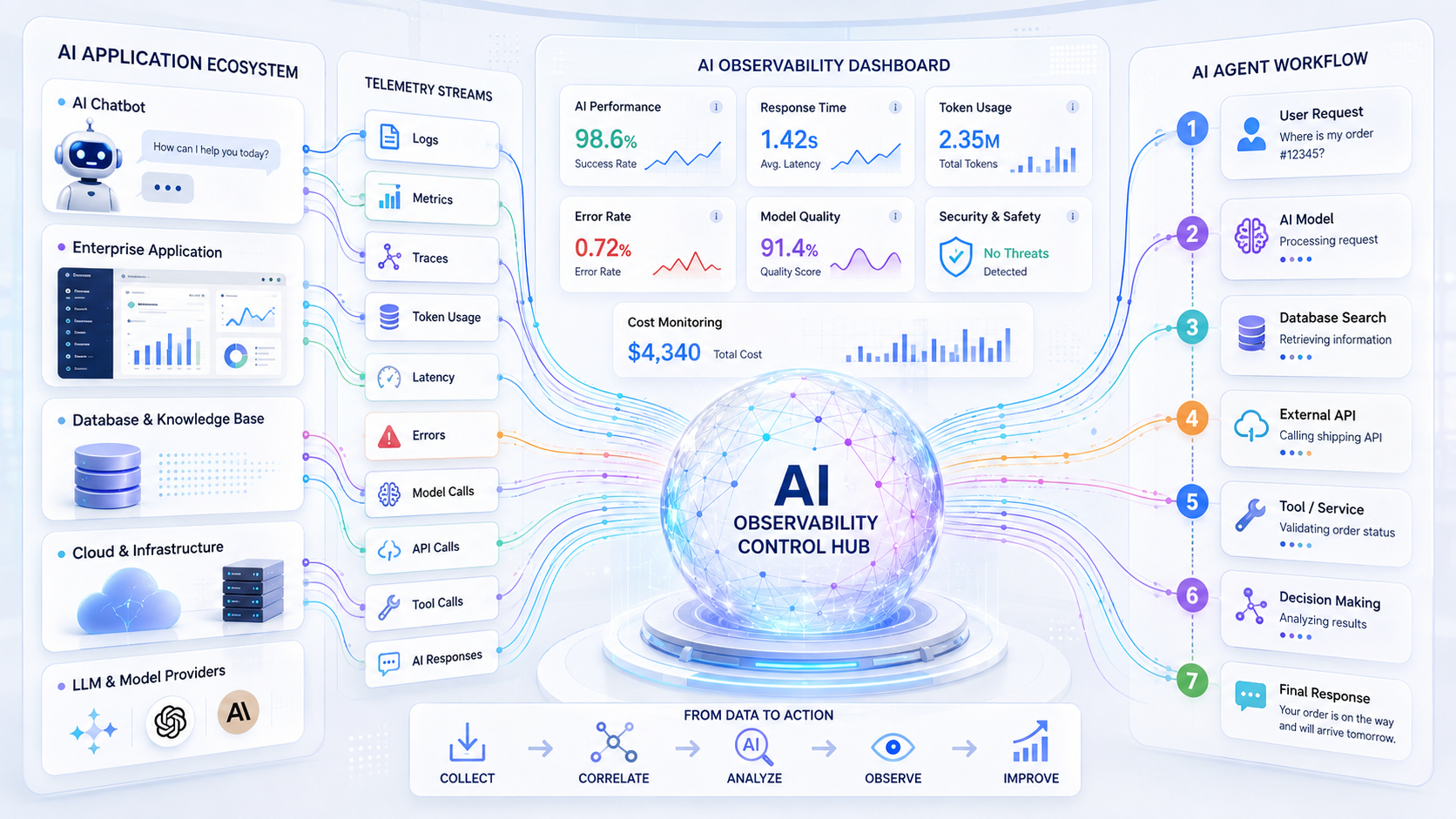
It can show which AI model was used, how long the response took, how many tokens were consumed, whether a database was accessed, whether a tool failed and what happened during the complete request.
In simple words, AI observability gives developers a window into the behavior of an AI system.
Why Do AI Applications Need Observability?
Traditional software usually follows predictable instructions.
For example:
User clicks button → Server receives request → Database returns data → Application shows result.
AI applications can be more complicated.
An AI system may:
User question → AI model → Search database → Call API → Process information → Generate answer
If the final answer is incorrect or slow, developers need to know which step caused the problem.
Without observability, finding the problem can be difficult.
With AI observability, developers can follow the complete journey of a request.
AI Observability vs Traditional Monitoring
Traditional application monitoring focuses on things such as servers, APIs, databases, errors and response times.
AI observability includes these things but adds information specifically related to artificial intelligence.
For example:
| Traditional Monitoring | AI Observability |
|---|---|
| Server performance | AI model performance |
| API response time | Model response time |
| Application errors | AI generation errors |
| Database queries | AI retrieval activity |
| Request count | Token usage |
| Server logs | AI prompts and responses |
| Service traces | Agent and tool traces |
| Infrastructure cost | AI model cost |
This makes AI observability especially useful for applications powered by large language models and AI agents.
What Does AI Observability Monitor?
AI observability can monitor many parts of an AI application.
The exact information depends on the system, but common areas include model performance, token usage, latency, errors, tool calls, traces and response quality.
Let’s look at the most important ones.
1. AI Model Performance
Companies can monitor how their AI models perform in real-world applications.
For example, developers can track:
- Response speed
- Error rates
- Model availability
- Token usage
- Response quality
- Number of requests
This information can help companies decide whether they are using the right AI model for a particular task.
For example, a company might discover that a smaller model is fast enough for simple customer questions while a larger model is needed for more complex requests.
2. Token Usage
Tokens are the pieces of text that AI models process.
AI services often calculate usage based partly on the number of tokens processed.
For this reason, token monitoring is important for controlling AI costs.
AI observability can show:
- Input tokens
- Output tokens
- Total tokens
- Token usage per request
- Token usage by model
- Token usage by application
If a company notices that one AI workflow is using far more tokens than expected, developers can investigate and optimize it.
3. Response Time
Users expect AI applications to respond quickly.
Sometimes an AI response may take several seconds because multiple operations are happening in the background.
For example:
User → AI model → Database → External API → AI model → Final response
AI observability can show how long each step takes.
If the complete request takes 10 seconds, developers can identify whether the problem is the AI model, database, API or another part of the workflow.
4. AI Errors
AI systems can fail in different ways.
For example:
- AI model timeout
- API failure
- Database error
- Tool failure
- Invalid response
- Rate-limit error
- Network problem
AI observability helps developers find these errors and understand when they happened.
This is particularly important for AI agents because agents may depend on several external tools.
If one tool fails, it can affect the entire task.
5. Prompts and AI Responses
Developers can sometimes monitor the prompts sent to an AI model and the responses generated by it.
This can help answer questions such as:
- Why did the AI give a poor answer?
- Which prompts are causing problems?
- Is the AI producing irrelevant information?
- Are users asking questions the system cannot handle?
- Is the application producing unexpected responses?
However, companies must be careful when storing prompts and responses because they may contain personal, confidential or sensitive information.
6. AI Tool Calls
Modern AI agents can use external tools to complete tasks.
For example, imagine an AI shopping assistant.
A user asks:
“Where is my order?”
The AI agent might:
- Understand the question.
- Access the customer database.
- Find the order number.
- Call a shipping API.
- Check the delivery status.
- Give the user an answer.
AI observability can track these steps.
If the answer is wrong, developers can see where the process failed.
What Is AI Agent Observability?
AI agent observability is focused specifically on AI agents that can perform tasks automatically.
A simple chatbot may only receive a question and generate an answer.
An AI agent can do much more.
It may:
- Make decisions
- Use tools
- Call APIs
- Search databases
- Perform multiple steps
- Complete actions automatically
For example:
User → AI Agent → LLM → Database → API → Tool → LLM → Final Action
This creates a much more complicated system.
AI agent observability helps developers understand what the agent did during each step.
How Does AI Observability Work?
The basic process is easy to understand.
Step 1: AI Application Generates Data
While an AI application is running, it produces information about what it is doing.
This can include:
- Logs
- Metrics
- Traces
- Model calls
- Token usage
- Tool calls
- Errors
- Response information
Step 2: The Data Is Collected
This information is collected by an observability system.
Tools and frameworks can organize the information so developers can analyze it.
OpenTelemetry is also working on common standards for collecting telemetry from generative AI applications and agents.
Step 3: Developers Analyze the Data
Developers can then investigate problems.
For example:
Why is this AI response slow?
The monitoring data might show:
- AI model: 4 seconds
- Database search: 1 second
- API request: 3 seconds
- Other processing: 1 second
Now the developer knows where to focus.
Step 4: The Application Is Improved
After finding the problem, developers can improve the AI system.
They might:
- Change the AI model
- Improve the prompt
- Reduce unnecessary API calls
- Optimize database queries
- Reduce token usage
- Fix failed tools
- Improve the AI workflow
This creates a continuous improvement cycle.
What Is an AI Observability Dashboard?
An AI observability dashboard is a visual screen that shows the health and performance of an AI application.
For example, a dashboard might show:
AI Requests: 100,000
Average Response Time: 2.5 seconds
Error Rate: 1.5%
Average Tokens: 1,100
AI Cost: $500
Tool Failures: 120
Quality Score: 91%
Instead of checking thousands of technical logs manually, developers can use the dashboard to quickly identify important problems.
How AI Observability Helps Reduce Costs
AI can become expensive when applications make too many model requests or use unnecessarily large prompts.
Imagine an AI agent that uses five expensive model calls to complete a task that could be completed with two calls.
Without observability, the company may not notice the problem.
With observability, developers can see exactly how many model calls and tokens are being used.
They can then reduce costs by:
- Using smaller models for simple tasks
- Reducing unnecessary prompts
- Caching repeated information
- Limiting unnecessary tool calls
- Improving database retrieval
- Selecting the right model for each task
This makes AI observability useful for both developers and business teams.
How AI Observability Improves AI Quality
A successful AI application is not just one that stays online.
It also needs to produce useful answers.
For example, an AI chatbot could have excellent uptime but still provide incorrect answers to customers.
AI observability can help teams monitor areas such as:
- Response quality
- Accuracy
- Relevance
- User feedback
- Hallucinations
- Safety
- Model behavior
This allows companies to continuously improve their AI applications.
AI Observability and Security
AI applications can sometimes access important company systems.
An AI agent might have access to:
- Customer databases
- Internal documents
- APIs
- Business applications
- Cloud services
- Payment or order systems
This creates security risks.
Observability can help companies identify unusual activity and investigate what an AI system did.
For example, if an AI agent suddenly makes hundreds of unexpected API calls, monitoring systems can help developers detect the problem.
However, observability should be combined with proper authentication, authorization and security controls.
How Companies Use AI Observability
AI observability can be useful across many industries.
Banking
Banks can monitor AI systems used for customer support, fraud detection and financial analysis.
Healthcare
Healthcare organizations can monitor AI applications used for documentation, research and workflow automation.
E-Commerce
Online stores can monitor recommendation systems, AI shopping assistants and customer-support agents.
Software Development
Technology companies can monitor AI coding tools, AI-powered applications and automated development workflows.
Customer Service
Companies can monitor AI agents that answer questions and perform customer-support tasks.
The goal is the same in each case: understand what the AI is doing and make sure it works as expected.
What Is OpenTelemetry?
OpenTelemetry is an open-source project for collecting software observability data.
It supports common types of telemetry such as:
- Logs
- Metrics
- Traces
The project is also developing standards for generative AI and AI agents.
This is important because AI applications can use many different models, frameworks and services.
Standardized telemetry can make it easier for companies to collect and understand AI-related monitoring data.
Challenges of AI Observability
AI observability is useful, but it also comes with challenges.
Large Amounts of Data
AI systems can generate a lot of logs, traces and monitoring information.
Privacy
Prompts and AI responses can contain personal or confidential information.
Companies need to protect this data properly.
Cost
Collecting and storing large amounts of monitoring data can increase infrastructure costs.
Complex AI Agents
AI agents can perform many actions, making their behavior harder to understand than a simple chatbot.
Measuring AI Quality
It is easy to measure response time.
It is much harder to determine whether an AI answer is actually correct and useful.
What Is the Future of AI Observability?
AI observability is likely to become an important part of production AI development.
As companies move from simple AI chatbots toward more advanced AI agents, monitoring these systems will become increasingly important.
Future AI observability systems could include:
- Real-time AI monitoring
- Automatic quality evaluation
- AI-powered error detection
- Automated cost optimization
- Agent behavior monitoring
- AI security monitoring
- Automated incident response
- Self-healing AI applications
The goal is moving beyond a simple question:
“Is my AI application running?”
The next question is:
“Is my AI application behaving correctly, safely, efficiently and reliably?”
Final Thoughts
AI observability helps companies understand what is happening inside their AI applications.
It can monitor model performance, token usage, response times, errors, tool calls, AI agents and other important information.
For developers, this makes AI applications easier to debug and improve.
For businesses, it can help control costs, improve reliability and understand whether AI systems are delivering useful results.
As AI becomes a bigger part of modern software, AI observability will become increasingly important for building reliable and production-ready AI applications.
In simple terms:
AI development builds the system.
AI observability helps you understand the system.
And as AI agents become more autonomous, that visibility will become even more important.
