Introduction: A New Era of Precise Measurement
Sensors are everywhere around us. Smartphones use sensors to detect movement, cars use them to monitor speed and distance, and medical devices use them to measure important signals from the human body.
But what if we need to measure something extremely small or difficult to detect?
This is where quantum sensors come into the picture. Quantum sensors use the unusual properties of quantum physics to make highly sensitive measurements. They could help engineers and scientists detect tiny changes in gravity, magnetic fields, acceleration, time, and other physical properties.
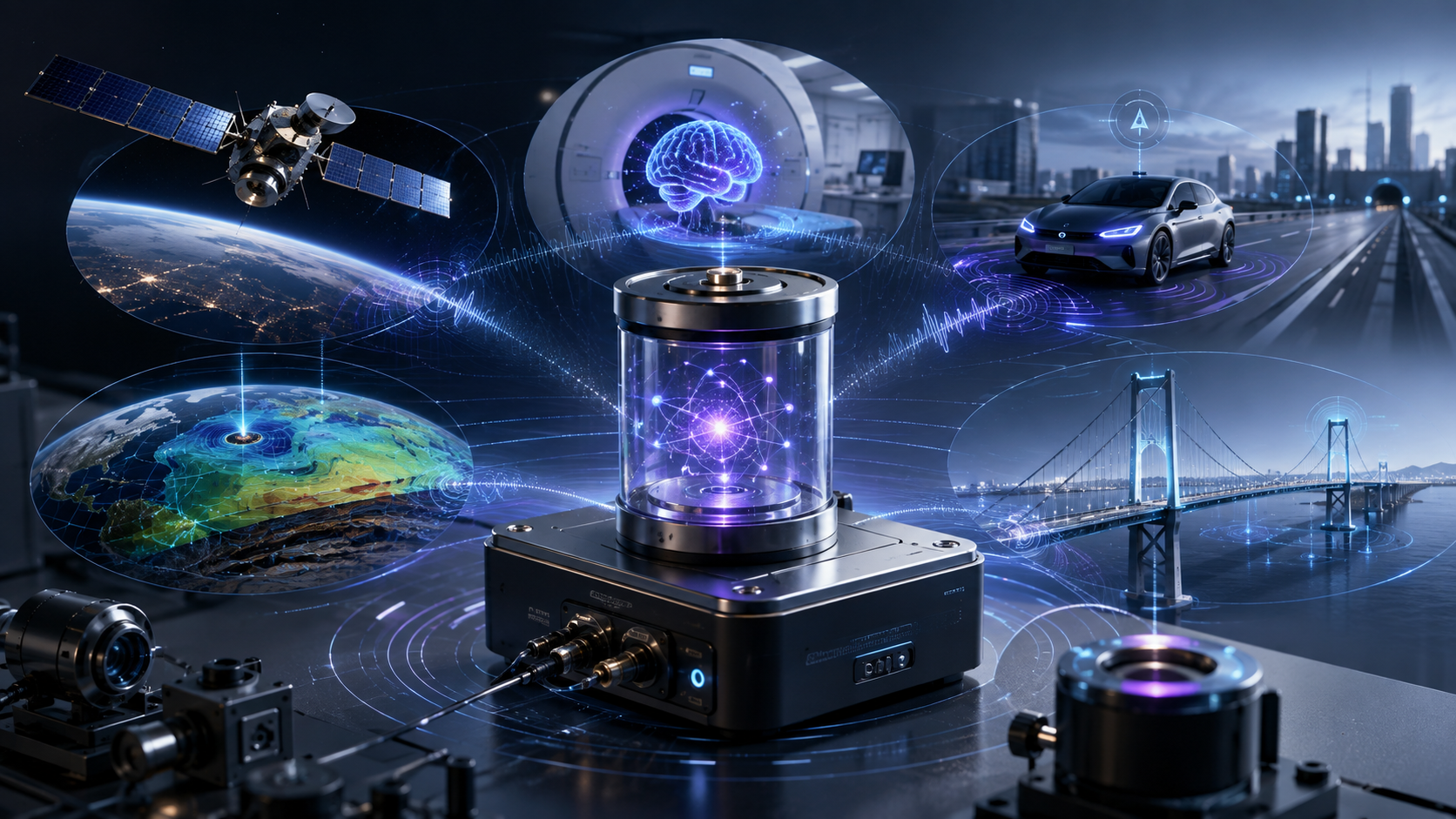
From healthcare and navigation to space exploration and environmental monitoring, quantum sensors could become an important technology for the future.
What Are Quantum Sensors?
A quantum sensor is a device that uses the behavior of atoms, electrons, photons, or other quantum systems to make extremely precise measurements.
Traditional sensors already provide accurate measurements, but quantum sensors can potentially detect much smaller changes.
For example, imagine trying to find a very small vibration in a huge building. A normal sensor may detect large movements, while a highly sensitive quantum sensor could potentially detect much smaller changes.
In simple terms, quantum sensors are designed to measure things that are difficult to measure with conventional technology.
How Do Quantum Sensors Work?
Quantum physics describes how extremely small particles behave. At this scale, particles can behave in ways that are very different from everyday objects.
Quantum sensors take advantage of these special properties.
A quantum sensor generally prepares a quantum system, exposes it to something that needs to be measured, and then observes how the quantum system changes.
For example, a change in a magnetic field could cause a measurable change in a quantum system. By analyzing that change, the sensor can estimate the strength of the magnetic field.
The basic process can be simplified as:
Quantum system → Physical signal → Quantum response → Measurement → Useful information
This allows researchers to detect extremely small changes with high precision.
What Can Quantum Sensors Measure?
Quantum sensors can be designed to measure many different physical properties.
Some can detect extremely weak magnetic fields, while others can measure gravity, acceleration, rotation, or time.
This makes quantum sensing useful for many different industries.
The most important types include quantum magnetic sensors, quantum gravimeters, quantum accelerometers, quantum gyroscopes, and highly accurate quantum clocks.
Quantum Magnetic Sensors
Magnetic fields exist everywhere, but some are extremely weak.
Quantum magnetic sensors can detect very small changes in magnetic fields. This could make them useful for scientific research, medical applications, geological exploration, and navigation.
For example, the human brain produces tiny magnetic signals when neurons communicate. Highly sensitive magnetic sensors could help researchers study these signals and better understand brain activity.
Quantum Gravimeters
Gravity is not exactly the same everywhere on Earth. Small differences can occur because of variations in underground structures and the distribution of materials beneath the surface.
Quantum gravimeters are designed to measure tiny changes in gravitational acceleration.
This could help scientists and engineers investigate underground structures, geological formations, groundwater, and other hidden features.
In the future, this technology could become useful for geological surveys and infrastructure monitoring.
Quantum Accelerometers
An accelerometer measures changes in movement or acceleration.
Quantum accelerometers aim to provide extremely accurate measurements of acceleration.
This could be useful for aircraft, ships, spacecraft, autonomous vehicles, and other systems that need accurate navigation.
One important possibility is navigation without continuously depending on GPS signals.
Quantum Clocks
Time measurement is extremely important for modern technology.
Navigation systems, communication networks, scientific experiments, and financial systems all depend on accurate timing.
Quantum clocks use highly stable atomic or quantum properties to measure time with extraordinary precision.
Better clocks could improve technologies that depend on synchronization and precise timing.
Quantum Sensors vs Traditional Sensors
Quantum sensors are not designed to replace every conventional sensor.
Traditional sensors are already inexpensive, reliable, compact, and widely available. They work extremely well for many everyday applications.
Quantum sensors are different because their biggest advantage is their potential for extremely high sensitivity and precision.
For specialized applications where tiny changes matter, the additional complexity of quantum sensing could be worthwhile.
Quantum Sensors in Healthcare
Healthcare could become one of the most interesting application areas for quantum sensors.
The human body produces very weak electrical and magnetic signals. Detecting these signals can provide useful information about biological activity.
Highly sensitive quantum magnetic sensors could help researchers study brain and heart activity.
They could potentially support advanced medical imaging and research into neurological and cardiovascular conditions.
However, many healthcare applications are still under research, so quantum sensors should be viewed as an emerging technology rather than a replacement for today’s medical equipment.
Quantum Sensors for GPS-Free Navigation
Modern navigation depends heavily on satellites such as GPS. But satellite signals can become unavailable or unreliable inside buildings, underwater, underground, or in areas where signals are blocked or disrupted.
Quantum sensors could help solve part of this problem.
Highly precise quantum accelerometers and gyroscopes could measure how a vehicle moves and rotates. Combined with accurate timing and other information, these measurements could help calculate the vehicle’s position without constantly receiving satellite signals.
This could be valuable for aircraft, ships, submarines, spacecraft, and autonomous systems.
Quantum Sensors in Environmental Monitoring
The environment is constantly changing, and some of those changes are difficult to detect.
Quantum sensors could help monitor small variations in gravity, magnetic fields, and other physical properties.
For example, gravity measurements could potentially help researchers monitor underground water movement or geological changes.
This could provide new tools for environmental research and resource management.
Finding Hidden Structures Underground
One exciting possibility is using quantum sensors to look beneath the Earth’s surface without extensive drilling.
Small variations in gravity or magnetic fields can provide clues about what is underground.
Quantum gravimeters could potentially help identify underground tunnels, geological formations, groundwater, or other hidden structures.
This could make them valuable tools for geology, construction, environmental studies, and infrastructure planning.
Quantum Sensors in Infrastructure
Buildings, bridges, tunnels, railways, and dams need regular monitoring to remain safe.
Very small changes in a structure can sometimes become serious problems if they are not detected early.
Highly sensitive sensors could potentially help engineers identify tiny changes in movement, vibration, or other physical properties.
This could support a future where infrastructure is monitored continuously instead of relying only on occasional inspections.
Quantum Sensors in Space
Space exploration requires extremely accurate measurements.
Spacecraft need to understand their movement, position, acceleration, and surrounding environment.
Quantum sensors could provide highly precise measurements for navigation and scientific experiments.
They could also help scientists study the gravity of planets and moons and investigate other physical phenomena in space.
As space missions become longer and more complex, highly accurate sensing could become increasingly important.
Advantages of Quantum Sensors
Quantum sensors offer several potential benefits.
Extremely high sensitivity: They can potentially detect very small physical changes.
High precision: Quantum systems can provide exceptionally accurate measurements.
New measurement capabilities: They may allow scientists to measure things that are difficult to detect using traditional sensors.
GPS-independent navigation: Some quantum sensing technologies could support navigation without continuous satellite signals.
Scientific discovery: Better measurements can help researchers study previously difficult-to-observe phenomena.
Wide range of applications: Quantum sensing could be useful in healthcare, engineering, environmental science, navigation, and space exploration.
Challenges of Quantum Sensors
Despite their potential, quantum sensors are not perfect.
One major challenge is complexity. Quantum systems can be difficult to control and maintain.
Environmental conditions can also affect measurements. Temperature changes, vibration, electromagnetic interference, and other disturbances can reduce performance.
Another challenge is cost. Some quantum sensing systems currently require specialized equipment and highly trained experts.
Engineers are working to make these systems smaller, more stable, easier to operate, and more affordable.
Are Quantum Sensors Ready for Everyday Use?
Quantum sensing is already moving beyond pure laboratory research, but the technology is still developing.
Some quantum sensors have practical applications today, while others are still being tested and improved.
The next major step is miniaturization.
Researchers want to transform large and complex laboratory systems into compact devices that can operate reliably outside controlled environments.
If this happens, quantum sensors could eventually become part of vehicles, medical devices, industrial equipment, satellites, and other technologies.
What Is the Future of Quantum Sensing?
The future of quantum sensing could be very different from traditional measurement technology.
As quantum systems become smaller and easier to control, sensors could become more sensitive while also becoming easier to deploy.
Future quantum sensors could help autonomous vehicles navigate without GPS, allow doctors and researchers to detect extremely weak biological signals, help engineers monitor infrastructure, and give scientists new ways to study Earth and space.
The technology may not replace conventional sensors. Instead, both technologies could work together, with traditional sensors handling everyday measurements and quantum sensors being used where extreme precision is required.
Final Thoughts
Quantum sensors are an exciting example of how quantum physics is moving from research laboratories into practical engineering.
Their ability to detect extremely small changes could open new possibilities in healthcare, navigation, environmental monitoring, infrastructure, geology, scientific research, and space exploration.
However, challenges such as cost, complexity, size, environmental sensitivity, and reliability still need to be solved.
The future of quantum sensing will depend on how successfully engineers can turn powerful laboratory technology into affordable, compact, and reliable real-world devices.
If that happens, quantum sensors could fundamentally change how we measure the world around us.
