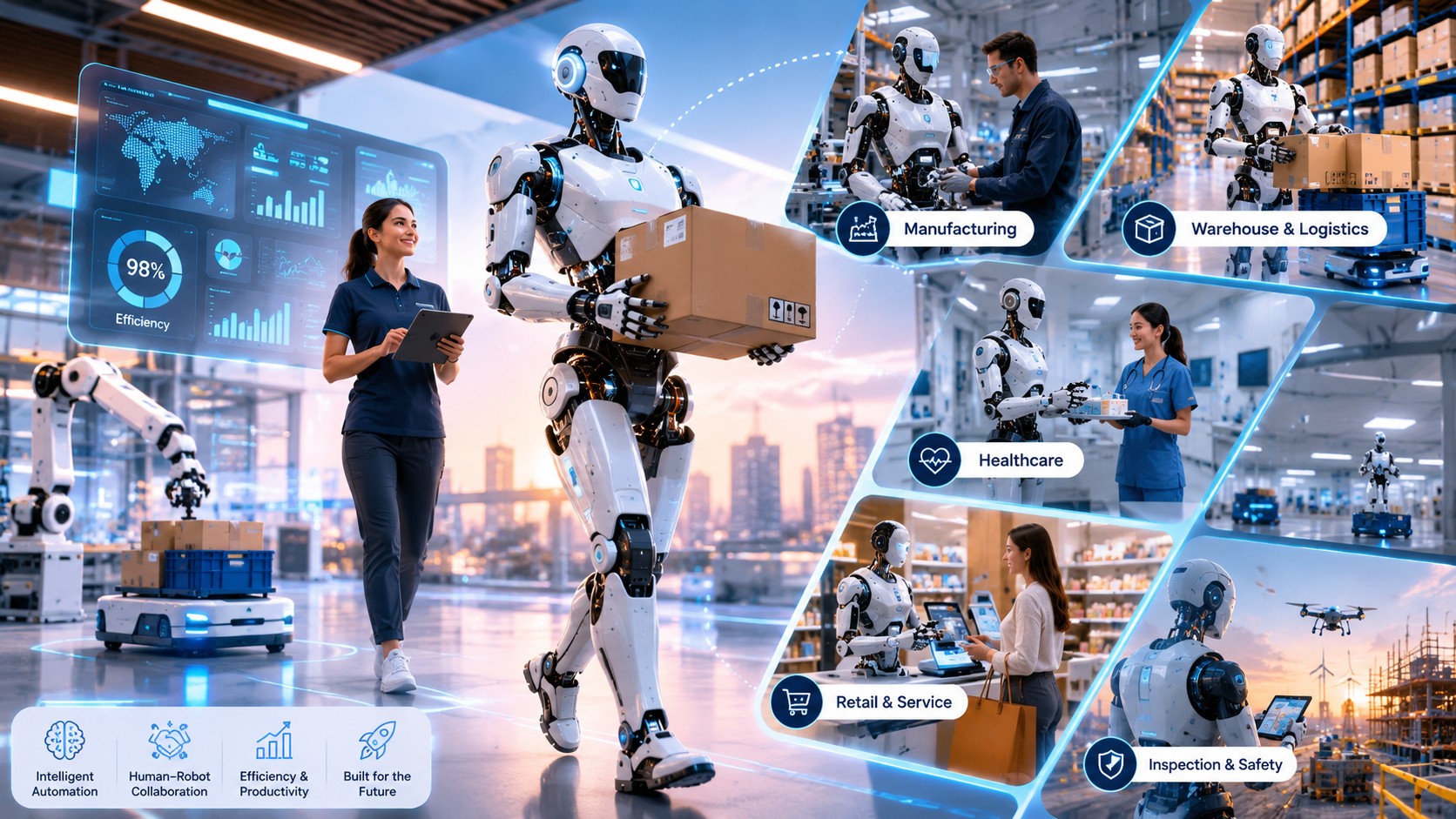
Humanoid robots have quickly become one of the most exciting areas of robotics and artificial intelligence. Videos of robots walking, carrying objects, performing factory tasks, and interacting with people often go viral on social media. But beyond these impressive demonstrations, an important question remains: Are humanoid robots actually becoming useful in the real world?
The answer is increasingly yes. Companies and researchers are testing humanoid robots in factories, warehouses, logistics centers, research facilities, and other workplaces. As artificial intelligence becomes more capable, these robots are learning to understand their surroundings, recognize objects, follow instructions, and perform physical tasks.
What Are Humanoid Robots?
Humanoid robots are machines designed to have a body shape similar to humans. They typically have a head or sensor system, two arms, two hands, and two legs. Some models are also designed with human-like movements and the ability to interact with objects made for people.
The main idea behind this design is simple: our world is already built for humans. Buildings, stairs, doors, shelves, tools, workstations, and vehicles are generally designed around the human body. A robot with a human-like shape could potentially work in these environments without requiring companies to completely redesign them.
Why Are Humanoid Robots Suddenly So Popular?
Humanoid robots are not a completely new idea, but recent advances in AI have made them much more capable. Modern robots can combine cameras, sensors, computer vision, machine learning, and AI models to understand what is happening around them.
Another reason for their popularity is social media. Videos showing robots walking naturally, lifting objects, performing factory tasks, or responding to instructions can quickly attract millions of views. These demonstrations have helped make robotics more understandable and interesting to the general public.
However, viral videos only show one part of the story. The more important development is that humanoid robots are gradually moving from demonstrations and laboratories into real-world testing.
How AI Is Making Humanoid Robots Smarter
Traditional robots are usually programmed to perform specific tasks in controlled environments. For example, an industrial robotic arm may repeatedly pick up a component and place it in exactly the same location.
AI is changing this approach. Modern humanoid robots can use cameras and sensors to understand their environment and identify objects. AI can then help the robot decide how to respond to different situations.
For example, instead of programming every possible movement, a robot could receive an instruction such as “pick up the box and place it on the table.” The robot can use its vision system to find the box, plan its movement, pick it up, and move it to the requested location.
This combination of robotics and AI is helping create more flexible machines that can handle tasks that were previously difficult to automate.
Humanoid Robots in Manufacturing
Manufacturing is one of the most promising areas for humanoid robots. Factories contain many repetitive physical tasks that can potentially be automated.
Humanoid robots could be used for activities such as moving components, handling materials, performing basic assembly tasks, transporting parts, and supporting workers with repetitive jobs.
One advantage is flexibility. A traditional robot may require a dedicated setup for a particular task. A humanoid robot could potentially move between different workstations and perform several types of tasks with software changes rather than major physical modifications.
Humanoid Robots in Warehouses
Warehouses are another important application. Workers often spend long hours moving boxes, sorting products, collecting items, and transporting materials.
Humanoid robots could assist with these repetitive activities. They can potentially move around warehouse environments, pick up objects, place items on shelves, and transport materials from one location to another.
The biggest opportunity is not necessarily replacing every warehouse worker. Instead, humanoid robots could take over repetitive or physically demanding activities while human employees focus on tasks requiring judgment, communication, supervision, and problem-solving.
Humanoid Robots in Logistics
Logistics involves moving products from one location to another, which creates many opportunities for automation.
Humanoid robots could eventually help with loading and unloading goods, moving packages, sorting materials, and performing other physical tasks.
Their human-like design could be particularly useful in environments where existing equipment and workspaces are already designed for people.
Humanoid Robots in Healthcare
Healthcare is another area where humanoid robots could become useful, although widespread adoption will require strict safety testing and reliable operation.
Potential applications include transporting supplies, delivering medicines or equipment, assisting with routine physical tasks, and supporting healthcare workers with non-clinical activities.
Humanoid robots are unlikely to replace doctors or nurses. Instead, their role could be to reduce repetitive physical workloads and give healthcare professionals more time to focus on patients.
Humanoid Robots for Dangerous Jobs
Some jobs are physically dangerous for humans. Workers may need to enter areas with extreme temperatures, hazardous materials, unstable structures, or other risks.
Humanoid robots could potentially perform certain tasks in these environments while keeping people farther away from danger.
This could make robotics particularly valuable in industries such as manufacturing, construction, mining, inspection, and disaster response.
Why Businesses Are Interested in Humanoid Robots
Businesses are interested in humanoid robots for several reasons. Labor shortages, rising operational costs, repetitive work, and the need for greater productivity are encouraging companies to explore new forms of automation.
Another advantage is flexibility. Businesses do not always want a machine that can perform only one task. They are increasingly interested in robots that can potentially perform multiple tasks and adapt to changing requirements.
If humanoid robots become reliable and affordable enough, they could become another tool for companies looking to automate physical work.
Humanoid Robots Are Not Ready to Do Everything
Despite the excitement, humanoid robots still have significant limitations. A robot walking across a stage or completing a carefully prepared demonstration does not necessarily mean it can operate independently for an entire work shift.
Real-world environments are unpredictable. Objects can move, floors can be uneven, people can suddenly enter the robot’s path, and unexpected situations can occur.
Robots also need to manage battery life, movement, safety, maintenance, and reliable decision-making. These challenges must be solved before humanoid robots can become common in everyday workplaces.
The Cost Challenge
Building and operating advanced humanoid robots can be expensive. Companies must consider not only the cost of purchasing a robot but also software, maintenance, training, charging infrastructure, safety systems, and integration with existing operations.
For businesses, the most important question is not simply “Can a robot perform this task?”
The more important question is:
“Can the robot perform the task reliably and economically?”
The future of humanoid robotics will depend heavily on whether companies can achieve a strong return on investment.
Humanoid Robots vs Traditional Robots
Humanoid robots and traditional industrial robots have different strengths.
Traditional industrial robots are already highly effective for repetitive tasks in controlled environments. They can work quickly, accurately, and continuously on dedicated production lines.
Humanoid robots are being developed with a different goal: flexibility.
A humanoid robot could potentially move around a workplace, interact with different objects, and perform multiple tasks. However, this flexibility comes with additional technical challenges.
For highly repetitive production tasks, traditional robots may remain the better option. For flexible environments with changing physical tasks, humanoid robots could become increasingly attractive.
Will Humanoid Robots Replace Human Workers?
This is one of the biggest questions surrounding the technology.
Humanoid robots could replace some repetitive and physically demanding tasks, but that does not automatically mean they will replace humans completely.
In many workplaces, robots and humans are more likely to work together. Robots can handle repetitive physical work while people focus on decision-making, creativity, communication, supervision, and tasks that require human judgment.
The impact on employment will depend on how quickly the technology develops and how businesses choose to use it.
From Viral Videos to Real-World Robots
The humanoid robotics industry is now moving into an important stage. The focus is gradually shifting from impressive demonstrations to practical questions about productivity, safety, reliability, cost, and real-world performance.
A robot that can walk or perform a short demonstration is interesting. A robot that can safely complete useful work for several hours, consistently and economically, is much more valuable.
This transition from viral demo to useful workplace machine will determine how quickly humanoid robots become commercially important.
What Is the Future of Humanoid Robots?
The future of humanoid robots will likely be driven by improvements in artificial intelligence, batteries, sensors, robotic hands, motors, computer vision, and motion control.
As these technologies improve, robots could become better at understanding instructions, learning new tasks, navigating unfamiliar environments, and working safely around humans.
We may first see humanoid robots performing a limited number of specific workplace tasks. Over time, their capabilities could expand to more complex activities.
The goal is not simply to build robots that look like humans. The real goal is to create machines that can work effectively in environments designed for humans.
Final Thoughts
Humanoid robots have moved far beyond science-fiction concepts. Viral videos have introduced the technology to millions of people, but real-world applications are now becoming the more important story.
Manufacturing, warehouses, logistics, healthcare, inspection, and dangerous workplaces could all benefit from humanoid robotics. However, major challenges involving cost, safety, reliability, battery life, and AI capabilities still need to be solved.
The next stage of humanoid robotics will not be decided by how impressive a robot looks in a demonstration. It will be decided by how useful, reliable, safe, and affordable these machines become in the real world.
For businesses and technology enthusiasts, humanoid robots are therefore worth watching closely. The transition from viral demonstrations to practical applications could become one of the most important developments in automation and robotics.
