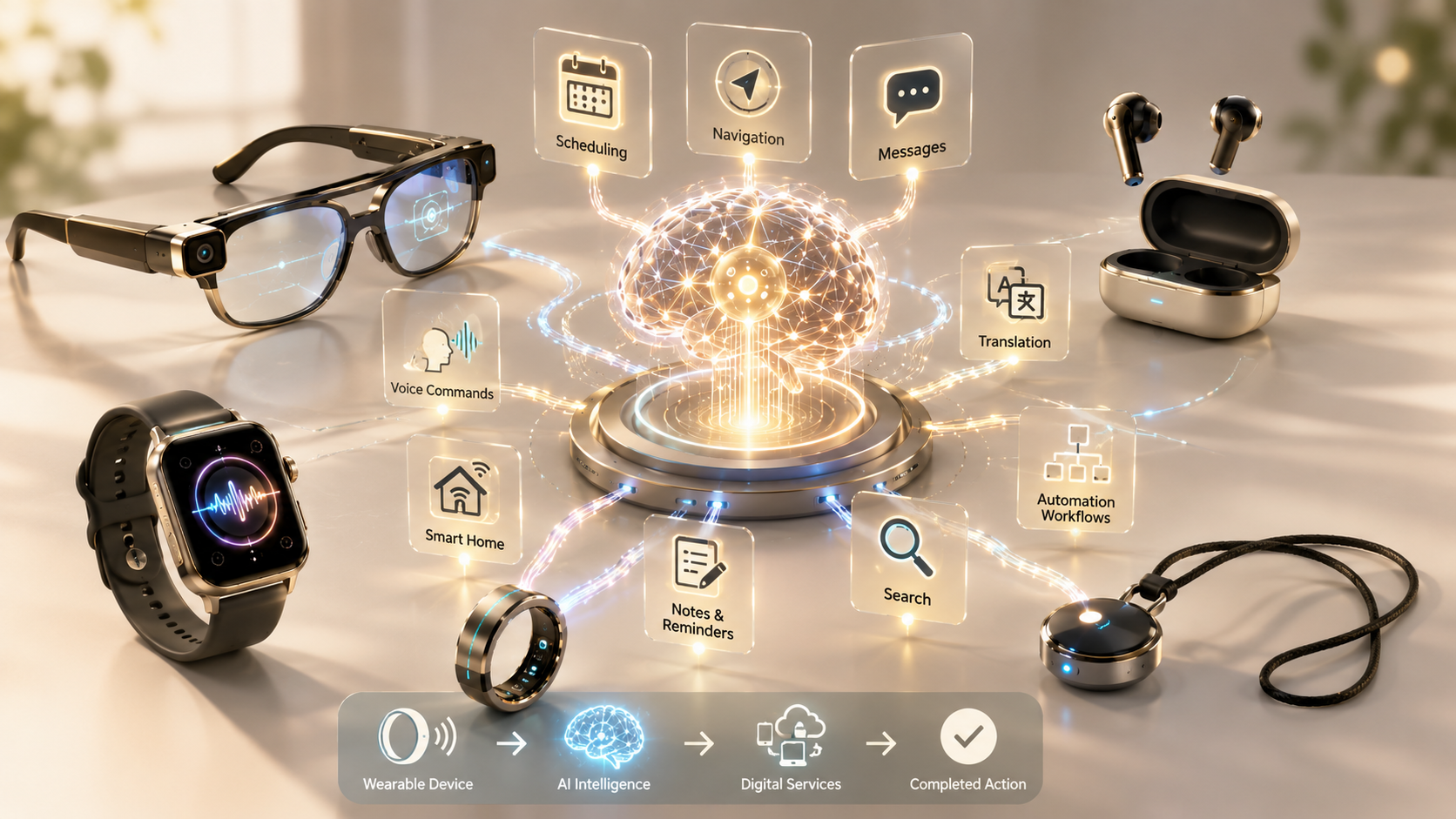
Introduction: Wearables Are Becoming Smarter
Wearable gadgets are no longer limited to counting steps or showing notifications. Smart glasses, smart rings, smartwatches, earbuds, and other small devices are becoming smarter with artificial intelligence.
A new technology called wearable AI agents could take this idea even further. Instead of only giving information, these devices could connect with AI agents that can understand what you want and help complete tasks for you.
For example, you could tell your smart glasses, “Remind me about this when I get home,” or ask your earbuds, “Add tomorrow’s meeting to my calendar.”
The AI could understand the request and perform the action automatically.
1. What Are Wearable AI Agents?
Wearable AI agents are AI-powered assistants that work through devices you wear.
These devices may include:
- Smart glasses
- Smartwatches
- Smart rings
- AI earbuds
- AI pins
- Smart pendants
- Other connected wearables
The wearable does not always need to run the entire AI system itself. It can collect your command and send it to an AI system running on your smartphone, another device, or in the cloud.
Think of the wearable as an easy way to communicate with your personal AI agent.
2. What Is an AI Agent?
An AI agent is different from a basic AI chatbot.
A chatbot usually answers questions.
For example:
You: “What’s on my calendar today?”
AI: “You have three meetings.”
An AI agent can potentially take action.
For example:
You: “Move my afternoon meeting to tomorrow and remind me one hour before it starts.”
The AI agent could understand the request, access your calendar, make the change, and create the reminder if you have given it permission.
In simple words:
AI Assistant → Gives information
AI Agent → Helps complete tasks
3. How Do Wearable AI Agents Work?
Wearable AI agents combine hardware, sensors, AI models, and connected applications.
The wearable may use:
- Microphones
- Cameras
- Touch controls
- Motion sensors
- GPS
- Health sensors
- Bluetooth
- Internet connectivity
When you give the wearable a command, the AI tries to understand what you want.
A simple process could look like:
You → Wearable Device → AI Agent → App or Service → Action
For example:
“Create a reminder for 7 PM.”
↓
Your smartwatch hears the command.
↓
The AI understands it.
↓
The AI connects to your reminder app.
↓
The reminder is created.
This can make everyday digital tasks faster and more natural.
4. Why Are Wearable AI Agents Trending?
AI is becoming more useful at understanding voice, images, surroundings, and user requests.
At the same time, wearable devices are becoming smaller, lighter, and more powerful.
Combining these technologies creates a new type of personal computing.
Instead of taking out your smartphone every few minutes, you may be able to use:
Voice + Gestures + Wearables + AI
to complete common tasks.
This hands-free experience is one of the biggest reasons wearable AI is attracting attention.
5. Smart Glasses and AI Agents
Smart glasses could become one of the most useful devices for wearable AI.
Unlike a smartphone sitting in your pocket, glasses can potentially understand what you are looking at.
Imagine walking through a city and seeing a restaurant.
You could ask:
“What restaurant is this?”
The AI could identify it and provide useful information.
You might then say:
“Find out if they have a table available tonight.”
This moves the experience from simply recognizing something to helping you take action.
6. Smart Rings as Simple AI Controllers
Smart rings are another interesting option.
Because rings are small, they usually cannot provide large displays or complicated interfaces.
But that could actually make them useful as simple AI controllers.
For example:
Single tap → Activate AI
Double tap → Start voice recording
Gesture → Control music
Long press → Trigger an AI workflow
Instead of trying to put everything on the ring itself, the ring could act as a quick controller for an AI system running on another device.
7. AI Earbuds as Personal Assistants
Earbuds already have two important features needed for AI interaction:
Microphones and speakers.
This makes them a natural interface for voice-based AI agents.
Imagine visiting another city and saying:
“Find a highly rated coffee shop nearby and guide me there.”
The AI could understand your request, find a suitable location, and provide directions through your earbuds.
AI earbuds could also help with:
- Translation
- Navigation
- Messages
- Reminders
- Calls
- Search
- Voice notes
- Everyday questions
This could make AI available without constantly looking at a screen.
8. Smartwatches Could Become AI Assistants
Smartwatches are already popular wearable devices.
They provide notifications, health tracking, calls, apps, navigation, and other useful features.
Adding AI agents could make them much more capable.
Instead of manually opening different apps, you could simply say:
“Summarize my schedule for today.”
or:
“Remind me to send the project report after my meeting.”
The AI could understand your request and interact with connected applications.
This could turn smartwatches from notification devices into more useful personal assistants.
9. Wearable AI Can Understand Context
One of the most powerful features of wearable AI is context awareness.
Context means understanding what is happening around you.
For example, an AI wearable could potentially understand:
- Where you are
- What you are looking at
- What you are doing
- What time it is
- What you are saying
- What device you are using
Imagine looking at a poster for an event.
You could tell your glasses:
“Add this event to my calendar.”
The AI could read the event information and create the calendar entry.
This is much faster than manually typing everything into your phone.
10. What Can Wearable AI Agents Do?
Wearable AI agents could help with many everyday tasks.
Productivity
AI wearables could create reminders, organize tasks, summarize meetings, manage calendars, and take notes.
Navigation
Smart glasses or earbuds could provide hands-free directions.
Translation
AI could translate conversations, signs, or other information into a language you understand.
Communication
Wearables could help users read, summarize, and reply to messages.
Shopping
AI could help identify products, compare information, or create shopping lists.
Smart Home
Wearables could potentially control lights, thermostats, TVs, speakers, and other connected devices.
Information
You could ask questions about objects, places, documents, or situations around you.
11. Wearable AI Agents vs AI Assistants
Traditional AI assistants usually work like this:
Ask → Receive an Answer
Wearable AI agents could work more like:
Give a Goal → AI Performs Actions → Receive a Result
For example, instead of asking:
“What meetings do I have tomorrow?”
you might say:
“Prepare me for tomorrow’s meetings.”
An advanced AI agent could potentially review your schedule, organize relevant information, and create a short summary.
The important idea is that AI moves from simply answering questions toward helping complete tasks.
12. Can Gadgets Really Control AI?
Yes, but the wearable itself does not necessarily need to contain a powerful AI model.
A wearable can work as the controller or interface.
For example:
Smart Ring → Smartphone → AI Agent → Application
or:
Smart Glasses → Cloud AI → Calendar → Action
This allows small devices to access powerful AI capabilities without requiring large processors inside the wearable.
The wearable simply provides a convenient way for you to interact with AI.
13. Could Wearable AI Reduce Smartphone Use?
One of the biggest advantages of wearable AI could be reducing how often we need to take out our phones.
Imagine receiving a message while walking.
Instead of checking your phone, you could ask:
“Who messaged me?”
The wearable could tell you.
Then you could say:
“Reply that I’ll call them later.”
The AI could prepare or send the reply depending on your permissions and settings.
This could make digital interactions faster and more hands-free.
14. Will Wearable AI Replace Smartphones?
Probably not anytime soon.
Smartphones are still extremely useful because they provide:
- Large displays
- Powerful processors
- Cameras
- Applications
- Storage
- Internet connectivity
- Touch controls
Wearables are better suited to quick and simple interactions.
A more realistic future could look like:
Wearable → Quick Interaction
Smartphone → Main Computing Device
AI Agent → Intelligence and Automation
These devices could work together instead of replacing each other.
15. Privacy Is a Big Challenge
Wearable AI can create serious privacy concerns.
Some devices may use cameras, microphones, location tracking, and other sensors to understand the user’s environment.
That could mean collecting information about:
- Conversations
- Locations
- Surroundings
- Other people
- Daily routines
- Personal preferences
For this reason, wearable companies need clear privacy controls.
Users should know when cameras or microphones are active and what information is being stored.
16. Security Is Also Important
Security becomes even more important when an AI agent can perform actions.
Imagine an AI agent having permission to:
- Send emails
- Access documents
- Control smart devices
- Manage calendars
- Make purchases
If someone gains unauthorized access, they could potentially misuse those permissions.
Wearable AI systems therefore need strong security features such as authentication, encryption, permission controls, and user confirmation for sensitive actions.
17. Battery Life Could Be a Problem
AI processing can require significant computing power.
Wearable devices are small, which means they also have small batteries.
Constantly using:
- Cameras
- Microphones
- GPS
- Internet connections
- Sensors
- AI processing
can consume battery quickly.
Companies therefore need to balance powerful AI features with practical battery life.
Some AI processing may happen on the wearable, while more demanding tasks may be handled by a smartphone or cloud service.
18. AI Accuracy Is Not Perfect
AI can still make mistakes.
It may misunderstand your voice, incorrectly identify an object, or perform the wrong action.
This becomes more important when AI agents are allowed to take actions.
If AI answers a question incorrectly, the result may simply be inconvenient.
But if an AI agent sends the wrong email or changes the wrong appointment, the mistake can have a larger impact.
Important actions should therefore include clear confirmation and user controls.
19. Advantages of Wearable AI Agents
Wearable AI agents could provide several benefits.
Hands-Free Interaction
Users can interact with AI without constantly holding a smartphone.
Faster Tasks
Simple voice commands or gestures could replace several manual steps.
Personal Assistance
AI could provide information based on the user’s situation and preferences.
Better Accessibility
Voice and visual AI features could make technology easier to use for people with different accessibility needs.
Automation
AI agents could automate repetitive digital tasks.
Context Awareness
Wearables can potentially understand more about what is happening around the user.
20. Disadvantages of Wearable AI Agents
There are also important disadvantages.
Privacy
Always-available cameras and microphones can create privacy concerns.
Security
AI agents may have access to sensitive applications and information.
Battery Life
Advanced sensors and AI features can consume significant power.
Cost
New AI wearables may initially be expensive.
Accuracy
AI can misunderstand requests or make incorrect decisions.
Internet Dependence
Some AI features may require an internet connection.
Social Acceptance
People may feel uncomfortable around devices that can record or analyze their surroundings.
21. What Could Wearable AI Look Like in the Future?
Future wearable AI may not depend on one single device.
Instead, several devices could work together.
For example:
Smart Glasses
Understand what you are seeing.
↓
AI Earbuds
Handle voice communication.
↓
Smart Ring
Provides quick gesture controls.
↓
Smartwatch
Displays important information.
↓
Smartphone
Provides connectivity and computing.
↓
AI Agent
Connects everything and helps complete tasks.
This could create a complete personal AI ecosystem around the user.
22. Are Wearable AI Agents Ready Today?
Wearable AI technology is developing quickly, but it is still an emerging area.
Current devices can already provide AI-powered voice assistance, image understanding, translation, health insights, and other smart features.
However, fully autonomous wearable AI agents that safely complete complex tasks still need improvement.
Major challenges include:
- Privacy
- Security
- Battery life
- AI reliability
- Connectivity
- Cost
- Application support
- User trust
The technology is promising, but it still has room to grow.
23. The Future of Wearable AI Agents
The biggest change in wearable technology may not be adding better screens or more sensors.
It may be changing how we interact with technology.
Today, we usually:
Open App → Find Feature → Enter Information → Complete Task
With wearable AI, the experience could become:
Tell AI What You Want → AI Handles the Steps
For example:
Instead of opening maps, searching for a restaurant, checking reviews, finding directions, and setting navigation manually, you could simply say:
“Find a good Italian restaurant nearby and guide me there.”
The AI agent could potentially handle the entire process.
That is what makes wearable AI agents an exciting technology.
24. Final Verdict: Can Gadgets Control AI for You?
Yes, wearable gadgets can become powerful interfaces for controlling AI agents.
Smart glasses, smart rings, smartwatches, earbuds, and other wearable devices could allow people to interact with AI using voice, gestures, vision, and contextual information.
However, wearable AI is still developing.
Privacy, security, battery life, accuracy, and user trust need to improve before advanced AI agents become a normal part of everyday wearables.
Wearable AI is therefore unlikely to replace smartphones immediately.
Instead, the future may involve smartphones, wearables, and AI agents working together as one connected personal AI ecosystem.
The real future of wearables may not simply be about gadgets that track what we do.
It could be about gadgets that understand what we want and help us get it done.
