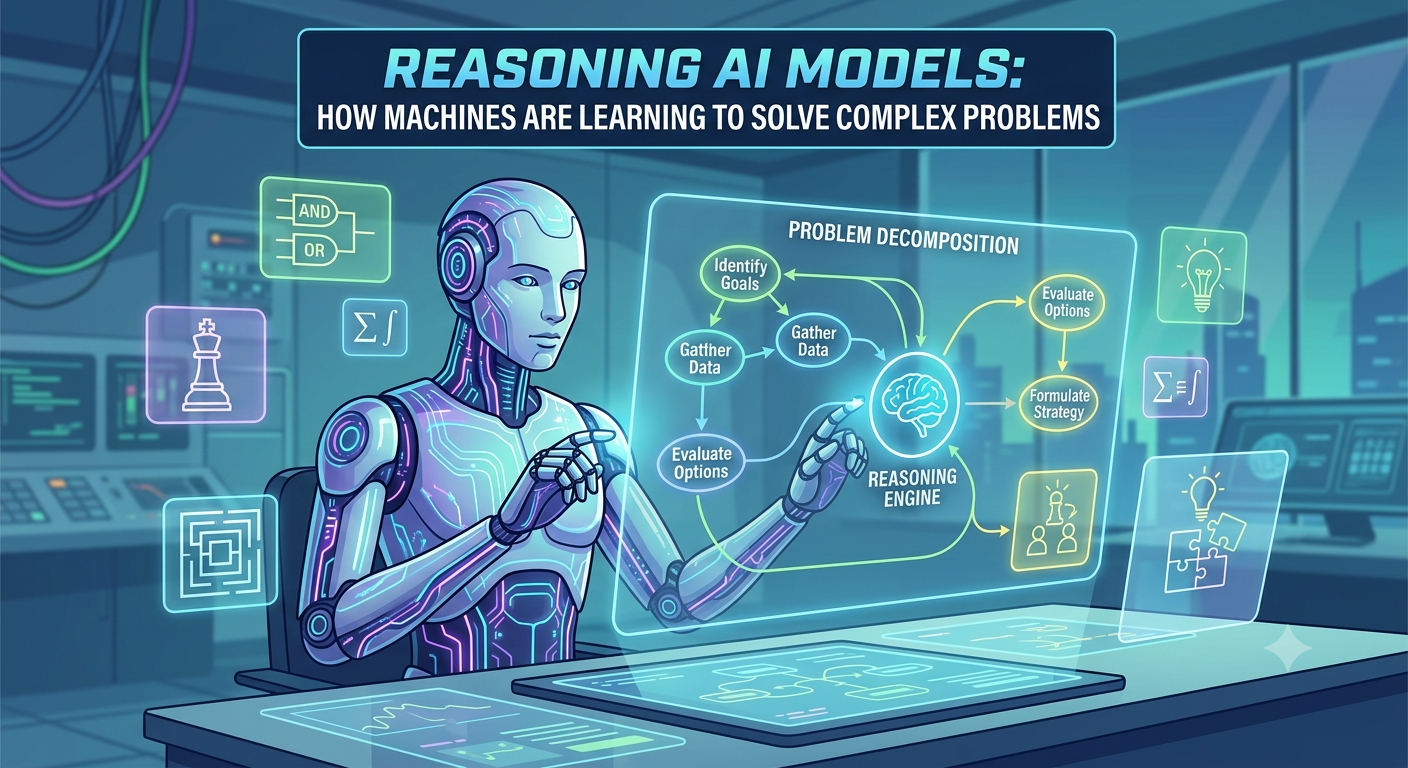
Artificial Intelligence is becoming better at handling difficult tasks. In the past, most AI systems were mainly used to recognize patterns, predict results, answer questions, or create content. Today, AI is moving toward something more advanced: solving problems that need planning, analysis, and several steps.
This is where reasoning AI models come in. These models are designed to work through complex problems more carefully before giving an answer. They are becoming useful in areas such as software development, education, science, finance, healthcare, engineering, and business.
What Are Reasoning AI Models?
Reasoning AI models are AI systems designed to handle problems that need more than a quick answer. They can analyze a task, understand important details, compare possible approaches, and work toward a useful result.
For example, imagine giving an AI a difficult coding problem. A basic AI system may quickly suggest a piece of code. A reasoning-focused model can examine the problem requirements, think about possible approaches, check for errors, and then provide a more suitable solution.
In simple words, reasoning AI tries to handle a difficult problem in smaller, manageable parts instead of treating it like a simple question.
How Reasoning AI Models Solve Problems
Reasoning AI models use advanced machine learning methods to deal with complex tasks. When a problem requires deeper analysis, these models can use more computing effort before providing a final response.
The process usually starts by understanding the goal. The AI then identifies useful information and important limits or requirements. It may consider different ways to solve the problem, evaluate the results, and improve its response before presenting the final answer.
The real technology behind reasoning models is complex, but the main idea is simple: difficult problems often benefit from more analysis and checking.
Reasoning AI and Traditional AI Models
Traditional AI models are useful for many everyday tasks. They can summarize documents, translate languages, generate text, classify information, recognize images, and answer common questions.
Reasoning AI models are designed to perform better on tasks that involve multiple connected decisions. These tasks may include solving difficult math problems, debugging software, planning a project, comparing different options, or analyzing complex information.
This does not mean traditional AI cannot perform reasoning tasks. The main difference is that reasoning-focused models are trained and optimized to handle difficult problem-solving tasks more effectively.
Why Reasoning AI Is Becoming Important
Many real-world problems do not have simple answers. A business decision may depend on cost, time, customer needs, available resources, and possible risks. A software bug may come from several connected parts of an application. An engineering problem may involve many technical requirements.
Reasoning AI can help people work with these complicated situations. It can organize information, compare options, identify possible problems, and support better decision-making.
This is one reason why reasoning AI models are becoming an important part of modern Artificial Intelligence and Machine Learning.
Reasoning AI in Software Development
Software development is one of the most promising areas for reasoning AI.
Developers can use AI to understand unfamiliar code, investigate bugs, explain errors, generate tests, and plan new features. Instead of only generating a small code snippet, advanced AI systems can help developers understand how different parts of an application work together.
For example, when an application has a complex error, a reasoning AI assistant can examine the error message, review related code, suggest possible causes, and recommend steps for testing each possibility.
This can save development time, but developers still need to review and test AI-generated suggestions.
Reasoning AI in Education
Reasoning AI can make digital learning tools more helpful and personalized.
A traditional learning application may simply tell a student whether an answer is correct or incorrect. A reasoning-based AI tutor can explain the topic in a different way, provide examples, identify where the student is confused, and adjust the explanation.
For example, if a student is struggling with a mathematics problem, the AI can guide them through the important ideas instead of only showing the final answer.
This could make online learning more interactive and flexible for different types of learners.
Reasoning AI in Scientific Research
Scientific research often involves large amounts of information and complicated questions. Researchers spend significant time reading papers, comparing findings, analyzing data, and exploring possible ideas.
Reasoning AI can support researchers by helping organize information, summarize research areas, compare results, and assist with computational tasks.
However, scientific conclusions need strong evidence and expert review. AI can support researchers, but it should not replace careful experiments, verification, or scientific judgment.
Reasoning AI in Healthcare
Healthcare involves complex information and high-stakes decisions. Reasoning AI may help professionals organize medical information, summarize records, compare research findings, and support administrative or research workflows.
For example, an AI system could help organize information from multiple documents so that a professional can review the important details more efficiently.
Because healthcare decisions can directly affect people, AI outputs must be carefully reviewed. Accuracy, privacy, safety, and professional oversight are especially important in this field.
Reasoning AI in Finance and Business
Companies work with large amounts of data, reports, documents, and business rules. Reasoning AI can help teams analyze this information and understand possible options.
In finance, AI can assist with document analysis, scenario comparison, risk research, and data interpretation. In general business operations, it can help summarize reports, compare plans, identify missing information, and support workflow planning.
The goal is not simply to let AI make every decision. A more practical approach is to use AI as a tool that helps people understand complex information more quickly.
What Is Test-Time Compute?
Test-time compute is an important idea connected with modern reasoning AI.
In simple terms, it means allowing an AI model to use more computing resources while solving a difficult problem. A simple question may need only a quick response, while a complex problem may benefit from more processing and evaluation.
This approach can improve performance on some difficult tasks. However, using more computing resources can also increase costs and make responses slower.
AI developers are therefore working to find the right balance between accuracy, speed, and cost.
Benefits of Reasoning AI Models
One major benefit of reasoning AI is its ability to support complex problem-solving. It can help analyze large amounts of information and connect details that may be difficult to review manually.
Reasoning AI can also improve productivity. Developers can get help with debugging, students can receive personalized explanations, researchers can organize information, and businesses can compare possible decisions more efficiently.
Another benefit is flexibility. The same general technology can support many different industries when it is connected with the right data, tools, and safety controls.
Challenges and Limitations
Reasoning AI models are powerful, but they are not always correct.
An AI system can provide an answer that sounds clear and confident while still containing mistakes. This means important results should be checked, especially in fields such as healthcare, finance, law, security, and engineering.
Another challenge is cost. Advanced reasoning may require more computing resources, which can make AI systems more expensive to operate.
There are also concerns about privacy, security, bias, and responsible use. Organizations need clear rules for what information AI systems can access and what actions they are allowed to perform.
Do Reasoning AI Models Think Like Humans?
The term “reasoning AI” can make it sound as if machines think exactly like people. That is not an accurate way to understand the technology.
AI models work through computational systems built using machine learning. They learn patterns and relationships from large amounts of data and use those learned capabilities to perform tasks.
Some AI models can solve problems that require logic, mathematics, coding, and planning. However, performing these tasks does not mean that AI experiences or understands the world in the same way a human does.
A practical way to evaluate AI is to focus on its performance, reliability, accuracy, and limitations.
The Future of Reasoning AI
Reasoning AI is likely to become an important part of future software and digital services.
Instead of only answering questions, future AI systems may be able to understand a goal, create a plan, search approved information sources, use software tools, check results, and ask for human approval when needed.
Reasoning AI will also become more connected with AI agents, multimodal AI, memory systems, and business software. This could lead to AI assistants that can handle longer and more complicated workflows.
At the same time, developers will continue working to make reasoning models faster, more affordable, safer, and more reliable.
Final Thoughts
Reasoning AI models are changing how Artificial Intelligence can be used for complex problem-solving. Instead of focusing only on fast answers or content generation, these systems are designed to handle tasks that require deeper analysis, planning, and evaluation.
Their potential applications include software development, education, science, healthcare, finance, engineering, and business operations. However, reasoning AI still has limitations, and important decisions require careful review and human judgment.
As AI technology continues to improve, reasoning models may become a common part of the tools people use every day. The most useful AI systems will not simply provide quick answers. They will help people understand complex information, explore possible solutions, and make better-informed decisions.
