Technology has changed the way we communicate with computers. We use keyboards, touchscreens, voice commands, and gestures to control digital devices. But what if a computer could respond to signals from the brain?
This is the idea behind Brain-Computer Interfaces, also known as BCIs.
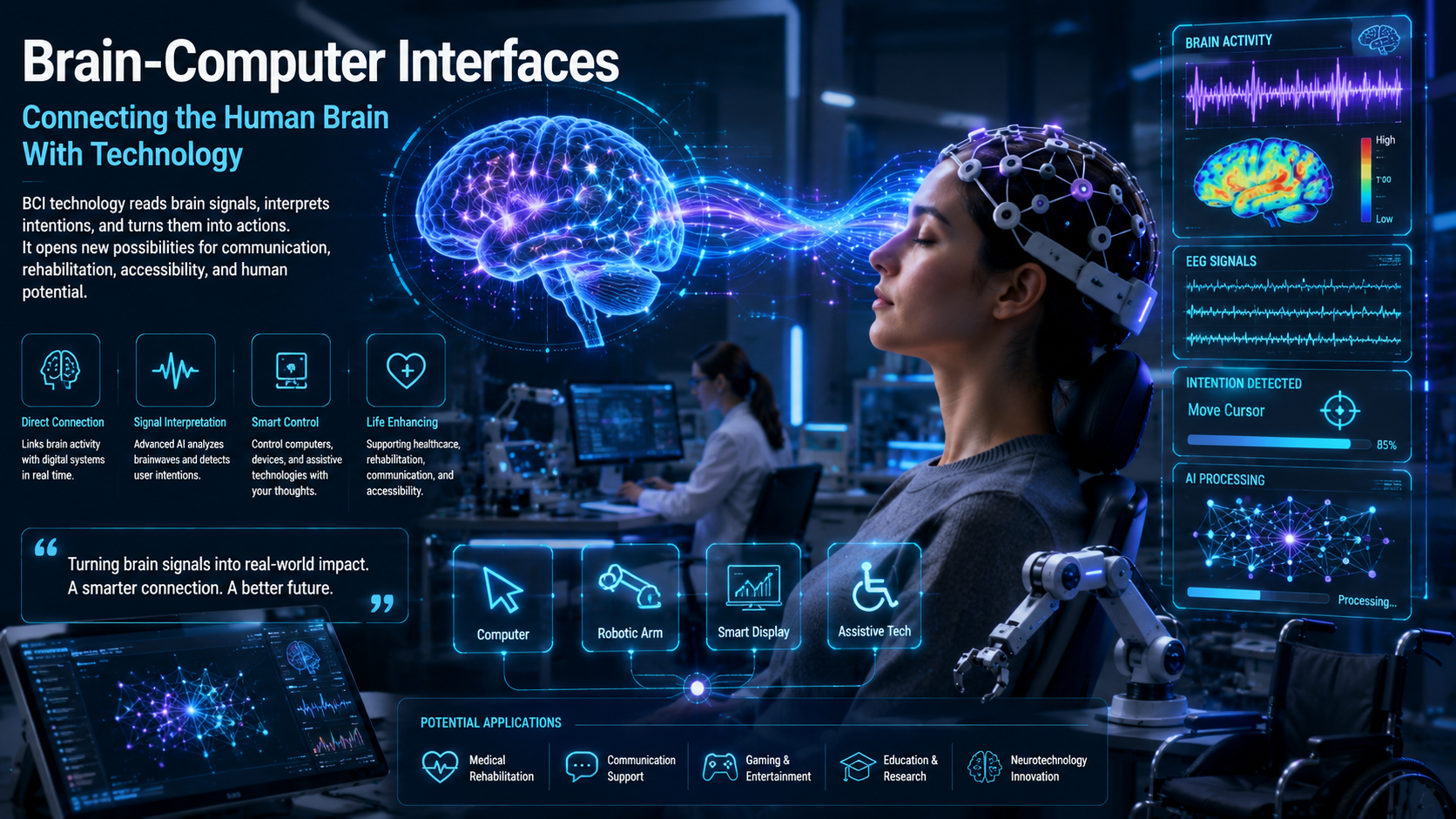
A Brain-Computer Interface creates a communication connection between brain activity and an external device. The system reads patterns in brain signals, processes them, and turns them into commands that a computer or another device can understand.
This technology is still developing, but it has the potential to create new possibilities in healthcare, accessibility, rehabilitation, research, and human-computer interaction.
What Is a Brain-Computer Interface?
A Brain-Computer Interface is a system that allows brain activity to be used as an input for technology.
Normally, when we want to use a computer, we move a mouse, type on a keyboard, touch a screen, or speak into a microphone. A BCI takes a different approach. It collects signals related to brain activity and uses software to find patterns that can be connected to specific actions.
For example, a person may focus on moving a cursor. The BCI system analyzes the related brain activity and translates the detected pattern into a command that moves the cursor on the screen.
In simple words, a BCI works like a bridge between brain activity and a digital device.
How Does a Brain-Computer Interface Work?
A Brain-Computer Interface works through several connected steps.
First, sensors or implanted electrodes collect signals related to brain activity. These signals can contain a lot of background noise, so the system processes the data to make useful patterns easier to identify.
Next, software analyzes the processed signals. Machine learning models may be used to recognize patterns that are linked to a particular intention or task.
Finally, the system translates the recognized pattern into a command. Depending on the application, that command could move a cursor, select a letter, control an assistive device, or perform another digital action.
The system may also improve over time as it collects more data and adapts to the user.
Different Types of Brain-Computer Interfaces
Brain-Computer Interfaces can be grouped into different types based on how they collect brain signals.
Non-invasive BCIs collect signals from outside the body. A common example uses electrodes placed on the scalp. These systems do not require surgery, which makes them useful for research, experiments, and some assistive applications.
Invasive BCIs use devices that are implanted through medical procedures and placed closer to brain tissue. Because they can collect signals closer to their source, they may provide more detailed information for certain applications.
There are also approaches that sit between these two categories, using devices placed inside the body but not as deeply within brain tissue.
Each method has different benefits and limitations related to signal quality, comfort, medical risk, cost, portability, and long-term use.
How Artificial Intelligence Helps BCI Technology
Artificial intelligence plays an important role in modern Brain-Computer Interface systems.
Brain signals are complex. They can change depending on the person, the task, the environment, and even the time of day. This makes signal interpretation difficult.
Machine learning models can help identify useful patterns inside large amounts of signal data. As the system learns from more examples, it may become better at connecting certain patterns with intended actions.
AI can also help BCI systems adapt to individual users. Instead of using exactly the same model for everyone, a system can be trained or adjusted based on a person’s own signal patterns.
This combination of neuroscience, engineering, data processing, and artificial intelligence is helping researchers build more practical BCI systems.
Brain-Computer Interfaces for Communication
One of the most important areas of BCI research is assistive communication.
Some people may have difficulty speaking or using normal input devices because of severe movement limitations. Researchers are exploring systems that could help users communicate by selecting letters, words, or options through brain-related signals.
For example, a person may focus on a letter or action displayed on a screen. The BCI system analyzes the signal pattern and attempts to identify the intended selection.
The goal is to create additional ways for people to interact with communication tools when traditional methods are difficult or unavailable.
BCI Technology in Rehabilitation
Brain-Computer Interfaces are also being studied in rehabilitation.
In some rehabilitation systems, a person attempts or imagines a movement while the BCI records related brain activity. The system can then provide feedback or connect with another rehabilitation device.
For example, a BCI may be combined with robotic rehabilitation equipment, computer-based training, or other assistive technologies.
Researchers are studying whether these approaches can support rehabilitation programs by creating more interactive connections between brain activity, movement intention, and feedback.
The results and suitability of these systems can vary, and many applications remain active areas of clinical research.
Human-Computer Interaction and BCI
Brain-Computer Interfaces may also change the future of human-computer interaction.
Today, most devices depend on physical input such as touch, typing, clicking, or speaking. BCI research explores whether brain-related signals could become another form of input.
In the future, some systems may combine brain signals with eye tracking, voice commands, gestures, and other sensors. This could create more flexible ways to interact with computers.
However, BCI technology is not simply about reading every thought in a person’s mind. Current systems generally focus on detecting specific signal patterns under controlled conditions and translating them into limited commands.
Understanding this difference is important when discussing the real abilities and limitations of BCI technology.
The Role of Sensors and Hardware
Hardware is an important part of every Brain-Computer Interface.
The system needs sensors that can collect useful signals, electronics that can process data, and software that can interpret the information.
Researchers are working on making BCI hardware smaller, more comfortable, more energy-efficient, and easier to use.
For non-invasive systems, comfortable wearable sensors could make longer sessions more practical. For implanted systems, long-term reliability, safety, power use, and communication between the implant and external devices are major engineering challenges.
Better hardware will be important for moving BCI technology from controlled research environments toward wider practical use.
Challenges Facing Brain-Computer Interfaces
Brain-Computer Interfaces have significant potential, but they also face many technical and practical challenges.
Brain signals can be difficult to measure and interpret. Movement, electrical interference, sensor placement, and other factors can affect signal quality.
Accuracy is another major challenge. A BCI needs to understand intended commands reliably, especially in applications where mistakes could have serious consequences.
Comfort and usability are also important. A system may perform well in a laboratory but still be difficult to use for long periods in everyday life.
Other challenges include battery life, processing speed, device cost, long-term maintenance, training time, and access to specialized medical or technical support.
Solving these problems will require collaboration between engineers, neuroscientists, healthcare professionals, software developers, designers, and ethics experts.
Privacy and Security of Brain Data
Privacy is one of the most important topics in the future of Brain-Computer Interfaces.
BCI systems collect data connected to brain activity. This information should be treated with strong privacy and security protections.
Users need clear information about what data is being collected, how it is processed, where it is stored, and who can access it.
Strong cybersecurity is also essential. Connected BCI devices and their supporting software systems need protection against unauthorized access and data misuse.
As BCI technology develops, technical progress should be supported by clear ethical standards, informed consent, responsible data policies, and appropriate regulation.
Can Brain-Computer Interfaces Read Thoughts?
One common misunderstanding about BCI technology is that it can simply read every thought in a person’s mind.
Current Brain-Computer Interfaces do not work like science-fiction mind-reading machines.
Most BCI systems are designed for specific tasks. They look for particular patterns in brain-related signals and connect those patterns to limited commands or outputs.
For example, a system might be trained to recognize patterns connected with selecting an option, attempting a movement, or focusing attention on a particular target.
BCI research is advancing, but it is important to explain the technology accurately and avoid unrealistic claims.
The Future of Brain-Computer Interface Technology
The future of Brain-Computer Interfaces will depend on progress across many fields.
Better sensors could improve signal quality. Faster processors could support real-time analysis. More efficient AI models could improve pattern recognition and personalization. Advances in materials and electronics could make devices smaller and more comfortable.
Healthcare and accessibility are likely to remain important areas of development. Researchers will continue exploring ways BCIs may support communication, rehabilitation, and assistive technology.
At the same time, privacy, security, safety, ethics, affordability, and equal access will remain important parts of the discussion.
The most successful BCI technologies will need to be useful, reliable, safe, and designed around real human needs.
Conclusion
Brain-Computer Interfaces are creating a new connection between neuroscience and digital technology.
By collecting patterns of brain activity and translating them into digital commands, BCI systems can create new ways to interact with computers and assistive devices.
The technology has promising applications in communication, rehabilitation, accessibility, research, and human-computer interaction. However, there are still major challenges related to accuracy, comfort, safety, cost, privacy, security, and long-term reliability.
Brain-Computer Interfaces are still an evolving field. As researchers, engineers, healthcare professionals, and technology developers continue working together, BCI technology may become an important part of future assistive and computing systems.
The future of BCI is not simply about controlling technology with the brain. It is about finding responsible and useful ways to create better connections between people and machines.
