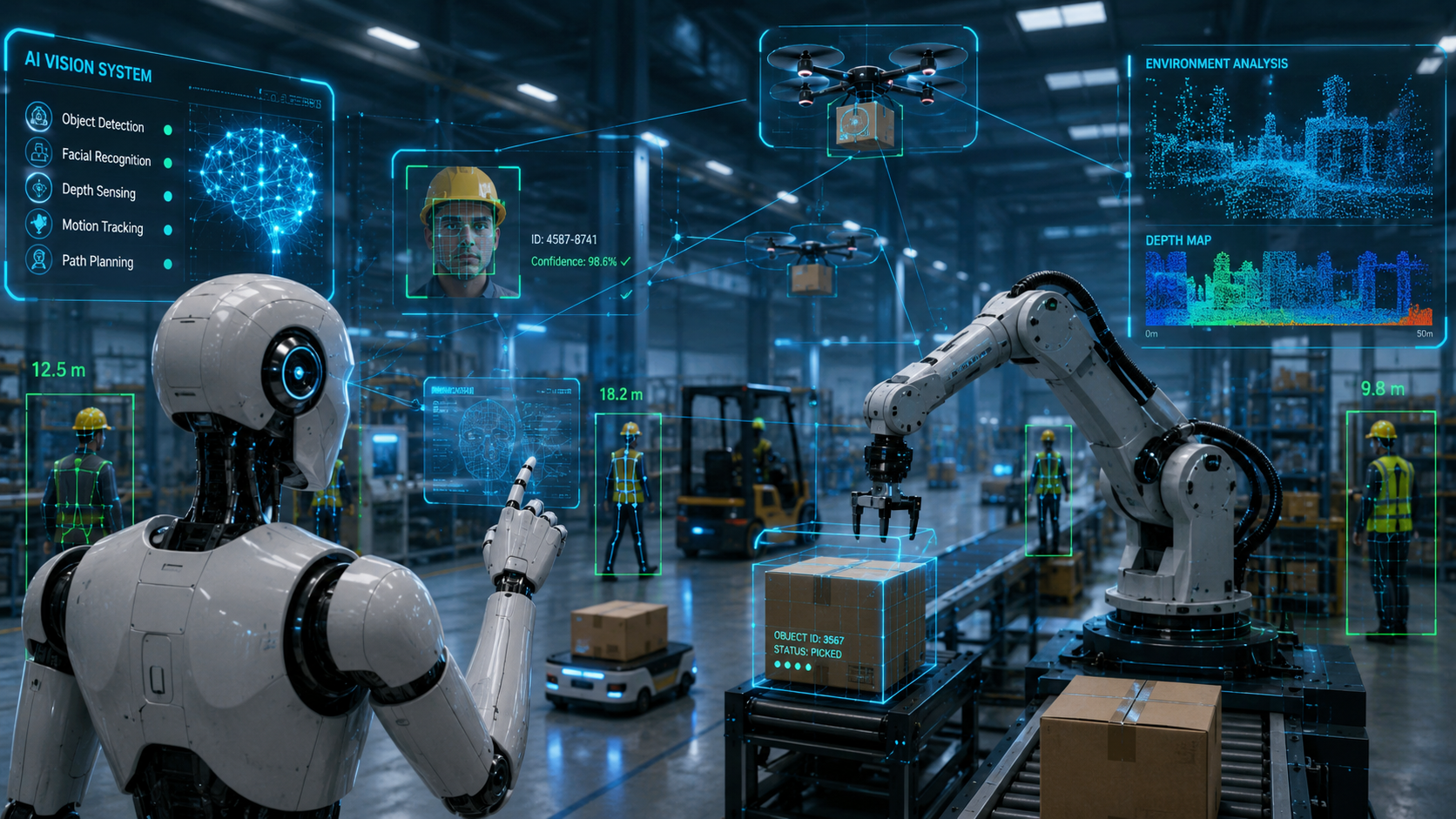
Robots are becoming a common part of factories, warehouses, hospitals, farms, and even our homes. But have you ever wondered how a robot knows where to move, which object to pick up, or when something is blocking its path?
The answer is computer vision.
Computer vision helps robots use cameras and artificial intelligence to understand the world around them. It gives machines the ability to recognize objects, detect movement, measure distance, and make decisions based on what they see.
What Is Computer Vision in Robotics?
Computer vision is a technology that allows robots and machines to understand images and videos.
A robot uses cameras and sensors to capture information from its surroundings. Artificial intelligence then processes this information to understand what is happening in the environment.
For example, a warehouse robot can use a camera to identify a package, find its location, move toward it, and avoid people or objects along the way.
In simple words, cameras act like the robot’s eyes, while computer vision software works like the part of the brain that understands what those eyes are seeing.
How Does Computer Vision Help Robots See?
A robot does not understand an image in the same way a human does. When a camera captures an image, the robot receives digital information made up of pixels.
Computer vision software analyzes this information to find useful details. It can recognize shapes, colors, objects, faces, movement, and distances.
Modern robots often use artificial intelligence and machine learning models that are trained with large collections of images. By learning from these examples, robots can recognize similar objects when they see them in the real world.
For example, if an AI model is trained using thousands of images of boxes, it can learn to identify boxes of different sizes, colors, and shapes.
The Role of Artificial Intelligence in Robot Vision
Artificial intelligence plays an important role in modern computer vision systems.
Traditional robots usually follow fixed instructions. They perform the same movement again and again, which works well in predictable environments. However, real-world environments are always changing.
AI-powered computer vision allows robots to respond to these changes.
For example, if a package is placed in a different position on a conveyor belt, a vision-enabled robotic arm can detect its new location and adjust its movement. It does not always need the object to be placed in exactly the same position.
This makes robots more flexible and useful for complex tasks.
Computer Vision in Smart Factories
Manufacturing is one of the biggest areas where computer vision and robotics work together.
Factories use vision-enabled robots for product inspection, assembly, sorting, packaging, welding, and material handling.
A robotic system can inspect products moving along a production line and identify problems such as cracks, scratches, missing parts, or incorrect shapes.
This helps manufacturers find quality problems quickly, reduce waste, and maintain consistent product quality.
Robotic arms can also use cameras to find objects and pick them up even when their position changes.
Computer Vision in Warehouse Automation
Modern warehouses handle thousands of products every day. Finding, sorting, moving, and packing these products manually can take a lot of time.
Autonomous mobile robots use computer vision to understand warehouse environments and move safely.
They can identify shelves, recognize packages, detect people, avoid obstacles, and find safe paths to their destination.
Computer vision also helps robotic picking systems locate products inside boxes or storage bins. This can improve order processing speed and reduce repetitive manual work.
Computer Vision in Healthcare Robotics
Computer vision is also helping improve healthcare technology.
Medical robots can use cameras and imaging systems to support doctors during certain procedures. Vision systems can help provide detailed visual information and improve accuracy when performing precise tasks.
Robots can also support hospitals with tasks such as transporting supplies, delivering medicines, cleaning rooms, and monitoring specific areas.
Computer vision allows these machines to understand their surroundings and move more safely around patients and healthcare workers.
Computer Vision in Agriculture
Farmers are using robotics and computer vision to manage crops more efficiently.
Agricultural robots can capture images of plants and analyze their condition. They can help identify weeds, detect signs of plant disease, monitor crop growth, and find fruits that are ready for harvesting.
For example, a smart farming robot can identify weeds and target only the required areas instead of treating an entire field.
This can reduce unnecessary use of resources and help farmers make better decisions about crop management.
Computer Vision in Autonomous Vehicles and Drones
Autonomous vehicles depend heavily on cameras, sensors, artificial intelligence, and computer vision.
Computer vision helps a vehicle identify road signs, traffic lights, pedestrians, other vehicles, road lanes, and possible obstacles.
Drones also use computer vision for navigation, mapping, inspection, monitoring, and object tracking.
For example, an inspection drone can capture images of bridges, buildings, solar panels, or power lines. Computer vision software can then analyze the images to help identify possible damage or maintenance needs.
Why Computer Vision Is Important for Modern Robots
Computer vision makes robots more aware of their surroundings.
Without vision technology, many robots would need carefully controlled environments and fixed object positions. With computer vision, robots can handle more changes in their surroundings.
Some important benefits include better accuracy, faster inspection, improved navigation, safer movement, automatic object detection, and more flexible automation.
These capabilities are helping businesses use robots for tasks that were difficult to automate in the past.
Challenges of Computer Vision in Robotics
Computer vision technology is powerful, but it still has challenges.
Lighting conditions can affect how clearly a camera sees an object. Shadows, reflections, dust, rain, and low light can make object detection more difficult.
Objects can also be partially hidden behind other objects. This makes recognition more challenging.
Another important issue is processing speed. Robots often need to understand visual information and make decisions very quickly. A delay of even a few seconds can affect performance in fast-moving environments.
AI models also need high-quality training data. If a model is not trained with enough different examples, it may struggle when it faces unfamiliar situations.
How Edge AI Is Improving Robot Vision
Edge AI is becoming increasingly important in robotics.
Instead of sending every image to a remote cloud server for processing, robots can analyze information directly on the device or on nearby computing hardware.
This can reduce delays and allow robots to make faster decisions.
For example, a warehouse robot that detects a person in its path needs to react immediately. Local processing can help the robot respond quickly without waiting for data to travel to and from a remote server.
Edge AI can also help reduce network dependency and improve how robotics systems handle real-time tasks.
The Future of Computer Vision in Robotics
Computer vision will continue to play an important role in the future of robotics.
As AI models, cameras, sensors, and computing hardware improve, robots will become better at understanding complex environments.
Future robots may be able to learn new tasks more quickly, work safely alongside people, understand objects from different angles, and adapt to unfamiliar situations.
Humanoid robots, autonomous machines, smart factories, agricultural robots, healthcare systems, and delivery robots will all benefit from better visual understanding.
The goal is not simply to help robots capture images. The real goal is to help machines understand what they see and use that information to make useful decisions.
Conclusion
Computer vision is changing how robots interact with the real world. By combining cameras, sensors, artificial intelligence, machine learning, and real-time data processing, robots can recognize objects, understand their surroundings, and make better decisions.
From inspecting products in factories to navigating warehouses, monitoring crops, assisting in healthcare, and supporting autonomous vehicles, computer vision has many practical applications.
As this technology continues to improve, robots will become more flexible, accurate, and capable. Computer vision will remain one of the most important technologies behind the next generation of intelligent automation and robotics.
