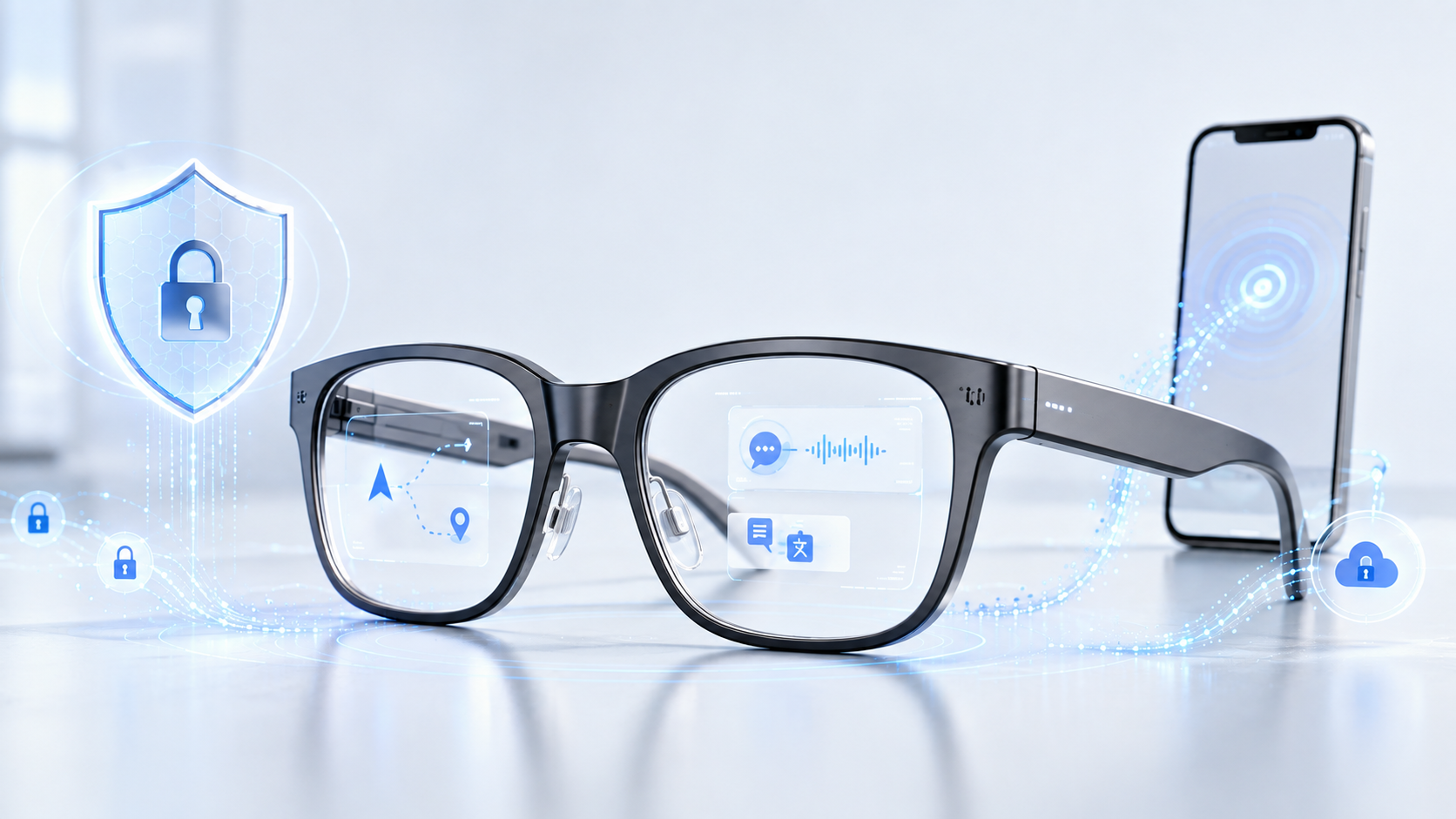
Smart glasses are becoming one of the most interesting types of wearable technology. Unlike normal glasses, smart glasses can provide information, notifications, navigation, translation, and AI assistance directly in front of your eyes.
However, many smart glasses also come with cameras. While cameras can make smart glasses more useful, they also create an important question: What happens to our privacy when people can record the world around them without holding a phone?
This is where AI glasses without cameras come into the picture. These devices focus on useful AI features while removing the outward-facing camera. The result could be a simpler and more privacy-friendly type of wearable technology.
What Are AI Glasses Without Cameras?
AI glasses without cameras are smart glasses that provide digital and AI-powered features without using an outward-facing camera.
Instead of capturing photos and videos, these glasses can use technologies such as small displays, microphones, sensors, Bluetooth, smartphone connections, and AI software.
For example, users may be able to see notifications, receive navigation directions, translate languages, or interact with an AI assistant without needing to take out their smartphone.
The basic idea is simple:
Useful smart features without constantly recording the world around you.
Why Are Camera-Free AI Glasses Important?
The main reason is privacy.
A camera-equipped pair of smart glasses can potentially capture photos and videos while the person wearing them is walking, talking, shopping, working, or attending an event.
The problem is that other people may not always know when they are being recorded.
A smartphone usually becomes noticeable when someone points it toward another person. Smart glasses can look like ordinary glasses, making recording less obvious.
Camera-free glasses remove one major source of this concern because there is no outward-facing camera to capture the surrounding environment.
How Are Smart Glasses Different From Normal Glasses?
Normal glasses are designed mainly to improve or protect your vision.
Smart glasses add technology to the frame.
Depending on the device, smart glasses can provide:
- Notifications
- Navigation
- Voice commands
- AI assistance
- Language translation
- Calls
- Music or audio
- Productivity features
- Health or activity information
The important difference is that smart glasses can connect the physical world with digital information.
How Do Camera-Free AI Glasses Work?
You might wonder how smart glasses can provide AI features if they cannot see the environment.
The answer is that a camera is not the only way a wearable can interact with a user.
Camera-free AI glasses can use a combination of:
Microphone → Voice command → AI processing → Smart display → User
For example, you could ask the glasses:
“Translate this sentence.”
The glasses can receive your voice, process the request through their connected AI system, and show or provide the translated result.
This approach allows the glasses to remain useful without needing to continuously capture images.
What Can AI Glasses Do Without a Camera?
Removing a camera does not mean that smart glasses become useless.
They can still provide several useful features.
AI Assistant
Users can interact with an AI assistant using voice commands.
For example, you could ask a question, request a summary, create a reminder, or get information without opening your phone.
Navigation
Smart glasses can display directions directly in your field of view.
Instead of constantly checking Google Maps or another navigation app on your phone, you could receive simple directions through the glasses.
Language Translation
AI glasses can also help with language translation.
For example, a translated phrase could appear on the display while you are traveling or talking with someone who speaks another language.
Notifications
Messages, reminders, calendar events, and other important notifications can appear through the glasses.
This can reduce the need to repeatedly check your smartphone.
Productivity
Camera-free smart glasses could also be useful at work.
For example, a presenter could view notes through the glasses while speaking to an audience.
The technology could also provide reminders, short instructions, or other information without requiring a laptop or phone screen.
Why Is Privacy a Major Concern With Smart Glasses?
Privacy becomes more complicated when a wearable device can record its surroundings.
Imagine someone sitting in a restaurant wearing smart glasses with a camera.
Other people may not know whether the person is simply wearing the glasses or recording them.
This creates questions about:
- Recording people without permission
- Capturing private conversations
- Recording inside workplaces
- Recording in schools
- Recording in public places
- Storing photos and videos
- Sending captured information to cloud services
These concerns are one reason camera-free smart glasses are becoming an interesting alternative.
Are Camera-Free AI Glasses Completely Private?
No.
This is one of the most important things to understand.
Removing the camera can reduce visual-recording risks, but it does not make a device completely private.
Smart glasses can still have microphones.
They may also connect to a smartphone or cloud-based AI service.
This means users should still consider:
- What information the microphone collects
- Where voice recordings are processed
- Whether data is stored
- Whether data is sent to the cloud
- What information the companion app collects
- How long personal data is retained
- Whether users can delete their information
So, camera-free does not mean privacy-proof.
It simply removes one major source of privacy concerns.
Camera-Free vs Camera-Equipped AI Glasses
Both types of smart glasses have advantages.
Camera-Equipped AI Glasses
Smart glasses with cameras can potentially understand visual information.
They may be able to:
- Take photos
- Record videos
- Identify objects
- Understand surroundings
- Provide visual AI assistance
- Analyze images
This makes them more powerful for certain applications.
However, they also create additional privacy concerns.
Camera-Free AI Glasses
Camera-free glasses focus more on:
- AI assistants
- Voice commands
- Navigation
- Translation
- Notifications
- Smart displays
- Productivity
Their biggest limitation is simple:
They cannot directly see the world through an outward-facing camera.
This creates an interesting trade-off.
Camera glasses offer more visual capabilities.
Camera-free glasses offer a more privacy-focused experience.
Why Would Someone Choose Camera-Free Smart Glasses?
There are several reasons someone might prefer this type of wearable.
Privacy-Conscious Users
People who are uncomfortable with wearable cameras may prefer a device that does not have one.
Professionals
Some workplaces deal with sensitive information.
Doctors, lawyers, business professionals, teachers, and other workers may prefer technology that does not continuously capture images.
Minimalist Users
Some people simply want smart features without a device that looks like a camera.
Camera-free glasses can have a more traditional appearance.
Smartphone Users
Smart glasses can also reduce the number of times people need to look at their phones.
Instead of checking a smartphone for every notification or simple piece of information, users can receive selected information through their glasses.
Can Camera-Free AI Glasses Replace Smartphones?
Probably not completely.
Smartphones still provide many features that glasses cannot easily replace.
Phones have:
- Large displays
- Powerful cameras
- Full applications
- Keyboards
- Gaming
- Video playback
- File management
- Mobile payments
- Advanced settings
Smart glasses are better suited to quick information and hands-free interaction.
Therefore, the more realistic future is:
Smartphone + Smart Glasses
rather than:
Smart Glasses replacing the smartphone completely.
Could AI Glasses Become a New Type of Computer?
Yes, and this is one of the most interesting possibilities.
Computing does not always need to happen on a large screen.
A smartphone moved computing into our pockets.
Smartwatches moved some computing onto our wrists.
Smart glasses could move computing into our field of vision.
This could create a future where we interact with digital information without constantly holding a device.
The Rise of Invisible Technology
One interesting trend in wearable technology is the movement toward less visible technology.
Instead of creating gadgets with large screens and lots of buttons, manufacturers are trying to make technology feel more natural.
The device should help you without constantly demanding your attention.
This idea is sometimes described as ambient or invisible technology.
The goal is not to make technology more noticeable.
The goal is to make technology more useful while keeping it in the background.
AI Glasses and the Future of Wearable Technology
AI is changing what wearables can do.
Older wearables mainly focused on simple functions such as counting steps, measuring heart rate, or showing notifications.
AI-powered wearables can go further.
They can understand voice commands, summarize information, translate languages, provide personalized assistance, and connect different types of information.
Camera-free AI glasses could become part of this trend by focusing on AI assistance without visual recording.
Will Privacy Become a Selling Point?
Privacy could become an important selling point for future wearable devices.
As people become more aware of how much personal information their gadgets can collect, they may start asking more questions before buying them.
Instead of only asking:
“What features does this device have?”
consumers may also ask:
“What data does this device collect?”
and:
“What can this device see or hear?”
A camera-free design can be one answer to those concerns.
What Are the Limitations of Camera-Free AI Glasses?
Camera-free glasses also have limitations.
Without a camera, the device cannot directly analyze what is happening visually around the user.
For example, it may not be able to:
- Identify an object visually
- Read a physical sign automatically
- Analyze a scene
- Recognize a product
- Understand visual surroundings
These capabilities may require a camera or another source of visual information.
Therefore, camera-free glasses are not necessarily better for everyone.
They are better suited to users who value privacy, simplicity, and hands-free information.
What Should You Check Before Buying AI Glasses?
If you are considering AI glasses, don’t only look at the design and AI features.
Check the privacy features as well.
Look for information about:
- Cameras
- Microphones
- Data collection
- Cloud processing
- AI services
- Storage
- Smartphone permissions
- Privacy controls
- Data deletion
- Recording indicators
Understanding these details can help you choose a wearable that matches your privacy expectations.
The Future of Camera-Free AI Glasses
The future of smart glasses may not be about adding every possible sensor.
Instead, manufacturers may begin focusing on purpose-built devices.
Some people may want glasses that can see and understand the world.
Others may want glasses that provide AI assistance while keeping cameras away from their faces.
This could create several different categories of smart glasses instead of one universal design.
Camera-free AI glasses could become particularly attractive to people who want wearable technology but do not want to carry a wearable camera.
Final Thoughts
AI glasses without cameras represent an interesting direction for the future of wearable technology.
They show that smart glasses do not necessarily need cameras to be useful.
With features such as AI assistance, navigation, translation, notifications, and smart displays, camera-free glasses can provide many useful experiences while avoiding one of the biggest privacy concerns associated with wearable cameras.
However, users should remember that camera-free does not mean completely private. Microphones, cloud services, smartphone apps, and data collection can still create privacy risks.
The bigger idea is simple:
The future of wearable technology may not be about collecting more information. It may be about delivering useful information while collecting less.
If manufacturers can combine useful AI features with strong privacy controls, camera-free AI glasses could become an important part of the next generation of wearable technology.
